

THE MEDIEVAL TOURNAMENTS - THE MEDIEVAL 
'WAR GAMES' 
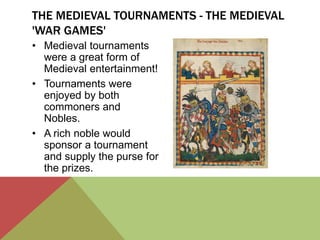
• Medieval tournaments 
were a great form of 
Medieval entertainment! 
• Tournaments were 
enjoyed by both 
commoners and 
Nobles. 
• A rich noble would 
sponsor a tournament 
and supply the purse for 
the prizes.
MEDIEVAL TOURNAMENTS 
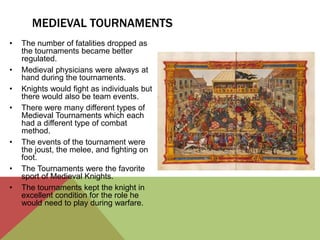
• A Medieval Tournament was a series of mounted and armoured combats 
• They were fought as contests, in which a number of combatants compete 
• The one that prevails through the final round or that finishes with the best 
record is declared the winner and is awarded the prize. 
• Tournaments were imported from France during the 12th century and formed 
an important element of Medieval military and social life. 
• Roger of Hoveden an English chronicler, who was employed by King Henry II, 
described tournaments as "military exercises carried out, not in the spirit of 
hostility but solely for practice and the display of prowess". 
• The contests in the tournament were fought with blunted swords or lances. 
• However there were still many casualties, as many as 10% were injured, and 
there were also fatalities.
MEDIEVAL TOURNAMENTS 
• The number of fatalities dropped as 
the tournaments became better 
regulated. 
• Medieval physicians were always at 
hand during the tournaments. 
• Knights would fight as individuals but 
there would also be team events. 
• There were many different types of 
Medieval Tournaments which each 
had a different type of combat 
method. 
• The events of the tournament were 
the joust, the melee, and fighting on 
foot. 
• The Tournaments were the favorite 
sport of Medieval Knights. 
• The tournaments kept the knight in 
excellent condition for the role he 
would need to play during warfare.
TYPES OF COMBAT 
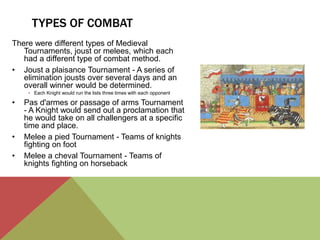
There were different types of Medieval 
Tournaments, joust or melees, which each 
had a different type of combat method. 
• Joust a plaisance Tournament - A series of 
elimination jousts over several days and an 
overall winner would be determined. 
• Each Knight would run the lists three times with each opponent 
• Pas d'armes or passage of arms Tournament 
- A Knight would send out a proclamation that 
he would take on all challengers at a specific 
time and place. 
• Melee a pied Tournament - Teams of knights 
fighting on foot 
• Melee a cheval Tournament - Teams of 
knights fighting on horseback
THE STATUTE OF ARMS 
• The number of injuries and fatalities that occurred during early Medieval 
tournaments had to be regulated. 
• Early tournaments were wild affairs - copious alcohol was consumed and 
many tournaments ended with the pillage, rape, and slaughter of local 
villagers! 
• Valuable Knights were killed and injured at tournaments. 
• In 1292 the "Statute of Arms for Tournaments" was ordained "at the request 
of the earls and barons and of the knighthood of England" which provided 
new laws for tournaments. 
• The Statute of Arms ordained that no pointed weapons should be used - they 
should be blunted. 
• And that tournaments had to be properly organised and only authorised 
combatants were allowed to carry arms.
THE LOCATION 
• The Medieval Tournaments lasted over several days. 
• As the tournaments became more organised, so did the event itself. 
• The location of the tournament would be allocated by the sponsor. 
• The sponsor was often a rich noble who would finance the prize. 
• The tournament would therefore be located on a field near to the nobles castle and local 
village. 
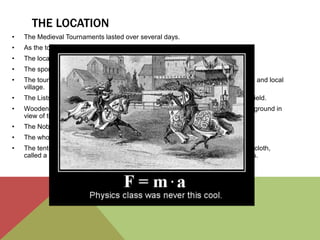
• The Lists were the designated area for jousting fenced off in the centre of the field. 
• Wooden bench seats were sometimes erected but usually villagers sat on the ground in 
view of the lists. 
• The Nobles sat in the galleries - pavilions erected to provide shelter. 
• The whole area would be blazoned with color. 
• The tents and blazons of the Knights. Even the horses were draped in flowing cloth, 
called a caparison, which was patterned according to its owner's heraldic signs.
THE KIPPERS AND THE SPOILS! 
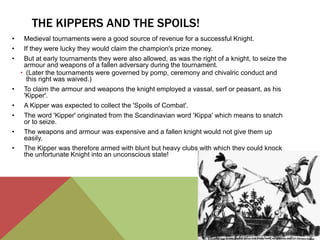
• Medieval tournaments were a good source of revenue for a successful Knight. 
• If they were lucky they would claim the champion's prize money. 
• But at early tournaments they were also allowed, as was the right of a knight, to seize the 
armour and weapons of a fallen adversary during the tournament. 
• (Later the tournaments were governed by pomp, ceremony and chivalric conduct and 
this right was waived.) 
• To claim the armour and weapons the knight employed a vassal, serf or peasant, as his 
'Kipper'. 
• A Kipper was expected to collect the 'Spoils of Combat'. 
• The word 'Kipper' originated from the Scandinavian word 'Kippa' which means to snatch 
or to seize. 
• The weapons and armour was expensive and a fallen knight would not give them up 
easily. 
• The Kipper was therefore armed with blunt but heavy clubs with which they could knock 
the unfortunate Knight into an unconscious state!
THE LADIES FAVOURS, COURTLY LOVE AND THE 
CHIVALRIC CODE! 
• Ladies attended Medieval tournaments. 
• Watching the exploits of the men during the day and attending the feasts and 
banquets in the evening. 
• The rise of the ideals of courtly love was dominated by the concept that that honor 
should be done to a lady by her champion. 
• The Rules of Courtly Love allowed a Knight to express his admiration even for 
married ladies. Knights begged "tokens" from ladies. 
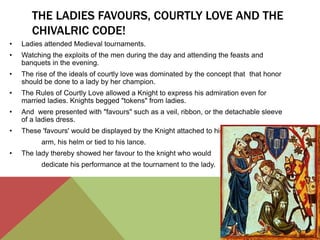
• And were presented with "favours" such as a veil, ribbon, or the detachable sleeve 
of a ladies dress. 
• These 'favours' would be displayed by the Knight attached to his 
arm, his helm or tied to his lance. 
• The lady thereby showed her favour to the knight who would 
dedicate his performance at the tournament to the lady.
THE SONG OF ROLAND - CHARLEMAGNE'S 
CODE OF CHIVALRY 
A Code of Chivalry was documented in 'The Song of Roland' in the early 11th Century 
Medieval period of William the Conqueror. The 'Song of Roland' describes the 8th 
Century Knights and battles of the Emperor Charlemagne and has been described as 
Charlemagne's Code of Chivalry. The duties of a Knight were described as follows: 
To fear God and maintain His Church 
To serve the liege lord in valour and faith 
To protect the weak and defenceless 
To give succour to widows and orphans 
To refrain from the wanton giving of offence 
To live by honour and for glory 
To despise pecuniary reward 
To fight for the welfare of all 
To obey those placed in authority 
To guard the honour of fellow knights 
To eschew unfairness, meanness and deceit 
To keep faith 
At all times to speak the truth 
To persevere to the end in any enterprise begun 
To respect the honour of women 
Never to refuse a challenge from an equal 
Never to turn the back upon a foe.
FAMOUS KNIGHTS 
• http://historylists.org/people/list-of-10-most-famous-medieval-knights. 
html 
• Knights and Jousting 
• https://www.youtube.com/watch?v=1Rtm6pWyog8

Medieval Tournaments

  • 2.
    THE MEDIEVAL TOURNAMENTS- THE MEDIEVAL 'WAR GAMES' • Medieval tournaments were a great form of Medieval entertainment! • Tournaments were enjoyed by both commoners and Nobles. • A rich noble would sponsor a tournament and supply the purse for the prizes.
  • 3.
    MEDIEVAL TOURNAMENTS •A Medieval Tournament was a series of mounted and armoured combats • They were fought as contests, in which a number of combatants compete • The one that prevails through the final round or that finishes with the best record is declared the winner and is awarded the prize. • Tournaments were imported from France during the 12th century and formed an important element of Medieval military and social life. • Roger of Hoveden an English chronicler, who was employed by King Henry II, described tournaments as "military exercises carried out, not in the spirit of hostility but solely for practice and the display of prowess". • The contests in the tournament were fought with blunted swords or lances. • However there were still many casualties, as many as 10% were injured, and there were also fatalities.
  • 4.
    MEDIEVAL TOURNAMENTS •The number of fatalities dropped as the tournaments became better regulated. • Medieval physicians were always at hand during the tournaments. • Knights would fight as individuals but there would also be team events. • There were many different types of Medieval Tournaments which each had a different type of combat method. • The events of the tournament were the joust, the melee, and fighting on foot. • The Tournaments were the favorite sport of Medieval Knights. • The tournaments kept the knight in excellent condition for the role he would need to play during warfare.
  • 6.
    TYPES OF COMBAT There were different types of Medieval Tournaments, joust or melees, which each had a different type of combat method. • Joust a plaisance Tournament - A series of elimination jousts over several days and an overall winner would be determined. • Each Knight would run the lists three times with each opponent • Pas d'armes or passage of arms Tournament - A Knight would send out a proclamation that he would take on all challengers at a specific time and place. • Melee a pied Tournament - Teams of knights fighting on foot • Melee a cheval Tournament - Teams of knights fighting on horseback
  • 7.
    THE STATUTE OFARMS • The number of injuries and fatalities that occurred during early Medieval tournaments had to be regulated. • Early tournaments were wild affairs - copious alcohol was consumed and many tournaments ended with the pillage, rape, and slaughter of local villagers! • Valuable Knights were killed and injured at tournaments. • In 1292 the "Statute of Arms for Tournaments" was ordained "at the request of the earls and barons and of the knighthood of England" which provided new laws for tournaments. • The Statute of Arms ordained that no pointed weapons should be used - they should be blunted. • And that tournaments had to be properly organised and only authorised combatants were allowed to carry arms.
  • 8.
    THE LOCATION •The Medieval Tournaments lasted over several days. • As the tournaments became more organised, so did the event itself. • The location of the tournament would be allocated by the sponsor. • The sponsor was often a rich noble who would finance the prize. • The tournament would therefore be located on a field near to the nobles castle and local village. • The Lists were the designated area for jousting fenced off in the centre of the field. • Wooden bench seats were sometimes erected but usually villagers sat on the ground in view of the lists. • The Nobles sat in the galleries - pavilions erected to provide shelter. • The whole area would be blazoned with color. • The tents and blazons of the Knights. Even the horses were draped in flowing cloth, called a caparison, which was patterned according to its owner's heraldic signs.
  • 9.
    THE KIPPERS ANDTHE SPOILS! • Medieval tournaments were a good source of revenue for a successful Knight. • If they were lucky they would claim the champion's prize money. • But at early tournaments they were also allowed, as was the right of a knight, to seize the armour and weapons of a fallen adversary during the tournament. • (Later the tournaments were governed by pomp, ceremony and chivalric conduct and this right was waived.) • To claim the armour and weapons the knight employed a vassal, serf or peasant, as his 'Kipper'. • A Kipper was expected to collect the 'Spoils of Combat'. • The word 'Kipper' originated from the Scandinavian word 'Kippa' which means to snatch or to seize. • The weapons and armour was expensive and a fallen knight would not give them up easily. • The Kipper was therefore armed with blunt but heavy clubs with which they could knock the unfortunate Knight into an unconscious state!
  • 10.
    THE LADIES FAVOURS,COURTLY LOVE AND THE CHIVALRIC CODE! • Ladies attended Medieval tournaments. • Watching the exploits of the men during the day and attending the feasts and banquets in the evening. • The rise of the ideals of courtly love was dominated by the concept that that honor should be done to a lady by her champion. • The Rules of Courtly Love allowed a Knight to express his admiration even for married ladies. Knights begged "tokens" from ladies. • And were presented with "favours" such as a veil, ribbon, or the detachable sleeve of a ladies dress. • These 'favours' would be displayed by the Knight attached to his arm, his helm or tied to his lance. • The lady thereby showed her favour to the knight who would dedicate his performance at the tournament to the lady.
  • 11.
    THE SONG OFROLAND - CHARLEMAGNE'S CODE OF CHIVALRY A Code of Chivalry was documented in 'The Song of Roland' in the early 11th Century Medieval period of William the Conqueror. The 'Song of Roland' describes the 8th Century Knights and battles of the Emperor Charlemagne and has been described as Charlemagne's Code of Chivalry. The duties of a Knight were described as follows: To fear God and maintain His Church To serve the liege lord in valour and faith To protect the weak and defenceless To give succour to widows and orphans To refrain from the wanton giving of offence To live by honour and for glory To despise pecuniary reward To fight for the welfare of all To obey those placed in authority To guard the honour of fellow knights To eschew unfairness, meanness and deceit To keep faith At all times to speak the truth To persevere to the end in any enterprise begun To respect the honour of women Never to refuse a challenge from an equal Never to turn the back upon a foe.
  • 12.
    FAMOUS KNIGHTS •http://historylists.org/people/list-of-10-most-famous-medieval-knights. html • Knights and Jousting • https://www.youtube.com/watch?v=1Rtm6pWyog8