You are Political 
POLITICS IS ALL AROUND YOU! THIS 
EXERCISE WILL DEMONSTRATE WHY 
PEOPLE THINK DIFFERENTLY ABOUT THE 
SAME ISSUES, AND HOW TO DEAL WITH IT.
Political Significance 
 Hopefully you have watched the news, read articles 
in the newspaper or followed stories online. 
 With a partner, create a list of at least FIVE current 
news stories or events that have been in the news 
over the summer or very recently 
 Once you have created the list, go over it again and 
try to determine which events are politically 
significant. 
 Choose one or two that you feel are the most 
significant and share them with the class with an 
explanation of why you chose them.
Political Significance Criteria 
 What makes an event politically significant? 
1. Does it have a lasting impact on society? 
2. Is the impact extreme is a positive or negative way? 
3. Are many people affected by the issue positively or negatively? 
4. Does it directly affect you, your family, friends, and/r community? 
5. Are many people for and/or against it? 
6. Are the differences between supporters and opponents great? 
7. Is it an ethical issue involving right and wrong? 
 If you answered ‘yes’ to a majority of this criteria with 
the event you chose, it is most likely politically 
significant.
Scenario 
 It has been decided by Parliament that they will be 
given access to all of the digital information (e-mail, 
texts, social media) of potential terrorists without a 
warrant. 
 Do you agree or disagree with this decision? 
 Try to create a ‘pro & con’ list 
 Discuss with a partner. Be prepared to share with the 
class.
Political Perspective 
 Why do you think there were many different 
viewpoints in the class? 
 As a class, brainstorm the factors that contribute to 
citizens having different opinions
Political Perspective 
 Reasons for different 
perspectives: 
 Age 
 Family 
 Community 
 Personal Experiences 
 Gender 
 Job 
 Personal Interest 
 Income 
 Education 
 Religion 
 Values
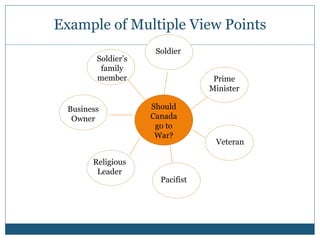
Example of Multiple View Points 
Soldier 
Should 
Canada 
go to 
War? 
Pacifist 
Business 
Owner 
Prime 
Minister 
Veteran 
Soldier’s 
family 
member 
Religious 
Leader
Case Study: Climate Change 
 Watch the following video and keep track of the 
evidence that is used to support or refute the debate 
concerning climate change: 
 https://www.youtube.com/watch?v=1zFruNyiUHQ 
 These two individuals have very different opinions 
on one issue. What reasons are there to explain this? 
(think of our perspective criteria). 
 Is it a positive or a negative that people can be on 
such opposite ends of an issue?
Reflection 
 What if your beliefs, values, and ideology are 
different from someone else’s? Who is right in their 
perspective? 
 What are the consequences of not considering the 
perspectives of others? 
 How might the political perspective of someone who 
is a part of the majority differ compared to someone 
who is in the minority? 
 How do you react when others ignore or reject your 
perspective?
Now What? 
 We have determined so far what issues can be considered 
politically significant. 
 We have also determined that citizens can have totally 
different perspectives on one issue and how many factors 
can determine why. 
 How can people look at the same evidence and come to 
different conclusions? 
 What is fact compared to opinion? 
 What is evidence compared to an argument? 
 It is important to understand these differences when 
looking at an issue
Evidence 
 The ability to gather evidence is the key to 
understanding the difference between fact and 
opinion. 
 Evidence is a fact that supports a conclusion. 
 It offers proof of accuracy and helps us understand what is 
happening. 
 Active citizens need to be able to tell the difference 
between facts, opinions, and arguments. 
 They also need to be able to gather evidence tin 
support of their beliefs to determine conclusions that 
make sense.
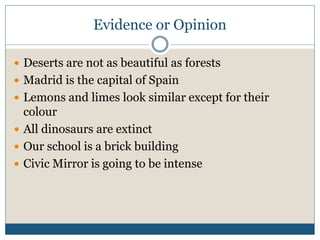
Evidence or Opinion 
 Deserts are not as beautiful as forests 
 Madrid is the capital of Spain 
 Lemons and limes look similar except for their 
colour 
 All dinosaurs are extinct 
 Our school is a brick building 
 Civic Mirror is going to be intense
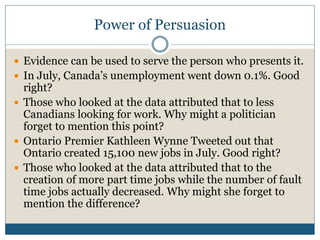
Power of Persuasion 
 Evidence can be used to serve the person who presents it. 
 In July, Canada’s unemployment went down 0.1%. Good 
right? 
 Those who looked at the data attributed that to less 
Canadians looking for work. Why might a politician 
forget to mention this point? 
 Ontario Premier Kathleen Wynne Tweeted out that 
Ontario created 15,100 new jobs in July. Good right? 
 Those who looked at the data attributed that to the 
creation of more part time jobs while the number of fault 
time jobs actually decreased. Why might she forget to 
mention the difference?
Sources 
 Civics and Citizenship by Canadian Investigations 
 http://www.teach-nology. 
com/worksheets/language_arts/factopin/fa 
ctop1.html

You are Political

  • 1.
    You are Political POLITICS IS ALL AROUND YOU! THIS EXERCISE WILL DEMONSTRATE WHY PEOPLE THINK DIFFERENTLY ABOUT THE SAME ISSUES, AND HOW TO DEAL WITH IT.
  • 2.
    Political Significance Hopefully you have watched the news, read articles in the newspaper or followed stories online.  With a partner, create a list of at least FIVE current news stories or events that have been in the news over the summer or very recently  Once you have created the list, go over it again and try to determine which events are politically significant.  Choose one or two that you feel are the most significant and share them with the class with an explanation of why you chose them.
  • 3.
    Political Significance Criteria  What makes an event politically significant? 1. Does it have a lasting impact on society? 2. Is the impact extreme is a positive or negative way? 3. Are many people affected by the issue positively or negatively? 4. Does it directly affect you, your family, friends, and/r community? 5. Are many people for and/or against it? 6. Are the differences between supporters and opponents great? 7. Is it an ethical issue involving right and wrong?  If you answered ‘yes’ to a majority of this criteria with the event you chose, it is most likely politically significant.
  • 4.
    Scenario  Ithas been decided by Parliament that they will be given access to all of the digital information (e-mail, texts, social media) of potential terrorists without a warrant.  Do you agree or disagree with this decision?  Try to create a ‘pro & con’ list  Discuss with a partner. Be prepared to share with the class.
  • 5.
    Political Perspective Why do you think there were many different viewpoints in the class?  As a class, brainstorm the factors that contribute to citizens having different opinions
  • 6.
    Political Perspective Reasons for different perspectives:  Age  Family  Community  Personal Experiences  Gender  Job  Personal Interest  Income  Education  Religion  Values
  • 7.
    Example of MultipleView Points Soldier Should Canada go to War? Pacifist Business Owner Prime Minister Veteran Soldier’s family member Religious Leader
  • 8.
    Case Study: ClimateChange  Watch the following video and keep track of the evidence that is used to support or refute the debate concerning climate change:  https://www.youtube.com/watch?v=1zFruNyiUHQ  These two individuals have very different opinions on one issue. What reasons are there to explain this? (think of our perspective criteria).  Is it a positive or a negative that people can be on such opposite ends of an issue?
  • 9.
    Reflection  Whatif your beliefs, values, and ideology are different from someone else’s? Who is right in their perspective?  What are the consequences of not considering the perspectives of others?  How might the political perspective of someone who is a part of the majority differ compared to someone who is in the minority?  How do you react when others ignore or reject your perspective?
  • 10.
    Now What? We have determined so far what issues can be considered politically significant.  We have also determined that citizens can have totally different perspectives on one issue and how many factors can determine why.  How can people look at the same evidence and come to different conclusions?  What is fact compared to opinion?  What is evidence compared to an argument?  It is important to understand these differences when looking at an issue
  • 11.
    Evidence  Theability to gather evidence is the key to understanding the difference between fact and opinion.  Evidence is a fact that supports a conclusion.  It offers proof of accuracy and helps us understand what is happening.  Active citizens need to be able to tell the difference between facts, opinions, and arguments.  They also need to be able to gather evidence tin support of their beliefs to determine conclusions that make sense.
  • 12.
    Evidence or Opinion  Deserts are not as beautiful as forests  Madrid is the capital of Spain  Lemons and limes look similar except for their colour  All dinosaurs are extinct  Our school is a brick building  Civic Mirror is going to be intense
  • 13.
    Power of Persuasion  Evidence can be used to serve the person who presents it.  In July, Canada’s unemployment went down 0.1%. Good right?  Those who looked at the data attributed that to less Canadians looking for work. Why might a politician forget to mention this point?  Ontario Premier Kathleen Wynne Tweeted out that Ontario created 15,100 new jobs in July. Good right?  Those who looked at the data attributed that to the creation of more part time jobs while the number of fault time jobs actually decreased. Why might she forget to mention the difference?
  • 14.
    Sources  Civicsand Citizenship by Canadian Investigations  http://www.teach-nology. com/worksheets/language_arts/factopin/fa ctop1.html