THE CRUSADES
A Quest for the Holy Land
Crusades
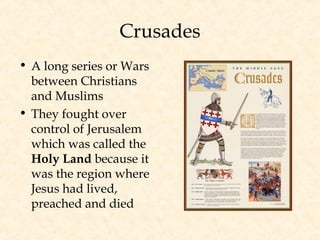
• A long series or Wars
between Christians
and Muslims
• They fought over
control of Jerusalem
which was called the
Holy Land because it
was the region where
Jesus had lived,
preached and died
Causes of the Crusades
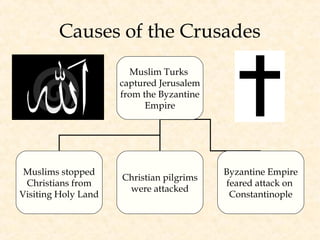
Muslim Turks
captured Jerusalem
from the Byzantine
Empire
Muslims stopped
Christians from
Visiting Holy Land
Christian pilgrims
were attacked
Byzantine Empire
feared attack on
Constantinople
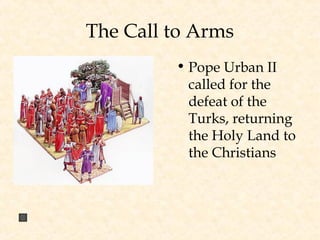
The Call to Arms
• Pope Urban II
called for the
defeat of the
Turks, returning
the Holy Land to
the Christians
Mobilization of the Crusades
• Pope Urban traveled to various cities for nine months
preaching the Crusade and offering extraordinary
inducements.
• Absolving all the sins for those who died on the Crusade
• Serfs were allowed to leave the land to which they were
bound
• Citizens were exempted from taxes
• Debtors were given a excused from paying interest
• Prisoners were freed and death sentences were
commuted to life service in Palestine
This was a bold extension of the Pope’s authority
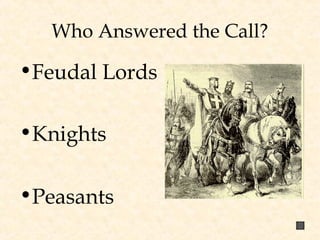
Who Answered the Call?
•Feudal Lords
•Knights
•Peasants
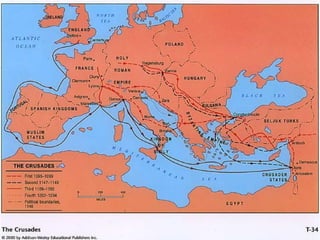
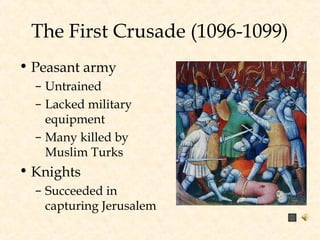
The First Crusade (1096-1099)
• Peasant army
– Untrained
– Lacked military
equipment
– Many killed by
Muslim Turks
• Knights
– Succeeded in
capturing Jerusalem
Second Crusade (1147-1149)
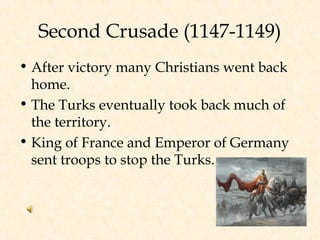
• After victory many Christians went back
home.
• The Turks eventually took back much of
the territory.
• King of France and Emperor of Germany
sent troops to stop the Turks.
Second Crusade (1147-1149)
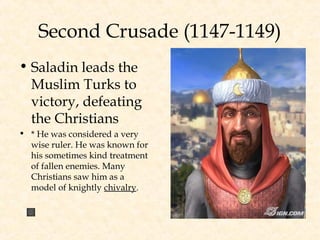
• Saladin leads the
Muslim Turks to
victory, defeating
the Christians
• * He was considered a very
wise ruler. He was known for
his sometimes kind treatment
of fallen enemies. Many
Christians saw him as a
model of knightly chivalry.
Third Crusade (1189-1192)
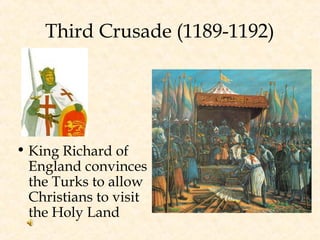
• King Richard of
England convinces
the Turks to allow
Christians to visit
the Holy Land
Crusades Continue Through 1200’s
• Several more crusades attempted with no
victories for the Christians
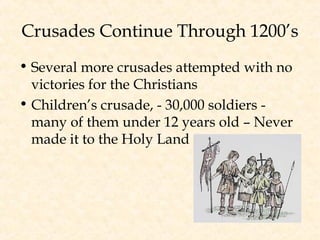
• Children’s crusade, - 30,000 soldiers -
many of them under 12 years old – Never
made it to the Holy Land
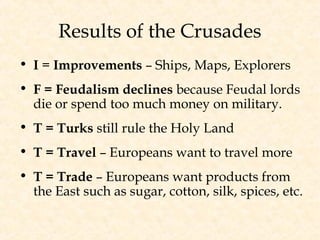
Results of the Crusades
• I = Improvements – Ships, Maps, Explorers
• F = Feudalism declines because Feudal lords
die or spend too much money on military.
• T = Turks still rule the Holy Land
• T = Travel – Europeans want to travel more
• T = Trade – Europeans want products from
the East such as sugar, cotton, silk, spices, etc.

The crusades

  • 1.
    THE CRUSADES A Questfor the Holy Land
  • 2.
    Crusades • A longseries or Wars between Christians and Muslims • They fought over control of Jerusalem which was called the Holy Land because it was the region where Jesus had lived, preached and died
  • 4.
    Causes of theCrusades Muslim Turks captured Jerusalem from the Byzantine Empire Muslims stopped Christians from Visiting Holy Land Christian pilgrims were attacked Byzantine Empire feared attack on Constantinople
  • 5.
    The Call toArms • Pope Urban II called for the defeat of the Turks, returning the Holy Land to the Christians
  • 6.
    Mobilization of theCrusades • Pope Urban traveled to various cities for nine months preaching the Crusade and offering extraordinary inducements. • Absolving all the sins for those who died on the Crusade • Serfs were allowed to leave the land to which they were bound • Citizens were exempted from taxes • Debtors were given a excused from paying interest • Prisoners were freed and death sentences were commuted to life service in Palestine This was a bold extension of the Pope’s authority
  • 7.
    Who Answered theCall? •Feudal Lords •Knights •Peasants
  • 8.
    The First Crusade(1096-1099) • Peasant army – Untrained – Lacked military equipment – Many killed by Muslim Turks • Knights – Succeeded in capturing Jerusalem
  • 9.
    Second Crusade (1147-1149) •After victory many Christians went back home. • The Turks eventually took back much of the territory. • King of France and Emperor of Germany sent troops to stop the Turks.
  • 10.
    Second Crusade (1147-1149) •Saladin leads the Muslim Turks to victory, defeating the Christians • * He was considered a very wise ruler. He was known for his sometimes kind treatment of fallen enemies. Many Christians saw him as a model of knightly chivalry.
  • 11.
    Third Crusade (1189-1192) •King Richard of England convinces the Turks to allow Christians to visit the Holy Land
  • 12.
    Crusades Continue Through1200’s • Several more crusades attempted with no victories for the Christians • Children’s crusade, - 30,000 soldiers - many of them under 12 years old – Never made it to the Holy Land
  • 13.
    Results of theCrusades • I = Improvements – Ships, Maps, Explorers • F = Feudalism declines because Feudal lords die or spend too much money on military. • T = Turks still rule the Holy Land • T = Travel – Europeans want to travel more • T = Trade – Europeans want products from the East such as sugar, cotton, silk, spices, etc.