OLMECS AND MAYAS
Based on: http://www.slideshare.net/jmarazas/wh-
chapter-7-olmecs-and-mayas#
LEGACY OF THE OLMECS
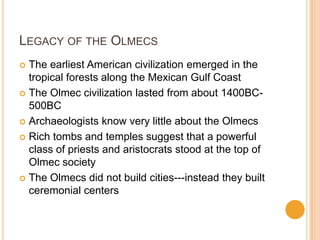
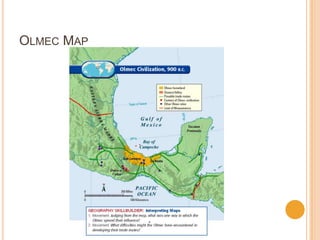
 The earliest American civilization emerged in the
tropical forests along the Mexican Gulf Coast
 The Olmec civilization lasted from about 1400BC-
500BC
 Archaeologists know very little about the Olmecs
 Rich tombs and temples suggest that a powerful
class of priests and aristocrats stood at the top of
Olmec society
 The Olmecs did not build cities---instead they built
ceremonial centers
OLMEC MAP
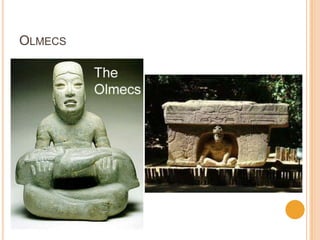
OLMECS
LEGACY OF THE OLMECS
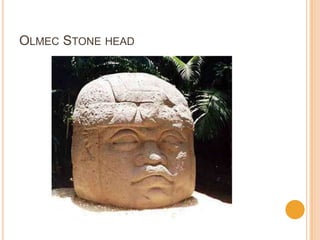
 The most dramatic remains of the Olmec civilization
are the giant carved stone heads found in the ruins
of a religious center at La Venta
 No one knows how the Olmecs moved these
colossal 40-ton stones from distant quarries without
wheeled vehicles or draft animals
OLMEC STONE HEAD
LEGACY OF THE OLMECS
 Through trade, Olmec influence spread over a wide
area
 The Olmecs invented a calendar and used carved
inscriptions as a form of writing
 Their most important legacy may be the tradition of
priestly leadership and religious devotion that
became a basic part of later Middle American
civilizations
INTRODUCTION TO THE MAYANS
 https://www.youtube.com/watch?v=OkTaSiAmnwg
THE WORLD OF THE MAYAS
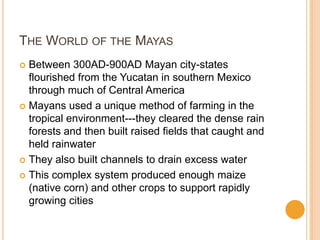
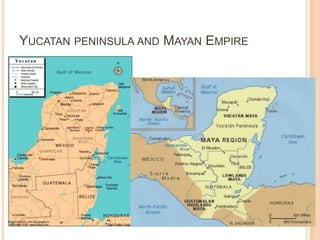
 Between 300AD-900AD Mayan city-states
flourished from the Yucatan in southern Mexico
through much of Central America
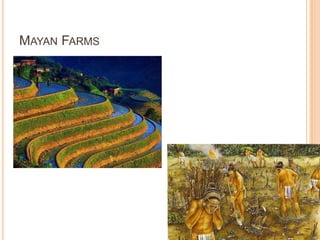
 Mayans used a unique method of farming in the
tropical environment---they cleared the dense rain
forests and then built raised fields that caught and
held rainwater
 They also built channels to drain excess water
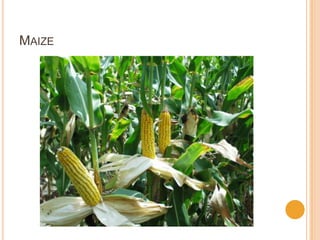
 This complex system produced enough maize
(native corn) and other crops to support rapidly
growing cities
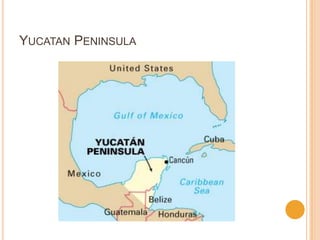
YUCATAN PENINSULA
YUCATAN PENINSULA AND MAYAN EMPIRE
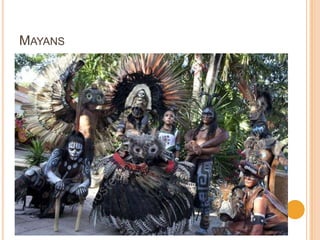
MAYANS
MAYAN FARMS
MAIZE
TEMPLES AND PALACES
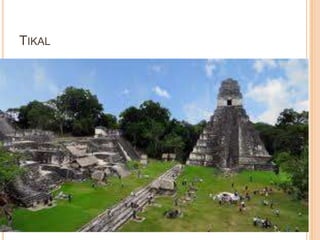
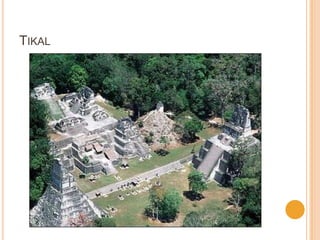
 Towering pyramid temples dominated the largest
Mayan city of Tikal, located in present-day
Guatemala
 Priests climbed steep temple stairs to perform
sacrifices while the people watched from the plazas
below
 The Mayan pyramids remained the tallest
structures in the world until 1903 when the Flatiron
Building skyscraper was built in New York City
TIKAL
TIKAL
TEMPLES AND PALACES
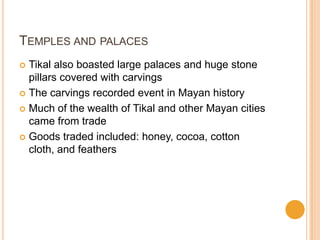
 Tikal also boasted large palaces and huge stone
pillars covered with carvings
 The carvings recorded event in Mayan history
 Much of the wealth of Tikal and other Mayan cities
came from trade
 Goods traded included: honey, cocoa, cotton
cloth, and feathers
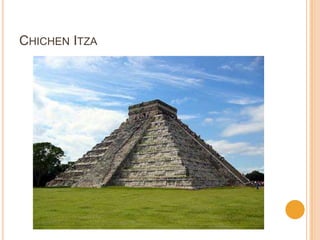
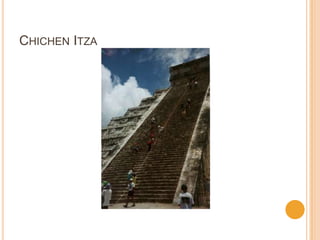
CHICHEN ITZA
CHICHEN ITZA
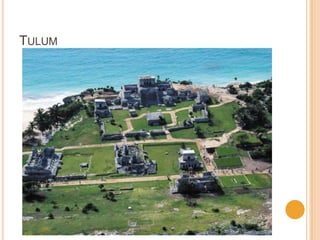
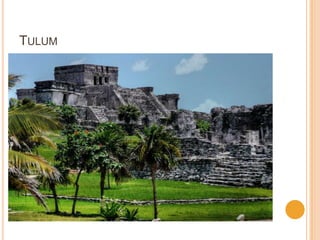
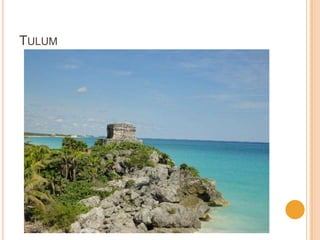
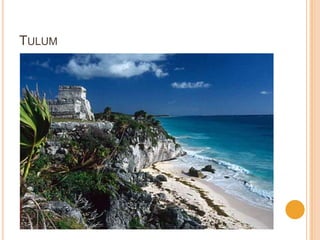
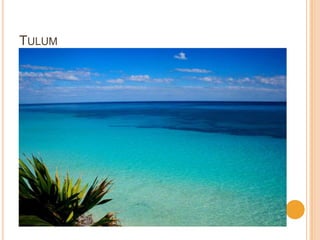
TULUM
TULUM
TULUM
TULUM
TULUM
ENGINEERING AN EMPIRE
 Watch the episode of Engineering and Empire and
describe the building techniques and importance of:
 Tikal
 Palenque
 Chichen Itza
SOCIAL CLASSES
 Each Mayan city has its own ruling chief
 Nobles served as military leaders and officials who
managed public works, collected taxes, and
enforced laws
 Rulers were usually men, however, Mayan records
and carvings show that women occasionally
governed on their own or in the name of young
sons
 Priests held great power because only they could
conduct the elaborate ceremonies needed to
ensure good harvests and success in war
SOCIAL CLASSES
 Most Mayans were farmers
 They grew corn, beans, squash---the basic food
crops of Middle America---as well as fruit
trees, cotton, and brilliant tropical flowers
 Men grew the crops while women turned them into
food
 To support the cities, farmers paid taxes in food and
helped build the temples
ADVANCES IN LEARNING
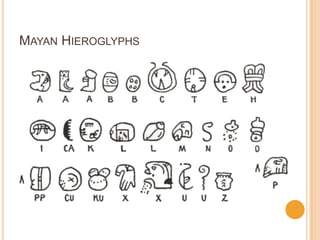
 The Mayans developed a hieroglyphic writing
system, which has only recently been deciphered
 Mayan scribes kept their sacred knowledge in
books made of bark (Spanish conquistadors later
burned most of these books but a handful were
taken to Europe and are in museums)
 Many priests were expert mathematicians and
astronomers and developed an accurate 365-day
solar calendar
 Mayan priests invented a numbering system and
understood the concept of zero
MAYAN HIEROGLYPHS
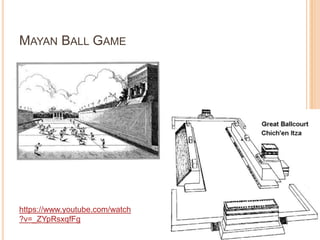
ENTERTAINMENT: MAYAN BALL GAME
 1st Team Sport in History (3500 years ago)
 Much of society revolved around the game
 Survival of both the players and spectators
depended upon the results of the game
 Mayans sacrificed people to the gods to keep the
sun shining, crops growing and keep people
healthy.
 What was more valuable than a ball player??
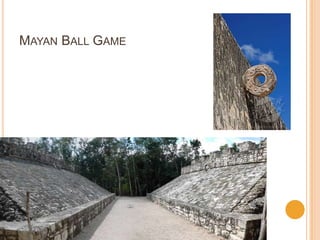
MAYAN BALL GAME
 The goal of the game was to pass the ball
around, without having it touch your hands, and
then get the ball to pass through one of the rings.
 Since the rings were so high and players were not
allowed to use their hands, it was extremely difficult
to get the ball through a ring.
 In fact, when a player did manage to get a ball
through a ring, that usually ended the game.
 People would gamble on the results
MAYAN BALL GAME
https://www.youtube.com/watch
?v=_ZYpRsxqfFg
MAYAN BALL GAME
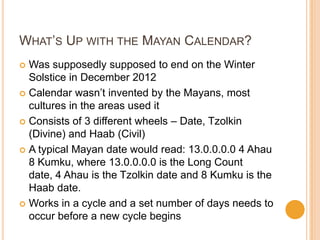
WHAT’S UP WITH THE MAYAN CALENDAR?
 Was supposedly supposed to end on the Winter
Solstice in December 2012
 Calendar wasn’t invented by the Mayans, most
cultures in the areas used it
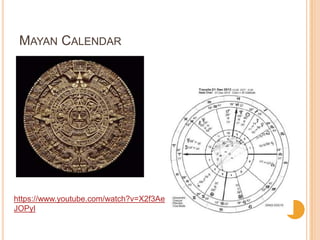
 Consists of 3 different wheels – Date, Tzolkin
(Divine) and Haab (Civil)
 A typical Mayan date would read: 13.0.0.0.0 4 Ahau
8 Kumku, where 13.0.0.0.0 is the Long Count
date, 4 Ahau is the Tzolkin date and 8 Kumku is the
Haab date.
 Works in a cycle and a set number of days needs to
occur before a new cycle begins
MAYAN CALENDAR
https://www.youtube.com/watch?v=X2f3Ae
JOPyI
DECLINE
 About 900AD, the Mayans abandoned their
cities, leaving their great stone palaces and temples
to be swallowed up by the jungle (some of these
were not “rediscovered” till modern times)
 No one knows for sure why the Mayan civilization
declined
 Some remnants of the civilization survive today:
millions of people in Guatemala and southern
Mexico speak Mayan languages and are
descendents from the original Mayans
INVESTIGATION
 Exercise to determine why the Mayans fell
 Some causes may have been---frequent
warfare, overpopulation and over farming, and
heavy taxes
OTHER SOURCES
 http://www.socialstudiesforkids.com/articles/worldhi
story/mayanballgame.htm
 http://www.timeanddate.com/calendar/mayan.html

Mayan Civilization

  • 1.
    OLMECS AND MAYAS Basedon: http://www.slideshare.net/jmarazas/wh- chapter-7-olmecs-and-mayas#
  • 2.
    LEGACY OF THEOLMECS  The earliest American civilization emerged in the tropical forests along the Mexican Gulf Coast  The Olmec civilization lasted from about 1400BC- 500BC  Archaeologists know very little about the Olmecs  Rich tombs and temples suggest that a powerful class of priests and aristocrats stood at the top of Olmec society  The Olmecs did not build cities---instead they built ceremonial centers
  • 3.
  • 4.
  • 5.
    LEGACY OF THEOLMECS  The most dramatic remains of the Olmec civilization are the giant carved stone heads found in the ruins of a religious center at La Venta  No one knows how the Olmecs moved these colossal 40-ton stones from distant quarries without wheeled vehicles or draft animals
  • 6.
  • 7.
    LEGACY OF THEOLMECS  Through trade, Olmec influence spread over a wide area  The Olmecs invented a calendar and used carved inscriptions as a form of writing  Their most important legacy may be the tradition of priestly leadership and religious devotion that became a basic part of later Middle American civilizations
  • 8.
    INTRODUCTION TO THEMAYANS  https://www.youtube.com/watch?v=OkTaSiAmnwg
  • 9.
    THE WORLD OFTHE MAYAS  Between 300AD-900AD Mayan city-states flourished from the Yucatan in southern Mexico through much of Central America  Mayans used a unique method of farming in the tropical environment---they cleared the dense rain forests and then built raised fields that caught and held rainwater  They also built channels to drain excess water  This complex system produced enough maize (native corn) and other crops to support rapidly growing cities
  • 10.
  • 11.
  • 12.
  • 13.
  • 14.
  • 15.
    TEMPLES AND PALACES Towering pyramid temples dominated the largest Mayan city of Tikal, located in present-day Guatemala  Priests climbed steep temple stairs to perform sacrifices while the people watched from the plazas below  The Mayan pyramids remained the tallest structures in the world until 1903 when the Flatiron Building skyscraper was built in New York City
  • 16.
  • 17.
  • 18.
    TEMPLES AND PALACES Tikal also boasted large palaces and huge stone pillars covered with carvings  The carvings recorded event in Mayan history  Much of the wealth of Tikal and other Mayan cities came from trade  Goods traded included: honey, cocoa, cotton cloth, and feathers
  • 19.
  • 20.
  • 21.
  • 22.
  • 23.
  • 24.
  • 25.
  • 26.
    ENGINEERING AN EMPIRE Watch the episode of Engineering and Empire and describe the building techniques and importance of:  Tikal  Palenque  Chichen Itza
  • 27.
    SOCIAL CLASSES  EachMayan city has its own ruling chief  Nobles served as military leaders and officials who managed public works, collected taxes, and enforced laws  Rulers were usually men, however, Mayan records and carvings show that women occasionally governed on their own or in the name of young sons  Priests held great power because only they could conduct the elaborate ceremonies needed to ensure good harvests and success in war
  • 28.
    SOCIAL CLASSES  MostMayans were farmers  They grew corn, beans, squash---the basic food crops of Middle America---as well as fruit trees, cotton, and brilliant tropical flowers  Men grew the crops while women turned them into food  To support the cities, farmers paid taxes in food and helped build the temples
  • 29.
    ADVANCES IN LEARNING The Mayans developed a hieroglyphic writing system, which has only recently been deciphered  Mayan scribes kept their sacred knowledge in books made of bark (Spanish conquistadors later burned most of these books but a handful were taken to Europe and are in museums)  Many priests were expert mathematicians and astronomers and developed an accurate 365-day solar calendar  Mayan priests invented a numbering system and understood the concept of zero
  • 30.
  • 31.
    ENTERTAINMENT: MAYAN BALLGAME  1st Team Sport in History (3500 years ago)  Much of society revolved around the game  Survival of both the players and spectators depended upon the results of the game  Mayans sacrificed people to the gods to keep the sun shining, crops growing and keep people healthy.  What was more valuable than a ball player??
  • 32.
    MAYAN BALL GAME The goal of the game was to pass the ball around, without having it touch your hands, and then get the ball to pass through one of the rings.  Since the rings were so high and players were not allowed to use their hands, it was extremely difficult to get the ball through a ring.  In fact, when a player did manage to get a ball through a ring, that usually ended the game.  People would gamble on the results
  • 33.
  • 34.
  • 35.
    WHAT’S UP WITHTHE MAYAN CALENDAR?  Was supposedly supposed to end on the Winter Solstice in December 2012  Calendar wasn’t invented by the Mayans, most cultures in the areas used it  Consists of 3 different wheels – Date, Tzolkin (Divine) and Haab (Civil)  A typical Mayan date would read: 13.0.0.0.0 4 Ahau 8 Kumku, where 13.0.0.0.0 is the Long Count date, 4 Ahau is the Tzolkin date and 8 Kumku is the Haab date.  Works in a cycle and a set number of days needs to occur before a new cycle begins
  • 36.
  • 37.
    DECLINE  About 900AD,the Mayans abandoned their cities, leaving their great stone palaces and temples to be swallowed up by the jungle (some of these were not “rediscovered” till modern times)  No one knows for sure why the Mayan civilization declined  Some remnants of the civilization survive today: millions of people in Guatemala and southern Mexico speak Mayan languages and are descendents from the original Mayans
  • 38.
    INVESTIGATION  Exercise todetermine why the Mayans fell  Some causes may have been---frequent warfare, overpopulation and over farming, and heavy taxes
  • 39.