The Victorian Era Society and Living Conditions
Public Sphere Industrialization brought many working class women into the “paid” economy 1832: All property-owning males could vote 1847: Karl Marx –  Communist Manifesto inequity of industrial capitalist society revolution is the necessary response 1867: voting rights extended to ALL males
Private Life Really only applies to Upper-middle class families A man’s home was his “castle” and the woman was “the angel in the house” Wives had responsibility for instilling morals, propriety and culture in children
Intellectual Issues Intellectual Progress Laws of nature and human intelligence continued to thrive throughout the Victorian period.  Darwin’s  Origin of Species  Education was now viewed as the vehicle to take society out of poverty and need.  Success was measured for the first time not by the position you were born into--but the position you climbed to.
Domestic Issues Cities were filthy--raw sewage was polluting the Thames river.  Unemployment was high since England was in the midst of economic depression.  Ten to twelve hour work day was normal.  Children worked in slave conditions in coal mines and factories.
Domestic Progress Streets were named  Houses were numbered  Garbage was collected  Sewage was eventually moved away from people’s homes and treated  Inventions (light bulb, telephone, anesthesia etc) aided in everyday life
Gender Issues Women were expected to marry, produce children In 1850, women outnumbered men in England by 500,000  By 1880, public education was generally available for both boys and girls
The Woman’s Question Questions first addressed by Wollstonecraft in the 18 th  Century, become major issues of public debate. Right to vote was only one of main issues discussed. Unequal rights for women was defended on both religious and increasingly pseudo-scientific grounds.
Industrial Revolution The application of power-driven machinery to manufacturing.  change was rapid Destroyed home/small scale industry, crafts, guilds, and peasant farmer Often skilled artisans found themselves degraded to routine process laborers as machines began to mass produce the products formerly made by hand.
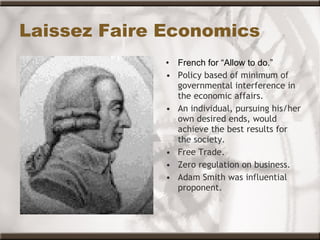
Laissez Faire Economics French for “Allow to do.” Policy based of minimum of governmental interference in the economic affairs. An individual, pursuing his/her own desired ends, would achieve the best results for the society. Free Trade. Zero regulation on business.  Adam Smith was influential proponent.
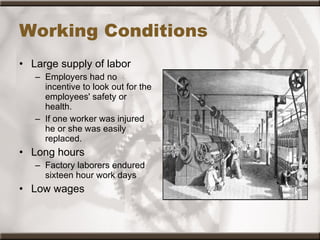
Working Conditions Large supply of labor Employers had no incentive to look out for the employees' safety or health.   If one worker was injured he or she was easily replaced.  Long hours Factory laborers endured sixteen hour work days  Low wages
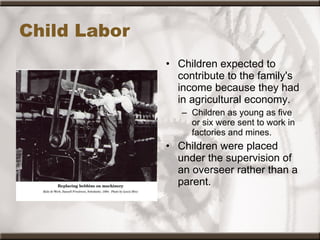
Child Labor Children expected to contribute to the family's income because they had in agricultural economy. Children as young as five or six were sent to work in factories and mines. Children were placed under the supervision of an overseer rather than a parent. 
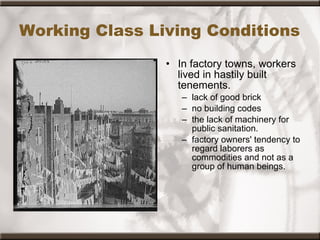
Working Class Living Conditions In factory towns, workers lived in hastily built tenements.  lack of good brick no building codes the lack of machinery for public sanitation.  factory owners' tendency to regard laborers as commodities and not as a group of human beings.

Victorianism

  • 1.
    The Victorian EraSociety and Living Conditions
  • 2.
    Public Sphere Industrializationbrought many working class women into the “paid” economy 1832: All property-owning males could vote 1847: Karl Marx – Communist Manifesto inequity of industrial capitalist society revolution is the necessary response 1867: voting rights extended to ALL males
  • 3.
    Private Life Reallyonly applies to Upper-middle class families A man’s home was his “castle” and the woman was “the angel in the house” Wives had responsibility for instilling morals, propriety and culture in children
  • 4.
    Intellectual Issues IntellectualProgress Laws of nature and human intelligence continued to thrive throughout the Victorian period. Darwin’s Origin of Species Education was now viewed as the vehicle to take society out of poverty and need. Success was measured for the first time not by the position you were born into--but the position you climbed to.
  • 5.
    Domestic Issues Citieswere filthy--raw sewage was polluting the Thames river. Unemployment was high since England was in the midst of economic depression. Ten to twelve hour work day was normal. Children worked in slave conditions in coal mines and factories.
  • 6.
    Domestic Progress Streetswere named Houses were numbered Garbage was collected Sewage was eventually moved away from people’s homes and treated Inventions (light bulb, telephone, anesthesia etc) aided in everyday life
  • 7.
    Gender Issues Womenwere expected to marry, produce children In 1850, women outnumbered men in England by 500,000 By 1880, public education was generally available for both boys and girls
  • 8.
    The Woman’s QuestionQuestions first addressed by Wollstonecraft in the 18 th Century, become major issues of public debate. Right to vote was only one of main issues discussed. Unequal rights for women was defended on both religious and increasingly pseudo-scientific grounds.
  • 9.
    Industrial Revolution Theapplication of power-driven machinery to manufacturing. change was rapid Destroyed home/small scale industry, crafts, guilds, and peasant farmer Often skilled artisans found themselves degraded to routine process laborers as machines began to mass produce the products formerly made by hand.
  • 10.
    Laissez Faire EconomicsFrench for “Allow to do.” Policy based of minimum of governmental interference in the economic affairs. An individual, pursuing his/her own desired ends, would achieve the best results for the society. Free Trade. Zero regulation on business. Adam Smith was influential proponent.
  • 11.
    Working Conditions Largesupply of labor Employers had no incentive to look out for the employees' safety or health.  If one worker was injured he or she was easily replaced. Long hours Factory laborers endured sixteen hour work days Low wages
  • 12.
    Child Labor Childrenexpected to contribute to the family's income because they had in agricultural economy. Children as young as five or six were sent to work in factories and mines. Children were placed under the supervision of an overseer rather than a parent. 
  • 13.
    Working Class LivingConditions In factory towns, workers lived in hastily built tenements. lack of good brick no building codes the lack of machinery for public sanitation. factory owners' tendency to regard laborers as commodities and not as a group of human beings.