The Hacker’s Guide to Kubernetes
Patrycja Wegrzynowicz
Form3
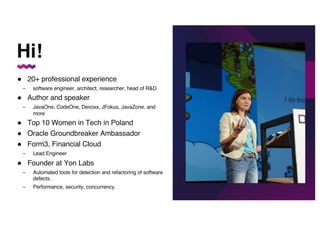
● 20+ professional experience
– software engineer, architect, researcher, head of R&D
● Author and speaker
– JavaOne, CodeOne, Devoxx, JFokus, JavaZone, and
more
● Top 10 Women in Tech in Poland
● Oracle Groundbreaker Ambassador
● Form3, Financial Cloud
– Lead Engineer
● Founder at Yon Labs
– Automated tools for detection and refactoring of software
defects.
– Performance, security, concurrency.
You can insert a picture here!
Hi!
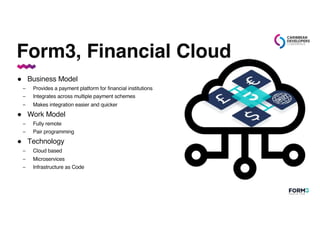
Form3, Financial Cloud
● Business Model
– Provides a payment platform for financial institutions
– Integrates across multiple payment schemes
– Makes integration easier and quicker
● Work Model
– Fully remote
– Pair programming
● Technology
– Cloud based
– Microservices
– Infrastructure as Code
Agenda
● Introduction to Kubernetes Architecture
● Introduction to OWASP Kubernetes Top 10
● Demos
● Summary
Introduction to Kubernetes
Architecture
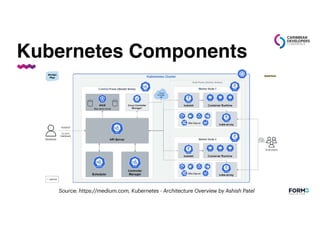
Kubernetes Components
Source: https://medium.com, Kubernetes - Architecture Overview by Ashish Patel
Introduction to OWASP
Kubernetes Top 10
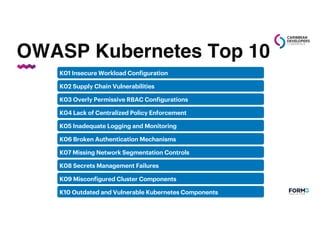
OWASP Kubernetes Top 10
K01 Insecure Workload Configuration
K02 Supply Chain Vulnerabilities
K03 Overly Permissive RBAC Configurations
K04 Lack of Centralized Policy Enforcement
K05 Inadequate Logging and Monitoring
K06 Broken Authentication Mechanisms
K07 Missing Network Segmentation Controls
K08 Secrets Management Failures
K09 Misconfigured Cluster Components
K10 Outdated and Vulnerable Kubernetes Components
Demos
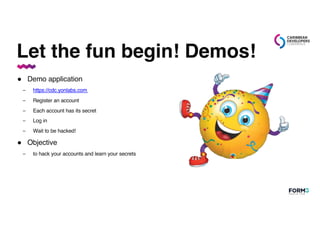
Let the fun begin! Demos!
● Demo application
– https://cdc.yonlabs.com
– Register an account
– Each account has its secret
– Log in
– Wait to be hacked!
● Objective
– to hack your accounts and learn your secrets
Demo #1
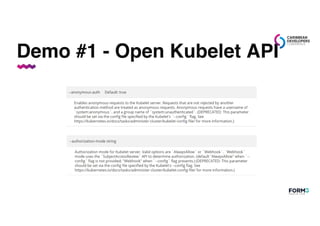
Demo #1 - Open Kubelet API
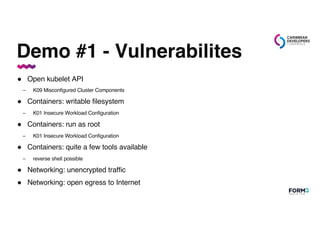
Demo #1 - Vulnerabilites
● Open kubelet API
– K09 Misconfigured Cluster Components
● Containers: writable filesystem
– K01 Insecure Workload Configuration
● Containers: run as root
– K01 Insecure Workload Configuration
● Containers: quite a few tools available
– reverse shell possible
● Networking: unencrypted traffic
● Networking: open egress to Internet
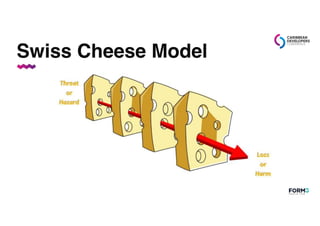
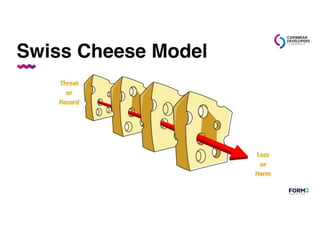
Swiss Cheese Model
Demo #2
Demo #2 – RCE & Network
● Remote Code Execution
● Missing Network Segmentation
– Pods able to connect to unrelated pods in a different namespace
Demo #2 - Vulnerabilites
● RCE in one (!) Kubernetes deployment
– K10 Outdated and Vulnerable Components
● Missing network segmentation
– K07 Missing Network Segmentation Controls
● Containers: quite a few tools available
– reverse shell possible
● Anonymous access to Redis
OWASP Kubernetes Top 10
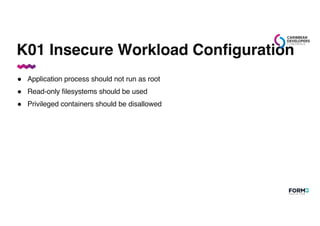
K01 Insecure Workload Configuration
● Application process should not run as root
● Read-only filesystems should be used
● Privileged containers should be disallowed
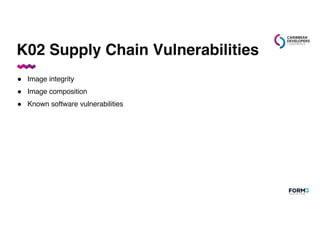
K02 Supply Chain Vulnerabilities
● Image integrity
● Image composition
● Known software vulnerabilities
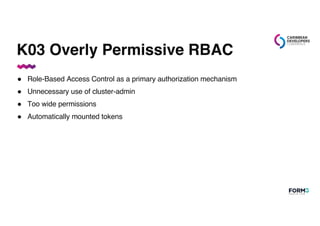
K03 Overly Permissive RBAC
● Role-Based Access Control as a primary authorization mechanism
● Unnecessary use of cluster-admin
● Too wide permissions
● Automatically mounted tokens
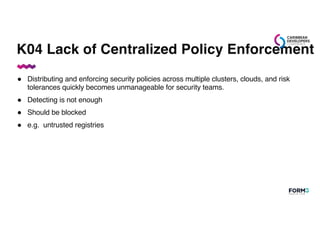
K04 Lack of Centralized Policy Enforcement
● Distributing and enforcing security policies across multiple clusters, clouds, and risk
tolerances quickly becomes unmanageable for security teams.
● Detecting is not enough
● Should be blocked
● e.g. untrusted registries
K05 Inadequate Logging and Monitoring
● Relevant events such as failed authentication attempts, access to sensitive
resources, manual deletion or modification of Kubernetes resources are not
logged.
● Logs and traces of running workloads are not monitored for suspicious activity.
● Alerting thresholds are not in place or escalated appropriately.
● Logs are not centrally stored and protected against tampering.
● Logging infrastructure is disabled completely.
K06 Broken Authentication Mechanisms
● Human authentication
– OpenID Connect, Certificates, Cloud IAM, ServiceAccount tokens
● Service Account Authentication
– Should be configured with RBAC
K07 Missing Network Segmentation
● Kubernetes flat network model
● Multi-cluster – cluster segmentation
● Network policies
K08 Secrets Management Failures
● Kubernetes secret - a small standalone object containing sensitive data like
passwords, tokens
● Leaking kubernetes secrets
● Encryption at rest
● Addressing security misconfiguration
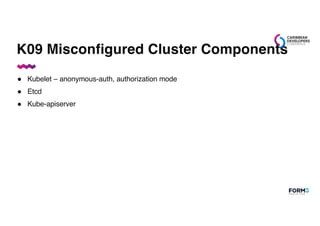
K09 Misconfigured Cluster Components
● Kubelet – anonymous-auth, authorization mode
● Etcd
● Kube-apiserver
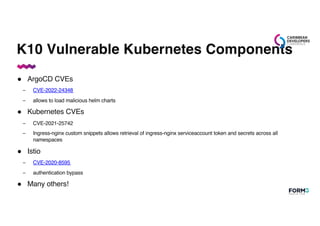
K10 Vulnerable Kubernetes Components
● ArgoCD CVEs
– CVE-2022-24348
– allows to load malicious helm charts
● Kubernetes CVEs
– CVE-2021-25742
– Ingress-nginx custom snippets allows retrieval of ingress-nginx serviceaccount token and secrets across all
namespaces
● Istio
– CVE-2020-8595
– authentication bypass
● Many others!
Summary
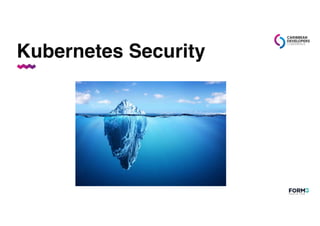
Kubernetes Security
Swiss Cheese Model
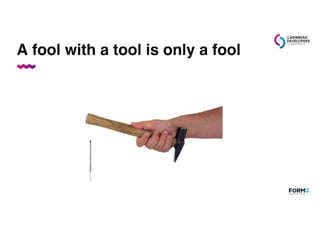
A fool with a tool is only a fool
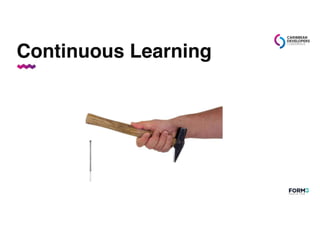
Continuous Learning
Q&A
@yonlabs
Thank You!

The Hacker's Guide to Kubernetes

  • 1.
    The Hacker’s Guideto Kubernetes Patrycja Wegrzynowicz Form3
  • 2.
    ● 20+ professionalexperience – software engineer, architect, researcher, head of R&D ● Author and speaker – JavaOne, CodeOne, Devoxx, JFokus, JavaZone, and more ● Top 10 Women in Tech in Poland ● Oracle Groundbreaker Ambassador ● Form3, Financial Cloud – Lead Engineer ● Founder at Yon Labs – Automated tools for detection and refactoring of software defects. – Performance, security, concurrency. You can insert a picture here! Hi!
  • 3.
    Form3, Financial Cloud ●Business Model – Provides a payment platform for financial institutions – Integrates across multiple payment schemes – Makes integration easier and quicker ● Work Model – Fully remote – Pair programming ● Technology – Cloud based – Microservices – Infrastructure as Code
  • 4.
    Agenda ● Introduction toKubernetes Architecture ● Introduction to OWASP Kubernetes Top 10 ● Demos ● Summary
  • 5.
  • 6.
    Kubernetes Components Source: https://medium.com,Kubernetes - Architecture Overview by Ashish Patel
  • 7.
  • 8.
    OWASP Kubernetes Top10 K01 Insecure Workload Configuration K02 Supply Chain Vulnerabilities K03 Overly Permissive RBAC Configurations K04 Lack of Centralized Policy Enforcement K05 Inadequate Logging and Monitoring K06 Broken Authentication Mechanisms K07 Missing Network Segmentation Controls K08 Secrets Management Failures K09 Misconfigured Cluster Components K10 Outdated and Vulnerable Kubernetes Components
  • 9.
  • 10.
    Let the funbegin! Demos! ● Demo application – https://cdc.yonlabs.com – Register an account – Each account has its secret – Log in – Wait to be hacked! ● Objective – to hack your accounts and learn your secrets
  • 11.
  • 12.
    Demo #1 -Open Kubelet API
  • 13.
    Demo #1 -Vulnerabilites ● Open kubelet API – K09 Misconfigured Cluster Components ● Containers: writable filesystem – K01 Insecure Workload Configuration ● Containers: run as root – K01 Insecure Workload Configuration ● Containers: quite a few tools available – reverse shell possible ● Networking: unencrypted traffic ● Networking: open egress to Internet
  • 14.
  • 15.
  • 16.
    Demo #2 –RCE & Network ● Remote Code Execution ● Missing Network Segmentation – Pods able to connect to unrelated pods in a different namespace
  • 17.
    Demo #2 -Vulnerabilites ● RCE in one (!) Kubernetes deployment – K10 Outdated and Vulnerable Components ● Missing network segmentation – K07 Missing Network Segmentation Controls ● Containers: quite a few tools available – reverse shell possible ● Anonymous access to Redis
  • 18.
  • 19.
    K01 Insecure WorkloadConfiguration ● Application process should not run as root ● Read-only filesystems should be used ● Privileged containers should be disallowed
  • 20.
    K02 Supply ChainVulnerabilities ● Image integrity ● Image composition ● Known software vulnerabilities
  • 21.
    K03 Overly PermissiveRBAC ● Role-Based Access Control as a primary authorization mechanism ● Unnecessary use of cluster-admin ● Too wide permissions ● Automatically mounted tokens
  • 22.
    K04 Lack ofCentralized Policy Enforcement ● Distributing and enforcing security policies across multiple clusters, clouds, and risk tolerances quickly becomes unmanageable for security teams. ● Detecting is not enough ● Should be blocked ● e.g. untrusted registries
  • 23.
    K05 Inadequate Loggingand Monitoring ● Relevant events such as failed authentication attempts, access to sensitive resources, manual deletion or modification of Kubernetes resources are not logged. ● Logs and traces of running workloads are not monitored for suspicious activity. ● Alerting thresholds are not in place or escalated appropriately. ● Logs are not centrally stored and protected against tampering. ● Logging infrastructure is disabled completely.
  • 24.
    K06 Broken AuthenticationMechanisms ● Human authentication – OpenID Connect, Certificates, Cloud IAM, ServiceAccount tokens ● Service Account Authentication – Should be configured with RBAC
  • 25.
    K07 Missing NetworkSegmentation ● Kubernetes flat network model ● Multi-cluster – cluster segmentation ● Network policies
  • 26.
    K08 Secrets ManagementFailures ● Kubernetes secret - a small standalone object containing sensitive data like passwords, tokens ● Leaking kubernetes secrets ● Encryption at rest ● Addressing security misconfiguration
  • 27.
    K09 Misconfigured ClusterComponents ● Kubelet – anonymous-auth, authorization mode ● Etcd ● Kube-apiserver
  • 28.
    K10 Vulnerable KubernetesComponents ● ArgoCD CVEs – CVE-2022-24348 – allows to load malicious helm charts ● Kubernetes CVEs – CVE-2021-25742 – Ingress-nginx custom snippets allows retrieval of ingress-nginx serviceaccount token and secrets across all namespaces ● Istio – CVE-2020-8595 – authentication bypass ● Many others!
  • 29.
  • 30.
  • 31.
  • 32.
    A fool witha tool is only a fool
  • 33.
  • 34.
  • 35.