Securing
Kubernetes
Workloads
Best Practices for Securing Kubernetes Workload Configurations Across Clouds
Jim Bugwadia
Founder and CEO
Agenda
• Kubernetes Security Framework
• Kubernetes Constructs for Workload Security
• Q & A
2
3
About me
• @JimBugwadia
• Founder and CEO at Nirmata
• Working on large-scale distributed
systems (C++, Java, JS, Go) since 1994
CKA-1700-0169-0100
4
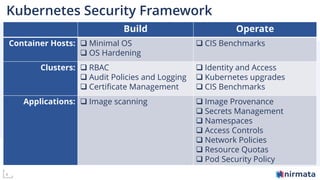
Kubernetes Security Framework
Build Operate
Container Hosts: ❑ Minimal OS
❑ OS Hardening
❑ CIS Benchmarks
Clusters: ❑ RBAC
❑ Audit Policies and Logging
❑ Certificate Management
❑ Identity and Access
❑ Kubernetes upgrades
❑ CIS Benchmarks
Applications: ❑ Image scanning ❑ Image Provenance
❑ Secrets Management
❑ Namespaces
❑ Access Controls
❑ Network Policies
❑ Resource Quotas
❑ Pod Security Policy
5
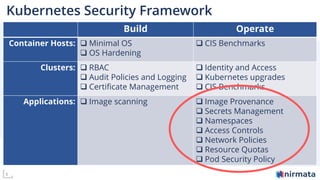
Kubernetes Security Framework
Build Operate
Container Hosts: ❑ Minimal OS
❑ OS Hardening
❑ CIS Benchmarks
Clusters: ❑ RBAC
❑ Audit Policies and Logging
❑ Certificate Management
❑ Identity and Access
❑ Kubernetes upgrades
❑ CIS Benchmarks
Applications: ❑ Image scanning ❑ Image Provenance
❑ Secrets Management
❑ Namespaces
❑ Access Controls
❑ Network Policies
❑ Resource Quotas
❑ Pod Security Policy
Image Provenance
6
7
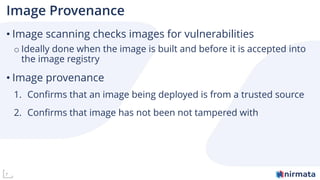
Image Provenance
• Image scanning checks images for vulnerabilities
o Ideally done when the image is built and before it is accepted into
the image registry
• Image provenance
1. Confirms that an image being deployed is from a trusted source
2. Confirms that image has not been not tampered with
8
Image Provenance - Solutions
• Kubernetes ImagePolicyWebhook
o Configured as an admission controller
o Sends an ImageReview request
o Expects an ImageReview response of accept or deny
9
Image Provenance - Solutions
• Portieris
o Also an admission controller
o Integrates with Notary (a content trust store) – part of the The
Update Framework (TUF)
o Provides way to specify image security policies at a namespace and
cluster level
https://github.com/IBM/portieris
https://theupdateframework.github.io/
https://github.com/theupdateframework/notary
10
Image Provenance – Partial Solutions
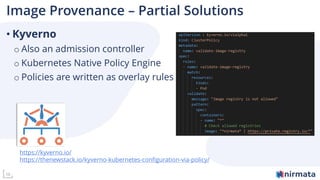
• Kyverno
o Also an admission controller
o Kubernetes Native Policy Engine
o Policies are written as overlay rules
https://kyverno.io/
https://thenewstack.io/kyverno-kubernetes-configuration-via-policy/
11
Image Provenance – Partial Solutions
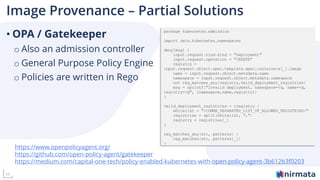
• OPA / Gatekeeper
o Also an admission controller
o General Purpose Policy Engine
o Policies are written in Rego
https://www.openpolicyagent.org/
https://github.com/open-policy-agent/gatekeeper
https://medium.com/capital-one-tech/policy-enabled-kubernetes-with-open-policy-agent-3b612b3f0203
Secrets Management
12
13
Secrets
• Any sensitive data that an application needs
o Passwords
o Certificates
o Keys
o …
14
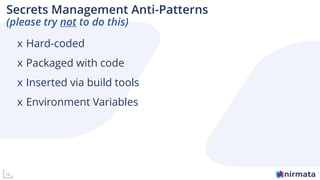
Secrets Management Anti-Patterns
(please try not to do this)
x Hard-coded
x Packaged with code
x Inserted via build tools
x Environment Variables
15
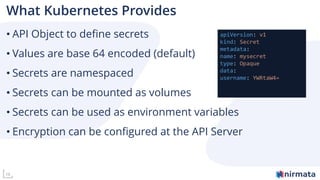
What Kubernetes Provides
• API Object to define secrets
• Values are base 64 encoded (default)
• Secrets are namespaced
• Secrets can be mounted as volumes
• Secrets can be used as environment variables
• Encryption can be configured at the API Server
apiVersion: v1
kind: Secret
metadata:
name: mysecret
type: Opaque
data:
username: YWRtaW4=
16
So, what’s missing?
Kubernetes secrets are a step forward, but have a few limitations:
• Encryption requires configuring static keys or a KMS
• Shared (static) approach
• No leases, rotation, etc.
17
Secrets Management with Hashicorp Vault
• Helps automates security best practices for
o Secrets Management
o Auditing
o Certificate Management
o Encryption
• Dynamic Secrets
o Credentials (keys, passwords, certificates) are
generated when a client requests them
o Credentials are per client
o Credentials are automatically deleted if a lease
expires
18
An init container to fetch secrets
init
container
Vault
Kubernetes Pod
application
container
Service Account & Role
Secrets
…
Volume
(secret)
https://github.com/nirmata/kube-vault-client
https://www.nirmata.com/2018/12/19/managing-kubernetes-secrets-with-hashicorp-vault-and-nirmata/
Namespaces
19
20
Namespaces
• Kubernetes Data Plane Virtualization
• Namespaces partition the Kubernetes object model so
multiple objects with the same name can exist in the same
cluster
• Namespaces are the foundation for applying other security
constructs
Kubernetes supports multiple virtual clusters backed by
the same physical cluster. These virtual clusters are called
namespaces.
https://kubernetes.io/docs/concepts/overview/working-with-objects/namespaces/
Access Controls
21
22
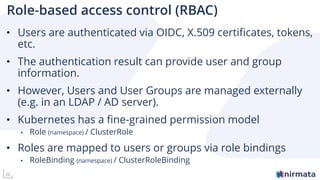
Role-based access control (RBAC)
• Users are authenticated via OIDC, X.509 certificates, tokens,
etc.
• The authentication result can provide user and group
information.
• However, Users and User Groups are managed externally
(e.g. in an LDAP / AD server).
• Kubernetes has a fine-grained permission model
• Role (namespace) / ClusterRole
• Roles are mapped to users or groups via role bindings
• RoleBinding (namespace) / ClusterRoleBinding
23
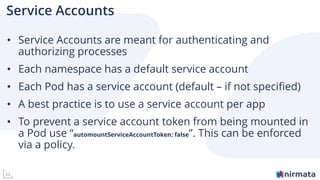
Service Accounts
• Service Accounts are meant for authenticating and
authorizing processes
• Each namespace has a default service account
• Each Pod has a service account (default – if not specified)
• A best practice is to use a service account per app
• To prevent a service account token from being mounted in
a Pod use “automountServiceAccountToken: false”. This can be enforced
via a policy.
Network Policies
24
25
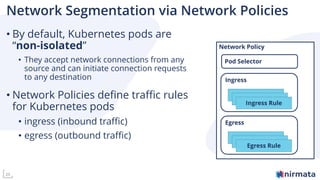
Network Segmentation via Network Policies
• By default, Kubernetes pods are
“non-isolated”
• They accept network connections from any
source and can initiate connection requests
to any destination
• Network Policies define traffic rules
for Kubernetes pods
• ingress (inbound traffic)
• egress (outbound traffic)
Network Policy
Pod Selector
Ingress
Ingress Rule
Ingress Rule
Ingress Rule
Egress
Ingress Rule
Ingress Rule
Egress Rule
Resource Quotas
26
27
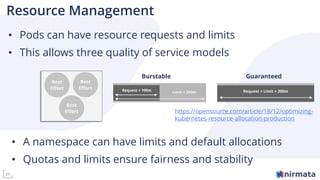
Resource Management
• Pods can have resource requests and limits
• This allows three quality of service models
GuaranteedBurstable
• A namespace can have limits and default allocations
• Quotas and limits ensure fairness and stability
https://opensource.com/article/18/12/optimizing-
kubernetes-resource-allocation-production
Pod Security Policies
28
29
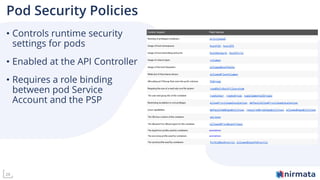
Pod Security Policies
• Controls runtime security
settings for pods
• Enabled at the API Controller
• Requires a role binding
between pod Service
Account and the PSP
30
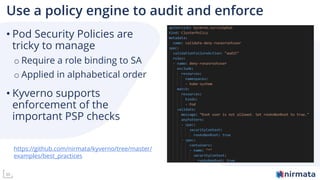
Use a policy engine to audit and enforce
• Pod Security Policies are
tricky to manage
o Require a role binding to SA
o Applied in alphabetical order
• Kyverno supports
enforcement of the
important PSP checks
https://github.com/nirmata/kyverno/tree/master/
examples/best_practices
Summary
31
32
33
Summary
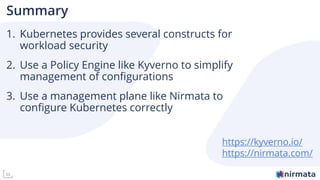
1. Kubernetes provides several constructs for
workload security
2. Use a Policy Engine like Kyverno to simplify
management of configurations
3. Use a management plane like Nirmata to
configure Kubernetes correctly
https://kyverno.io/
https://nirmata.com/
34
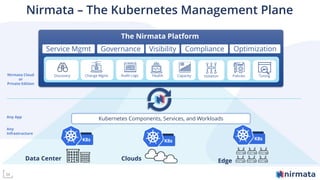
Nirmata – The Kubernetes Management Plane
Kubernetes Components, Services, and Workloads
K8s
Data Center
K8s
Clouds
K8s
Edge
Service Mgmt VisibilityGovernance Compliance Optimization
The Nirmata Platform
Change Mgmt. Audit Logs Health Capacity Isolation Policies TuningDiscovery
Any
Infrastructure
Nirmata Cloud
or
Private Edition
Any App
Thank-You!
https://try.nirmata.io

Securing Kubernetes Workloads

  • 1.
    Securing Kubernetes Workloads Best Practices forSecuring Kubernetes Workload Configurations Across Clouds Jim Bugwadia Founder and CEO
  • 2.
    Agenda • Kubernetes SecurityFramework • Kubernetes Constructs for Workload Security • Q & A 2
  • 3.
    3 About me • @JimBugwadia •Founder and CEO at Nirmata • Working on large-scale distributed systems (C++, Java, JS, Go) since 1994 CKA-1700-0169-0100
  • 4.
    4 Kubernetes Security Framework BuildOperate Container Hosts: ❑ Minimal OS ❑ OS Hardening ❑ CIS Benchmarks Clusters: ❑ RBAC ❑ Audit Policies and Logging ❑ Certificate Management ❑ Identity and Access ❑ Kubernetes upgrades ❑ CIS Benchmarks Applications: ❑ Image scanning ❑ Image Provenance ❑ Secrets Management ❑ Namespaces ❑ Access Controls ❑ Network Policies ❑ Resource Quotas ❑ Pod Security Policy
  • 5.
    5 Kubernetes Security Framework BuildOperate Container Hosts: ❑ Minimal OS ❑ OS Hardening ❑ CIS Benchmarks Clusters: ❑ RBAC ❑ Audit Policies and Logging ❑ Certificate Management ❑ Identity and Access ❑ Kubernetes upgrades ❑ CIS Benchmarks Applications: ❑ Image scanning ❑ Image Provenance ❑ Secrets Management ❑ Namespaces ❑ Access Controls ❑ Network Policies ❑ Resource Quotas ❑ Pod Security Policy
  • 6.
  • 7.
    7 Image Provenance • Imagescanning checks images for vulnerabilities o Ideally done when the image is built and before it is accepted into the image registry • Image provenance 1. Confirms that an image being deployed is from a trusted source 2. Confirms that image has not been not tampered with
  • 8.
    8 Image Provenance -Solutions • Kubernetes ImagePolicyWebhook o Configured as an admission controller o Sends an ImageReview request o Expects an ImageReview response of accept or deny
  • 9.
    9 Image Provenance -Solutions • Portieris o Also an admission controller o Integrates with Notary (a content trust store) – part of the The Update Framework (TUF) o Provides way to specify image security policies at a namespace and cluster level https://github.com/IBM/portieris https://theupdateframework.github.io/ https://github.com/theupdateframework/notary
  • 10.
    10 Image Provenance –Partial Solutions • Kyverno o Also an admission controller o Kubernetes Native Policy Engine o Policies are written as overlay rules https://kyverno.io/ https://thenewstack.io/kyverno-kubernetes-configuration-via-policy/
  • 11.
    11 Image Provenance –Partial Solutions • OPA / Gatekeeper o Also an admission controller o General Purpose Policy Engine o Policies are written in Rego https://www.openpolicyagent.org/ https://github.com/open-policy-agent/gatekeeper https://medium.com/capital-one-tech/policy-enabled-kubernetes-with-open-policy-agent-3b612b3f0203
  • 12.
  • 13.
    13 Secrets • Any sensitivedata that an application needs o Passwords o Certificates o Keys o …
  • 14.
    14 Secrets Management Anti-Patterns (pleasetry not to do this) x Hard-coded x Packaged with code x Inserted via build tools x Environment Variables
  • 15.
    15 What Kubernetes Provides •API Object to define secrets • Values are base 64 encoded (default) • Secrets are namespaced • Secrets can be mounted as volumes • Secrets can be used as environment variables • Encryption can be configured at the API Server apiVersion: v1 kind: Secret metadata: name: mysecret type: Opaque data: username: YWRtaW4=
  • 16.
    16 So, what’s missing? Kubernetessecrets are a step forward, but have a few limitations: • Encryption requires configuring static keys or a KMS • Shared (static) approach • No leases, rotation, etc.
  • 17.
    17 Secrets Management withHashicorp Vault • Helps automates security best practices for o Secrets Management o Auditing o Certificate Management o Encryption • Dynamic Secrets o Credentials (keys, passwords, certificates) are generated when a client requests them o Credentials are per client o Credentials are automatically deleted if a lease expires
  • 18.
    18 An init containerto fetch secrets init container Vault Kubernetes Pod application container Service Account & Role Secrets … Volume (secret) https://github.com/nirmata/kube-vault-client https://www.nirmata.com/2018/12/19/managing-kubernetes-secrets-with-hashicorp-vault-and-nirmata/
  • 19.
  • 20.
    20 Namespaces • Kubernetes DataPlane Virtualization • Namespaces partition the Kubernetes object model so multiple objects with the same name can exist in the same cluster • Namespaces are the foundation for applying other security constructs Kubernetes supports multiple virtual clusters backed by the same physical cluster. These virtual clusters are called namespaces. https://kubernetes.io/docs/concepts/overview/working-with-objects/namespaces/
  • 21.
  • 22.
    22 Role-based access control(RBAC) • Users are authenticated via OIDC, X.509 certificates, tokens, etc. • The authentication result can provide user and group information. • However, Users and User Groups are managed externally (e.g. in an LDAP / AD server). • Kubernetes has a fine-grained permission model • Role (namespace) / ClusterRole • Roles are mapped to users or groups via role bindings • RoleBinding (namespace) / ClusterRoleBinding
  • 23.
    23 Service Accounts • ServiceAccounts are meant for authenticating and authorizing processes • Each namespace has a default service account • Each Pod has a service account (default – if not specified) • A best practice is to use a service account per app • To prevent a service account token from being mounted in a Pod use “automountServiceAccountToken: false”. This can be enforced via a policy.
  • 24.
  • 25.
    25 Network Segmentation viaNetwork Policies • By default, Kubernetes pods are “non-isolated” • They accept network connections from any source and can initiate connection requests to any destination • Network Policies define traffic rules for Kubernetes pods • ingress (inbound traffic) • egress (outbound traffic) Network Policy Pod Selector Ingress Ingress Rule Ingress Rule Ingress Rule Egress Ingress Rule Ingress Rule Egress Rule
  • 26.
  • 27.
    27 Resource Management • Podscan have resource requests and limits • This allows three quality of service models GuaranteedBurstable • A namespace can have limits and default allocations • Quotas and limits ensure fairness and stability https://opensource.com/article/18/12/optimizing- kubernetes-resource-allocation-production
  • 28.
  • 29.
    29 Pod Security Policies •Controls runtime security settings for pods • Enabled at the API Controller • Requires a role binding between pod Service Account and the PSP
  • 30.
    30 Use a policyengine to audit and enforce • Pod Security Policies are tricky to manage o Require a role binding to SA o Applied in alphabetical order • Kyverno supports enforcement of the important PSP checks https://github.com/nirmata/kyverno/tree/master/ examples/best_practices
  • 31.
  • 32.
  • 33.
    33 Summary 1. Kubernetes providesseveral constructs for workload security 2. Use a Policy Engine like Kyverno to simplify management of configurations 3. Use a management plane like Nirmata to configure Kubernetes correctly https://kyverno.io/ https://nirmata.com/
  • 34.
    34 Nirmata – TheKubernetes Management Plane Kubernetes Components, Services, and Workloads K8s Data Center K8s Clouds K8s Edge Service Mgmt VisibilityGovernance Compliance Optimization The Nirmata Platform Change Mgmt. Audit Logs Health Capacity Isolation Policies TuningDiscovery Any Infrastructure Nirmata Cloud or Private Edition Any App
  • 35.