Kubernetes Security –Practical &
In Depth
‑
Hands on Security Concepts, Attacks
‑
& Defenses
Designed for DevOps, SRE & Security
Engineers
2.
Why Kubernetes Securityis Critical
• Kubernetes is an API driven control plane
‑
• If API access is compromised → entire cluster
is compromised
• Most attacks exploit misconfigurations, not
zero days
‑
• Security must be enforced continuously
Real World KubernetesAttacks
‑
• Exposed dashboard → cluster takeover
• Compromised pod → service account abuse
• Crypto mining via privileged containers
‑
• etcd exposed without authentication
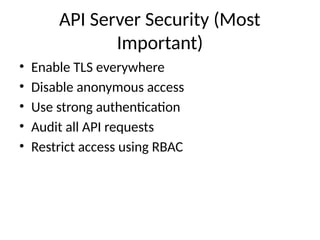
API Server Security(Most
Important)
• Enable TLS everywhere
• Disable anonymous access
• Use strong authentication
• Audit all API requests
• Restrict access using RBAC
7.
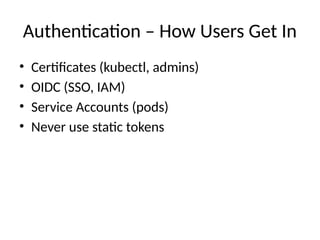
Authentication – HowUsers Get In
• Certificates (kubectl, admins)
• OIDC (SSO, IAM)
• Service Accounts (pods)
• Never use static tokens
8.
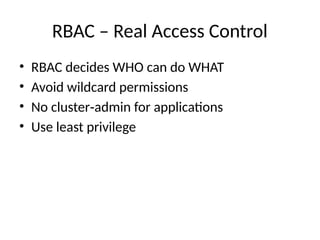
RBAC – RealAccess Control
• RBAC decides WHO can do WHAT
• Avoid wildcard permissions
• No cluster admin for applications
‑
• Use least privilege
9.
RBAC Misconfiguration Example
•Giving cluster admin to CI/CD pipelines
‑
• Binding default service account to admin
• Over privileged roles enable lateral movement
‑
10.
Service Account Attacks
•Pods get tokens automatically
• Attackers steal token from pod
• Token used to call Kubernetes API
• Leads to cluster takeover
11.
Service Account Hardening
•Disable auto mounting when not required
‑
• Use dedicated service accounts
• Restrict RBAC permissions
• Short lived tokens
‑
12.
Pod Security Standards(PSS)
• Replaces PodSecurityPolicy
• Three modes: Privileged, Baseline, Restricted
• Namespace level enforcement
‑
• Must have for production
‑
13.
Pod Security –Practical Controls
• No privileged containers
• No hostPath mounts
• Run as non root
‑
• Read only root filesystem
‑
Kyverno – PracticalSecurity
Example
• Block containers running as root
• Enforce image registries
• Auto mutate securityContext
‑
• Policy as code for Kubernetes
‑ ‑
16.
Network Policies –Zero Trust
Networking
• By default, all pods can talk to each other
• NetworkPolicy enforces isolation
• Limit blast radius
• Mandatory for multi tenant clusters
‑
17.
NetworkPolicy Attack Scenario
•Compromised frontend pod
• Without NetworkPolicy → access DB directly
• With NetworkPolicy → attack blocked
18.
Secrets Management in
Kubernetes
•Avoid plaintext secrets
• Use external secret managers
• Restrict secret access via RBAC
• Enable encryption at rest
19.
etcd Security (OftenIgnored)
• Contains all cluster state
• Encrypt data at rest
• Restrict network access
• Never expose etcd publicly
20.
Node Security &Kubelet
• Harden worker nodes
• Protect kubelet API
• Disable anonymous kubelet access
• Use minimal OS images
21.
Container Runtime Security
•Containers share host kernel
• Use seccomp, AppArmor, SELinux
• Drop Linux capabilities
• Prevent container escape
22.
Runtime Threat Detection
•Detect suspicious behavior at runtime
• Tools: Falco, Tetragon
• Alert on crypto mining, shell spawn
‑
• Essential for production
23.
Supply Chain Security
•Scan container images
• Use signed images
• Trusted registries only
• Prevent image poisoning attacks
24.
CI/CD Pipeline Security
•Scan images before deployment
• Enforce security gates
• No direct kubectl from pipelines
• Use GitOps (ArgoCD / Flux)