Or…
How industry standard network security
models can help achieve better network
 security without introducing unneeded
        complexity in your environment
 History   of a network…
  • From initial state to current state
 Threats  to current state
 We still have problems
 Why do architecture?
 What does it look like?
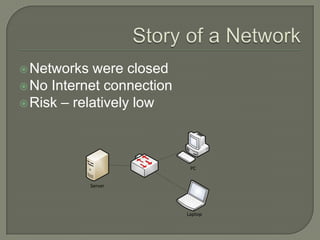
 Networks  were closed
 No Internet connection
 Risk – relatively low


                            PC


             Server


                           Laptop
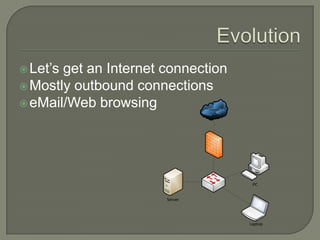
 Let’sget an Internet connection
 Mostly outbound connections
 eMail/Web browsing            Internet


                                            PC


                       Server


                                           Laptop
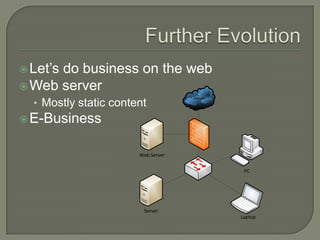
 Let’s
      do business on the web
 Web server
                                    Internet
  • Mostly static content
 E-Business


                       Web Server

                                                PC


                        Server
                                               Laptop
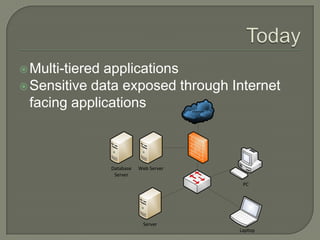
 Multi-tieredapplications
 Sensitive data exposed through Internet
  facing applications                    Internet


                 Database   Web Server
                  Server
                                                     PC


                             Server
                                                    Laptop
 Networks   are open
 Arguably mature set of standards
 Web sites integral part of business
 Security controls developed as we moved
  from Closed to Open architectures
 Linear development of security controls is
  not sufficient
 Because   we have exposed resources and
  data to Internet customers multiple attack
  vectors exist
 Proven vulnerabilities in web servers
 Can be used as launching point for further
  attacks
  • Pivoting
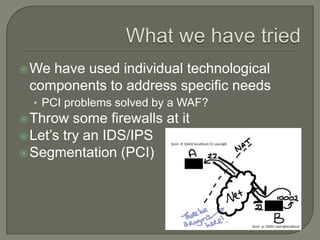
 Wehave used individual technological
 components to address specific needs
  • PCI problems solved by a WAF?
 Throw   some firewalls at it
 Let’s try an IDS/IPS
 Segmentation (PCI)
 Security tends to be reactive
 No structure for security controls
  • (or undocumented security
   assumptions/requirements)
 Every system has a unique set of controls
 Hard to manage
  • Is the control managed properly?
  • What are the governing rules for the management
    of the controls?
  • Are we in compliance with all of the controls?
 We   can’t just throw technology at these
  problems without proper process and
  staffing to manage the technology
 We can’t throw security point solutions at
  the problems without considering how they
  work together and how they impact the
  production system
 AlignIT Security Architecture with other
 architectural domains
  • Must align systems security with network and
   application security
 Align
      IT Security Architecture with the
 business requirements
  • Are we trying to solve a problem that the business
    doesn’t need?
  • Security Architecture needs to align with the
    business risk appetite
 Ensure technical controls function as an
 integrated system
  • IDS and vulnerability management integration
    reduces false positives
  • Is there alignment between what our tools are
    telling us
  • SEIM?
   ď‚– Not so sure without good brains behind it(people)
 BIG PICTURE THINKING
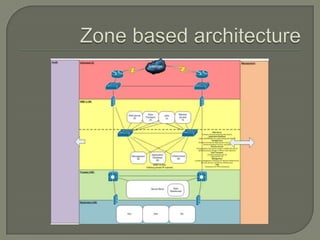
  • One candidate …
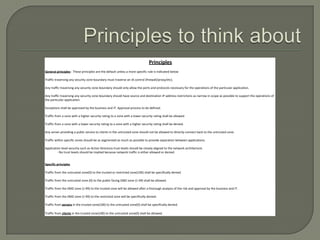
Principles
General principles - These principles are the default unless a more specific rule is indicated below

Traffic traversing any security zone boundary must traverse an IA control (firewall/proxy/etc).

Any traffic traversing any security zone boundary should only allow the ports and protocols necessary for the operations of the particular application.

Any traffic traversing any security zone boundary should have source and destination IP address restrictions as narrow in scope as possible to support the operations of
the particular application.

Exceptions shall be approved by the business and IT. Approval process to be defined.

Traffic from a zone with a higher security rating to a zone with a lower security rating shall be allowed.

Traffic from a zone with a lower security rating to a zone with a higher security rating shall be denied.

Any server providing a public service to clients in the untrusted zone should not be allowed to directly connect back to the untrusted zone.

Traffic within specific zones should be as segmented as much as possible to provide separation between applications.

Application level security such as Active Directory trust levels should be closely aligned to the network architecture.
         - No trust levels should be implied because network traffic is either allowed or denied


Specific principles

Traffic from the untrusted zone(0) to the trusted or restricted zone(100) shall be specifically denied.

Traffic from the untrusted zone (0) to the public facing DMZ zone (1-49) shall be allowed.

Traffic from the DMZ zone (1-99) to the trusted zone will be allowed after a thorough analysis of the risk and approval by the business and IT.

Traffic from the DMZ zone (1-99) to the restricted zone will be specifically denied.

Traffic from servers in the trusted zone(100) to the untrusted zone(0) shall be specifically denied.

Traffic from clients in the trusted zone(100) to the untrusted zone(0) shall be allowed.
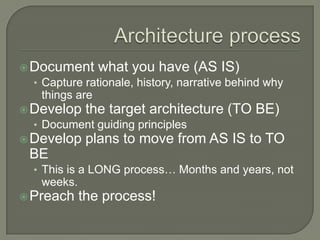
 Document what you have (AS IS)
  • Capture rationale, history, narrative behind why
    things are
 Develop the target architecture (TO BE)
  • Document guiding principles
 Develop plans to move from AS IS to TO
  BE
  • This is a LONG process… Months and years, not
    weeks.
 Preach     the process!
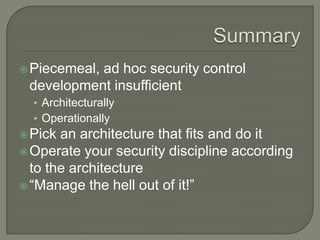
 Piecemeal,
           ad hoc security control
 development insufficient
  • Architecturally
  • Operationally
 Pick an architecture that fits and do it
 Operate your security discipline according
  to the architecture
 “Manage the hell out of it!”
Network Security Architecture

Network Security Architecture

  • 1.
    Or… How industry standardnetwork security models can help achieve better network security without introducing unneeded complexity in your environment
  • 3.
     History of a network… • From initial state to current state  Threats to current state  We still have problems  Why do architecture?  What does it look like?
  • 4.
     Networks were closed  No Internet connection  Risk – relatively low PC Server Laptop
  • 5.
     Let’sget anInternet connection  Mostly outbound connections  eMail/Web browsing Internet PC Server Laptop
  • 6.
     Let’s do business on the web  Web server Internet • Mostly static content  E-Business Web Server PC Server Laptop
  • 7.
     Multi-tieredapplications  Sensitivedata exposed through Internet facing applications Internet Database Web Server Server PC Server Laptop
  • 8.
     Networks are open  Arguably mature set of standards  Web sites integral part of business  Security controls developed as we moved from Closed to Open architectures  Linear development of security controls is not sufficient
  • 9.
     Because we have exposed resources and data to Internet customers multiple attack vectors exist  Proven vulnerabilities in web servers  Can be used as launching point for further attacks • Pivoting
  • 10.
     Wehave usedindividual technological components to address specific needs • PCI problems solved by a WAF?  Throw some firewalls at it  Let’s try an IDS/IPS  Segmentation (PCI)
  • 11.
     Security tendsto be reactive  No structure for security controls • (or undocumented security assumptions/requirements)  Every system has a unique set of controls  Hard to manage • Is the control managed properly? • What are the governing rules for the management of the controls? • Are we in compliance with all of the controls?
  • 12.
     We can’t just throw technology at these problems without proper process and staffing to manage the technology  We can’t throw security point solutions at the problems without considering how they work together and how they impact the production system
  • 13.
     AlignIT SecurityArchitecture with other architectural domains • Must align systems security with network and application security  Align IT Security Architecture with the business requirements • Are we trying to solve a problem that the business doesn’t need? • Security Architecture needs to align with the business risk appetite
  • 14.
     Ensure technicalcontrols function as an integrated system • IDS and vulnerability management integration reduces false positives • Is there alignment between what our tools are telling us • SEIM?  Not so sure without good brains behind it(people)  BIG PICTURE THINKING • One candidate …
  • 16.
    Principles General principles -These principles are the default unless a more specific rule is indicated below Traffic traversing any security zone boundary must traverse an IA control (firewall/proxy/etc). Any traffic traversing any security zone boundary should only allow the ports and protocols necessary for the operations of the particular application. Any traffic traversing any security zone boundary should have source and destination IP address restrictions as narrow in scope as possible to support the operations of the particular application. Exceptions shall be approved by the business and IT. Approval process to be defined. Traffic from a zone with a higher security rating to a zone with a lower security rating shall be allowed. Traffic from a zone with a lower security rating to a zone with a higher security rating shall be denied. Any server providing a public service to clients in the untrusted zone should not be allowed to directly connect back to the untrusted zone. Traffic within specific zones should be as segmented as much as possible to provide separation between applications. Application level security such as Active Directory trust levels should be closely aligned to the network architecture. - No trust levels should be implied because network traffic is either allowed or denied Specific principles Traffic from the untrusted zone(0) to the trusted or restricted zone(100) shall be specifically denied. Traffic from the untrusted zone (0) to the public facing DMZ zone (1-49) shall be allowed. Traffic from the DMZ zone (1-99) to the trusted zone will be allowed after a thorough analysis of the risk and approval by the business and IT. Traffic from the DMZ zone (1-99) to the restricted zone will be specifically denied. Traffic from servers in the trusted zone(100) to the untrusted zone(0) shall be specifically denied. Traffic from clients in the trusted zone(100) to the untrusted zone(0) shall be allowed.
  • 17.
     Document whatyou have (AS IS) • Capture rationale, history, narrative behind why things are  Develop the target architecture (TO BE) • Document guiding principles  Develop plans to move from AS IS to TO BE • This is a LONG process… Months and years, not weeks.  Preach the process!
  • 18.
     Piecemeal, ad hoc security control development insufficient • Architecturally • Operationally  Pick an architecture that fits and do it  Operate your security discipline according to the architecture  “Manage the hell out of it!”

Editor's Notes

  • #5 Networks were introduced to get cost savings from shared resourcesIntroduction of Network ServerInternal business applications (eMail, Calendaring/etc)
  • #6 What does this do for you? Keep real data tucked away deep in the networkDMZ hosts can be sacrificedStatic content didn’t require DMZ hosts to connect in to the network
  • #9 Analogy of house built room by room as the family growsNow always sufficient to the task
  • #10 Analogy of house built room by room as the family growsNow always sufficient to the task
  • #11 Analogy of house built room by room as the family growsNow always sufficient to the task
  • #14 Things like making security zones truly separate… (Not only network controls, but ensuring there are no implied application (AD) trusts)If we harden the networks without hardening the applications and systems, we don’t achieve the objective
  • #15 These are only a few examples…
  • #16 Nothing new. Fairly standard industry model. Requires adaptation