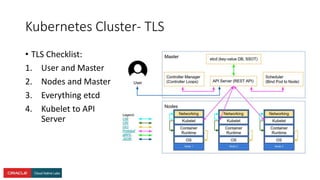
The document presents a comprehensive overview of Kubernetes security challenges and best practices, addressing complexities in container management, deployment, and operations in cloud-native environments. It emphasizes the importance of reducing the attack surface through various techniques, including securing cluster components, managing access controls, and utilizing Kubernetes' built-in security features. Additionally, it highlights open-source tools available for enhancing security, such as kube-bench and clair, while encouraging periodic audits and adherence to best practices.
• I’m KarthikGaekwad
• NOT a DBA
• https://cloudnative.oracle.com/
• Cloud Native evangelist at OCI
• Used to be a developer on the OKE Team.
Hello
@iteration1
3.
Hello
• Been inIndustry 15 years.
• In general, I like building stuff with friends.
• A maintainer for Gauntlt- Open source security scanner.
• Love Teaching and building community.
• Run Devopsdays Austin, Container Days, Cloud Austin.
• Chair All Day Devops Cloud Native track.
• LinkedIn Learning Author for Learning Kubernetes (and more).
4.
Need an OCITrial Account?
http://bitly.com/ocicloud
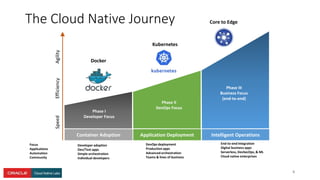
The Cloud NativeJourney
6
Phase I
Developer Focus
Phase II
DevOps Focus
Phase III
Business Focus
(end-to-end)
Container Adoption Application Deployment Intelligent Operations
SpeedEfficiencyAgility
Docker
Kubernetes
Core to Edge
Developer adoption
Dev/Test apps
Simple orchestration
Individual developers
DevOps deployment
Production apps
Advanced orchestration
Teams & lines of business
End-to-end integration
Digital business apps
Serverless, DevSecOps, & ML
Cloud native enterprises
Focus
Applications
Automation
Community
7.
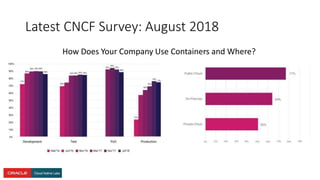
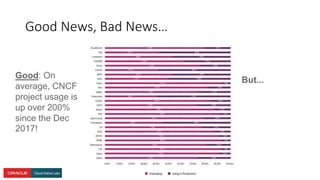
Latest CNCF Survey:August 2018
How Does Your Company Use Containers and Where?
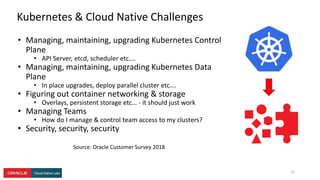
• Managing, maintaining,upgrading Kubernetes Control
Plane
• API Server, etcd, scheduler etc….
• Managing, maintaining, upgrading Kubernetes Data
Plane
• In place upgrades, deploy parallel cluster etc….
• Figuring out container networking & storage
• Overlays, persistent storage etc… - it should just work
• Managing Teams
• How do I manage & control team access to my clusters?
• Security, security, security
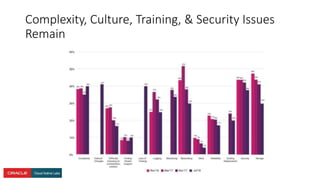
Kubernetes & Cloud Native Challenges
11
Source: Oracle Customer Survey 2018
12.
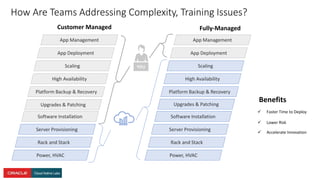
How Are TeamsAddressing Complexity, Training Issues?
App Management
Upgrades & Patching
Platform Backup & Recovery
High Availability
Scaling
App Deployment
Power, HVAC
Rack and Stack
Server Provisioning
Software Installation
Customer Managed Fully-Managed
App Management
Upgrades & Patching
Platform Backup & Recovery
High Availability
Scaling
App Deployment
Power, HVAC
Rack and Stack
Server Provisioning
Software Installation
Faster Time to Deploy
Lower Risk
Accelerate Innovation
Benefits
YOU
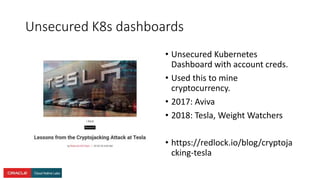
Unsecured K8s dashboards
•Unsecured Kubernetes
Dashboard with account creds.
• Used this to mine
cryptocurrency.
• 2017: Aviva
• 2018: Tesla, Weight Watchers
• https://redlock.io/blog/cryptoja
cking-tesla
16.
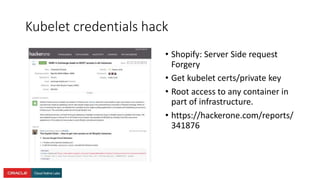
Kubelet credentials hack
•Shopify: Server Side request
Forgery
• Get kubelet certs/private key
• Root access to any container in
part of infrastructure.
• https://hackerone.com/reports/
341876
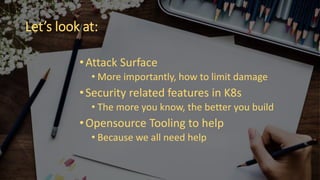
Let’s look at:
•AttackSurface
• More importantly, how to limit damage
•Security related features in K8s
• The more you know, the better you build
•Opensource Tooling to help
• Because we all need help
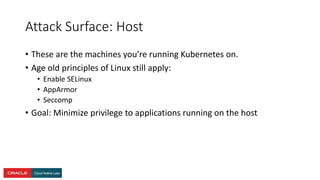
Attack Surface: Host
•These are the machines you’re running Kubernetes on.
• Age old principles of Linux still apply:
• Enable SELinux
• AppArmor
• Seccomp
• Goal: Minimize privilege to applications running on the host
31.
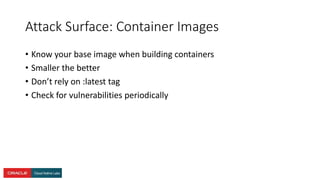
Attack Surface: ContainerImages
• Know your base image when building containers
• Smaller the better
• Don’t rely on :latest tag
• Check for vulnerabilities periodically
Attack Surface: Host
•These are the machines you’re running Kubernetes on.
• Age old principles of Linux still apply:
• Enable SELinux
• AppArmor
• Seccomp
• Hardened Images
• Goal: Minimize privilege to applications running on the host
• Good news: Already a wealth of information on this subject!
• http://lmgtfy.com/?q=how+to+reduce+attack+surface+linux
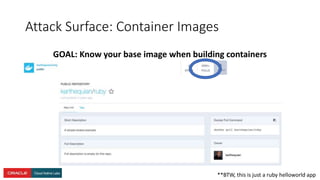
Attack Surface: ContainerImages
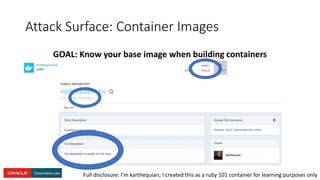
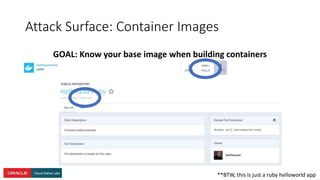
GOAL: Know your base image when building containers
**BTW, this is just a ruby helloworld app
38.
Attack Surface: ContainerImages
GOAL: Know your base image when building containers
**BTW, this is just a ruby helloworld app
39.
Attack Surface: ContainerImages
GOAL: Know your base image when building containers
Full disclosure: I’m karthequian; I created this as a ruby 101 container for learning purposes only
40.
Attack Surface: ContainerImages
GOAL: Know your base image when building containers
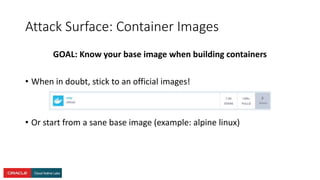
• When in doubt, stick to an official images!
• Or start from a sane base image (example: alpine linux)
41.
Attack Surface: ContainerImages
GOAL: Smaller the image, the better
• Less things for an attacker to exploit.
• Quicker to push, quicker to pull.
42.
Attack Surface: ContainerImages
GOAL: Don’t rely on :latest tag
• :latest image yesterday might not be :latest image tomorrow
• Instead, you’d want to know what specific version you’re operating
with.
• Side benefit: If there is a new vulnerability announced for OS version
x.y.z, you know immediately whether you’re running that version!
43.
Attack Surface: ContainerImages
GOAL: Check for vulnerabilities
periodically
• Plenty of ways to do this in registries. We’ll cover more in the tooling
section
44.
Attack Surface: RunningContainers
GOAL: Don’t run as root
• Containers running as root might be completely unnecessary for the
actual application.
• If compromised, attacker can do a lot more things..
• Pod security policies can help (we’ll see how later).
45.
Attack Surface: RunningContainers
GOAL: Limit host mounts
• Be wary of images that require broad access to paths on the host
• Limit your host mount to a smaller subset of directories
• Reduces blast radius on compromise
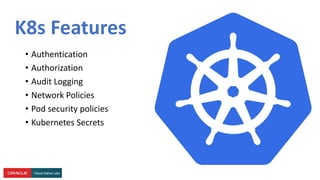
K8s Features
• Authentication
•Authorization
• Audit Logging
• Network Policies
• Pod security policies
• Kubernetes Secrets
54.
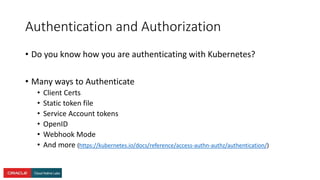
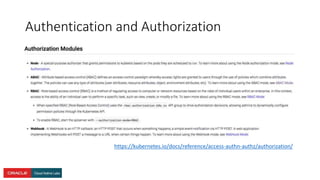
Authentication and Authorization
•Do you know how you are authenticating with Kubernetes?
• Many ways to Authenticate
• Client Certs
• Static token file
• Service Account tokens
• OpenID
• Webhook Mode
• And more (https://kubernetes.io/docs/reference/access-authn-authz/authentication/)
Authentication and Authorization
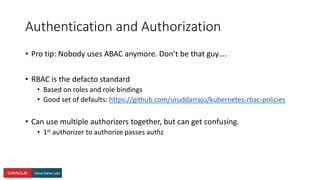
•Pro tip: Nobody uses ABAC anymore. Don’t be that guy….
• RBAC is the defacto standard
• Based on roles and role bindings
• Good set of defaults: https://github.com/uruddarraju/kubernetes-rbac-policies
• Can use multiple authorizers together, but can get confusing.
• 1st authorizer to authorize passes authz
59.
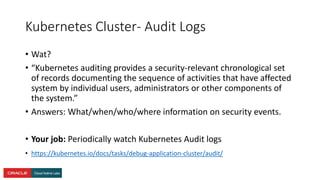
Kubernetes Cluster- AuditLogs
• Wat?
• “Kubernetes auditing provides a security-relevant chronological set
of records documenting the sequence of activities that have affected
system by individual users, administrators or other components of
the system.”
• Answers: What/when/who/where information on security events.
• Your job: Periodically watch Kubernetes Audit logs
• https://kubernetes.io/docs/tasks/debug-application-cluster/audit/
61.
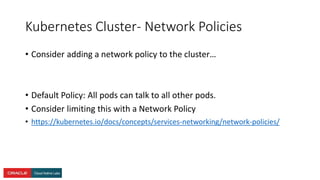
Kubernetes Cluster- NetworkPolicies
• Consider adding a network policy to the cluster…
• Default Policy: All pods can talk to all other pods.
• Consider limiting this with a Network Policy
• https://kubernetes.io/docs/concepts/services-networking/network-policies/
62.
Kubernetes Cluster- PodSecurity Policies
• Consider adding Pod Security policies
• PodSecurityPolicy: A Defined set of conditions a pod must run with.
• Think of this as authorization for pods.
63.
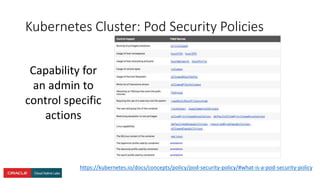
Kubernetes Cluster: PodSecurity Policies
https://kubernetes.io/docs/concepts/policy/pod-security-policy/#what-is-a-pod-security-policy
Capability for
an admin to
control specific
actions
64.
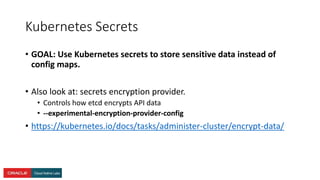
Kubernetes Secrets
• GOAL:Use Kubernetes secrets to store sensitive data instead of
config maps.
• Also look at: secrets encryption provider.
• Controls how etcd encrypts API data
• --experimental-encryption-provider-config
• https://kubernetes.io/docs/tasks/administer-cluster/encrypt-data/
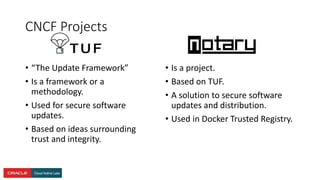
CNCF Projects
• “TheUpdate Framework”
• Is a framework or a
methodology.
• Used for secure software
updates.
• Based on ideas surrounding
trust and integrity.
• Is a project.
• Based on TUF.
• A solution to secure software
updates and distribution.
• Used in Docker Trusted Registry.
68.
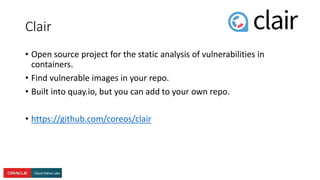
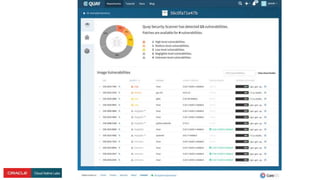
Clair
• Open sourceproject for the static analysis of vulnerabilities in
containers.
• Find vulnerable images in your repo.
• Built into quay.io, but you can add to your own repo.
• https://github.com/coreos/clair
70.
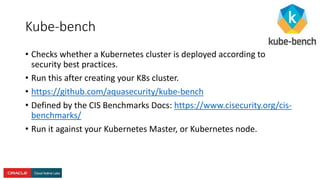
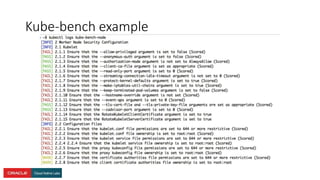
Kube-bench
• Checks whethera Kubernetes cluster is deployed according to
security best practices.
• Run this after creating your K8s cluster.
• https://github.com/aquasecurity/kube-bench
• Defined by the CIS Benchmarks Docs: https://www.cisecurity.org/cis-
benchmarks/
• Run it against your Kubernetes Master, or Kubernetes node.
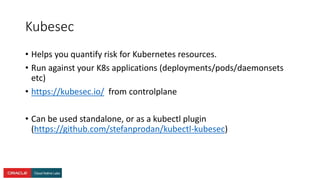
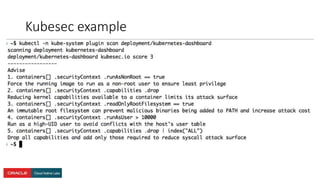
Kubesec
• Helps youquantify risk for Kubernetes resources.
• Run against your K8s applications (deployments/pods/daemonsets
etc)
• https://kubesec.io/ from controlplane
• Can be used standalone, or as a kubectl plugin
(https://github.com/stefanprodan/kubectl-kubesec)
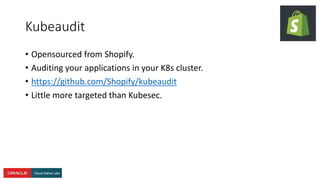
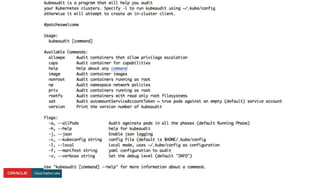
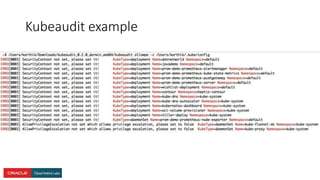
Kubeaudit
• Opensourced fromShopify.
• Auditing your applications in your K8s cluster.
• https://github.com/Shopify/kubeaudit
• Little more targeted than Kubesec.
Couple more resourcesto look at:
• 11 ways not to get hacked:
https://kubernetes.io/blog/2018/07/18/11-ways-not-to-get-hacked
• K8s security (from Image Hygiene to Network Policy):
https://speakerdeck.com/mhausenblas/kubernetes-security-from-
image-hygiene-to-network-policies
#12 However, customers face challenges along the way. As we have spoken to customers, many have agreed with the challenges presented on this slide.
#13 Faster Time to Deploy
No need to provision and maintain Operating System and Platforms (Linux, Kubernetes, Docker Registry, Continuous Integration Systems)
Lower Risk
Oracle is committed to SLAs on Performance and Manageability,in addition to Availability
Accelerate Innovation
Develop new Container Native apps quickly, and port existing apps faster