Introduction to the Gene Ontology
and GO annotation resources
Rachael Huntley
UniProt-GOA
EBI
PAGXX
January 2012
2
Why do we need GO?
Reasons for the Gene Ontology
www.geneontology.org
• Inconsistency in English language
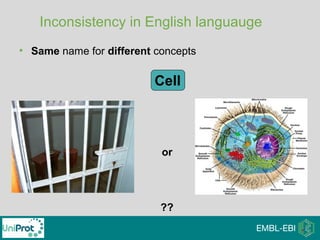
Inconsistency in English languauge
• Same name for different concepts
or
??
Cell
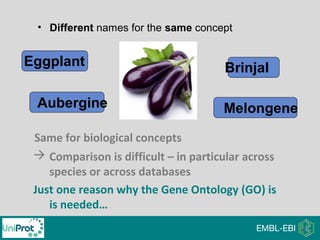
 Comparison is difficult – in particular across
species or across databases
Just one reason why the Gene Ontology (GO) is
is needed…
• Different names for the same concept
Eggplant
Aubergine
Brinjal
Melongene
Same for biological concepts
Reasons for the Gene Ontology
www.geneontology.org
• Inconsistency in English language
• Increasing amounts of biological data available
• Increasing amounts of biological data to come
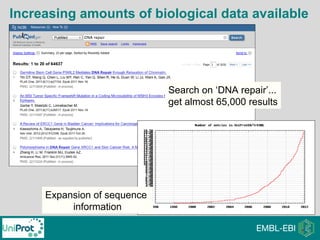
Search on ‘DNA repair’...
get almost 65,000 results
Increasing amounts of biological data available
Expansion of sequence
information
Reasons for the Gene Ontology
www.geneontology.org
• Inconsistency in English language
• Large datasets need to be interpreted quickly
• Increasing amounts of biological data available
• Increasing amounts of biological data to come
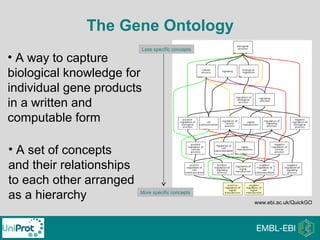
• A way to capture
biological knowledge for
individual gene products
in a written and
computable form
The Gene Ontology
• A set of concepts
and their relationships
to each other arranged
as a hierarchy www.ebi.ac.uk/QuickGO
Less specific concepts
More specific concepts
The Concepts in GO
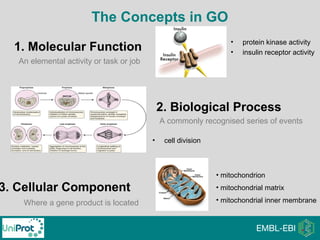
1. Molecular Function
2. Biological Process
3. Cellular Component
An elemental activity or task or job
• protein kinase activity
• insulin receptor activity
A commonly recognised series of events
• cell division
Where a gene product is located
• mitochondrion
• mitochondrial matrix
• mitochondrial inner membrane
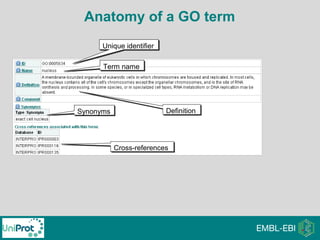
Anatomy of a GO term
Unique identifierUnique identifier
Term nameTerm name
DefinitionDefinitionSynonymsSynonyms
Cross-referencesCross-references
Ontology structure
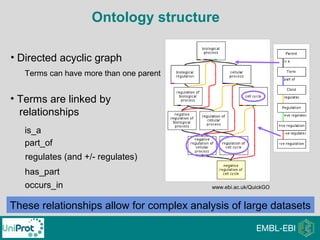
• Directed acyclic graph
Terms can have more than one parent
• Terms are linked by
relationships
is_a
part_of
regulates (and +/- regulates)
www.ebi.ac.uk/QuickGOoccurs_in
has_part
These relationships allow for complex analysis of large datasets
Reactome
http://www.geneontology.org
• Compile the ontologies
- currently over 35,000 terms
- constantly increasing and improving
• Annotate gene products using ontology terms
- around 30 groups provide annotations
• Provide a public resource of data and tools
- regular releases of annotations
- tools for browsing/querying annotations and editing the ontology
Aims of the GO project
GO Annotation
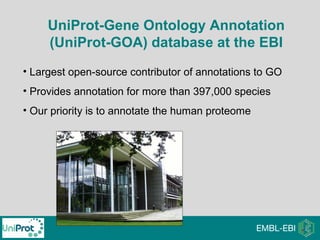
UniProt-Gene Ontology Annotation
(UniProt-GOA) database at the EBI
• Largest open-source contributor of annotations to GO
• Provides annotation for more than 397,000 species
• Our priority is to annotate the human proteome
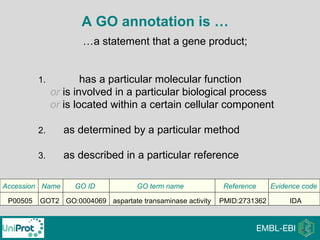
A GO annotation is …
…a statement that a gene product;
1. has a particular molecular function
or is involved in a particular biological process
or is located within a certain cellular component
2. as determined by a particular method
3. as described in a particular reference
P00505
Accession Name GO ID GO term name Reference Evidence code
IDAPMID:2731362aspartate transaminase activityGO:0004069GOT2
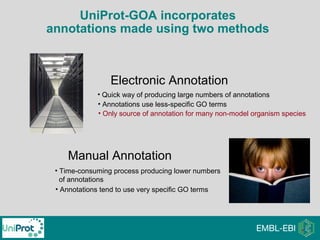
Electronic Annotation
Manual Annotation
UniProt-GOA incorporates
annotations made using two methods
• Quick way of producing large numbers of annotations
• Annotations use less-specific GO terms
• Time-consuming process producing lower numbers
of annotations
• Annotations tend to use very specific GO terms
• Only source of annotation for many non-model organism species
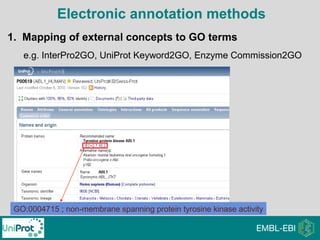
1. Mapping of external concepts to GO terms
e.g. InterPro2GO, UniProt Keyword2GO, Enzyme Commission2GO
Electronic annotation methods
GO:0004715 ; non-membrane spanning protein tyrosine kinase activity
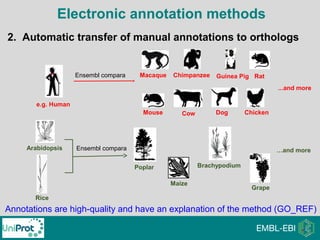
Annotations are high-quality and have an explanation of the method (GO_REF)
Macaque
Mouse DogCow
Guinea PigChimpanzee Rat
Chicken
Ensembl compara
2. Automatic transfer of manual annotations to orthologs
...and more
e.g. Human
Arabidopsis
Rice
Brachypodium
Maize
Poplar
Grape
…and moreEnsembl compara
Electronic annotation methods
Manual annotation by GOA
High–quality, specific annotations made using:
• Full text peer-reviewed papers
• A range of evidence codes to categorise
the types of evidence found in a paper
e.g. IDA, IMP, IPI
http://www.ebi.ac.uk/GOA
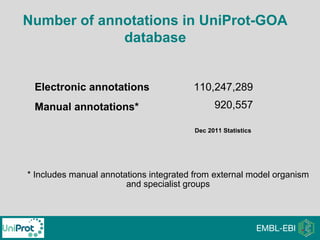
* Includes manual annotations integrated from external model organism
and specialist groups
920,557Manual annotations*
110,247,289Electronic annotations
Dec 2011 Statistics
Number of annotations in UniProt-GOA
database
How to access and use
GO annotation data
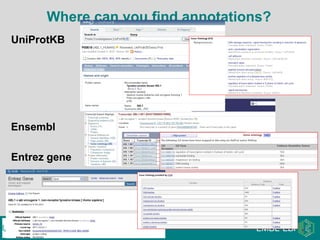
Where can you find annotations?
UniProtKB
Ensembl
Entrez gene
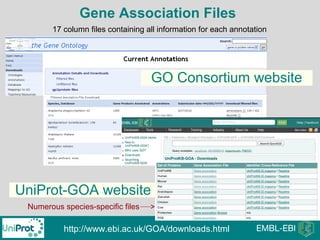
GO Consortium website
Gene Association Files
17 column files containing all information for each annotation
http://www.ebi.ac.uk/GOA/downloads.html
UniProt-GOA website
Numerous species-specific files
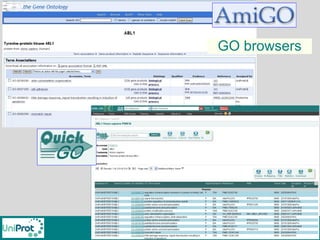
GO browsers
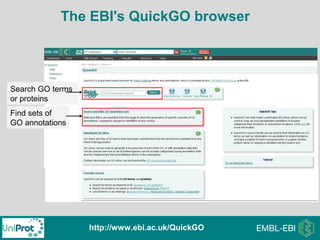
http://www.ebi.ac.uk/QuickGO
The EBI's QuickGO browser
Search GO terms
or proteins
Find sets of
GO annotations
• Access gene product functional information
• Analyse high-throughput genomic or proteomic datasets
• Validation of experimental techniques
• Get a broad overview of a proteome
• Obtain functional information for novel gene products
How scientists use the GO
Some examples…
Term enrichment
• Most popular type of GO analysis
• Determines which GO terms are more often associated
with a specified list of genes/proteins compared with a
control list or rest of genome
• Many tools available to do this analysis
• User must decide which is best for their analysis
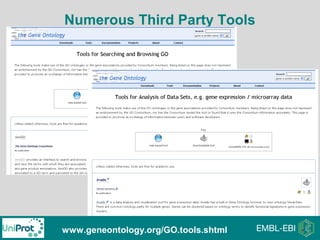
Numerous Third Party Tools
www.geneontology.org/GO.tools.shtml
pears on lw n3d ...
: Set_LW_n3d_5p_...
Colored by: Copy of Copy of C5_RMA (Defa...
Gene List: all genes (14010)
attacked
time
control
Puparial adhesion
Molting cycle
Hemocyanin
Defense response
Immune response
Response to stimulus
Toll regulated genes
JAK-STAT regulated genes
Immune response
Toll regulated genes
Amino acid catabolism
Lipid metobolism
Peptidase activity
Protein catabolism
Immune response
cted Gene Tree: pearson lw n3d ...
ch color classification: Set_LW_n3d_5p_...
Colored by: Copy of Copy of C5_RMA (Defa...
Gene List: all genes (14010)
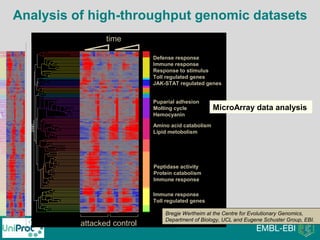
Bregje Wertheim at the Centre for Evolutionary Genomics,
Department of Biology, UCL and Eugene Schuster Group, EBI.
MicroArray data analysis
Analysis of high-throughput genomic datasets
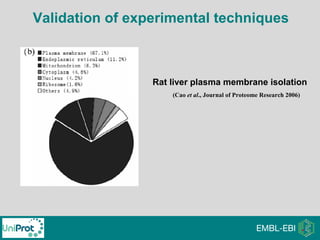
Validation of experimental techniques
(Cao et al., Journal of Proteome Research 2006)
Rat liver plasma membrane isolation
Annotating novel sequences
• Can use BLAST queries to find similar sequences with
GO annotation which can be transferred to the new sequence
• Two tools currently available;
AmiGO BLAST – searches the GO Consortium database
BLAST2GO – searches the NCBI database
Using the GO to provide a functional
overview for a large dataset
• Many GO analysis tools use GO slims to give a broad
overview of the dataset
• GO slims are cut-down versions of the GO and
contain a subset of the terms in the whole GO
• GO slims usually contain less-specialised GO terms
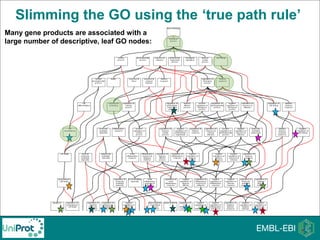
Slimming the GO using the ‘true path rule’
Many gene products are associated with a
large number of descriptive, leaf GO nodes:
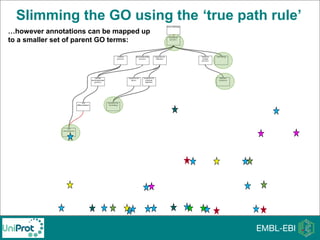
Slimming the GO using the ‘true path rule’
…however annotations can be mapped up
to a smaller set of parent GO terms:
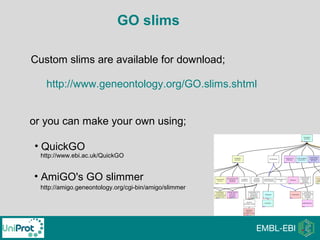
GO slims
or you can make your own using;
Custom slims are available for download;
http://www.geneontology.org/GO.slims.shtml
• AmiGO's GO slimmer
• QuickGO
http://www.ebi.ac.uk/QuickGO
http://amigo.geneontology.org/cgi-bin/amigo/slimmer
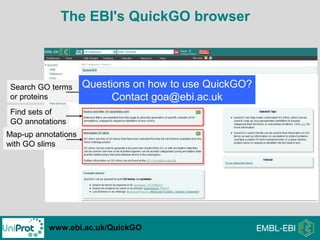
www.ebi.ac.uk/QuickGO
Map-up annotations
with GO slims
The EBI's QuickGO browser
Search GO terms
or proteins
Find sets of
GO annotations
Questions on how to use QuickGO?
Contact goa@ebi.ac.uk
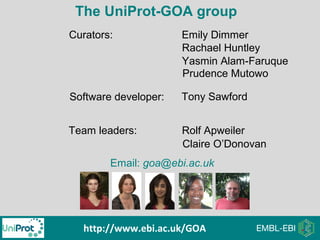
The UniProt-GOA group
Curators:
Software developer:
Team leaders:
Emily Dimmer
Rachael Huntley
Rolf Apweiler
Email: goa@ebi.ac.uk
http://www.ebi.ac.uk/GOA
Claire O’Donovan
Tony Sawford
Yasmin Alam-Faruque
Prudence Mutowo
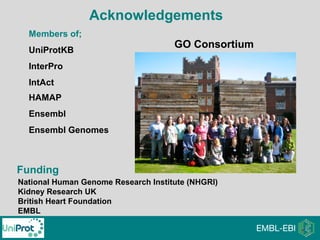
Acknowledgements
GO Consortium
Members of;
UniProtKB
InterPro
IntAct
HAMAP
Ensembl
Ensembl Genomes
Funding
National Human Genome Research Institute (NHGRI)
Kidney Research UK
British Heart Foundation
EMBL

UniProt-GOA

  • 1.
    Introduction to theGene Ontology and GO annotation resources Rachael Huntley UniProt-GOA EBI PAGXX January 2012
  • 2.
    2 Why do weneed GO?
  • 3.
    Reasons for theGene Ontology www.geneontology.org • Inconsistency in English language
  • 4.
    Inconsistency in Englishlanguauge • Same name for different concepts or ?? Cell
  • 5.
     Comparison isdifficult – in particular across species or across databases Just one reason why the Gene Ontology (GO) is is needed… • Different names for the same concept Eggplant Aubergine Brinjal Melongene Same for biological concepts
  • 6.
    Reasons for theGene Ontology www.geneontology.org • Inconsistency in English language • Increasing amounts of biological data available • Increasing amounts of biological data to come
  • 7.
    Search on ‘DNArepair’... get almost 65,000 results Increasing amounts of biological data available Expansion of sequence information
  • 8.
    Reasons for theGene Ontology www.geneontology.org • Inconsistency in English language • Large datasets need to be interpreted quickly • Increasing amounts of biological data available • Increasing amounts of biological data to come
  • 9.
    • A wayto capture biological knowledge for individual gene products in a written and computable form The Gene Ontology • A set of concepts and their relationships to each other arranged as a hierarchy www.ebi.ac.uk/QuickGO Less specific concepts More specific concepts
  • 10.
    The Concepts inGO 1. Molecular Function 2. Biological Process 3. Cellular Component An elemental activity or task or job • protein kinase activity • insulin receptor activity A commonly recognised series of events • cell division Where a gene product is located • mitochondrion • mitochondrial matrix • mitochondrial inner membrane
  • 11.
    Anatomy of aGO term Unique identifierUnique identifier Term nameTerm name DefinitionDefinitionSynonymsSynonyms Cross-referencesCross-references
  • 12.
    Ontology structure • Directedacyclic graph Terms can have more than one parent • Terms are linked by relationships is_a part_of regulates (and +/- regulates) www.ebi.ac.uk/QuickGOoccurs_in has_part These relationships allow for complex analysis of large datasets
  • 13.
  • 14.
    • Compile theontologies - currently over 35,000 terms - constantly increasing and improving • Annotate gene products using ontology terms - around 30 groups provide annotations • Provide a public resource of data and tools - regular releases of annotations - tools for browsing/querying annotations and editing the ontology Aims of the GO project
  • 15.
  • 16.
    UniProt-Gene Ontology Annotation (UniProt-GOA)database at the EBI • Largest open-source contributor of annotations to GO • Provides annotation for more than 397,000 species • Our priority is to annotate the human proteome
  • 17.
    A GO annotationis … …a statement that a gene product; 1. has a particular molecular function or is involved in a particular biological process or is located within a certain cellular component 2. as determined by a particular method 3. as described in a particular reference P00505 Accession Name GO ID GO term name Reference Evidence code IDAPMID:2731362aspartate transaminase activityGO:0004069GOT2
  • 18.
    Electronic Annotation Manual Annotation UniProt-GOAincorporates annotations made using two methods • Quick way of producing large numbers of annotations • Annotations use less-specific GO terms • Time-consuming process producing lower numbers of annotations • Annotations tend to use very specific GO terms • Only source of annotation for many non-model organism species
  • 19.
    1. Mapping ofexternal concepts to GO terms e.g. InterPro2GO, UniProt Keyword2GO, Enzyme Commission2GO Electronic annotation methods GO:0004715 ; non-membrane spanning protein tyrosine kinase activity
  • 20.
    Annotations are high-qualityand have an explanation of the method (GO_REF) Macaque Mouse DogCow Guinea PigChimpanzee Rat Chicken Ensembl compara 2. Automatic transfer of manual annotations to orthologs ...and more e.g. Human Arabidopsis Rice Brachypodium Maize Poplar Grape …and moreEnsembl compara Electronic annotation methods
  • 21.
    Manual annotation byGOA High–quality, specific annotations made using: • Full text peer-reviewed papers • A range of evidence codes to categorise the types of evidence found in a paper e.g. IDA, IMP, IPI http://www.ebi.ac.uk/GOA
  • 22.
    * Includes manualannotations integrated from external model organism and specialist groups 920,557Manual annotations* 110,247,289Electronic annotations Dec 2011 Statistics Number of annotations in UniProt-GOA database
  • 23.
    How to accessand use GO annotation data
  • 24.
    Where can youfind annotations? UniProtKB Ensembl Entrez gene
  • 25.
    GO Consortium website GeneAssociation Files 17 column files containing all information for each annotation http://www.ebi.ac.uk/GOA/downloads.html UniProt-GOA website Numerous species-specific files
  • 26.
  • 27.
    http://www.ebi.ac.uk/QuickGO The EBI's QuickGObrowser Search GO terms or proteins Find sets of GO annotations
  • 28.
    • Access geneproduct functional information • Analyse high-throughput genomic or proteomic datasets • Validation of experimental techniques • Get a broad overview of a proteome • Obtain functional information for novel gene products How scientists use the GO Some examples…
  • 29.
    Term enrichment • Mostpopular type of GO analysis • Determines which GO terms are more often associated with a specified list of genes/proteins compared with a control list or rest of genome • Many tools available to do this analysis • User must decide which is best for their analysis
  • 30.
    Numerous Third PartyTools www.geneontology.org/GO.tools.shtml
  • 31.
    pears on lwn3d ... : Set_LW_n3d_5p_... Colored by: Copy of Copy of C5_RMA (Defa... Gene List: all genes (14010) attacked time control Puparial adhesion Molting cycle Hemocyanin Defense response Immune response Response to stimulus Toll regulated genes JAK-STAT regulated genes Immune response Toll regulated genes Amino acid catabolism Lipid metobolism Peptidase activity Protein catabolism Immune response cted Gene Tree: pearson lw n3d ... ch color classification: Set_LW_n3d_5p_... Colored by: Copy of Copy of C5_RMA (Defa... Gene List: all genes (14010) Bregje Wertheim at the Centre for Evolutionary Genomics, Department of Biology, UCL and Eugene Schuster Group, EBI. MicroArray data analysis Analysis of high-throughput genomic datasets
  • 32.
    Validation of experimentaltechniques (Cao et al., Journal of Proteome Research 2006) Rat liver plasma membrane isolation
  • 33.
    Annotating novel sequences •Can use BLAST queries to find similar sequences with GO annotation which can be transferred to the new sequence • Two tools currently available; AmiGO BLAST – searches the GO Consortium database BLAST2GO – searches the NCBI database
  • 34.
    Using the GOto provide a functional overview for a large dataset • Many GO analysis tools use GO slims to give a broad overview of the dataset • GO slims are cut-down versions of the GO and contain a subset of the terms in the whole GO • GO slims usually contain less-specialised GO terms
  • 35.
    Slimming the GOusing the ‘true path rule’ Many gene products are associated with a large number of descriptive, leaf GO nodes:
  • 36.
    Slimming the GOusing the ‘true path rule’ …however annotations can be mapped up to a smaller set of parent GO terms:
  • 37.
    GO slims or youcan make your own using; Custom slims are available for download; http://www.geneontology.org/GO.slims.shtml • AmiGO's GO slimmer • QuickGO http://www.ebi.ac.uk/QuickGO http://amigo.geneontology.org/cgi-bin/amigo/slimmer
  • 38.
    www.ebi.ac.uk/QuickGO Map-up annotations with GOslims The EBI's QuickGO browser Search GO terms or proteins Find sets of GO annotations Questions on how to use QuickGO? Contact goa@ebi.ac.uk
  • 39.
    The UniProt-GOA group Curators: Softwaredeveloper: Team leaders: Emily Dimmer Rachael Huntley Rolf Apweiler Email: goa@ebi.ac.uk http://www.ebi.ac.uk/GOA Claire O’Donovan Tony Sawford Yasmin Alam-Faruque Prudence Mutowo
  • 40.
    Acknowledgements GO Consortium Members of; UniProtKB InterPro IntAct HAMAP Ensembl EnsemblGenomes Funding National Human Genome Research Institute (NHGRI) Kidney Research UK British Heart Foundation EMBL

Editor's Notes

  • #5 The English language is not precise
  • #21 Electronic annotations are important for non-model species as these do not have a dedicated manual annotation effort
  • #32 Genes differentially expressed during parasitoid attack versus control