Vega and Community Manual
Annotation
Jane Loveland
Havana group, Wellcome Trust Sanger Institute,
Hinxton, Cambridge, UK
PhotobyMajBrittHansen
PAG XX, 15th January 2012
Havana: Human and vertebrate analysis and
annotation
•  Manual annotation of human, mouse and zebrafish
whole chromosomes or genomes
•  Human ENCODE, mouse EUCOMM annotation
•  Annotation of specific regions: human MHC & LRC
haplotypes, multiple species MHCs & LRCs,
Vega: Vertebrate Genome Annotation
•  Ensembl derived browser focusing on manual
annotation
Overview
•  Manual annotation process: tools/pipeline/
access of data (VEGA)
•  Community Manual Annotation –
Mouse (KOMP and NorCOMM)
Swine autosomes (IRAG)
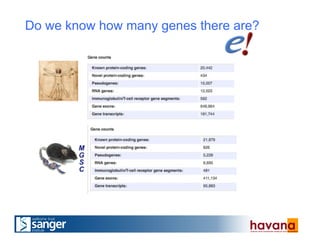
Do we know how many genes there are?
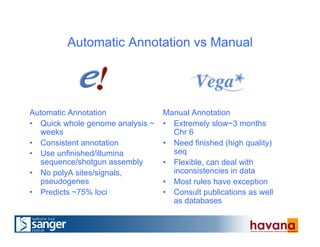
Automatic Annotation vs Manual
Automatic Annotation
•  Quick whole genome analysis ~
weeks
•  Consistent annotation
•  Use unfinished/illumina
sequence/shotgun assembly
•  No polyA sites/signals,
pseudogenes
•  Predicts ~75% loci
Manual Annotation
•  Extremely slow~3 months
Chr 6
•  Need finished (high quality)
seq
•  Flexible, can deal with
inconsistencies in data
•  Most rules have exception
•  Consult publications as well
as databases
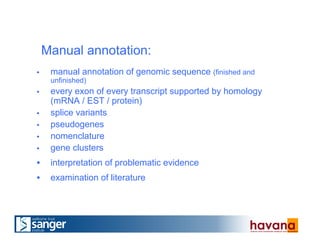
•  manual annotation of genomic sequence (finished and
unfinished)
•  every exon of every transcript supported by homology
(mRNA / EST / protein)
•  splice variants
•  pseudogenes
•  nomenclature
•  gene clusters
•  interpretation of problematic evidence
•  examination of literature
Manual annotation:
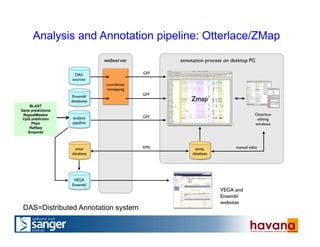
DAS=Distributed Annotation system
Analysis and Annotation pipeline: Otterlace/ZMap
BLAST
Gene predictions
RepeatMasker
CpG prediction
Pfam
RefSeq
Ensembl
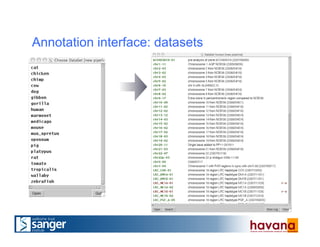
Annotation interface: datasets
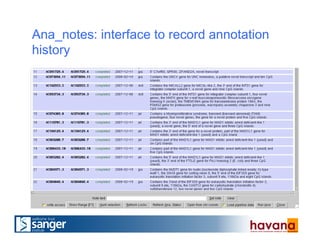
Ana_notes: interface to record annotation
history
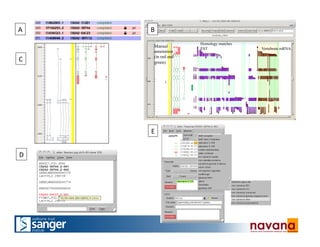
A	
  
C	
  
B	
  
D	
  
E	
  
Homology matches
EST Vertebrate mRNA
Manual
annotation
(in red and
green)
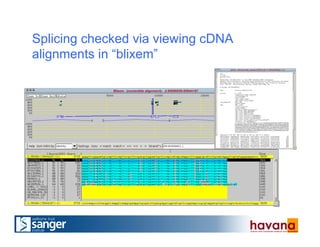
Splicing checked via viewing cDNA
alignments in “blixem”
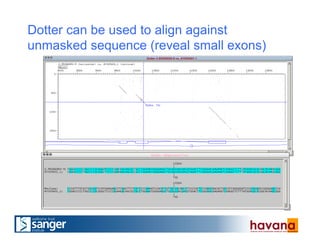
Dotter can be used to align against
unmasked sequence (reveal small exons)
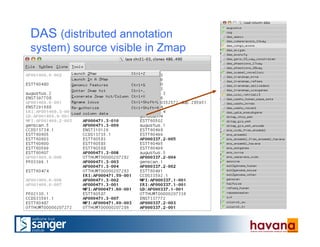
DAS (distributed annotation
system) source visible in Zmap
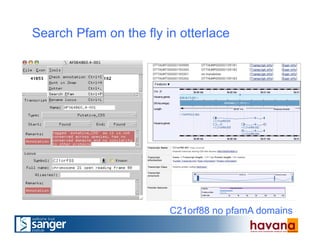
Search Pfam on the fly in otterlace
C21orf88 no pfamA domains
AAAAA
cDNAs
ESTs
Genomic sequence
Protein
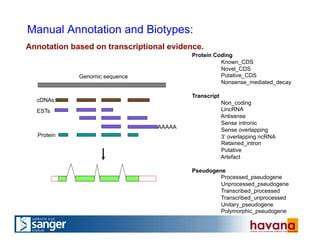
Annotation based on transcriptional evidence.
Manual Annotation and Biotypes:
Protein Coding
Known_CDS
Novel_CDS
Putative_CDS
Nonsense_mediated_decay
Transcript
Non_coding
LincRNA
Antisense
Sense intronic
Sense overlapping
3’ overlapping ncRNA
Retained_intron
Putative
Artefact
Pseudogene
Processed_pseudogene
Unprocessed_pseudogene
Transcribed_processed
Transcribed_unprocessed
Unitary_pseudogene
Polymorphic_pseudogene
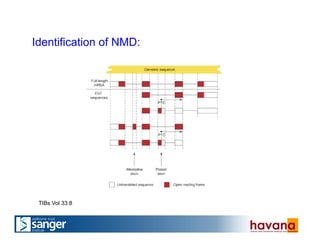
Identification of NMD:
TIBs Vol 33:8
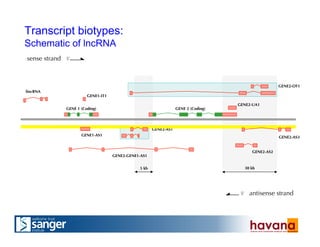
GENE2-AS1
GENE2-UA1
GENE2-OT1
5 kb 30 kb
GENE1-IT1
GENE 1 (Coding) GENE 2 (Coding)
GENE1-AS1
GENE2-AS2
GENE2-AS3
antisense strand
lincRNA
GENE2-GENE1-AS1
sense strand 5’
5’
Transcript biotypes:
Schematic of lncRNA
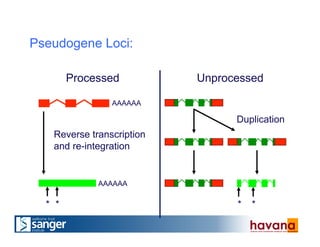
Pseudogene Loci:
Unprocessed
Duplication
Reverse transcription
and re-integration
AAAAAA
Processed
AAAAAA
* * **
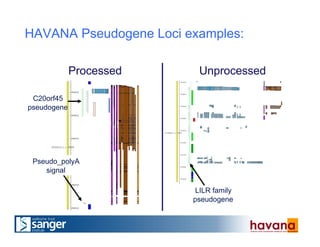
HAVANA Pseudogene Loci examples:
UnprocessedProcessed
C20orf45
pseudogene
LILR family
pseudogene
Pseudo_polyA
signal
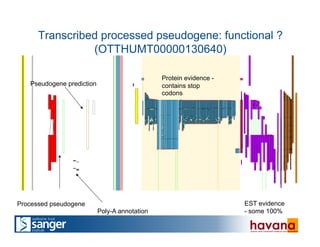
Transcribed processed pseudogene: functional ?
(OTTHUMT00000130640)!
Processed pseudogene
Poly-A annotation
EST evidence
- some 100%
Protein evidence -
contains stop
codons
Pseudogene prediction
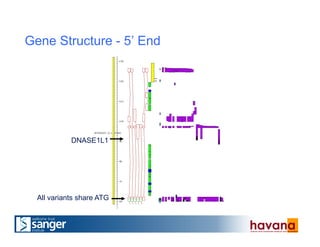
Gene Structure - 5’ End
DNASE1L1
All variants share ATG
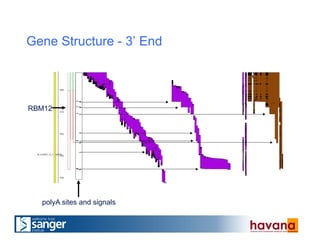
Gene Structure - 3’ End
polyA sites and signals
RBM12
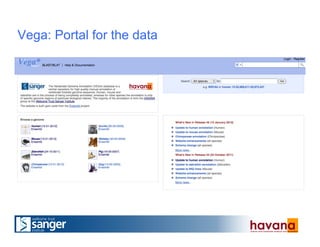
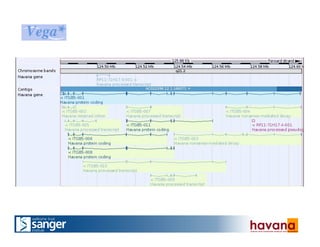
Vega: Portal for the data
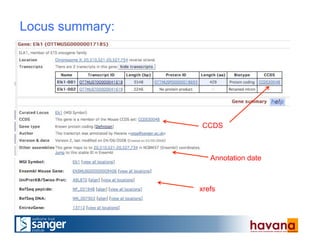
Locus summary:
CCDS
Annotation date
xrefs
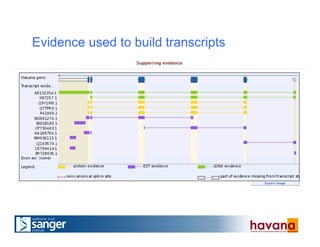
Evidence used to build transcripts
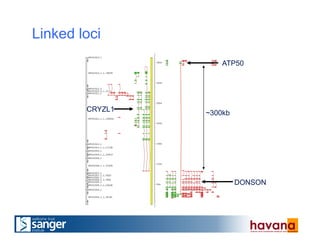
Linked loci
ATP50
DONSON
CRYZL1
~300kb
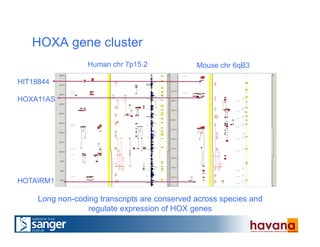
HOXA gene cluster
Human chr 7p15.2 Mouse chr 6qB3
HIT18844
HOXA11AS
HOTAIRM1
Long non-coding transcripts are conserved across species and
regulate expression of HOX genes
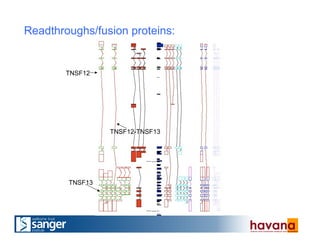
TNSF12
TNSF13
TNSF12-TNSF13
Readthroughs/fusion proteins:
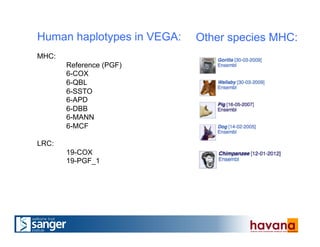
Human haplotypes in VEGA:
MHC:
Reference (PGF)
6-COX
6-QBL
6-SSTO
6-APD
6-DBB
6-MANN
6-MCF
LRC:
19-COX
19-PGF_1
Other species MHC:
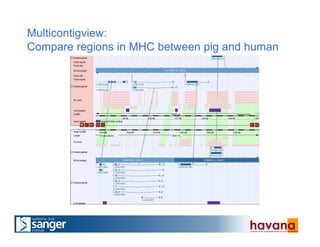
Multicontigview:
Compare regions in MHC between pig and human
Community Annotation:
• Otterlace/Zmap software available for Mac and Linux
• Part of IKMC with EUCOMM annotation in mouse:
• KOMP and NorCOMM annotation
• Jamborees for species with strong community interest:
• Xenopus tropicalis 2005 (cDNA)
• Cow 2007 (Genomic WGS) Publication
• Pig
• 2008 (Genomic WGS)
• 2010 - 2012
• IR genes in Pig (~2000 genes) manually annotated by community
• Chromosomes X and Y to be fully finished and annotated by Havana
Community Annotation Approaches:
The value of a genome is only as good as its annotation
Otterlace/Zmap Annotation Software: Anacode team
Authentication:
Sanger single sign-on account (email)
Registered email for otterlace permitted users:
Access to our data and and analysis pipeline
“Blessed Annotator”
Mouse KOMP and NorCOMM (part of IKMC)
External annotators (3) trained from Wash U and U Manitoba
Identifying critical exons to make knock-out constructs
6 months of training and QC – Integrated into mouse gene build
“Gatekeeper”
Swine autosomes
External annotators worldwide (~30)
Short training for European and US groups, plus regular calls and WebEx
Guidance and QC by WTSI
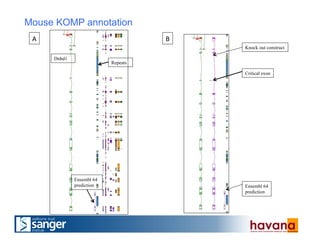
Dnhd1
Ensembl 64
prediction
Repeats
Knock out construct
Critical exon
Ensembl 64
prediction
A	
   B	
  
Mouse KOMP annotation
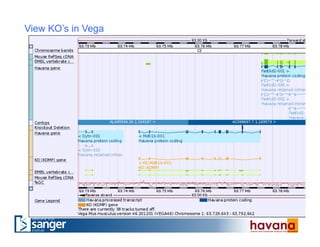
View KO’s in Vega
Swine Immune Response Annotation Group (IRAG)
Chris Tuggle (Iowa State), Claire Rogel-Gaillard (INRA)
USA: Iowa State China: Huazong Agricultural University
USDA
Michigan State Europe: INRA
Univ Minnesota Parco Tecnologico Padano
Oaklahoma State Roslin
Kansas State UCL
WTSI
Japan: AFFRC
STAFF ~30 annotators!
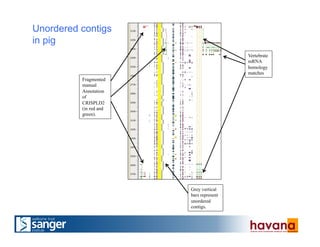
Unordered contigs
in pig
Fragmented
manual
Annotation
of
CRISPLD2
(in red and
green).
Grey vertical
bars represent
unordered
contigs.
Vertebrate
mRNA
homology
matches
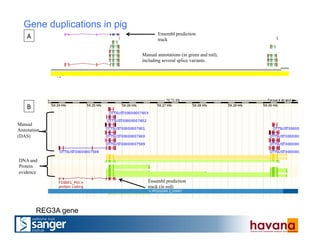
A	
  
B	
  
Manual annotations (in green and red),
including several splice variants.
Ensembl prediction
track
Ensembl prediction
track (in red)
DNA and
Protein
evidence	
  
Manual
Annotation
(DAS)
Gene duplications in pig
REG3A gene
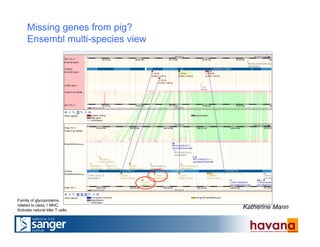
Missing genes from pig?
Ensembl multi-species view
Family of glycoproteins,
related to class 1 MHC.
Activate natural kller T cells
Katherine Mann
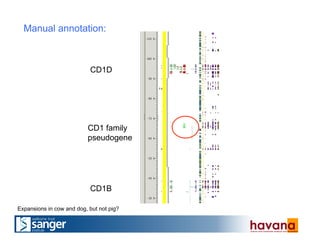
CD1D
CD1B
CD1 family
pseudogene
Manual annotation:
Expansions in cow and dog, but not pig?
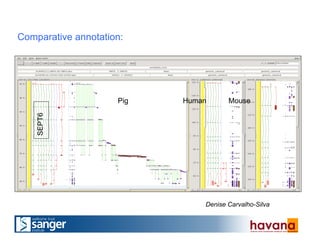
Comparative annotation:SEPT6
Pig Human Mouse
Denise Carvalho-Silva
Community Annotation: Summary
“Blessed Annotator”:
Extended training means less QC
Wide range of biotypes
Annotation figures: KOMP 1876 genes, NorCOMM 378 genes
“Gatekeeper”:
Shorter training means more QC
Annotation figures: Pig IRAG 1276 genes
Lessons Learned:
QC
How to maintain quality with diverse annotation expertise
Training
Essential, plus regular updates (WebEx)
Nomenclature
Swine Nomenclature Committee
What next:
Merge the IRAG manual annotation with the automated Ensembl annotation:
~ 8% of genome
Extend annotation / collaboration:
Refined gene list for IRAG
QC: Complex and partial genes
Publications
Acknowledgements
Havana:
Jen Harrow
If Barnes
Ruth Bennett
Alex Bignell
Veronika Boychenko
Gloria Despacio-Reyes
Sarah Donaldson
Adam Frankish
Matthew Hardy
Toby Hunt
Mike Kay
Gavin Laird
David Lloyd
Jane Loveland
Deepa Manthravadi
Gaurab Mukherjee
Jonathan Mudge
Jeena Rajan
Liam Redgrave
Gary Saunders
Catherine Snow
Charles Steward
Marie-Marthe Suner
Mark Thomas
Laurens Wilming
Anacode:
James Gilbert
Matthew Astley
Michael Gray
Jeremy Henty
Vega:
Stephen Trevanion
Maurice Hendrix
Zmap:
Ed Griffiths
Gemma Barson
Malcolm Hinsley
Mouse annotation:
KOMP:
Amy Horton
NorCOMM:
Molly Pind
http://vega.sanger.ac.uk
IRAG annotators:
USA:
Jim Reecy
Chris Tuggle
Daniel Berman
Frank Blecha
Ryan Chen
Celine Chen
Daniel Ciobanu
Harry Dawson
Cathy Earnst
Zhiliang Hu
Joan Lunney
Katherine Mann
Michael Murtaugh
Yongming Sang
John Schwartz
China:
Shuhong Zhao
Japan:
Hirohide Huenishi
Takeya Morozumi
Hiroke Sinkai
Diasuke Toki
Europe:
Alan Archibald
Claire Rogel-Gaillard
Anna Anselmo
Bouabid Badauoi
Betrand Bed’Hom
Dario Beraldi
Lynsey Fairbairn
Elisabetta Giuffra
David Hume
Ronan Kapetanovich
Dennis Prickett
Christelle Robert
Yasu Takeuchi
The Vertebrate Genome Annotation Database

The Vertebrate Genome Annotation Database

  • 1.
    Vega and CommunityManual Annotation Jane Loveland Havana group, Wellcome Trust Sanger Institute, Hinxton, Cambridge, UK PhotobyMajBrittHansen PAG XX, 15th January 2012
  • 2.
    Havana: Human andvertebrate analysis and annotation •  Manual annotation of human, mouse and zebrafish whole chromosomes or genomes •  Human ENCODE, mouse EUCOMM annotation •  Annotation of specific regions: human MHC & LRC haplotypes, multiple species MHCs & LRCs, Vega: Vertebrate Genome Annotation •  Ensembl derived browser focusing on manual annotation
  • 3.
    Overview •  Manual annotationprocess: tools/pipeline/ access of data (VEGA) •  Community Manual Annotation – Mouse (KOMP and NorCOMM) Swine autosomes (IRAG)
  • 4.
    Do we knowhow many genes there are?
  • 5.
    Automatic Annotation vsManual Automatic Annotation •  Quick whole genome analysis ~ weeks •  Consistent annotation •  Use unfinished/illumina sequence/shotgun assembly •  No polyA sites/signals, pseudogenes •  Predicts ~75% loci Manual Annotation •  Extremely slow~3 months Chr 6 •  Need finished (high quality) seq •  Flexible, can deal with inconsistencies in data •  Most rules have exception •  Consult publications as well as databases
  • 6.
    •  manual annotationof genomic sequence (finished and unfinished) •  every exon of every transcript supported by homology (mRNA / EST / protein) •  splice variants •  pseudogenes •  nomenclature •  gene clusters •  interpretation of problematic evidence •  examination of literature Manual annotation:
  • 7.
    DAS=Distributed Annotation system Analysisand Annotation pipeline: Otterlace/ZMap BLAST Gene predictions RepeatMasker CpG prediction Pfam RefSeq Ensembl
  • 8.
  • 9.
    Ana_notes: interface torecord annotation history
  • 10.
    A   C   B   D   E   Homology matches EST Vertebrate mRNA Manual annotation (in red and green)
  • 11.
    Splicing checked viaviewing cDNA alignments in “blixem”
  • 12.
    Dotter can beused to align against unmasked sequence (reveal small exons)
  • 13.
  • 14.
    Search Pfam onthe fly in otterlace C21orf88 no pfamA domains
  • 15.
    AAAAA cDNAs ESTs Genomic sequence Protein Annotation basedon transcriptional evidence. Manual Annotation and Biotypes: Protein Coding Known_CDS Novel_CDS Putative_CDS Nonsense_mediated_decay Transcript Non_coding LincRNA Antisense Sense intronic Sense overlapping 3’ overlapping ncRNA Retained_intron Putative Artefact Pseudogene Processed_pseudogene Unprocessed_pseudogene Transcribed_processed Transcribed_unprocessed Unitary_pseudogene Polymorphic_pseudogene
  • 16.
  • 17.
    GENE2-AS1 GENE2-UA1 GENE2-OT1 5 kb 30kb GENE1-IT1 GENE 1 (Coding) GENE 2 (Coding) GENE1-AS1 GENE2-AS2 GENE2-AS3 antisense strand lincRNA GENE2-GENE1-AS1 sense strand 5’ 5’ Transcript biotypes: Schematic of lncRNA
  • 18.
    Pseudogene Loci: Unprocessed Duplication Reverse transcription andre-integration AAAAAA Processed AAAAAA * * **
  • 19.
    HAVANA Pseudogene Lociexamples: UnprocessedProcessed C20orf45 pseudogene LILR family pseudogene Pseudo_polyA signal
  • 20.
    Transcribed processed pseudogene:functional ? (OTTHUMT00000130640)! Processed pseudogene Poly-A annotation EST evidence - some 100% Protein evidence - contains stop codons Pseudogene prediction
  • 21.
    Gene Structure -5’ End DNASE1L1 All variants share ATG
  • 22.
    Gene Structure -3’ End polyA sites and signals RBM12
  • 23.
  • 25.
  • 26.
    Evidence used tobuild transcripts
  • 27.
  • 28.
    HOXA gene cluster Humanchr 7p15.2 Mouse chr 6qB3 HIT18844 HOXA11AS HOTAIRM1 Long non-coding transcripts are conserved across species and regulate expression of HOX genes
  • 29.
  • 30.
    Human haplotypes inVEGA: MHC: Reference (PGF) 6-COX 6-QBL 6-SSTO 6-APD 6-DBB 6-MANN 6-MCF LRC: 19-COX 19-PGF_1 Other species MHC:
  • 31.
    Multicontigview: Compare regions inMHC between pig and human
  • 32.
    Community Annotation: • Otterlace/Zmap softwareavailable for Mac and Linux • Part of IKMC with EUCOMM annotation in mouse: • KOMP and NorCOMM annotation • Jamborees for species with strong community interest: • Xenopus tropicalis 2005 (cDNA) • Cow 2007 (Genomic WGS) Publication • Pig • 2008 (Genomic WGS) • 2010 - 2012 • IR genes in Pig (~2000 genes) manually annotated by community • Chromosomes X and Y to be fully finished and annotated by Havana
  • 33.
    Community Annotation Approaches: Thevalue of a genome is only as good as its annotation Otterlace/Zmap Annotation Software: Anacode team Authentication: Sanger single sign-on account (email) Registered email for otterlace permitted users: Access to our data and and analysis pipeline “Blessed Annotator” Mouse KOMP and NorCOMM (part of IKMC) External annotators (3) trained from Wash U and U Manitoba Identifying critical exons to make knock-out constructs 6 months of training and QC – Integrated into mouse gene build “Gatekeeper” Swine autosomes External annotators worldwide (~30) Short training for European and US groups, plus regular calls and WebEx Guidance and QC by WTSI
  • 34.
    Dnhd1 Ensembl 64 prediction Repeats Knock outconstruct Critical exon Ensembl 64 prediction A   B   Mouse KOMP annotation
  • 35.
  • 36.
    Swine Immune ResponseAnnotation Group (IRAG) Chris Tuggle (Iowa State), Claire Rogel-Gaillard (INRA) USA: Iowa State China: Huazong Agricultural University USDA Michigan State Europe: INRA Univ Minnesota Parco Tecnologico Padano Oaklahoma State Roslin Kansas State UCL WTSI Japan: AFFRC STAFF ~30 annotators!
  • 37.
    Unordered contigs in pig Fragmented manual Annotation of CRISPLD2 (inred and green). Grey vertical bars represent unordered contigs. Vertebrate mRNA homology matches
  • 38.
    A   B   Manualannotations (in green and red), including several splice variants. Ensembl prediction track Ensembl prediction track (in red) DNA and Protein evidence   Manual Annotation (DAS) Gene duplications in pig REG3A gene
  • 39.
    Missing genes frompig? Ensembl multi-species view Family of glycoproteins, related to class 1 MHC. Activate natural kller T cells Katherine Mann
  • 40.
  • 41.
    Comparative annotation:SEPT6 Pig HumanMouse Denise Carvalho-Silva
  • 42.
    Community Annotation: Summary “BlessedAnnotator”: Extended training means less QC Wide range of biotypes Annotation figures: KOMP 1876 genes, NorCOMM 378 genes “Gatekeeper”: Shorter training means more QC Annotation figures: Pig IRAG 1276 genes
  • 43.
    Lessons Learned: QC How tomaintain quality with diverse annotation expertise Training Essential, plus regular updates (WebEx) Nomenclature Swine Nomenclature Committee What next: Merge the IRAG manual annotation with the automated Ensembl annotation: ~ 8% of genome Extend annotation / collaboration: Refined gene list for IRAG QC: Complex and partial genes Publications
  • 44.
    Acknowledgements Havana: Jen Harrow If Barnes RuthBennett Alex Bignell Veronika Boychenko Gloria Despacio-Reyes Sarah Donaldson Adam Frankish Matthew Hardy Toby Hunt Mike Kay Gavin Laird David Lloyd Jane Loveland Deepa Manthravadi Gaurab Mukherjee Jonathan Mudge Jeena Rajan Liam Redgrave Gary Saunders Catherine Snow Charles Steward Marie-Marthe Suner Mark Thomas Laurens Wilming Anacode: James Gilbert Matthew Astley Michael Gray Jeremy Henty Vega: Stephen Trevanion Maurice Hendrix Zmap: Ed Griffiths Gemma Barson Malcolm Hinsley Mouse annotation: KOMP: Amy Horton NorCOMM: Molly Pind http://vega.sanger.ac.uk IRAG annotators: USA: Jim Reecy Chris Tuggle Daniel Berman Frank Blecha Ryan Chen Celine Chen Daniel Ciobanu Harry Dawson Cathy Earnst Zhiliang Hu Joan Lunney Katherine Mann Michael Murtaugh Yongming Sang John Schwartz China: Shuhong Zhao Japan: Hirohide Huenishi Takeya Morozumi Hiroke Sinkai Diasuke Toki Europe: Alan Archibald Claire Rogel-Gaillard Anna Anselmo Bouabid Badauoi Betrand Bed’Hom Dario Beraldi Lynsey Fairbairn Elisabetta Giuffra David Hume Ronan Kapetanovich Dennis Prickett Christelle Robert Yasu Takeuchi