
Computing on the shoulders
of giants:
how existing knowledge is represented
and applied in bioinformatics
Benjamin Good
bgood@scripps.edu
Assistant Professor of the Department of
Molecular and Experimental Medicine
Specialty: artificial intelligence, crowdsourcing
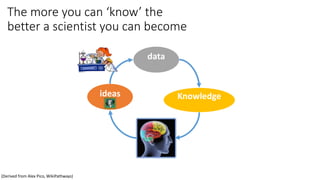
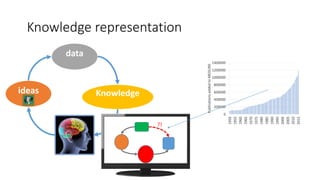
The more you can ‘know’ the
better a scientist you can become
(Derived from Alex Pico, WikiPathways)
ideas Knowledge
data
Too much to know
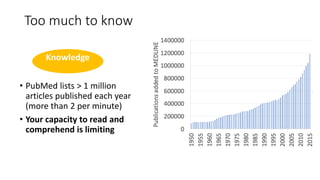
• PubMed lists > 1 million
articles published each year
(more than 2 per minute)
• Your capacity to read and
comprehend is limiting
Knowledge
Knowledge representation
ideas Knowledge
data
?!
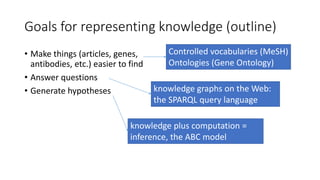
Goals for representing knowledge (outline)
• Make things (articles, genes,
antibodies, etc.) easier to find
• Answer questions
• Generate hypotheses
Controlled vocabularies (MeSH)
Ontologies (Gene Ontology)
knowledge graphs on the Web:
the SPARQL query language
knowledge plus computation =
inference, the ABC model
Part 1:
Medical Subject Headings
(MeSH)
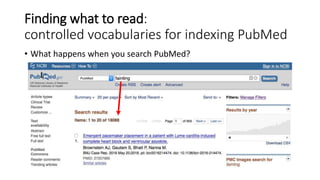
Finding what to read:
controlled vocabularies for indexing PubMed
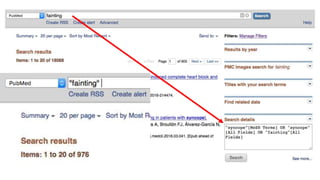
• What happens when you search PubMed?
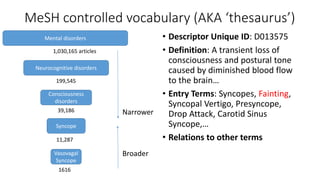
MeSH controlled vocabulary (AKA ‘thesaurus’)
• Descriptor Unique ID: D013575
• Definition: A transient loss of
consciousness and postural tone
caused by diminished blood flow
to the brain…
• Entry Terms: Syncopes, Fainting,
Syncopal Vertigo, Presyncope,
Drop Attack, Carotid Sinus
Syncope,…
• Relations to other terms
Syncope
Neurocognitive disorders
Consciousness
disorders
Mental disorders
Narrower
Vasovagal
Syncope
Broader
39,186
199,545
1,030,165 articles
1616
11,287
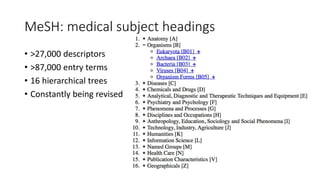
MeSH: medical subject headings
• >27,000 descriptors
• >87,000 entry terms
• 16 hierarchical trees
• Constantly being revised
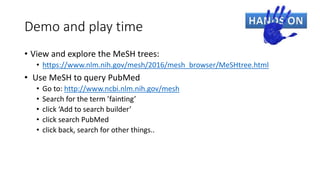
Demo and play time
• View and explore the MeSH trees:
• https://www.nlm.nih.gov/mesh/2016/mesh_browser/MeSHtree.html
• Use MeSH to query PubMed
• Go to: http://www.ncbi.nlm.nih.gov/mesh
• Search for the term ’fainting’
• click ‘Add to search builder’
• click search PubMed
• click back, search for other things..
Query demos
• Query expansion
• Hand Bones [Mesh]
• Hand Bones [Mesh:NoExp]
• Boolean operators
• cardiac hypertrophy and use rodents besides mice and rats in their experiments
• ("Cardiomegaly"[Mesh])
• AND "Rodentia"[Mesh]
• NOT "Mice"[Mesh] NOT "Rats"[Mesh]
• Article type filter
• Review papers about cardiac hypertrophy
• Cardiomegaly [MeSH] AND Review[ptyp]
• Try with http://www.ncbi.nlm.nih.gov/pubmed/advanced
Questions about MeSH ?
• Good 3 minute tutorial video on practical use:
http://www.youtube.com/watch?v=uyF8uQY9wys
Part 2: Ontology
“Ontology”
• The word comes from philosophy:
• “the branch of metaphysics dealing with the nature of being”
• In practice they are:
• A set of concepts, definitions and inter-relationships.
• (The dividing line between “controlled vocabulary”, “thesaurus”, “ontology” is
hazy and not terribly important for practical purposes.)
• We have hundreds of ontologies in biology, e.g. see:
• http://www.obofoundry.org (100+)
• http://bioportal.bioontology.org (500+)
The Gene Ontology
Ashburner et al., Nat Genet. 2000 May;25(1):25-9.
Started in 1999
As a collaboration between 3 Model Organism Databases
Slide credit: Mélanie Courtot, Ph.D.
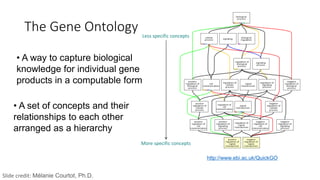
• A way to capture biological
knowledge for individual gene
products in a computable form
• A set of concepts and their
relationships to each other
arranged as a hierarchy
http://www.ebi.ac.uk/QuickGO
Less specific concepts
More specific concepts
The Gene Ontology
Slide credit: Mélanie Courtot, Ph.D.
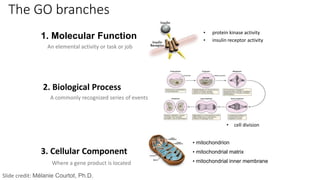
1. Molecular Function
An elemental activity or task or job
• protein kinase activity
• insulin receptor activity
3. Cellular Component
Where a gene product is located
• mitochondrion
• mitochondrial matrix
• mitochondrial inner membrane
2. Biological Process
A commonly recognized series of events
• cell division
The GO branches
Slide credit: Mélanie Courtot, Ph.D.
Building the GO
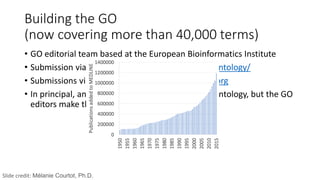
(now covering more than 40,000 terms)
• GO editorial team based at the European Bioinformatics Institute
• Submission via GitHub, https://github.com/geneontology/
• Submissions via TermGenie, http://go.termgenie.org
• In principal, anyone can suggest a change to the ontology, but the GO
editors make the decisions about what goes in.
Slide credit: Mélanie Courtot, Ph.D.
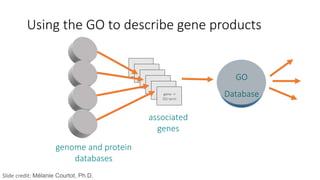
Using the GO to describe gene products
gene ->
GO term
associated
genes
GO
Database
genome and protein
databases
Slide credit: Mélanie Courtot, Ph.D.
Contributors
Slide credit: Mélanie Courtot, Ph.D.
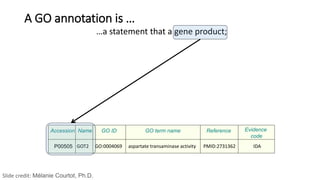
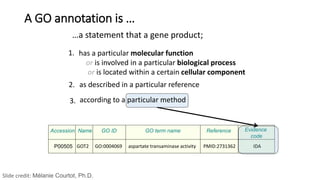
…a statement that a gene product;
P00505
Accession Name GO ID GO term name Reference Evidence
code
IDAPMID:2731362aspartate transaminase activityGO:0004069GOT2
A GO annotation is …
Slide credit: Mélanie Courtot, Ph.D.
…a statement that a gene product;
P00505
Accession Name GO ID GO term name Reference Evidence
code
IDAPMID:2731362aspartate transaminase activityGO:0004069GOT2
A GO annotation is …
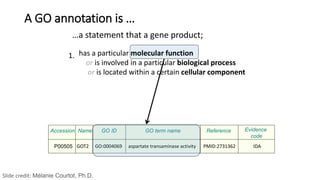
has a particular molecular function
or is involved in a particular biological process
or is located within a certain cellular component
1.
Slide credit: Mélanie Courtot, Ph.D.
…a statement that a gene product;
P00505
Accession Name GO ID GO term name Reference Evidence
code
IDAPMID:2731362aspartate transaminase activityGO:0004069GOT2
A GO annotation is …
has a particular molecular function
or is involved in a particular biological process
or is located within a certain cellular component
1.
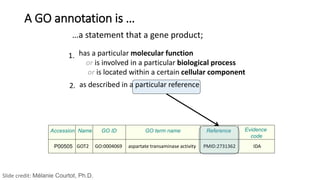
2. as described in a particular reference
Slide credit: Mélanie Courtot, Ph.D.
…a statement that a gene product;
P00505
Accession Name GO ID GO term name Reference Evidence
code
IDAPMID:2731362aspartate transaminase activityGO:0004069GOT2
A GO annotation is …
has a particular molecular function
or is involved in a particular biological process
or is located within a certain cellular component
1.
2. as described in a particular reference
3. according to a particular method
Slide credit: Mélanie Courtot, Ph.D.
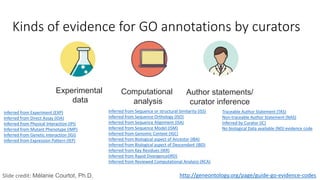
Experimental
data
Computational
analysis
Author statements/
curator inference
Kinds of evidence for GO annotations by curators
Slide credit: Mélanie Courtot, Ph.D. http://geneontology.org/page/guide-go-evidence-codes
Inferred from Experiment (EXP)
Inferred from Direct Assay (IDA)
Inferred from Physical Interaction (IPI)
Inferred from Mutant Phenotype (IMP)
Inferred from Genetic Interaction (IGI)
Inferred from Expression Pattern (IEP)
Inferred from Sequence or structural Similarity (ISS)
Inferred from Sequence Orthology (ISO)
Inferred from Sequence Alignment (ISA)
Inferred from Sequence Model (ISM)
Inferred from Genomic Context (IGC)
Inferred from Biological aspect of Ancestor (IBA)
Inferred from Biological aspect of Descendant (IBD)
Inferred from Key Residues (IKR)
Inferred from Rapid Divergence(IRD)
Inferred from Reviewed Computational Analysis (RCA)
Traceable Author Statement (TAS)
Non-traceable Author Statement (NAS)
Inferred by Curator (IC)
No biological Data available (ND) evidence code
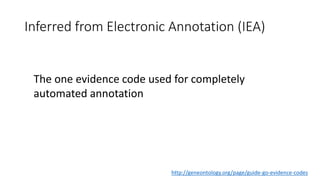
Inferred from Electronic Annotation (IEA)
http://geneontology.org/page/guide-go-evidence-codes
The one evidence code used for completely
automated annotation
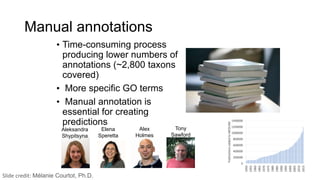
Manual annotations
• Time-consuming process
producing lower numbers of
annotations (~2,800 taxons
covered)
• More specific GO terms
• Manual annotation is
essential for creating
predictions
Aleksandra
Shypitsyna
Elena
Speretta
Alex
Holmes
Tony
Sawford
Slide credit: Mélanie Courtot, Ph.D.
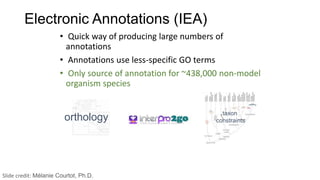
Electronic Annotations (IEA)
• Quick way of producing large numbers of
annotations
• Annotations use less-specific GO terms
• Only source of annotation for ~438,000 non-model
organism species
orthology taxon
constraints
Slide credit: Mélanie Courtot, Ph.D.
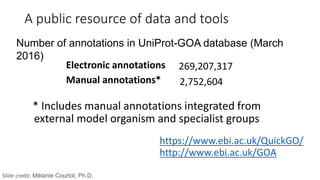
* Includes manual annotations integrated from
external model organism and specialist groups
2,752,604Manual annotations*
269,207,317Electronic annotations
A public resource of data and tools
Number of annotations in UniProt-GOA database (March
2016)
http://www.ebi.ac.uk/GOA
https://www.ebi.ac.uk/QuickGO/
Slide credit: Mélanie Courtot, Ph.D.
Slide credit: Mélanie Courtot, Ph.D. & IKEA
Using AMIGO2:
http://amigo.geneontology.org
• Find the Gene Ontology term for Nucleus
• Find its child term Pronucleus
• Find a C. Elegans gene associated with this term and find the PubMed
id of the reference supporting the annotation
• Repeat for a human gene, what is the evidence for the annotation?
http://geneontology.org/page/guide-go-evidence-codes
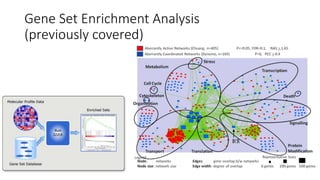
Gene Set Enrichment Analysis
(previously covered)
Questions about GO or other ontologies?
Part 3: Knowledge graphs
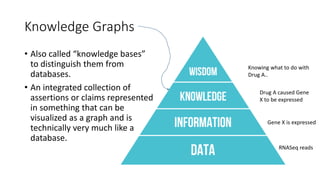
Knowledge Graphs
• Also called “knowledge bases”
to distinguish them from
databases.
• An integrated collection of
assertions or claims represented
in something that can be
visualized as a graph and is
technically very much like a
database.
RNASeq reads
Gene X is expressed
Drug A caused Gene
X to be expressed
Knowing what to do with
Drug A..
Example knowledge graphs
• Wikidata: The structured equivalent of Wikipedia
• http://wikidata.org
• UniProt Knowledge Base: Manually curated Protein
knowledge base
• http://www.uniprot.org/uniprot/
• Microsoft Knowledge Graph (“Satori”)
• Google Knowledge Graph
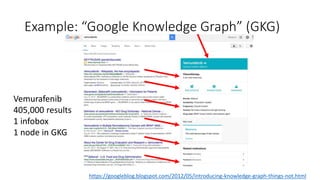
Example: “Google Knowledge Graph” (GKG)
Vemurafenib
405,000 results
1 infobox
1 node in GKG
https://googleblog.blogspot.com/2012/05/introducing-knowledge-graph-things-not.html
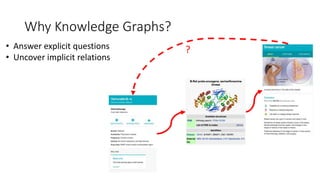
Why Knowledge Graphs?
?• Answer explicit questions
• Uncover implicit relations
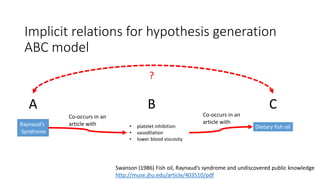
Implicit relations for hypothesis generation
ABC model
Swanson (1986) Fish oil, Raynaud’s syndrome and undiscovered public knowledge
http://muse.jhu.edu/article/403510/pdf
BA C
Raynaud’s
Syndrome
Dietary fish oil• platelet inhibition
• vasodilation
• lower blood viscosity
Co-occurs in an
article with
Co-occurs in an
article with
?
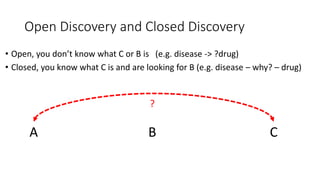
Open Discovery and Closed Discovery
• Open, you don’t know what C or B is (e.g. disease -> ?drug)
• Closed, you know what C is and are looking for B (e.g. disease – why? – drug)
BA C
?
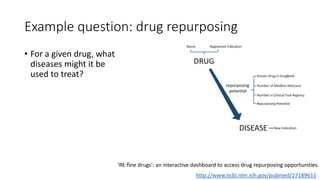
Example question: drug repurposing
• For a given drug, what
diseases might it be
used to treat?
http://www.ncbi.nlm.nih.gov/pubmed/27189611
'RE:fine drugs': an interactive dashboard to access drug repurposing opportunities.
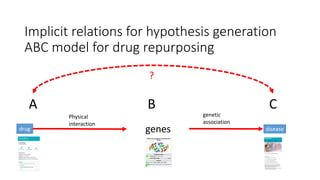
Implicit relations for hypothesis generation
ABC model for drug repurposing
BA C
drug diseasegenes
Physical
interaction
genetic
association
?
Questions on ABC model ?
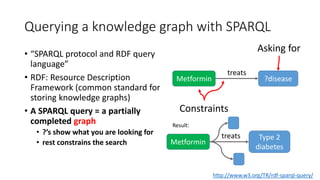
Querying a knowledge graph with SPARQL
• “SPARQL protocol and RDF query
language”
• RDF: Resource Description
Framework (common standard for
storing knowledge graphs)
• A SPARQL query = a partially
completed graph
• ?’s show what you are looking for
• rest constrains the search
http://www.w3.org/TR/rdf-sparql-query/
?disease
Asking for
Constraints
Metformin
treats
Result:
Metformin
Type 2
diabetes
treats
=
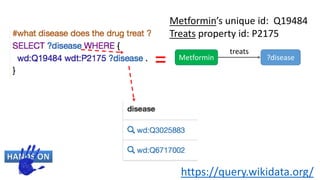
https://query.wikidata.org/
Metformin’s unique id: Q19484
Treats property id: P2175
Metformin ?disease
treats
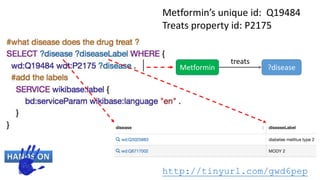
Metformin’s unique id: Q19484
Treats property id: P2175
Metformin ?disease
treats
http://tinyurl.com/gwd6pep
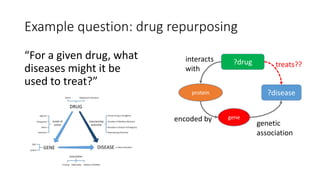
Example question: drug repurposing
“For a given drug, what
diseases might it be
used to treat?”
?drug
?disease
interacts
with
protein
geneencoded by
genetic
association
treats??
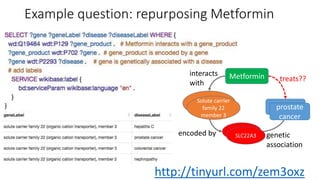
Example question: repurposing Metformin
http://tinyurl.com/zem3oxz
Metformin
?disease
interacts
with
protein
SLC22A3encoded by genetic
association
treats??
Solute carrier
family 22
member 3
SLC22A3
prostate
cancer
Aside
• “Validating drug repurposing signals using electronic health records: a
case study of metformin associated with reduced cancer mortality”
• https://jamia.oxfordjournals.org/content/22/1/179
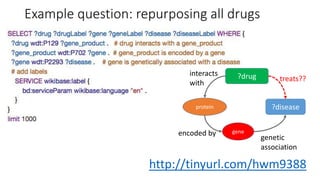
Example question: repurposing all drugs
http://tinyurl.com/hwm9388
?drug
?disease
interacts
with
protein
geneencoded by
genetic
association
treats??
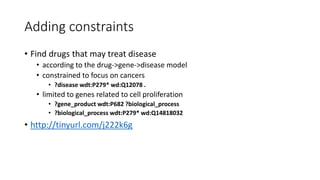
Adding constraints
• Find drugs that may treat disease
• according to the drug->gene->disease model
• constrained to focus on cancers
• ?disease wdt:P279* wd:Q12078 .
• limited to genes related to cell proliferation
• ?gene_product wdt:P682 ?biological_process
• ?biological_process wdt:P279* wd:Q14818032
• http://tinyurl.com/j222k6g
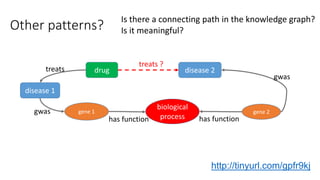
Other patterns?
drug disease 2
disease 1
gene 1
biological
process
Is there a connecting path in the knowledge graph?
Is it meaningful?
gene 2
treats
has function
gwas
has function
gwas
treats ?
http://tinyurl.com/gpfr9kj
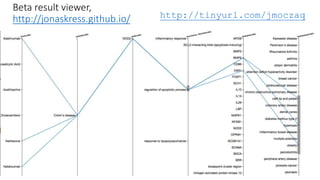
Beta result viewer,
http://jonaskress.github.io/ http://tinyurl.com/jmoczaq
SPARQL endpoints of interest
• Wikidata http://query.wikidata.org
• UniProt http://sparql.uniprot.org
• MeSH https://id.nlm.nih.gov/mesh/query
• EBI https://www.ebi.ac.uk/rdf/documentation/sparql-
endpoints
• Bio2RDF https://github.com/bio2rdf/bio2rdf-
scripts/wiki/Query-repository
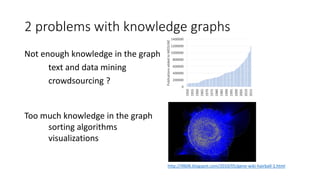
2 problems with knowledge graphs
Not enough knowledge in the graph
text and data mining
crowdsourcing ?
http://i9606.blogspot.com/2010/05/gene-wiki-hairball-1.html
Too much knowledge in the graph
sorting algorithms
visualizations
Plan for Thursday / Homework
• Implement and apply an ABC Model style hypothesis generating
program
• Assignment: write the program, explain its logic, explain how you
used it to generate a hypothesis, explain the hypothesis
• A Jupyter notebook with Python code will be provided to get you
started
• If you do not want to program, there will be another option using
online tools.
Suggested Reading
• Ontology
• Biomedical Ontologies in Action: Role in Knowledge Management, Data Integration and
Decision Support
• http://www.ncbi.nlm.nih.gov/pmc/articles/PMC2592252/
• Gene Ontology: tool for the unification of biology
• http://www.ncbi.nlm.nih.gov/pmc/articles/PMC3037419/
• Knowledge-based hypothesis generation
• Fish oil, Raynaud’s syndrome and undiscovered public knowledge
• http://muse.jhu.edu/article/403510/pdf
• Knowledge discovery by automated identification and ranking of implicit relationships
• http://bioinformatics.oxfordjournals.org/content/20/3/389.full.pdf
• Text mining
• Literature mining for the biologist: from information retrieval to biological discovery
• http://www.nature.com/nrg/journal/v7/n2/full/nrg1768.html

Computing on the shoulders of giants

  • 1.
    Computing on theshoulders of giants: how existing knowledge is represented and applied in bioinformatics Benjamin Good bgood@scripps.edu Assistant Professor of the Department of Molecular and Experimental Medicine Specialty: artificial intelligence, crowdsourcing
  • 2.
    The more youcan ‘know’ the better a scientist you can become (Derived from Alex Pico, WikiPathways) ideas Knowledge data
  • 3.
    Too much toknow • PubMed lists > 1 million articles published each year (more than 2 per minute) • Your capacity to read and comprehend is limiting Knowledge
  • 4.
  • 5.
    Goals for representingknowledge (outline) • Make things (articles, genes, antibodies, etc.) easier to find • Answer questions • Generate hypotheses Controlled vocabularies (MeSH) Ontologies (Gene Ontology) knowledge graphs on the Web: the SPARQL query language knowledge plus computation = inference, the ABC model
  • 6.
    Part 1: Medical SubjectHeadings (MeSH)
  • 7.
    Finding what toread: controlled vocabularies for indexing PubMed • What happens when you search PubMed?
  • 9.
    MeSH controlled vocabulary(AKA ‘thesaurus’) • Descriptor Unique ID: D013575 • Definition: A transient loss of consciousness and postural tone caused by diminished blood flow to the brain… • Entry Terms: Syncopes, Fainting, Syncopal Vertigo, Presyncope, Drop Attack, Carotid Sinus Syncope,… • Relations to other terms Syncope Neurocognitive disorders Consciousness disorders Mental disorders Narrower Vasovagal Syncope Broader 39,186 199,545 1,030,165 articles 1616 11,287
  • 10.
    MeSH: medical subjectheadings • >27,000 descriptors • >87,000 entry terms • 16 hierarchical trees • Constantly being revised
  • 11.
    Demo and playtime • View and explore the MeSH trees: • https://www.nlm.nih.gov/mesh/2016/mesh_browser/MeSHtree.html • Use MeSH to query PubMed • Go to: http://www.ncbi.nlm.nih.gov/mesh • Search for the term ’fainting’ • click ‘Add to search builder’ • click search PubMed • click back, search for other things..
  • 12.
    Query demos • Queryexpansion • Hand Bones [Mesh] • Hand Bones [Mesh:NoExp] • Boolean operators • cardiac hypertrophy and use rodents besides mice and rats in their experiments • ("Cardiomegaly"[Mesh]) • AND "Rodentia"[Mesh] • NOT "Mice"[Mesh] NOT "Rats"[Mesh] • Article type filter • Review papers about cardiac hypertrophy • Cardiomegaly [MeSH] AND Review[ptyp] • Try with http://www.ncbi.nlm.nih.gov/pubmed/advanced
  • 13.
    Questions about MeSH? • Good 3 minute tutorial video on practical use: http://www.youtube.com/watch?v=uyF8uQY9wys
  • 14.
  • 15.
    “Ontology” • The wordcomes from philosophy: • “the branch of metaphysics dealing with the nature of being” • In practice they are: • A set of concepts, definitions and inter-relationships. • (The dividing line between “controlled vocabulary”, “thesaurus”, “ontology” is hazy and not terribly important for practical purposes.) • We have hundreds of ontologies in biology, e.g. see: • http://www.obofoundry.org (100+) • http://bioportal.bioontology.org (500+)
  • 16.
    The Gene Ontology Ashburneret al., Nat Genet. 2000 May;25(1):25-9. Started in 1999 As a collaboration between 3 Model Organism Databases Slide credit: Mélanie Courtot, Ph.D.
  • 17.
    • A wayto capture biological knowledge for individual gene products in a computable form • A set of concepts and their relationships to each other arranged as a hierarchy http://www.ebi.ac.uk/QuickGO Less specific concepts More specific concepts The Gene Ontology Slide credit: Mélanie Courtot, Ph.D.
  • 18.
    1. Molecular Function Anelemental activity or task or job • protein kinase activity • insulin receptor activity 3. Cellular Component Where a gene product is located • mitochondrion • mitochondrial matrix • mitochondrial inner membrane 2. Biological Process A commonly recognized series of events • cell division The GO branches Slide credit: Mélanie Courtot, Ph.D.
  • 19.
    Building the GO (nowcovering more than 40,000 terms) • GO editorial team based at the European Bioinformatics Institute • Submission via GitHub, https://github.com/geneontology/ • Submissions via TermGenie, http://go.termgenie.org • In principal, anyone can suggest a change to the ontology, but the GO editors make the decisions about what goes in. Slide credit: Mélanie Courtot, Ph.D.
  • 20.
    Using the GOto describe gene products gene -> GO term associated genes GO Database genome and protein databases Slide credit: Mélanie Courtot, Ph.D.
  • 21.
  • 22.
    …a statement thata gene product; P00505 Accession Name GO ID GO term name Reference Evidence code IDAPMID:2731362aspartate transaminase activityGO:0004069GOT2 A GO annotation is … Slide credit: Mélanie Courtot, Ph.D.
  • 23.
    …a statement thata gene product; P00505 Accession Name GO ID GO term name Reference Evidence code IDAPMID:2731362aspartate transaminase activityGO:0004069GOT2 A GO annotation is … has a particular molecular function or is involved in a particular biological process or is located within a certain cellular component 1. Slide credit: Mélanie Courtot, Ph.D.
  • 24.
    …a statement thata gene product; P00505 Accession Name GO ID GO term name Reference Evidence code IDAPMID:2731362aspartate transaminase activityGO:0004069GOT2 A GO annotation is … has a particular molecular function or is involved in a particular biological process or is located within a certain cellular component 1. 2. as described in a particular reference Slide credit: Mélanie Courtot, Ph.D.
  • 25.
    …a statement thata gene product; P00505 Accession Name GO ID GO term name Reference Evidence code IDAPMID:2731362aspartate transaminase activityGO:0004069GOT2 A GO annotation is … has a particular molecular function or is involved in a particular biological process or is located within a certain cellular component 1. 2. as described in a particular reference 3. according to a particular method Slide credit: Mélanie Courtot, Ph.D.
  • 26.
    Experimental data Computational analysis Author statements/ curator inference Kindsof evidence for GO annotations by curators Slide credit: Mélanie Courtot, Ph.D. http://geneontology.org/page/guide-go-evidence-codes Inferred from Experiment (EXP) Inferred from Direct Assay (IDA) Inferred from Physical Interaction (IPI) Inferred from Mutant Phenotype (IMP) Inferred from Genetic Interaction (IGI) Inferred from Expression Pattern (IEP) Inferred from Sequence or structural Similarity (ISS) Inferred from Sequence Orthology (ISO) Inferred from Sequence Alignment (ISA) Inferred from Sequence Model (ISM) Inferred from Genomic Context (IGC) Inferred from Biological aspect of Ancestor (IBA) Inferred from Biological aspect of Descendant (IBD) Inferred from Key Residues (IKR) Inferred from Rapid Divergence(IRD) Inferred from Reviewed Computational Analysis (RCA) Traceable Author Statement (TAS) Non-traceable Author Statement (NAS) Inferred by Curator (IC) No biological Data available (ND) evidence code
  • 27.
    Inferred from ElectronicAnnotation (IEA) http://geneontology.org/page/guide-go-evidence-codes The one evidence code used for completely automated annotation
  • 28.
    Manual annotations • Time-consumingprocess producing lower numbers of annotations (~2,800 taxons covered) • More specific GO terms • Manual annotation is essential for creating predictions Aleksandra Shypitsyna Elena Speretta Alex Holmes Tony Sawford Slide credit: Mélanie Courtot, Ph.D.
  • 29.
    Electronic Annotations (IEA) •Quick way of producing large numbers of annotations • Annotations use less-specific GO terms • Only source of annotation for ~438,000 non-model organism species orthology taxon constraints Slide credit: Mélanie Courtot, Ph.D.
  • 30.
    * Includes manualannotations integrated from external model organism and specialist groups 2,752,604Manual annotations* 269,207,317Electronic annotations A public resource of data and tools Number of annotations in UniProt-GOA database (March 2016) http://www.ebi.ac.uk/GOA https://www.ebi.ac.uk/QuickGO/ Slide credit: Mélanie Courtot, Ph.D.
  • 31.
    Slide credit: MélanieCourtot, Ph.D. & IKEA
  • 32.
    Using AMIGO2: http://amigo.geneontology.org • Findthe Gene Ontology term for Nucleus • Find its child term Pronucleus • Find a C. Elegans gene associated with this term and find the PubMed id of the reference supporting the annotation • Repeat for a human gene, what is the evidence for the annotation? http://geneontology.org/page/guide-go-evidence-codes
  • 33.
    Gene Set EnrichmentAnalysis (previously covered)
  • 34.
    Questions about GOor other ontologies?
  • 35.
  • 36.
    Knowledge Graphs • Alsocalled “knowledge bases” to distinguish them from databases. • An integrated collection of assertions or claims represented in something that can be visualized as a graph and is technically very much like a database. RNASeq reads Gene X is expressed Drug A caused Gene X to be expressed Knowing what to do with Drug A..
  • 37.
    Example knowledge graphs •Wikidata: The structured equivalent of Wikipedia • http://wikidata.org • UniProt Knowledge Base: Manually curated Protein knowledge base • http://www.uniprot.org/uniprot/ • Microsoft Knowledge Graph (“Satori”) • Google Knowledge Graph
  • 38.
    Example: “Google KnowledgeGraph” (GKG) Vemurafenib 405,000 results 1 infobox 1 node in GKG https://googleblog.blogspot.com/2012/05/introducing-knowledge-graph-things-not.html
  • 39.
    Why Knowledge Graphs? ?•Answer explicit questions • Uncover implicit relations
  • 40.
    Implicit relations forhypothesis generation ABC model Swanson (1986) Fish oil, Raynaud’s syndrome and undiscovered public knowledge http://muse.jhu.edu/article/403510/pdf BA C Raynaud’s Syndrome Dietary fish oil• platelet inhibition • vasodilation • lower blood viscosity Co-occurs in an article with Co-occurs in an article with ?
  • 41.
    Open Discovery andClosed Discovery • Open, you don’t know what C or B is (e.g. disease -> ?drug) • Closed, you know what C is and are looking for B (e.g. disease – why? – drug) BA C ?
  • 42.
    Example question: drugrepurposing • For a given drug, what diseases might it be used to treat? http://www.ncbi.nlm.nih.gov/pubmed/27189611 'RE:fine drugs': an interactive dashboard to access drug repurposing opportunities.
  • 43.
    Implicit relations forhypothesis generation ABC model for drug repurposing BA C drug diseasegenes Physical interaction genetic association ?
  • 44.
  • 45.
    Querying a knowledgegraph with SPARQL • “SPARQL protocol and RDF query language” • RDF: Resource Description Framework (common standard for storing knowledge graphs) • A SPARQL query = a partially completed graph • ?’s show what you are looking for • rest constrains the search http://www.w3.org/TR/rdf-sparql-query/ ?disease Asking for Constraints Metformin treats Result: Metformin Type 2 diabetes treats
  • 46.
    = https://query.wikidata.org/ Metformin’s unique id:Q19484 Treats property id: P2175 Metformin ?disease treats
  • 47.
    Metformin’s unique id:Q19484 Treats property id: P2175 Metformin ?disease treats http://tinyurl.com/gwd6pep
  • 48.
    Example question: drugrepurposing “For a given drug, what diseases might it be used to treat?” ?drug ?disease interacts with protein geneencoded by genetic association treats??
  • 49.
    Example question: repurposingMetformin http://tinyurl.com/zem3oxz Metformin ?disease interacts with protein SLC22A3encoded by genetic association treats?? Solute carrier family 22 member 3 SLC22A3 prostate cancer
  • 50.
    Aside • “Validating drugrepurposing signals using electronic health records: a case study of metformin associated with reduced cancer mortality” • https://jamia.oxfordjournals.org/content/22/1/179
  • 51.
    Example question: repurposingall drugs http://tinyurl.com/hwm9388 ?drug ?disease interacts with protein geneencoded by genetic association treats??
  • 52.
    Adding constraints • Finddrugs that may treat disease • according to the drug->gene->disease model • constrained to focus on cancers • ?disease wdt:P279* wd:Q12078 . • limited to genes related to cell proliferation • ?gene_product wdt:P682 ?biological_process • ?biological_process wdt:P279* wd:Q14818032 • http://tinyurl.com/j222k6g
  • 53.
    Other patterns? drug disease2 disease 1 gene 1 biological process Is there a connecting path in the knowledge graph? Is it meaningful? gene 2 treats has function gwas has function gwas treats ? http://tinyurl.com/gpfr9kj
  • 54.
  • 55.
    SPARQL endpoints ofinterest • Wikidata http://query.wikidata.org • UniProt http://sparql.uniprot.org • MeSH https://id.nlm.nih.gov/mesh/query • EBI https://www.ebi.ac.uk/rdf/documentation/sparql- endpoints • Bio2RDF https://github.com/bio2rdf/bio2rdf- scripts/wiki/Query-repository
  • 56.
    2 problems withknowledge graphs Not enough knowledge in the graph text and data mining crowdsourcing ? http://i9606.blogspot.com/2010/05/gene-wiki-hairball-1.html Too much knowledge in the graph sorting algorithms visualizations
  • 57.
    Plan for Thursday/ Homework • Implement and apply an ABC Model style hypothesis generating program • Assignment: write the program, explain its logic, explain how you used it to generate a hypothesis, explain the hypothesis • A Jupyter notebook with Python code will be provided to get you started • If you do not want to program, there will be another option using online tools.
  • 58.
    Suggested Reading • Ontology •Biomedical Ontologies in Action: Role in Knowledge Management, Data Integration and Decision Support • http://www.ncbi.nlm.nih.gov/pmc/articles/PMC2592252/ • Gene Ontology: tool for the unification of biology • http://www.ncbi.nlm.nih.gov/pmc/articles/PMC3037419/ • Knowledge-based hypothesis generation • Fish oil, Raynaud’s syndrome and undiscovered public knowledge • http://muse.jhu.edu/article/403510/pdf • Knowledge discovery by automated identification and ranking of implicit relationships • http://bioinformatics.oxfordjournals.org/content/20/3/389.full.pdf • Text mining • Literature mining for the biologist: from information retrieval to biological discovery • http://www.nature.com/nrg/journal/v7/n2/full/nrg1768.html

Editor's Notes

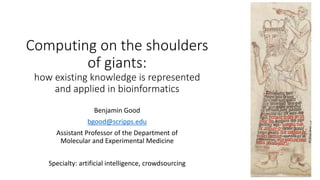
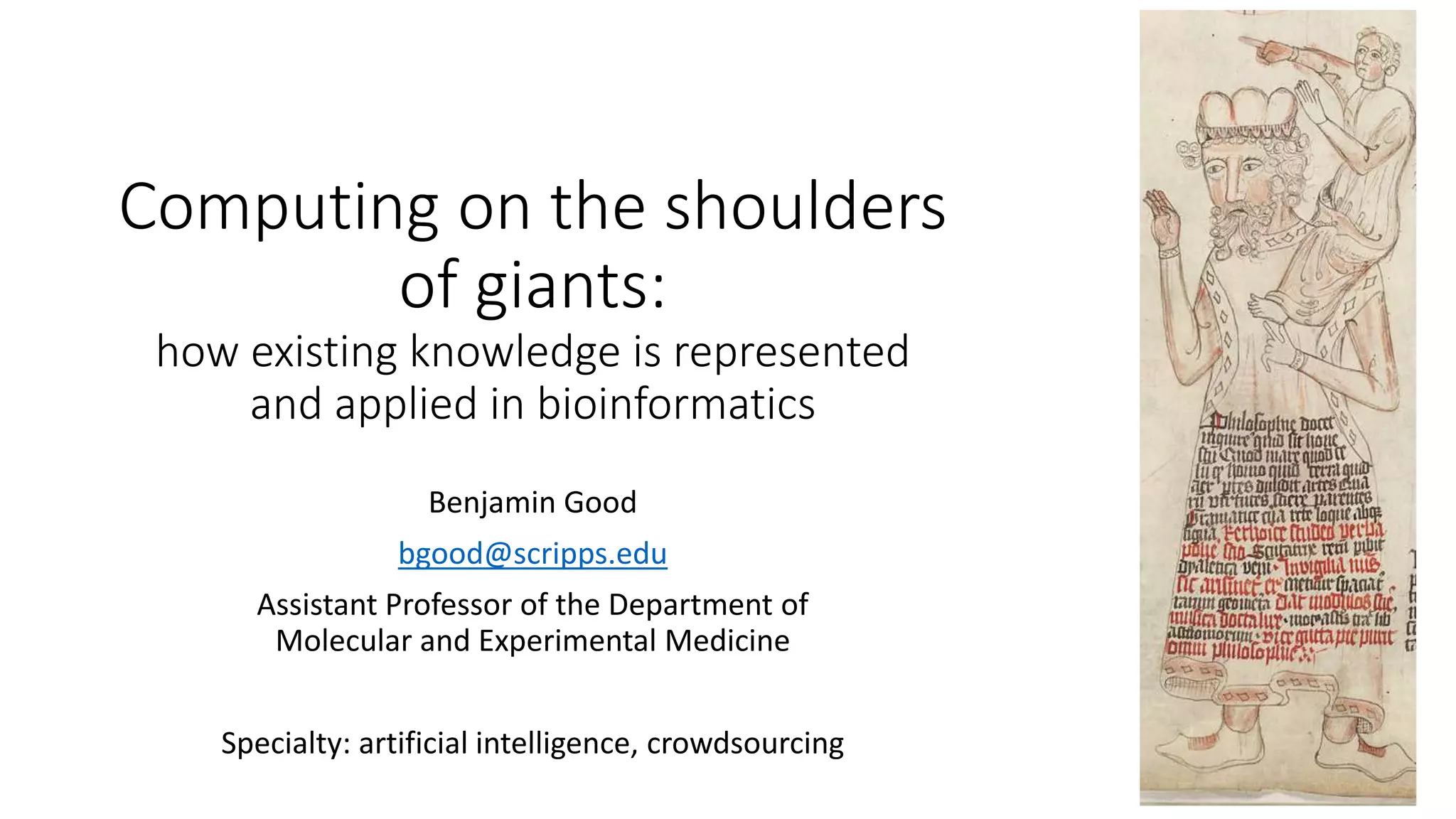
  • #2 This picture is derived from Greek mythology: the blind giant Orion carried his servant Cedalion on his shoulders to act as the giant's eyes.
  • #3 If I have seen further, it is by standing on the shoulders of giants. Isaac Newton 1676* Bernard of Chartres used to say that we [the Moderns] are like dwarves perched on the shoulders of giants [the Ancients], and thus we are able to see more and farther than the latter. And this is not at all because of the acuteness of our sight or the stature of our body, but because we are carried aloft and elevated by the magnitude of the giants. https://en.wikipedia.org/wiki/Bernard_of_Chartres#cite_note-5 around 1100
  • #4 You can’t hope to keep even a small fraction of what could inform your work in your mind. You need to be able to find relevant information rapidly, aggregate it from many sources, and use it all to build an integrated view of what is known or at least presumed.
  • #7 Using a controlled vocabulary for finding articles.
  • #8 Examples: fainting, dizziness, cardiac hypertrophy fainting http://www.ncbi.nlm.nih.gov/mesh/68013575
  • #10 http://www.ncbi.nlm.nih.gov/mesh/68013575
  • #13 Try with http://www.ncbi.nlm.nih.gov/pubmed/advanced
  • #30 Provides automatic prediction of for uncharacterized sequence Predicts membership of protein families and presence of domains and features manually curated mapping of families and domains to GO terms High-level – has to be true for all (or most) members of a family – can add downstream filters Incorrect annotations when spotted and fed back to improve the mapping – changing the mapping or adding QC filtering downstream e.g. taxon constraints Mapping of domains has recently been improved – used to be to the whole protein that contained the domain, now just to the domain itself. Much more accurate.
  • #33 will show the link to Wormbase and PubMed Will show that its basically all transferred from some orthology computation
  • #41 A is implicitly related to C if A is explicitly related to B and B is explicitly related to C
  • #44 A is implicitly related to C if A is explicitly related to B and B is explicitly related to C