Using R for GO Terms Analysis

     Boyce Thompson Institute for Plant
                 Research
                Tower Road
       Ithaca, New York 14853-1801
                  U.S.A.

                  by
      Aureliano Bombarely Gomez
Using R for GO Terms Analysis:
   1. What are GO terms ?
   2. What is R ?
   3. What is Bioconductor ?
   4. Bioconductor modules for GO terms
         4.1. Basics: GO.db
         4.2. Gene Enrinchment Analysis: TopGO
         4.3. GO profiles: GOProfiles
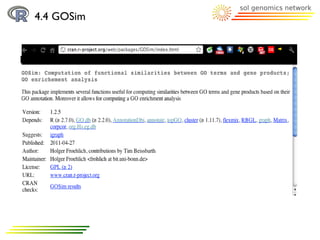
         4.4. Gene Similarities: GOSim
    5. Example.
         5.1. Comparing two arabidopsis chromosomes.
Using R for GO Terms Analysis:
   1. What are GO terms ?
   2. What is R ?
   3. What is Bioconductor ?
   4. Bioconductor modules for GO terms
         4.1. Basics: GO.db
         4.2. Gene Enrinchment Analysis: TopGO
         4.3. GO profiles: GOProfiles
         4.4. Gene Similarities: GOSim
    5. Example.
         5.1. Comparing two arabidopsis chromosomes.
1. What are GO Terms ?


Gene ontologies:
    Structured controlled vocabularies
(ontologies) that describe gene products
in terms of their associated
   biological processes,
   cellular components and
   molecular functions
in a species-independent manner


   http://www.geneontology.org/GO.doc.shtml
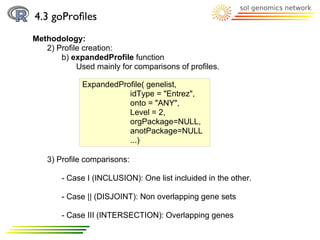
1. What are GO Terms ?


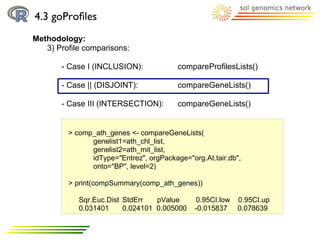
Biological processes,
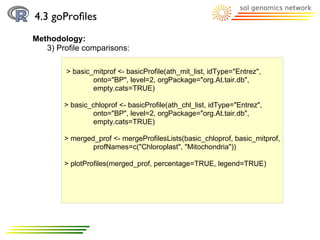
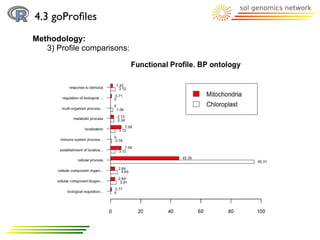
   Recognized series of events or molecular functions. A process is
a collection of molecular events with a defined beginning and end.

Cellular components,
  Describes locations, at the levels of subcellular structures and
macromolecular complexes.

Molecular functions
   Describes activities, such as catalytic or binding activities, that
occur at the molecular level.
1. What are GO Terms ?


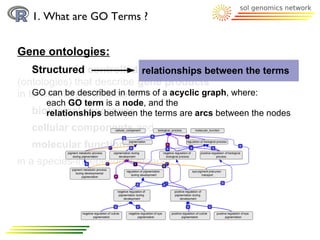
Gene ontologies:
    Structured controlled vocabulariesbetween the terms
                              relationships
(ontologies) that describe gene products
in terms ofbe described in terms of a acyclic graph, where:
    GO can their associated
      each GO term is a node, and the
   biological processes, the terms are arcs between the nodes
      relationships between
   cellular components and
   molecular functions
in a species-independent manner
Using R for GO Terms Analysis:
   1. What are GO terms ?
   2. What is R ?
   3. What is Bioconductor ?
   4. Bioconductor modules for GO terms
         4.1. Basics: GO.db
         4.2. Gene Enrinchment Analysis: TopGO
         4.3. GO profiles: GOProfiles
         4.4. Gene Similarities: GOSim
    5. Example.
         5.1. Comparing two arabidopsis chromosomes.
2. What is R ?


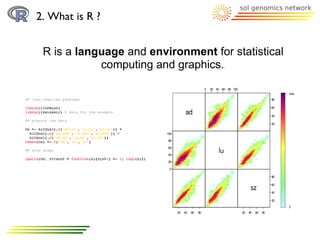
 R is a language and environment for statistical
            computing and graphics. .
2. What is R ?


WEB:
   OFICIAL WEB: http://www.r-project.org/index.html
   QUICK-R:                 http://www.statmethods.net/index.html


BOOKS:
   Introductory Statistics with R (Statistics and Computing), P. Dalgaard
  [available as manual at R project web]

   The R Book, MJ. Crawley


R itself:                        help() and example()
2. What is R ?


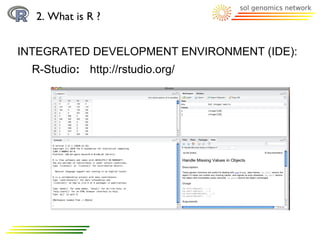
INTEGRATED DEVELOPMENT ENVIRONMENT (IDE):
  R-Studio: http://rstudio.org/
Using R for GO Terms Analysis:
   1. What are GO terms ?
   2. What is R ?
   3. What is Bioconductor ?
   4. Bioconductor modules for GO terms
         4.1. Basics: GO.db
         4.2. Gene Enrinchment Analysis: TopGO
         4.3. GO profiles: GOProfiles
         4.4. Gene Similarities: GOSim
    5. Example.
         5.1. Comparing two arabidopsis chromosomes.
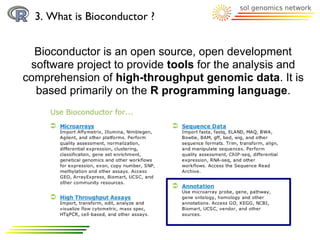
3. What is Bioconductor ?


  Bioconductor is an open source, open development
 software project to provide tools for the analysis and
comprehension of high-throughput genomic data. It is
  based primarily on the R programming language.
3. What is Bioconductor ?


WEB:
   OFICIAL WEB: http://www.bioconductor.org/


BOOKS:
   Bioinformatics and Computational Biology Solutions Using R and
Bioconductor, 2005, Gentleman R. et al. (Springer)
   R Programming for Bioinformatics, 2008, Gentleman R. (CRC Press)


MAILING LIST:
   http://www.bioconductor.org/help/mailing-list/
3. What is Bioconductor ?


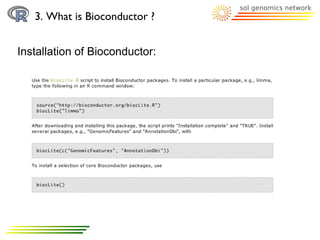
Installation of Bioconductor:
3. What is Bioconductor ?


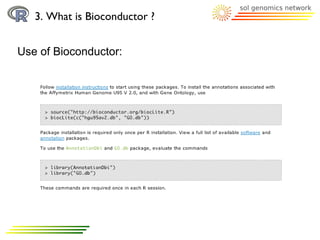
Use of Bioconductor:
Using R for GO Terms Analysis:
   1. What are GO terms ?
   2. What is R ?
   3. What is Bioconductor ?
   4. Bioconductor modules for GO terms
         4.1. Basics: GO.db
         4.2. Gene Similarities: GOSim
         4.3. GO profiles: GOProfiles
         4.4. Gene Enrinchment Analysis:TopGO
    5. Example.
         5.1. Comparing two arabidopsis chromosomes.
4. Bioconductor modules for GOterms


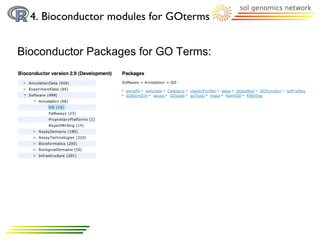
Bioconductor Packages for GO Terms:
4. Bioconductor modules for GOterms


Bioconductor Packages for GO Terms:

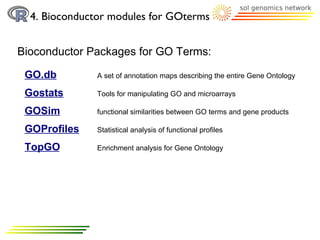
 GO.db         A set of annotation maps describing the entire Gene Ontology

 Gostats       Tools for manipulating GO and microarrays

 GOSim         functional similarities between GO terms and gene products

 GOProfiles    Statistical analysis of functional profiles

 TopGO         Enrichment analysis for Gene Ontology
Using R for GO Terms Analysis:
   1. What are GO terms ?
   2. What is R ?
   3. What is Bioconductor ?
   4. Bioconductor modules for GO terms
         4.1. Basics: GO.db
         4.2. Gene Enrinchment Analysis: TopGO
         4.3. GO profiles: GOProfiles
         4.4. Gene Similarities: GOSim
    5. Example.
         5.1. Comparing two arabidopsis chromosomes.
4.1 GO.db

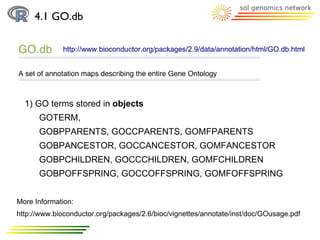
             http://www.bioconductor.org/packages/2.9/data/annotation/html/GO.db.html


  1) GO terms stored in objects
      GOTERM,
      GOBPPARENTS, GOCCPARENTS, GOMFPARENTS
      GOBPANCESTOR, GOCCANCESTOR, GOMFANCESTOR
      GOBPCHILDREN, GOCCCHILDREN, GOMFCHILDREN
      GOBPOFFSPRING, GOCCOFFSPRING, GOMFOFFSPRING


More Information:
http://www.bioconductor.org/packages/2.6/bioc/vignettes/annotate/inst/doc/GOusage.pdf
4.1 GO.db


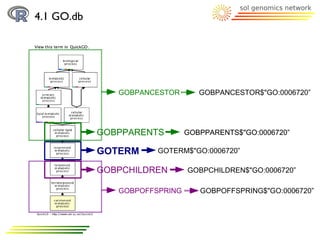
               GOBPANCESTOR       GOBPANCESTOR$"GO:0006720”


            GOBPPARENTS        GOBPPARENTS$"GO:0006720”

            GOTERM     GOTERM$"GO:0006720”

            GOBPCHILDREN       GOBPCHILDREN$"GO:0006720”

               GOBPOFFSPRING      GOBPOFFSPRING$"GO:0006720”
4.1 GO.db


Exercise 1:

   1.1 Which term correspond top the GOID: GO:0006720 ?

   1.2 How many synonyms has this term ?

   1.3 How many children ?

   1.4 … and parents ?

   1.5 … and offsprings ?

   1.6 … and ancestors ?
4.1 GO.db

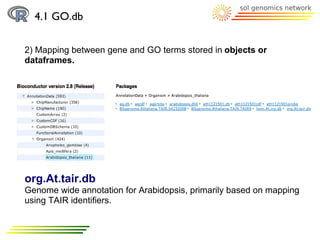
2) Mapping between gene and GO terms stored in objects or
dataframes.


org.At.tair.db
Genome wide annotation for Arabidopsis, primarily based on mapping
using TAIR identifiers.
4.1 GO.db

2) Mapping between gene and GO terms stored in objects
(annotate package) or dataframes.

     > library("org.At.tair.db")
     > org.At.tairGO[["AT5G58560"]]

Use a list:

     > org.At.tairGO[["AT5G58560"]][[1]]$Ontology

Functions (“annotate” package):
    + getOntology(inlist, gocategorylist)
    + getEvidence(inlist)
     > getOntology(org.At.tairGO[["AT5G58560"]])
     > getEvidence(org.At.tairGO[["AT5G58560"]])
4.1 GO.db


Exercise 2:

   2.1 How many terms map with the gene: AT5G58560 ?

   2.2 What biological process terms map with this gene?

   2.3 What evidences are associated with these terms ?
Using R for GO Terms Analysis:
   1. What are GO terms ?
   2. What is R ?
   3. What is Bioconductor ?
   4. Bioconductor modules for GO terms
         4.1. Basics: GO.db
         4.2. Gene Enrinchment Analysis: TopGO
         4.3. GO profiles: GOProfiles
         4.4. Gene Similarities: GOSim
    5. Example.
         5.1. Comparing two arabidopsis chromosomes.
4.2 TopGO

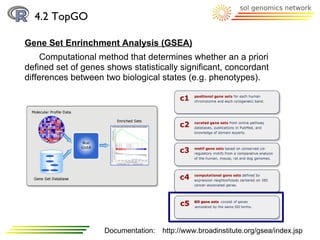
Gene Set Enrinchment Analysis (GSEA)
     Computational method that determines whether an a priori
defined set of genes shows statistically significant, concordant
differences between two biological states (e.g. phenotypes).


                    Documentation:   http://www.broadinstitute.org/gsea/index.jsp
4.2 TopGO

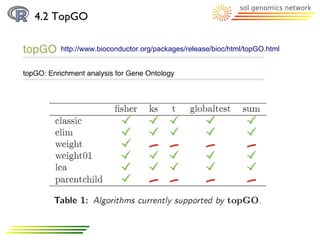
    http://www.bioconductor.org/packages/release/bioc/html/topGO.html
4.2 TopGO

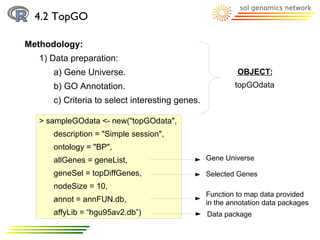
Methodology:
  1) Data preparation:
     a) Gene Universe.                                   OBJECT:
     b) GO Annotation.                                  topGOdata
     c) Criteria to select interesting genes.

  > sampleGOdata <- new("topGOdata",
     description = "Simple session",
     ontology = "BP",
     allGenes = geneList,                       Gene Universe

     geneSel = topDiffGenes,                    Selected Genes
     nodeSize = 10,
                                                Function to map data provided
     annot = annFUN.db,                         in the annotation data packages
     affyLib = “hgu95av2.db”)                   Data package
4.2 TopGO
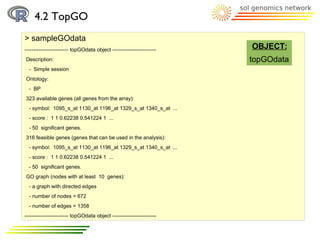
> sampleGOdata
------------------------- topGOdata object -------------------------   OBJECT:
Description:                                                           topGOdata
  - Simple session
Ontology:
  - BP
323 available genes (all genes from the array):
  - symbol: 1095_s_at 1130_at 1196_at 1329_s_at 1340_s_at ...
  - score : 1 1 0.62238 0.541224 1 ...
  - 50 significant genes.
316 feasible genes (genes that can be used in the analysis):
  - symbol: 1095_s_at 1130_at 1196_at 1329_s_at 1340_s_at ...
  - score : 1 1 0.62238 0.541224 1 ...
  - 50 significant genes.
GO graph (nodes with at least 10 genes):
  - a graph with directed edges
  - number of nodes = 672
  - number of edges = 1358
------------------------- topGOdata object -------------------------
4.2 TopGO

Methodology:
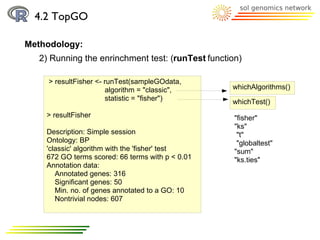
  2) Running the enrinchment test: (runTest function)

    > resultFisher <- runTest(sampleGOdata,
                      algorithm = "classic",      whichAlgorithms()
                      statistic = "fisher")       whichTest()
    > resultFisher                                 "fisher"
                                                   "ks"
    Description: Simple session                     "t"
    Ontology: BP                                    "globaltest"
    'classic' algorithm with the 'fisher' test     "sum"
    672 GO terms scored: 66 terms with p < 0.01    "ks.ties"
    Annotation data:
       Annotated genes: 316
       Significant genes: 50
       Min. no. of genes annotated to a GO: 10
       Nontrivial nodes: 607
4.2 TopGO

Methodology:
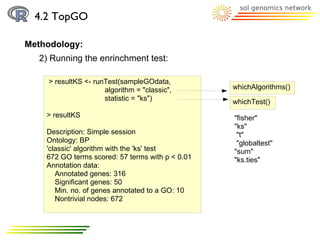
  2) Running the enrinchment test:

    > resultKS <- runTest(sampleGOdata,
                     algorithm = "classic",       whichAlgorithms()
                     statistic = "ks")            whichTest()
    > resultKS                                    "fisher"
                                                  "ks"
    Description: Simple session                    "t"
    Ontology: BP                                   "globaltest"
    'classic' algorithm with the 'ks' test        "sum"
    672 GO terms scored: 57 terms with p < 0.01   "ks.ties"
    Annotation data:
       Annotated genes: 316
       Significant genes: 50
       Min. no. of genes annotated to a GO: 10
       Nontrivial nodes: 672
4.2 TopGO

Methodology:
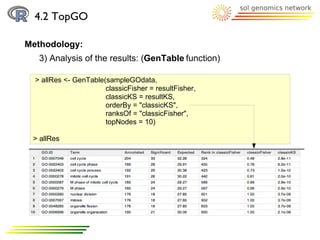
   3) Analysis of the results: (GenTable function)

  > allRes <- GenTable(sampleGOdata,
                       classicFisher = resultFisher,
                       classicKS = resultKS,
                       orderBy = "classicKS",
                       ranksOf = "classicFisher",
                       topNodes = 10)

 > allRes
Using R for GO Terms Analysis:
   1. What are GO terms ?
   2. What is R ?
   3. What is Bioconductor ?
   4. Bioconductor modules for GO terms
         4.1. Basics: GO.db
         4.2. Gene Enrinchment Analysis: TopGO
         4.3. GO profiles: GOProfiles
         4.4. Gene Similarities: GOSim
    5. Example.
         5.1. Comparing two arabidopsis chromosomes.
4.3 goProfiles

             http://www.bioconductor.org/packages/2.8/bioc/html/goProfiles.html


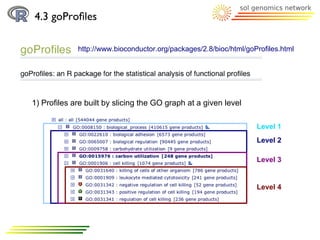
1) Profiles are built by slicing the GO graph at a given level

                                                                   Level 1
                                                                   Level 2

                                                                   Level 3


                                                                   Level 4
4.3 goProfiles
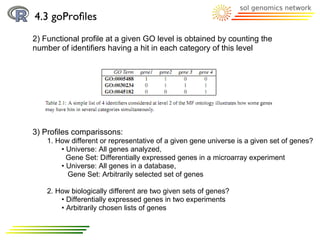
2) Functional profile at a given GO level is obtained by counting the
number of identifiers having a hit in each category of this level


3) Profiles comparissons:
    1. How different or representative of a given gene universe is a given set of genes?
        • Universe: All genes analyzed,
          Gene Set: Differentially expressed genes in a microarray experiment
        • Universe: All genes in a database,
          Gene Set: Arbitrarily selected set of genes

    2. How biologically different are two given sets of genes?
        • Differentially expressed genes in two experiments
        • Arbitrarily chosen lists of genes
4.3 goProfiles
Methodology:
   1) Data preparation:
       a) Gene GO term map (object or dataframe).
           Dataframe with 4 columns:
               + GeneID
               + Ontology
               + Evidence
               + GOID


   2) Profile creation:
       a) basicProfile function

          BasicProfile( genelist,                   “Entrez” (default),
                        idType = "Entrez",          “BiocProbes”,
                        onto = "ANY",               “GoTermsFrame”
                        Level = 2,
                        orgPackage=NULL,            Requested for “Entrez”
                        anotPackage=NULL,           Requested for
                        ...)                        “BiocProbes”
4.3 goProfiles
Methodology:
   2) Profile creation:
       a) basicProfile function

        > printProfiles(bpprofile)

        Functional Profile
        ==================
        [1] "BP ontology"
                      Description         GOID          Frequency
        25 cellular component biogen...   GO:0044085    5
        14 cellular component organi...   GO:0016043    6
        12          cellular process      GO:0009987   122
        32 establishment of localiza...   GO:0051234    4
        4     immune system process...    GO:0002376    1
        31            localization        GO:0051179    4
        2         metabolic process       GO:0008152    3
        33 multi-organism process...      GO:0051704    2
        30       response to stimulus     GO:0050896    4
4.3 goProfiles
Methodology:
   2) Profile creation:
       a) basicProfile function

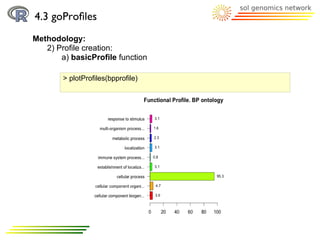
        > plotProfiles(bpprofile)
4.3 goProfiles
Methodology:
   2) Profile creation:
       b) expandedProfile function
            Used mainly for comparisons of profiles.

             ExpandedProfile( genelist,
                        idType = "Entrez",
                        onto = "ANY",
                        Level = 2,
                        orgPackage=NULL,
                        anotPackage=NULL
                        ...)

    3) Profile comparisons:

        - Case I (INCLUSION): One list incluided in the other.

        - Case || (DISJOINT): Non overlapping gene sets

        - Case III (INTERSECTION): Overlapping genes
4.3 goProfiles
Methodology:
   3) Profile comparisons:

       - Case I (INCLUSION):             compareProfilesLists()

       - Case || (DISJOINT):             compareGeneLists()

       - Case III (INTERSECTION):        compareGeneLists()


         > comp_ath_genes <- compareGeneLists(
               genelist1=ath_chl_list,
               genelist2=ath_mit_list,
               idType="Entrez", orgPackage="org.At.tair.db",
               onto="BP", level=2)

         > print(compSummary(comp_ath_genes))

            Sqr.Euc.Dist StdErr   pValue      0.95CI.low   0.95CI.up
            0.031401     0.024101 0.005000    -0.015837    0.078639
4.3 goProfiles
Methodology:
   3) Profile comparisons:

         > basic_mitprof <- basicProfile(ath_mit_list, idType="Entrez",
                 onto="BP", level=2, orgPackage="org.At.tair.db",
                 empty.cats=TRUE)

        > basic_chloprof <- basicProfile(ath_chl_list, idType="Entrez",
                 onto="BP", level=2, orgPackage="org.At.tair.db",
                 empty.cats=TRUE)

        > merged_prof <- mergeProfilesLists(basic_chloprof, basic_mitprof,
                profNames=c("Chloroplast", "Mitochondria"))

        > plotProfiles(merged_prof, percentage=TRUE, legend=TRUE)
4.3 goProfiles
Methodology:
   3) Profile comparisons:
Using R for GO Terms Analysis:
   1. What are GO terms ?
   2. What is R ?
   3. What is Bioconductor ?
   4. Bioconductor modules for GO terms
         4.1. Basics: GO.db
         4.2. Gene Enrinchment Analysis: TopGO
         4.3. GO profiles: GOProfiles
         4.4. Gene Similarities: GOSim
    5. Example.
         5.1. Comparing two arabidopsis chromosomes.
4.4 GOSim
Using R for GO Terms Analysis:
   1. What are GO terms ?
   2. What is R ?
   3. What is Bioconductor ?
   4. Bioconductor modules for GO terms
         4.1. Basics: GO.db
         4.2. Gene Enrinchment Analysis: TopGO
         4.3. GO profiles: GOProfiles
         4.4. Gene Similarities: GOSim
    5. Example.
         5.1. Comparing two arabidopsis chromosomes.
5 Example


Exercise 3:

   Compare the goProfiles for A. thaliana chromosomes 1 and 5.

   Are they significantly differents ?

   Source:
       ftp://ftp.arabidopsis.org/home/tair/Genes/

       TAIR10_genome_release/TAIR10_gene_lists/TAIR10_all_gene_models


   R Package:
       GoProfiles

GoTermsAnalysisWithR

  • 1.
    Using R forGO Terms Analysis Boyce Thompson Institute for Plant Research Tower Road Ithaca, New York 14853-1801 U.S.A. by Aureliano Bombarely Gomez
  • 2.
    Using R forGO Terms Analysis: 1. What are GO terms ? 2. What is R ? 3. What is Bioconductor ? 4. Bioconductor modules for GO terms 4.1. Basics: GO.db 4.2. Gene Enrinchment Analysis: TopGO 4.3. GO profiles: GOProfiles 4.4. Gene Similarities: GOSim 5. Example. 5.1. Comparing two arabidopsis chromosomes.
  • 3.
    Using R forGO Terms Analysis: 1. What are GO terms ? 2. What is R ? 3. What is Bioconductor ? 4. Bioconductor modules for GO terms 4.1. Basics: GO.db 4.2. Gene Enrinchment Analysis: TopGO 4.3. GO profiles: GOProfiles 4.4. Gene Similarities: GOSim 5. Example. 5.1. Comparing two arabidopsis chromosomes.
  • 4.
    1. What areGO Terms ? Gene ontologies: Structured controlled vocabularies (ontologies) that describe gene products in terms of their associated biological processes, cellular components and molecular functions in a species-independent manner http://www.geneontology.org/GO.doc.shtml
  • 5.
    1. What areGO Terms ? Biological processes, Recognized series of events or molecular functions. A process is a collection of molecular events with a defined beginning and end. Cellular components, Describes locations, at the levels of subcellular structures and macromolecular complexes. Molecular functions Describes activities, such as catalytic or binding activities, that occur at the molecular level.
  • 6.
    1. What areGO Terms ? Gene ontologies: Structured controlled vocabulariesbetween the terms relationships (ontologies) that describe gene products in terms ofbe described in terms of a acyclic graph, where: GO can their associated each GO term is a node, and the biological processes, the terms are arcs between the nodes relationships between cellular components and molecular functions in a species-independent manner
  • 7.
    Using R forGO Terms Analysis: 1. What are GO terms ? 2. What is R ? 3. What is Bioconductor ? 4. Bioconductor modules for GO terms 4.1. Basics: GO.db 4.2. Gene Enrinchment Analysis: TopGO 4.3. GO profiles: GOProfiles 4.4. Gene Similarities: GOSim 5. Example. 5.1. Comparing two arabidopsis chromosomes.
  • 8.
    2. What isR ? R is a language and environment for statistical computing and graphics. .
  • 9.
    2. What isR ? WEB: OFICIAL WEB: http://www.r-project.org/index.html QUICK-R: http://www.statmethods.net/index.html BOOKS: Introductory Statistics with R (Statistics and Computing), P. Dalgaard [available as manual at R project web] The R Book, MJ. Crawley R itself: help() and example()
  • 10.
    2. What isR ? INTEGRATED DEVELOPMENT ENVIRONMENT (IDE): R-Studio: http://rstudio.org/
  • 11.
    Using R forGO Terms Analysis: 1. What are GO terms ? 2. What is R ? 3. What is Bioconductor ? 4. Bioconductor modules for GO terms 4.1. Basics: GO.db 4.2. Gene Enrinchment Analysis: TopGO 4.3. GO profiles: GOProfiles 4.4. Gene Similarities: GOSim 5. Example. 5.1. Comparing two arabidopsis chromosomes.
  • 12.
    3. What isBioconductor ? Bioconductor is an open source, open development software project to provide tools for the analysis and comprehension of high-throughput genomic data. It is based primarily on the R programming language.
  • 13.
    3. What isBioconductor ? WEB: OFICIAL WEB: http://www.bioconductor.org/ BOOKS: Bioinformatics and Computational Biology Solutions Using R and Bioconductor, 2005, Gentleman R. et al. (Springer) R Programming for Bioinformatics, 2008, Gentleman R. (CRC Press) MAILING LIST: http://www.bioconductor.org/help/mailing-list/
  • 14.
    3. What isBioconductor ? Installation of Bioconductor:
  • 15.
    3. What isBioconductor ? Use of Bioconductor:
  • 16.
    Using R forGO Terms Analysis: 1. What are GO terms ? 2. What is R ? 3. What is Bioconductor ? 4. Bioconductor modules for GO terms 4.1. Basics: GO.db 4.2. Gene Similarities: GOSim 4.3. GO profiles: GOProfiles 4.4. Gene Enrinchment Analysis:TopGO 5. Example. 5.1. Comparing two arabidopsis chromosomes.
  • 17.
    4. Bioconductor modulesfor GOterms Bioconductor Packages for GO Terms:
  • 18.
    4. Bioconductor modulesfor GOterms Bioconductor Packages for GO Terms: GO.db A set of annotation maps describing the entire Gene Ontology Gostats Tools for manipulating GO and microarrays GOSim functional similarities between GO terms and gene products GOProfiles Statistical analysis of functional profiles TopGO Enrichment analysis for Gene Ontology
  • 19.
    Using R forGO Terms Analysis: 1. What are GO terms ? 2. What is R ? 3. What is Bioconductor ? 4. Bioconductor modules for GO terms 4.1. Basics: GO.db 4.2. Gene Enrinchment Analysis: TopGO 4.3. GO profiles: GOProfiles 4.4. Gene Similarities: GOSim 5. Example. 5.1. Comparing two arabidopsis chromosomes.
  • 20.
    4.1 GO.db http://www.bioconductor.org/packages/2.9/data/annotation/html/GO.db.html 1) GO terms stored in objects GOTERM, GOBPPARENTS, GOCCPARENTS, GOMFPARENTS GOBPANCESTOR, GOCCANCESTOR, GOMFANCESTOR GOBPCHILDREN, GOCCCHILDREN, GOMFCHILDREN GOBPOFFSPRING, GOCCOFFSPRING, GOMFOFFSPRING More Information: http://www.bioconductor.org/packages/2.6/bioc/vignettes/annotate/inst/doc/GOusage.pdf
  • 21.
    4.1 GO.db GOBPANCESTOR GOBPANCESTOR$"GO:0006720” GOBPPARENTS GOBPPARENTS$"GO:0006720” GOTERM GOTERM$"GO:0006720” GOBPCHILDREN GOBPCHILDREN$"GO:0006720” GOBPOFFSPRING GOBPOFFSPRING$"GO:0006720”
  • 22.
    4.1 GO.db Exercise 1: 1.1 Which term correspond top the GOID: GO:0006720 ? 1.2 How many synonyms has this term ? 1.3 How many children ? 1.4 … and parents ? 1.5 … and offsprings ? 1.6 … and ancestors ?
  • 23.
    4.1 GO.db 2) Mappingbetween gene and GO terms stored in objects or dataframes. org.At.tair.db Genome wide annotation for Arabidopsis, primarily based on mapping using TAIR identifiers.
  • 24.
    4.1 GO.db 2) Mappingbetween gene and GO terms stored in objects (annotate package) or dataframes. > library("org.At.tair.db") > org.At.tairGO[["AT5G58560"]] Use a list: > org.At.tairGO[["AT5G58560"]][[1]]$Ontology Functions (“annotate” package): + getOntology(inlist, gocategorylist) + getEvidence(inlist) > getOntology(org.At.tairGO[["AT5G58560"]]) > getEvidence(org.At.tairGO[["AT5G58560"]])
  • 25.
    4.1 GO.db Exercise 2: 2.1 How many terms map with the gene: AT5G58560 ? 2.2 What biological process terms map with this gene? 2.3 What evidences are associated with these terms ?
  • 26.
    Using R forGO Terms Analysis: 1. What are GO terms ? 2. What is R ? 3. What is Bioconductor ? 4. Bioconductor modules for GO terms 4.1. Basics: GO.db 4.2. Gene Enrinchment Analysis: TopGO 4.3. GO profiles: GOProfiles 4.4. Gene Similarities: GOSim 5. Example. 5.1. Comparing two arabidopsis chromosomes.
  • 27.
    4.2 TopGO Gene SetEnrinchment Analysis (GSEA) Computational method that determines whether an a priori defined set of genes shows statistically significant, concordant differences between two biological states (e.g. phenotypes). Documentation: http://www.broadinstitute.org/gsea/index.jsp
  • 28.
    4.2 TopGO http://www.bioconductor.org/packages/release/bioc/html/topGO.html
  • 29.
    4.2 TopGO Methodology: 1) Data preparation: a) Gene Universe. OBJECT: b) GO Annotation. topGOdata c) Criteria to select interesting genes. > sampleGOdata <- new("topGOdata", description = "Simple session", ontology = "BP", allGenes = geneList, Gene Universe geneSel = topDiffGenes, Selected Genes nodeSize = 10, Function to map data provided annot = annFUN.db, in the annotation data packages affyLib = “hgu95av2.db”) Data package
  • 30.
    4.2 TopGO > sampleGOdata -------------------------topGOdata object ------------------------- OBJECT: Description: topGOdata - Simple session Ontology: - BP 323 available genes (all genes from the array): - symbol: 1095_s_at 1130_at 1196_at 1329_s_at 1340_s_at ... - score : 1 1 0.62238 0.541224 1 ... - 50 significant genes. 316 feasible genes (genes that can be used in the analysis): - symbol: 1095_s_at 1130_at 1196_at 1329_s_at 1340_s_at ... - score : 1 1 0.62238 0.541224 1 ... - 50 significant genes. GO graph (nodes with at least 10 genes): - a graph with directed edges - number of nodes = 672 - number of edges = 1358 ------------------------- topGOdata object -------------------------
  • 31.
    4.2 TopGO Methodology: 2) Running the enrinchment test: (runTest function) > resultFisher <- runTest(sampleGOdata, algorithm = "classic", whichAlgorithms() statistic = "fisher") whichTest() > resultFisher "fisher" "ks" Description: Simple session "t" Ontology: BP "globaltest" 'classic' algorithm with the 'fisher' test "sum" 672 GO terms scored: 66 terms with p < 0.01 "ks.ties" Annotation data: Annotated genes: 316 Significant genes: 50 Min. no. of genes annotated to a GO: 10 Nontrivial nodes: 607
  • 32.
    4.2 TopGO Methodology: 2) Running the enrinchment test: > resultKS <- runTest(sampleGOdata, algorithm = "classic", whichAlgorithms() statistic = "ks") whichTest() > resultKS "fisher" "ks" Description: Simple session "t" Ontology: BP "globaltest" 'classic' algorithm with the 'ks' test "sum" 672 GO terms scored: 57 terms with p < 0.01 "ks.ties" Annotation data: Annotated genes: 316 Significant genes: 50 Min. no. of genes annotated to a GO: 10 Nontrivial nodes: 672
  • 33.
    4.2 TopGO Methodology: 3) Analysis of the results: (GenTable function) > allRes <- GenTable(sampleGOdata, classicFisher = resultFisher, classicKS = resultKS, orderBy = "classicKS", ranksOf = "classicFisher", topNodes = 10) > allRes
  • 34.
    Using R forGO Terms Analysis: 1. What are GO terms ? 2. What is R ? 3. What is Bioconductor ? 4. Bioconductor modules for GO terms 4.1. Basics: GO.db 4.2. Gene Enrinchment Analysis: TopGO 4.3. GO profiles: GOProfiles 4.4. Gene Similarities: GOSim 5. Example. 5.1. Comparing two arabidopsis chromosomes.
  • 35.
    4.3 goProfiles http://www.bioconductor.org/packages/2.8/bioc/html/goProfiles.html 1) Profiles are built by slicing the GO graph at a given level Level 1 Level 2 Level 3 Level 4
  • 36.
    4.3 goProfiles 2) Functionalprofile at a given GO level is obtained by counting the number of identifiers having a hit in each category of this level 3) Profiles comparissons: 1. How different or representative of a given gene universe is a given set of genes? • Universe: All genes analyzed, Gene Set: Differentially expressed genes in a microarray experiment • Universe: All genes in a database, Gene Set: Arbitrarily selected set of genes 2. How biologically different are two given sets of genes? • Differentially expressed genes in two experiments • Arbitrarily chosen lists of genes
  • 37.
    4.3 goProfiles Methodology: 1) Data preparation: a) Gene GO term map (object or dataframe). Dataframe with 4 columns: + GeneID + Ontology + Evidence + GOID 2) Profile creation: a) basicProfile function BasicProfile( genelist, “Entrez” (default), idType = "Entrez", “BiocProbes”, onto = "ANY", “GoTermsFrame” Level = 2, orgPackage=NULL, Requested for “Entrez” anotPackage=NULL, Requested for ...) “BiocProbes”
  • 38.
    4.3 goProfiles Methodology: 2) Profile creation: a) basicProfile function > printProfiles(bpprofile) Functional Profile ================== [1] "BP ontology" Description GOID Frequency 25 cellular component biogen... GO:0044085 5 14 cellular component organi... GO:0016043 6 12 cellular process GO:0009987 122 32 establishment of localiza... GO:0051234 4 4 immune system process... GO:0002376 1 31 localization GO:0051179 4 2 metabolic process GO:0008152 3 33 multi-organism process... GO:0051704 2 30 response to stimulus GO:0050896 4
  • 39.
    4.3 goProfiles Methodology: 2) Profile creation: a) basicProfile function > plotProfiles(bpprofile)
  • 40.
    4.3 goProfiles Methodology: 2) Profile creation: b) expandedProfile function Used mainly for comparisons of profiles. ExpandedProfile( genelist, idType = "Entrez", onto = "ANY", Level = 2, orgPackage=NULL, anotPackage=NULL ...) 3) Profile comparisons: - Case I (INCLUSION): One list incluided in the other. - Case || (DISJOINT): Non overlapping gene sets - Case III (INTERSECTION): Overlapping genes
  • 41.
    4.3 goProfiles Methodology: 3) Profile comparisons: - Case I (INCLUSION): compareProfilesLists() - Case || (DISJOINT): compareGeneLists() - Case III (INTERSECTION): compareGeneLists() > comp_ath_genes <- compareGeneLists( genelist1=ath_chl_list, genelist2=ath_mit_list, idType="Entrez", orgPackage="org.At.tair.db", onto="BP", level=2) > print(compSummary(comp_ath_genes)) Sqr.Euc.Dist StdErr pValue 0.95CI.low 0.95CI.up 0.031401 0.024101 0.005000 -0.015837 0.078639
  • 42.
    4.3 goProfiles Methodology: 3) Profile comparisons: > basic_mitprof <- basicProfile(ath_mit_list, idType="Entrez", onto="BP", level=2, orgPackage="org.At.tair.db", empty.cats=TRUE) > basic_chloprof <- basicProfile(ath_chl_list, idType="Entrez", onto="BP", level=2, orgPackage="org.At.tair.db", empty.cats=TRUE) > merged_prof <- mergeProfilesLists(basic_chloprof, basic_mitprof, profNames=c("Chloroplast", "Mitochondria")) > plotProfiles(merged_prof, percentage=TRUE, legend=TRUE)
  • 43.
    4.3 goProfiles Methodology: 3) Profile comparisons:
  • 44.
    Using R forGO Terms Analysis: 1. What are GO terms ? 2. What is R ? 3. What is Bioconductor ? 4. Bioconductor modules for GO terms 4.1. Basics: GO.db 4.2. Gene Enrinchment Analysis: TopGO 4.3. GO profiles: GOProfiles 4.4. Gene Similarities: GOSim 5. Example. 5.1. Comparing two arabidopsis chromosomes.
  • 45.
  • 46.
    Using R forGO Terms Analysis: 1. What are GO terms ? 2. What is R ? 3. What is Bioconductor ? 4. Bioconductor modules for GO terms 4.1. Basics: GO.db 4.2. Gene Enrinchment Analysis: TopGO 4.3. GO profiles: GOProfiles 4.4. Gene Similarities: GOSim 5. Example. 5.1. Comparing two arabidopsis chromosomes.
  • 47.
    5 Example Exercise 3: Compare the goProfiles for A. thaliana chromosomes 1 and 5. Are they significantly differents ? Source: ftp://ftp.arabidopsis.org/home/tair/Genes/ TAIR10_genome_release/TAIR10_gene_lists/TAIR10_all_gene_models R Package: GoProfiles