The Epsilon-Delta
Definition of a
Limit
A Calc I
Topic
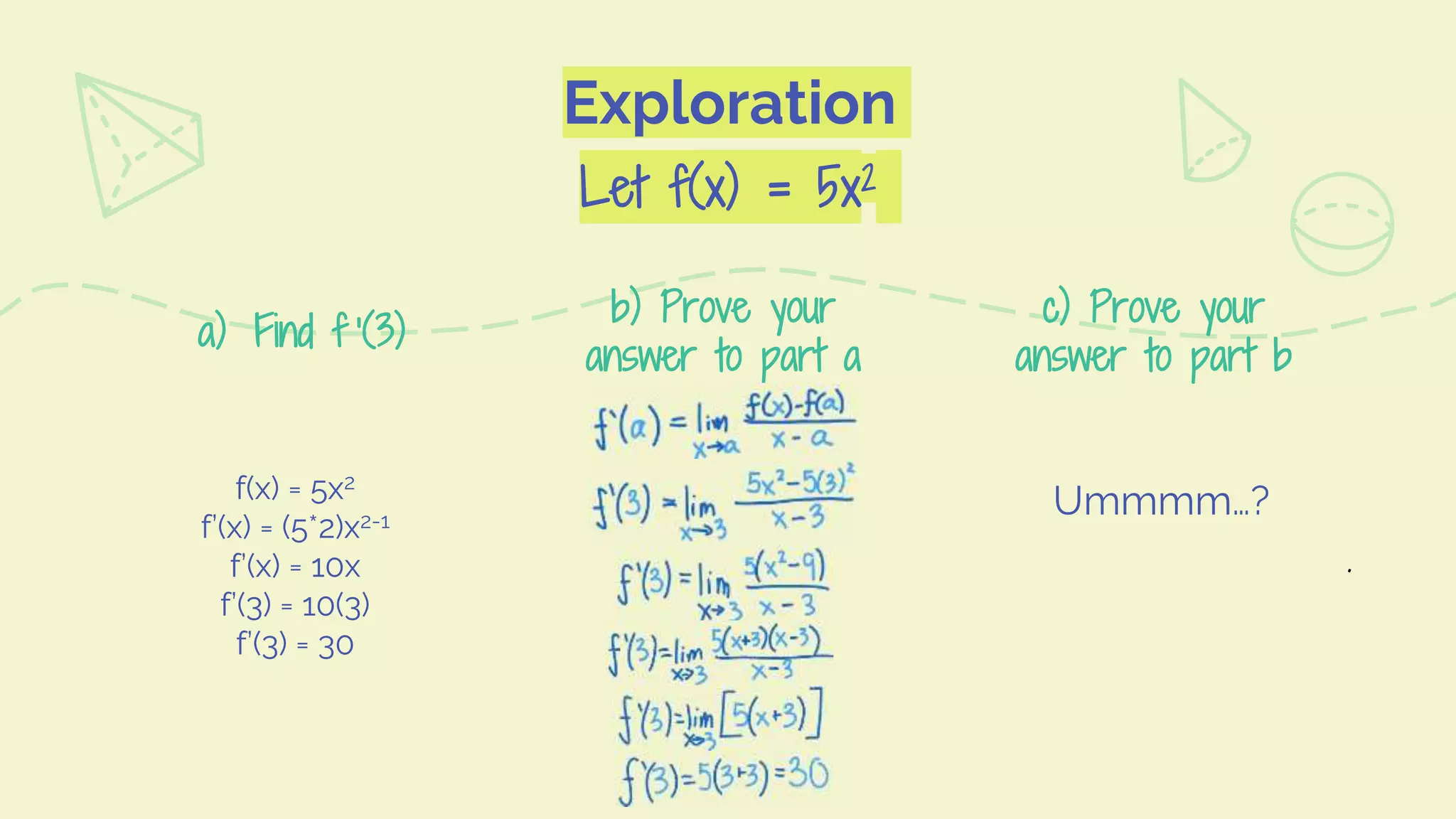
a) Find f ’(3)
c) Prove your
answer to part b
b) Prove your
answer to part a
Exploration
Let f(x) = 5x2
f(x) = 5x2
f’(x) = (5*2)x2-1
f’(x) = 10x
f’(3) = 10(3)
f’(3) = 30
Ummmm…?
Well… what is a limit?
If f(x) becomes arbitrarily close to a single number L as x approaches c
from either side, the limit of f(x), as x approaches c, is L, or
lim f(x) = L
x→c
f(x) becomes “arbitrarily” close to L?
f(x) “approaches” c?
This seems pretty unspecific.
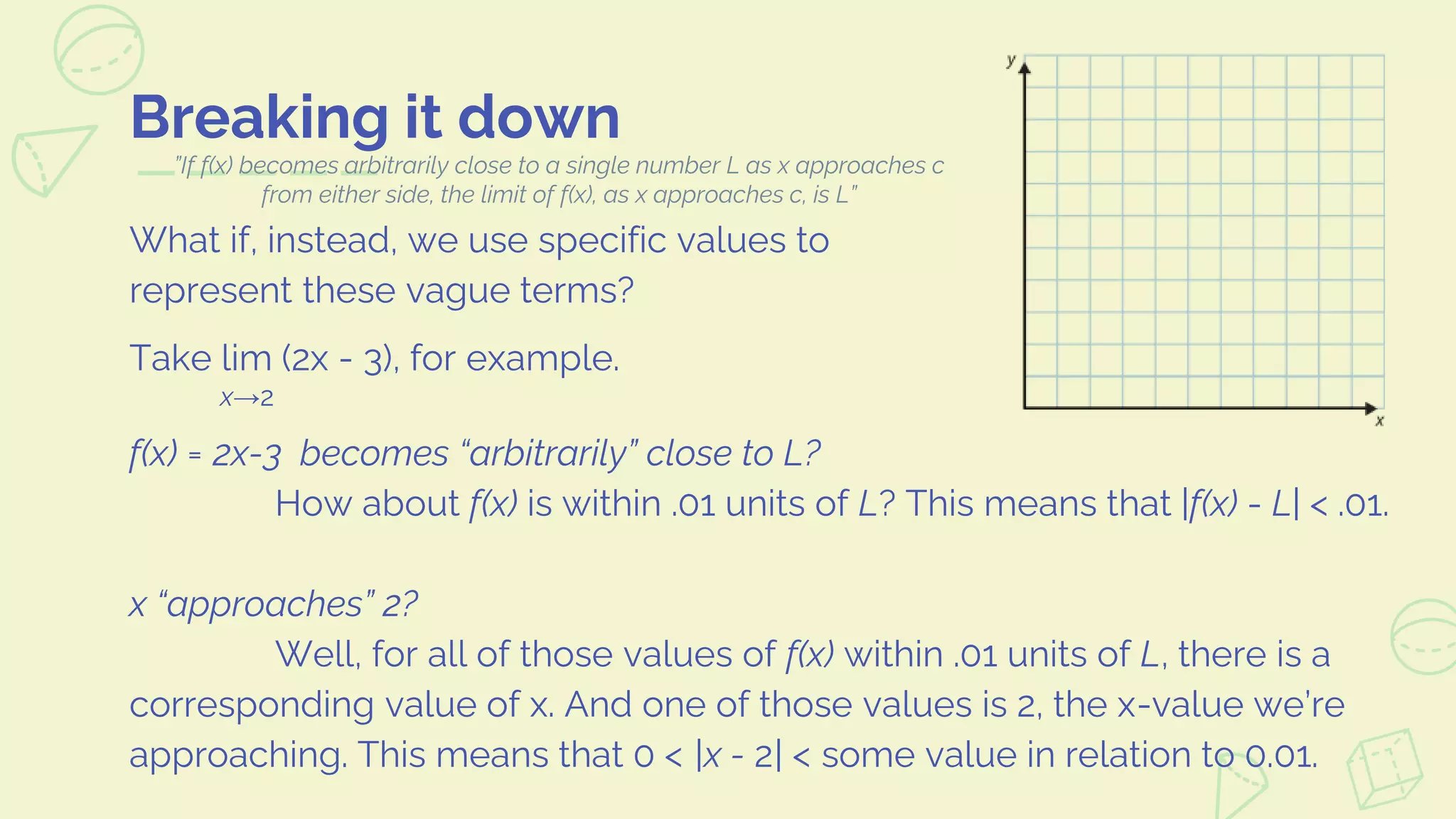
Breaking it down
What if, instead, we use specific values to
represent these vague terms?
Take lim (2x - 3), for example.
x→2
f(x) = 2x-3 becomes “arbitrarily” close to L?
How about f(x) is within .01 units of L? This means that |f(x) - L| < .01.
x “approaches” 2?
Well, for all of those values of f(x) within .01 units of L, there is a
corresponding value of x. And one of those values is 2, the x-value we’re
approaching. This means that 0 < |x - 2| < some value in relation to 0.01.
”If f(x) becomes arbitrarily close to a single number L as x approaches c
from either side, the limit of f(x), as x approaches c, is L”
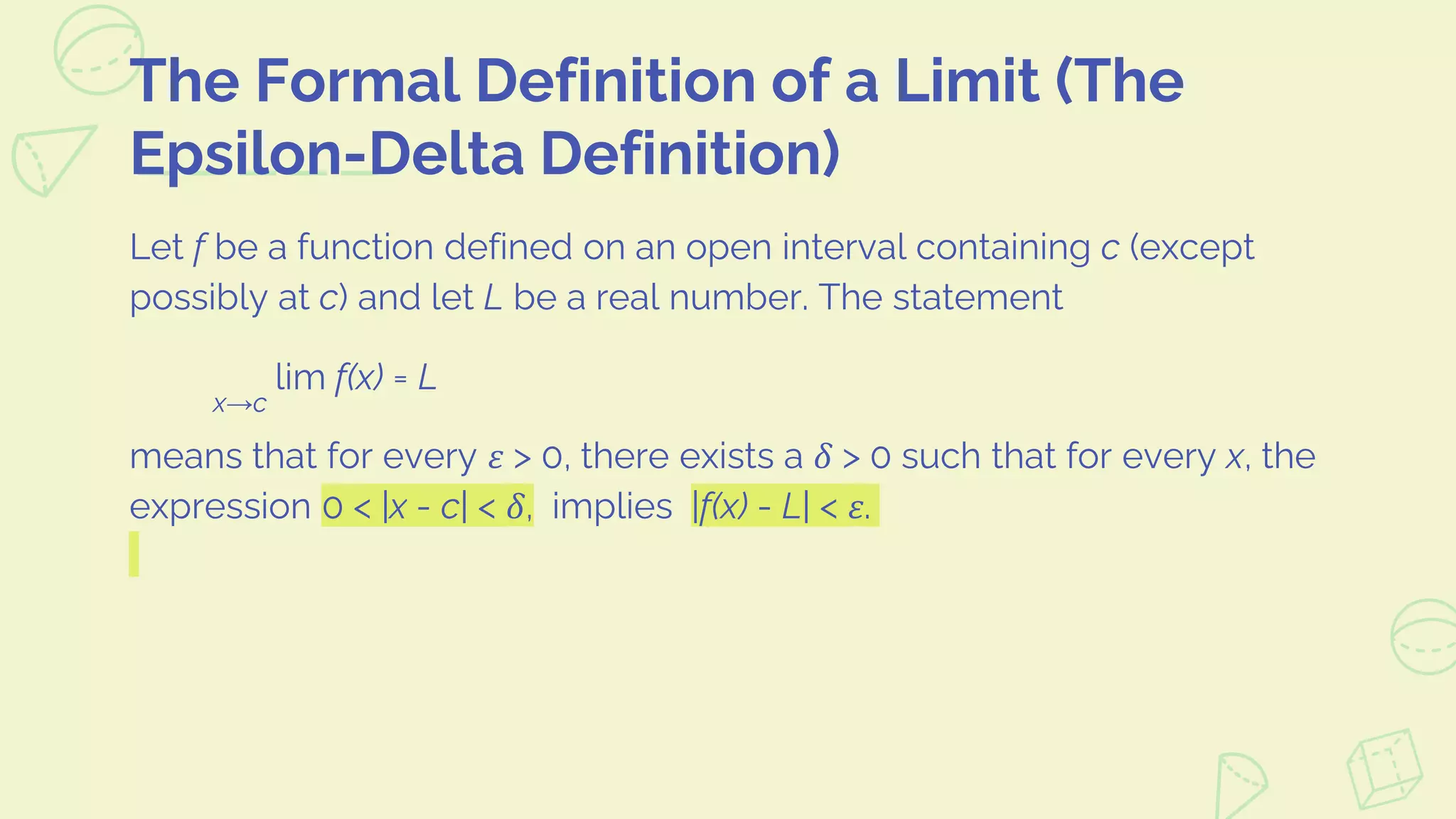
The Formal Definition of a Limit (The
Epsilon-Delta Definition)
Let f be a function defined on an open interval containing c (except
possibly at c) and let L be a real number. The statement
lim f(x) = L
x→c
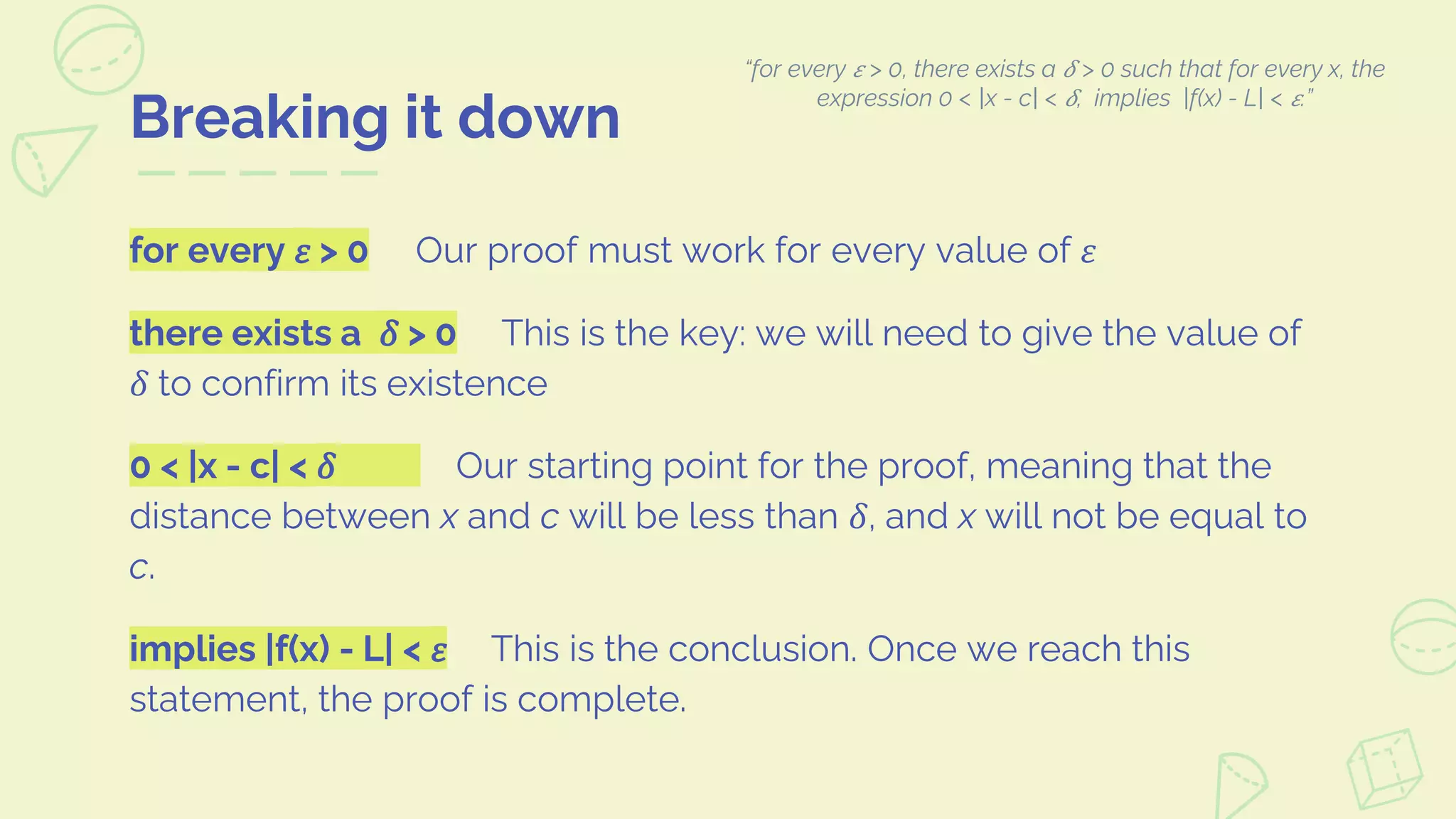
means that for every 𝜀 > 0, there exists a 𝛿 > 0 such that for every x, the
expression 0 < |x - c| < 𝛿, implies |f(x) - L| < 𝜀.
In simpler terms, this means: if the distance between x and c is less
than 𝛿, then the distance between the corresponding value of f(x) and
the limit is less than 𝜀.
for every 𝜀 > 0 Our proof must work for every value of 𝜀
there exists a 𝛿 > 0 This is the key: we will need to give the value of
𝛿 to confirm its existence
0 < |x - c| < 𝛿 Our starting point for the proof, meaning that the
distance between x and c will be less than 𝛿, and x will not be equal to
c.
implies |f(x) - L| < 𝜀 This is the conclusion. Once we reach this
statement, the proof is complete.
Breaking it down
“for every 𝜀 > 0, there exists a 𝛿 > 0 such that for every x, the
expression 0 < |x - c| < 𝛿, implies |f(x) - L| < 𝜀.”
Let’s Practice!
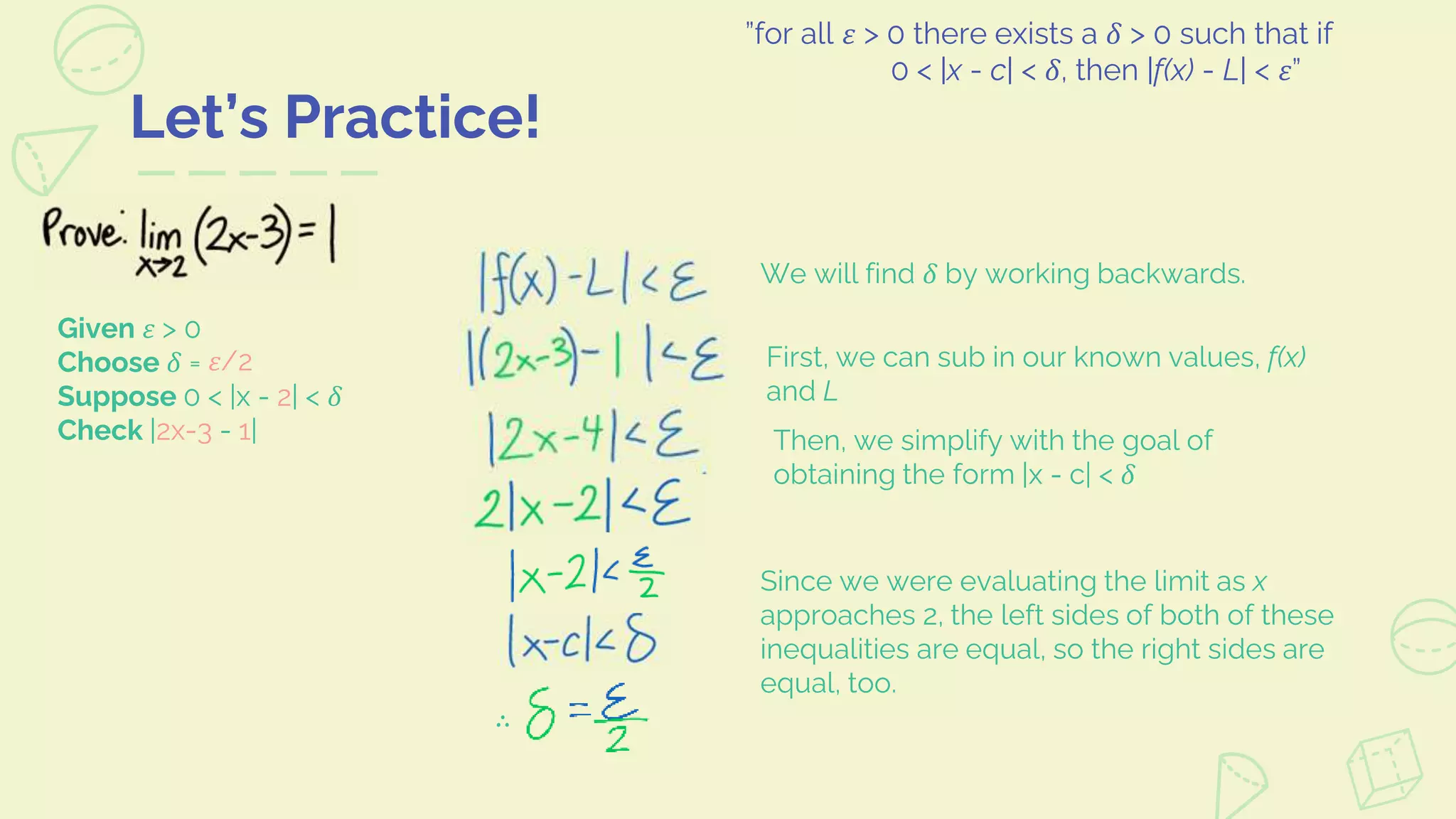
”for all 𝜀 > 0 there exists a 𝛿 > 0 such that if
0 < |x - c| < 𝛿, then |f(x) - L| < 𝜀”
We will find 𝛿 by working backwards.
First, we can sub in our known values, f(x)
and L
Then, we simplify with the goal of
obtaining the form |x - c| < 𝛿
Since we were evaluating the limit as x
approaches 2, the left sides of both of these
inequalities are equal, so the right sides are
equal, too.
Given 𝜀 > 0
Choose 𝛿 =
Suppose 0 < |x - 2| < 𝛿
Check |2x-3 - 1|
𝜀/2
∴
Let’s Practice!
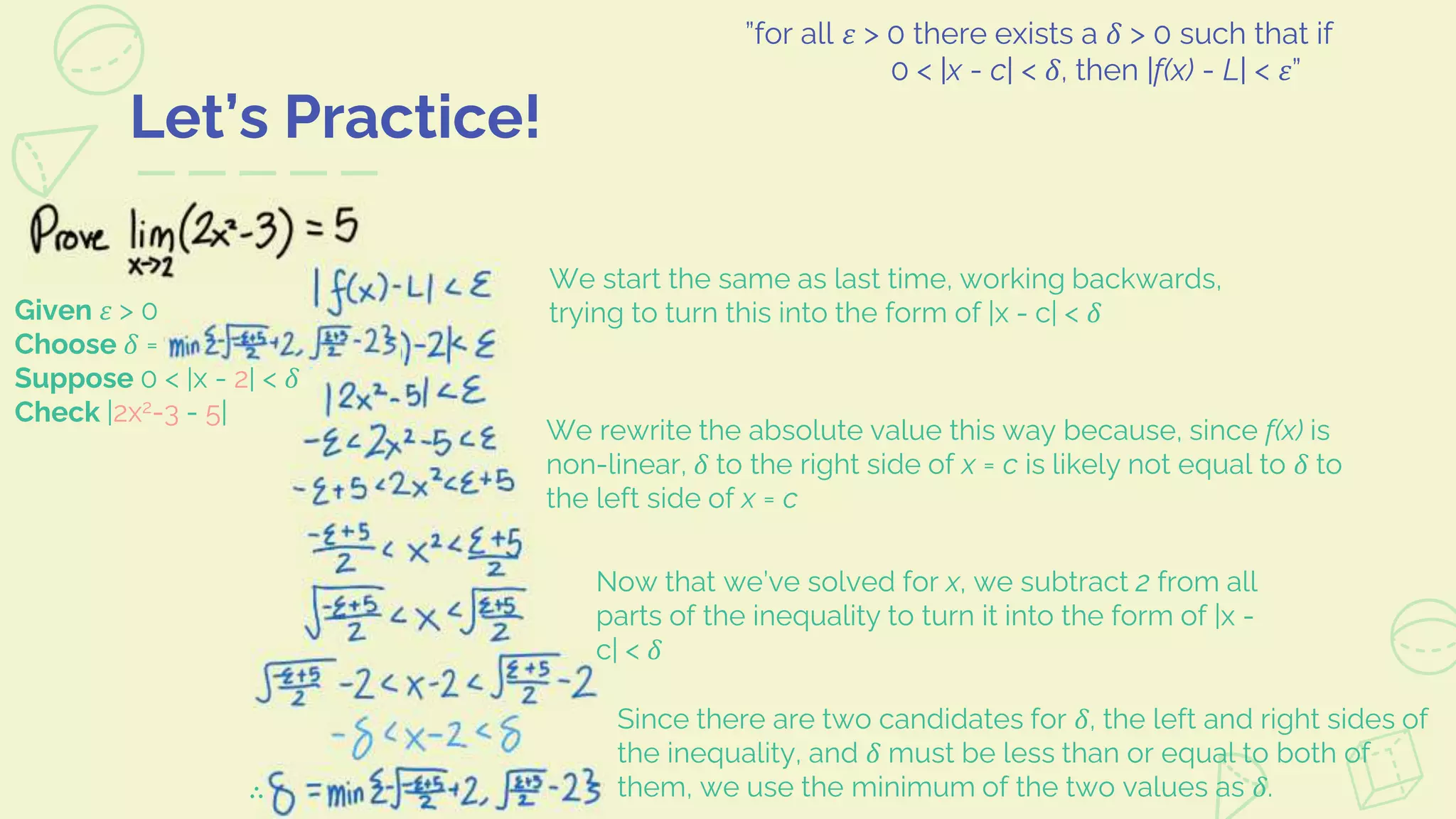
”for all 𝜀 > 0 there exists a 𝛿 > 0 such that if
0 < |x - c| < 𝛿, then |f(x) - L| < 𝜀”
We start the same as last time, working backwards,
trying to turn this into the form of |x - c| < 𝛿
We rewrite the absolute value this way because, since f(x) is
non-linear, 𝛿 to the right side of x = c is likely not equal to 𝛿 to
the left side of x = c
Now that we’ve solved for x, we subtract 2 from all
parts of the inequality to turn it into the form of |x -
c| < 𝛿
Since there are two candidates for 𝛿, the left and right sides of
the inequality, and 𝛿 must be less than or equal to both of
them, we use the minimum of the two values as 𝛿.
Given 𝜀 > 0
Choose 𝛿 =
Suppose 0 < |x - 2| < 𝛿
Check |2x2-3 - 5|
∴
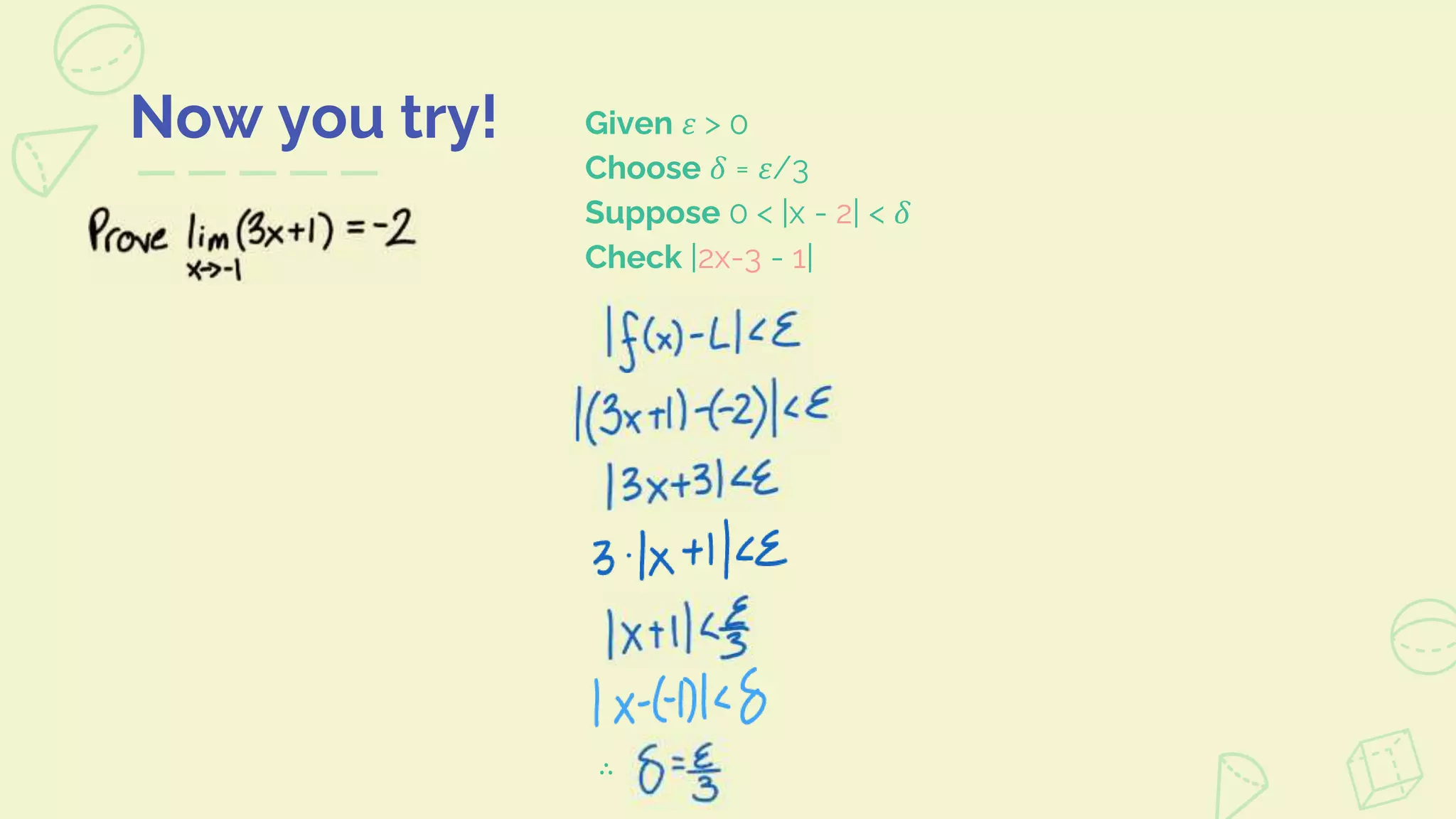
Now you try! Given 𝜀 > 0
Choose 𝛿 = 𝜀/3
Suppose 0 < |x - 2| < 𝛿
Check |2x-3 - 1|
∴
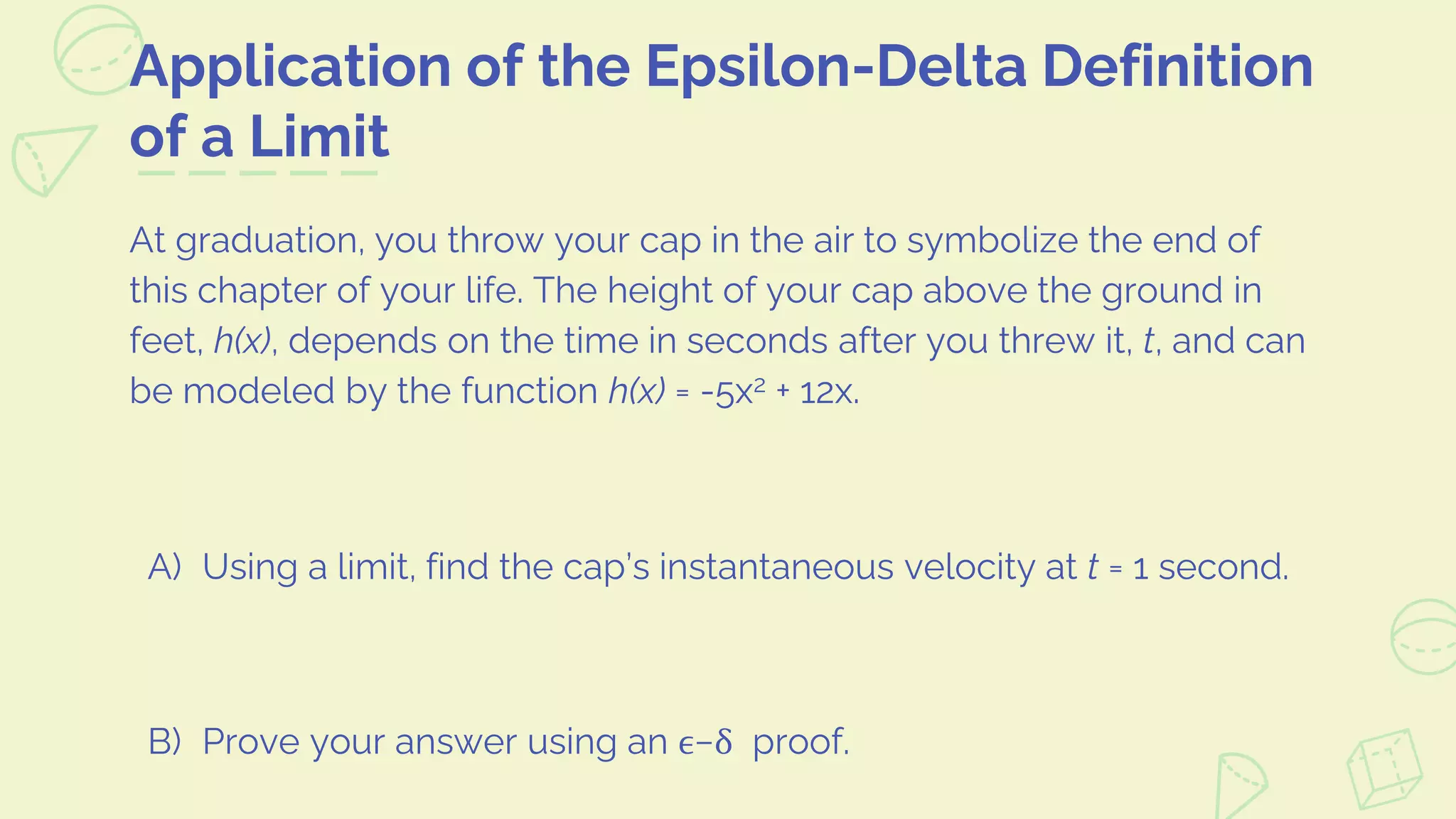
Application of the Epsilon-Delta Definition
of a Limit
At graduation, you throw your cap in the air to symbolize the end of
this chapter of your life. The height of your cap above the ground in
feet, h(x), depends on the time in seconds after you threw it, t, and can
be modeled by the function h(x) = -5x2 + 12x.
A) Using a limit, find the cap’s instantaneous velocity at t = 1 second.
B) Prove your answer using an ϵ−δ proof.
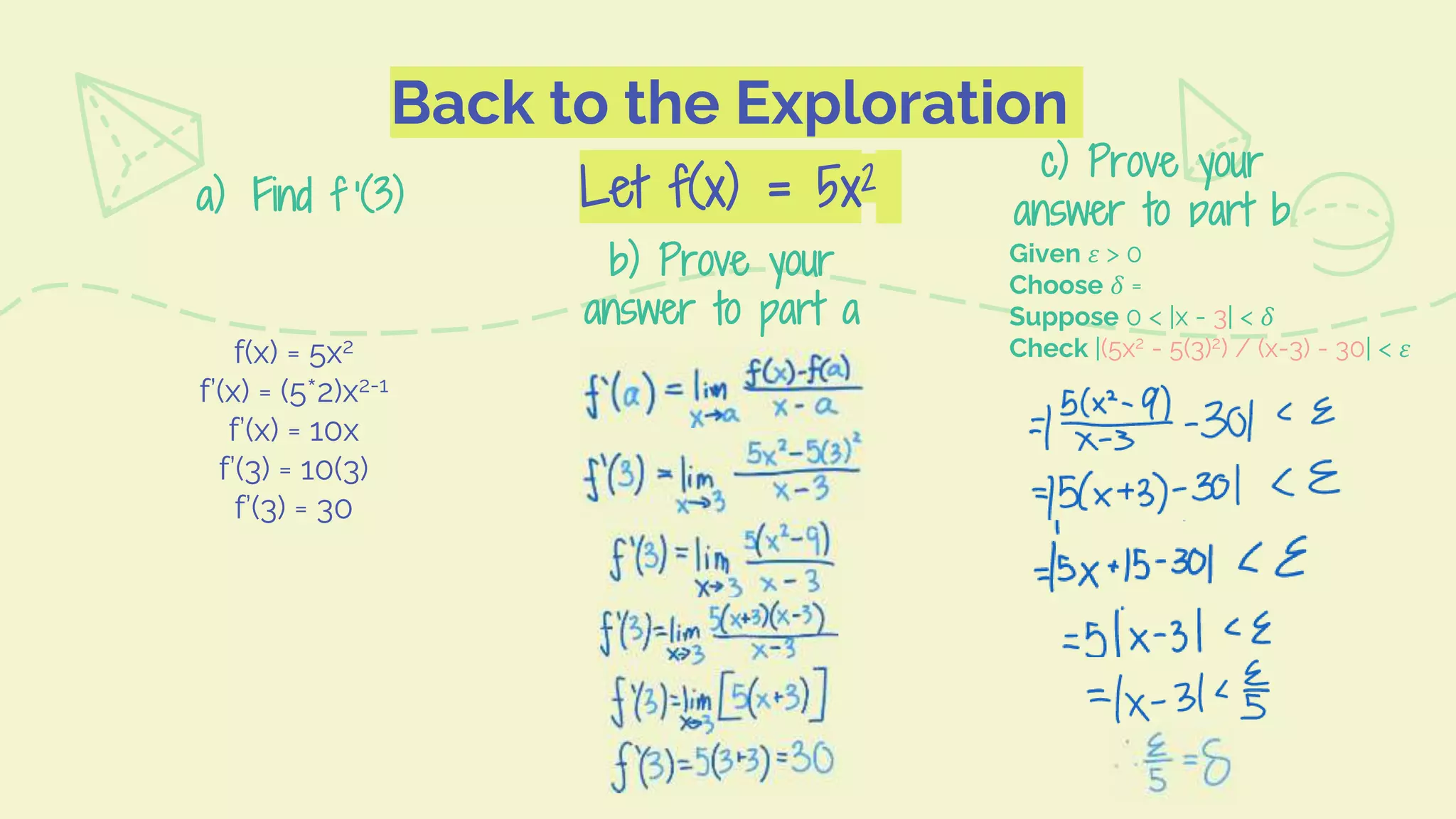
a) Find f ’(3)
c) Prove your
answer to part b
b) Prove your
answer to part a
Back to the Exploration
Let f(x) = 5x2
f(x) = 5x2
f’(x) = (5*2)x2-1
f’(x) = 10x
f’(3) = 10(3)
f’(3) = 30
Ummmm…?
Given 𝜀 > 0
Choose 𝛿 =
Suppose 0 < |x - 3| < 𝛿
Check |(5x2 - 5(3)2) / (x-3) - 30| < 𝜀
Works Cited
“The Hardest Calc 1 Topic, the Epsilon-Delta Definition of a Limit”. YouTube, uploaded by
blackpenredpen, 15 Jan. 2022, https://www.youtube.com/watch?v=DdtEQk_DHQs.
“Epsilon Delta Definition Of A Limit.” Calcworkshop, 22 Feb. 2021,
https://calcworkshop.com/limits/epsilon-delta-definition/.
Hartman, Gregory. “1.2: Epsilon-Delta Definition of a Limit.” Mathematics LibreTexts, NICE CXone
Expert, 21 Dec. 2020, https://math.libretexts.org/Bookshelves/Calculus/Book%3A_Calculus_(Apex)
/01%3A_Limits/1.02%3A_Epsilon-Delta_Definition_of_a_Limit.
“How To Construct a Delta-Epsilon Proof.” How to Construct a Delta-Epsilon Proof,
http://www.milefoot.com/math/calculus/limits/DeltaEpsilonProofs03.htm.
LARSON, RON. “Limits and Their Properties.” Calculus of a Single Variable, 7th ed., CENGAGE
LEARNING, S.l., 2022.
“Limits and Continuity | AP®︎/College Calculus AB | Math.” Khan Academy, Khan Academy,
https://www.khanacademy.org/math/ap-calculus-ab/ab-limits-new#ab-limits-optional.

The Epsilon-Delta Definition of a Limit

  • 1.
    The Epsilon-Delta Definition ofa Limit A Calc I Topic
  • 2.
    a) Find f’(3) c) Prove your answer to part b b) Prove your answer to part a Exploration Let f(x) = 5x2 f(x) = 5x2 f’(x) = (5*2)x2-1 f’(x) = 10x f’(3) = 10(3) f’(3) = 30 Ummmm…?
  • 3.
    Well… what isa limit? If f(x) becomes arbitrarily close to a single number L as x approaches c from either side, the limit of f(x), as x approaches c, is L, or lim f(x) = L x→c f(x) becomes “arbitrarily” close to L? f(x) “approaches” c? This seems pretty unspecific.
  • 4.
    Breaking it down Whatif, instead, we use specific values to represent these vague terms? Take lim (2x - 3), for example. x→2 f(x) = 2x-3 becomes “arbitrarily” close to L? How about f(x) is within .01 units of L? This means that |f(x) - L| < .01. x “approaches” 2? Well, for all of those values of f(x) within .01 units of L, there is a corresponding value of x. And one of those values is 2, the x-value we’re approaching. This means that 0 < |x - 2| < some value in relation to 0.01. ”If f(x) becomes arbitrarily close to a single number L as x approaches c from either side, the limit of f(x), as x approaches c, is L”
  • 5.
    The Formal Definitionof a Limit (The Epsilon-Delta Definition) Let f be a function defined on an open interval containing c (except possibly at c) and let L be a real number. The statement lim f(x) = L x→c means that for every 𝜀 > 0, there exists a 𝛿 > 0 such that for every x, the expression 0 < |x - c| < 𝛿, implies |f(x) - L| < 𝜀.
  • 6.
    In simpler terms,this means: if the distance between x and c is less than 𝛿, then the distance between the corresponding value of f(x) and the limit is less than 𝜀.
  • 7.
    for every 𝜀> 0 Our proof must work for every value of 𝜀 there exists a 𝛿 > 0 This is the key: we will need to give the value of 𝛿 to confirm its existence 0 < |x - c| < 𝛿 Our starting point for the proof, meaning that the distance between x and c will be less than 𝛿, and x will not be equal to c. implies |f(x) - L| < 𝜀 This is the conclusion. Once we reach this statement, the proof is complete. Breaking it down “for every 𝜀 > 0, there exists a 𝛿 > 0 such that for every x, the expression 0 < |x - c| < 𝛿, implies |f(x) - L| < 𝜀.”
  • 8.
    Let’s Practice! ”for all𝜀 > 0 there exists a 𝛿 > 0 such that if 0 < |x - c| < 𝛿, then |f(x) - L| < 𝜀” We will find 𝛿 by working backwards. First, we can sub in our known values, f(x) and L Then, we simplify with the goal of obtaining the form |x - c| < 𝛿 Since we were evaluating the limit as x approaches 2, the left sides of both of these inequalities are equal, so the right sides are equal, too. Given 𝜀 > 0 Choose 𝛿 = Suppose 0 < |x - 2| < 𝛿 Check |2x-3 - 1| 𝜀/2 ∴
  • 9.
    Let’s Practice! ”for all𝜀 > 0 there exists a 𝛿 > 0 such that if 0 < |x - c| < 𝛿, then |f(x) - L| < 𝜀” We start the same as last time, working backwards, trying to turn this into the form of |x - c| < 𝛿 We rewrite the absolute value this way because, since f(x) is non-linear, 𝛿 to the right side of x = c is likely not equal to 𝛿 to the left side of x = c Now that we’ve solved for x, we subtract 2 from all parts of the inequality to turn it into the form of |x - c| < 𝛿 Since there are two candidates for 𝛿, the left and right sides of the inequality, and 𝛿 must be less than or equal to both of them, we use the minimum of the two values as 𝛿. Given 𝜀 > 0 Choose 𝛿 = Suppose 0 < |x - 2| < 𝛿 Check |2x2-3 - 5| ∴
  • 10.
    Now you try!Given 𝜀 > 0 Choose 𝛿 = 𝜀/3 Suppose 0 < |x - 2| < 𝛿 Check |2x-3 - 1| ∴
  • 11.
    Application of theEpsilon-Delta Definition of a Limit At graduation, you throw your cap in the air to symbolize the end of this chapter of your life. The height of your cap above the ground in feet, h(x), depends on the time in seconds after you threw it, t, and can be modeled by the function h(x) = -5x2 + 12x. A) Using a limit, find the cap’s instantaneous velocity at t = 1 second. B) Prove your answer using an ϵ−δ proof.
  • 12.
    a) Find f’(3) c) Prove your answer to part b b) Prove your answer to part a Back to the Exploration Let f(x) = 5x2 f(x) = 5x2 f’(x) = (5*2)x2-1 f’(x) = 10x f’(3) = 10(3) f’(3) = 30 Ummmm…? Given 𝜀 > 0 Choose 𝛿 = Suppose 0 < |x - 3| < 𝛿 Check |(5x2 - 5(3)2) / (x-3) - 30| < 𝜀
  • 13.
    Works Cited “The HardestCalc 1 Topic, the Epsilon-Delta Definition of a Limit”. YouTube, uploaded by blackpenredpen, 15 Jan. 2022, https://www.youtube.com/watch?v=DdtEQk_DHQs. “Epsilon Delta Definition Of A Limit.” Calcworkshop, 22 Feb. 2021, https://calcworkshop.com/limits/epsilon-delta-definition/. Hartman, Gregory. “1.2: Epsilon-Delta Definition of a Limit.” Mathematics LibreTexts, NICE CXone Expert, 21 Dec. 2020, https://math.libretexts.org/Bookshelves/Calculus/Book%3A_Calculus_(Apex) /01%3A_Limits/1.02%3A_Epsilon-Delta_Definition_of_a_Limit. “How To Construct a Delta-Epsilon Proof.” How to Construct a Delta-Epsilon Proof, http://www.milefoot.com/math/calculus/limits/DeltaEpsilonProofs03.htm. LARSON, RON. “Limits and Their Properties.” Calculus of a Single Variable, 7th ed., CENGAGE LEARNING, S.l., 2022. “Limits and Continuity | AP®︎/College Calculus AB | Math.” Khan Academy, Khan Academy, https://www.khanacademy.org/math/ap-calculus-ab/ab-limits-new#ab-limits-optional.

Editor's Notes

  • #5 I will draw the graph of f(x) in the upper right corner as I speak and annotate it with what I’m talking about it.