Calculus Homework Help
For any Assignment related queries, Call us at: - +1 678 648 4277
You can mail us at info@mathsassignmenthelp.com or
reach us at: https://www.mathsassignmenthelp.com/
mathsassignmenthelp.com
Problem
Single Variable Calculus Fall
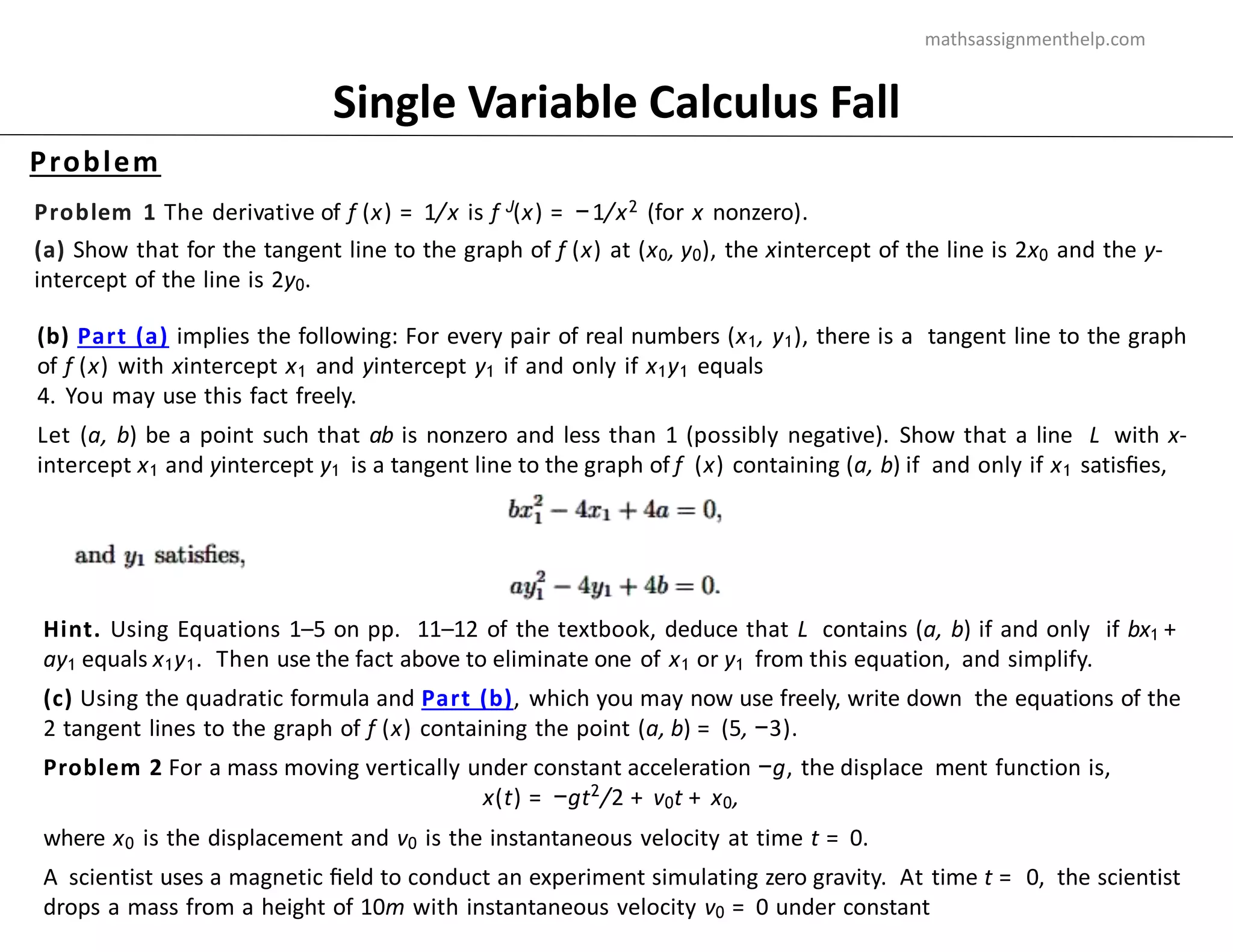
Problem 1 The derivative of f (x) = 1/x is f J(x) = −1/x2 (for x nonzero).
(a) Show that for the tangent line to the graph of f (x) at (x0, y0), the xintercept of the line is 2x0 and the y-
intercept of the line is 2y0.
(b) Part (a) implies the following: For every pair of real numbers (x1, y1), there is a tangent line to the graph
of f (x) with xintercept x1 and yintercept y1 if and only if x1y1 equals
4. You may use this fact freely.
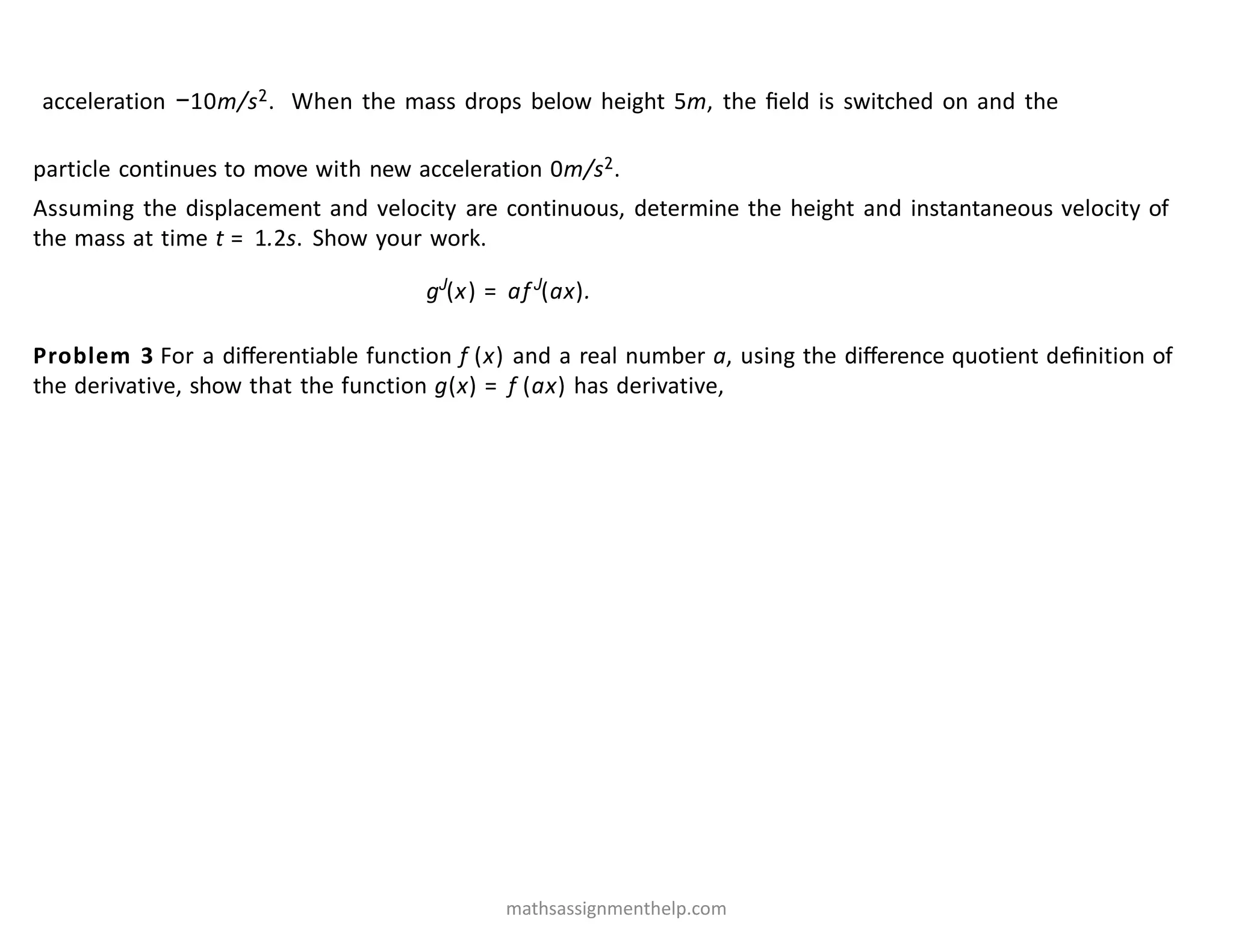
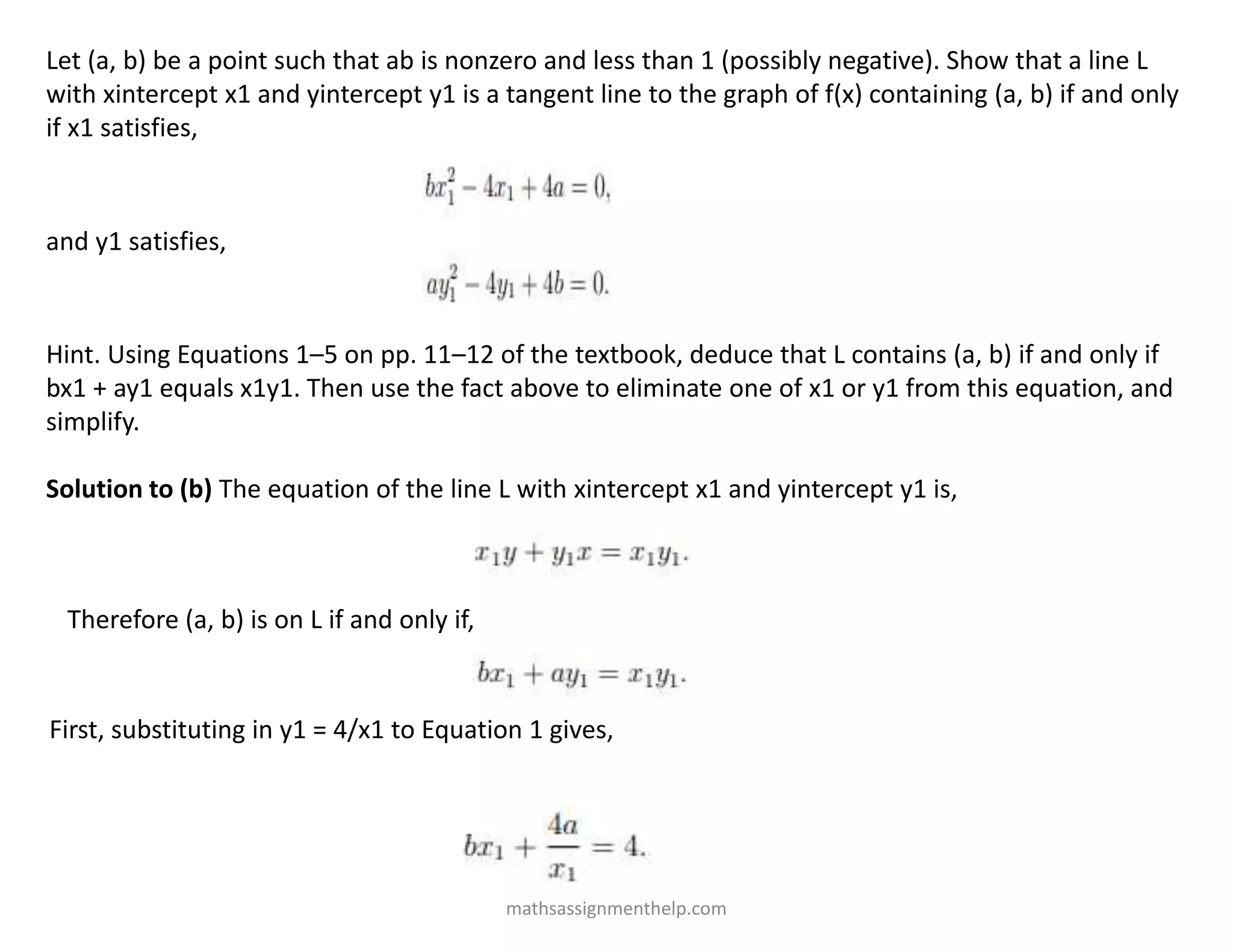
Let (a, b) be a point such that ab is nonzero and less than 1 (possibly negative). Show that a line L with x-
intercept x1 and yintercept y1 is a tangent line to the graph of f (x) containing (a, b) if and only if x1 satisfies,
Hint. Using Equations 1–5 on pp. 11–12 of the textbook, deduce that L contains (a, b) if and only if bx1 +
ay1 equals x1y1. Then use the fact above to eliminate one of x1 or y1 from this equation, and simplify.
(c) Using the quadratic formula and Part (b), which you may now use freely, write down the equations of the
2 tangent lines to the graph of f (x) containing the point (a, b) = (5, −3).
Problem 2 For a mass moving vertically under constant acceleration −g, the displace ment function is,
x(t) = −gt2
/2 + v0t + x0,
where x0 is the displacement and v0 is the instantaneous velocity at time t = 0.
A scientist uses a magnetic field to conduct an experiment simulating zero gravity. At time t = 0, the scientist
drops a mass from a height of 10m with instantaneous velocity v0 = 0 under constant
mathsassignmenthelp.com
acceleration −10m/s2. When the mass drops below height 5m, the field is switched on and the
particle continues to move with new acceleration 0m/s2.
Assuming the displacement and velocity are continuous, determine the height and instantaneous velocity of
the mass at time t = 1.2s. Show your work.
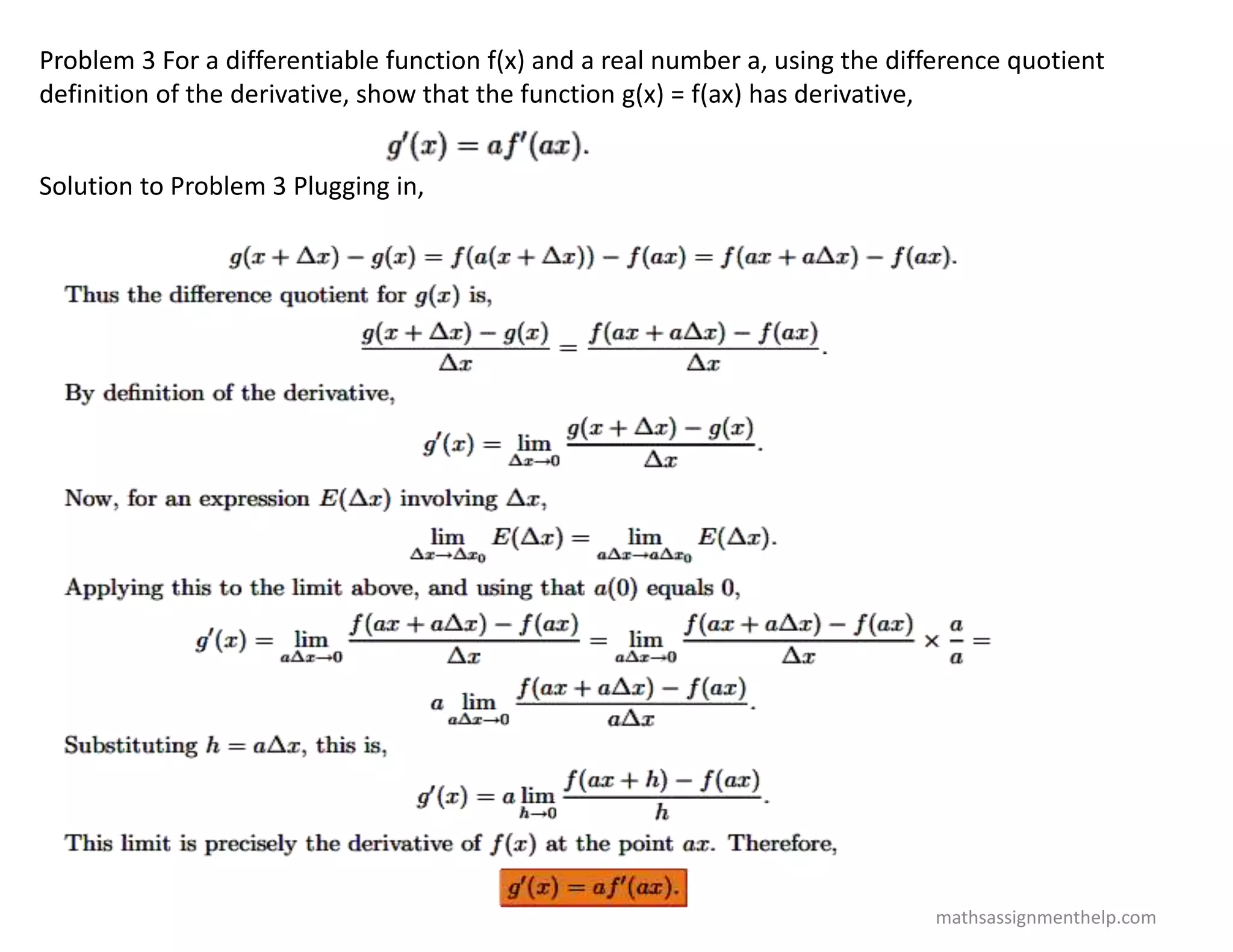
Problem 3 For a differentiable function f (x) and a real number a, using the difference quotient definition of
the derivative, show that the function g(x) = f (ax) has derivative,
gJ
(x) = afJ
(ax).
mathsassignmenthelp.com
Solution
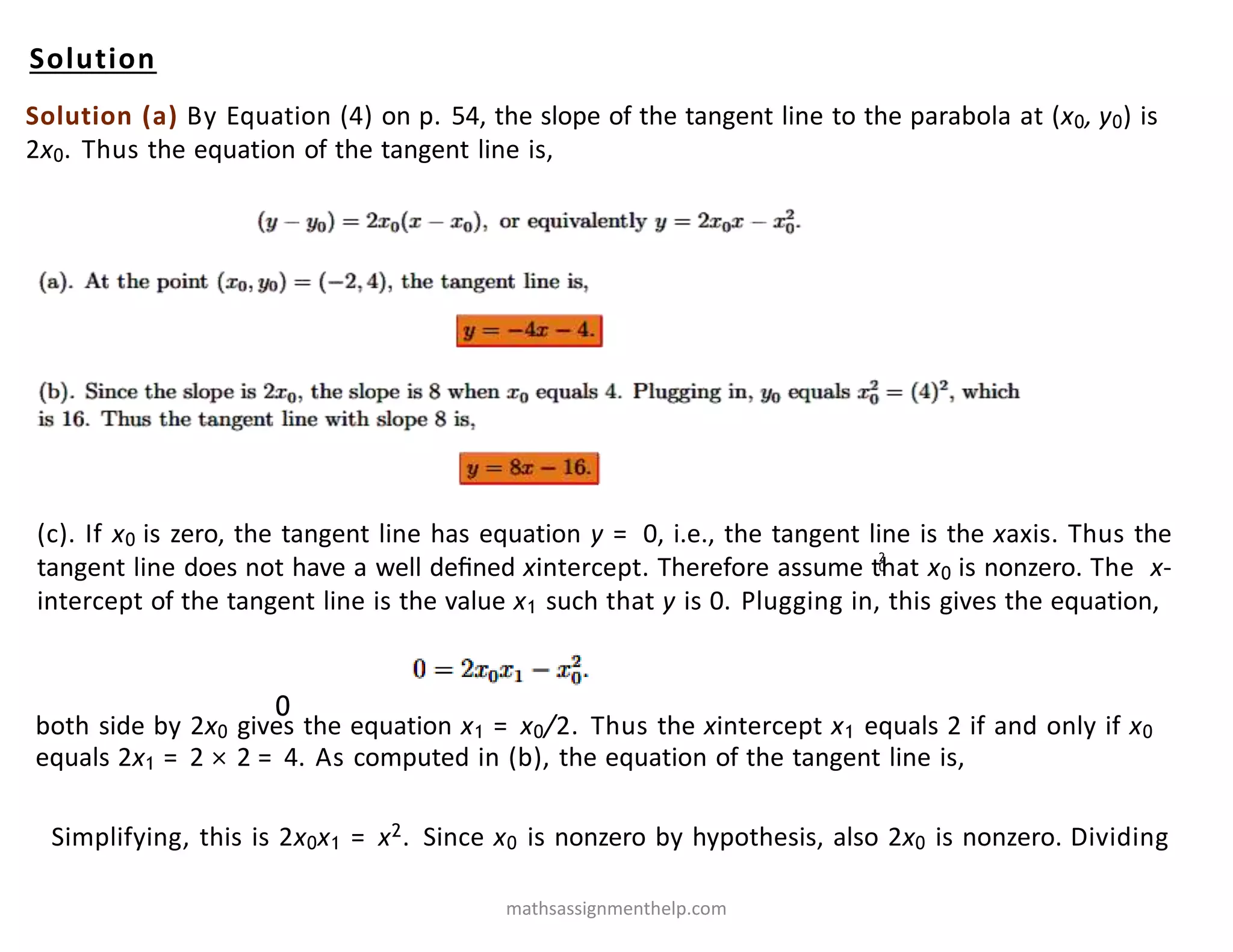
Solution (a) By Equation (4) on p. 54, the slope of the tangent line to the parabola at (x0, y0) is
2x0. Thus the equation of the tangent line is,
2
0
(c). If x0 is zero, the tangent line has equation y = 0, i.e., the tangent line is the xaxis. Thus the
tangent line does not have a well defined xintercept. Therefore assume that x0 is nonzero. The x-
intercept of the tangent line is the value x1 such that y is 0. Plugging in, this gives the equation,
Simplifying, this is 2x0x1 = x2. Since x0 is nonzero by hypothesis, also 2x0 is nonzero. Dividing
0
both side by 2x0 gives the equation x1 = x0/2. Thus the xintercept x1 equals 2 if and only if x0
equals 2x1 = 2 × 2 = 4. As computed in (b), the equation of the tangent line is,
mathsassignmenthelp.com
y = 8x − 16.
Solution (b) Since f (x) equals ax2 + bx + c, substituting x + Δx for x, f (x + Δx) equals,
a(x + Δx)2
+ b(x + Δx) + c.
Expanding the square, this is,
a(x2
+ 2xΔx + (Δx)2
) + b(x + Δx) + c.
Therefore f (x + Δ x) − f (x) equals,
[a(x2
+ 2xΔx + (Δx)2
) + b(x + Δx) + c] − [ax2
+ bx + c].
Cancelling like terms, namely ax2, bx and c, this simplifies to,
2axΔx + a(Δx)2
+ bΔx.
Separating the common factor Δx from these terms, this simplifies to,
f (x + Δ x) − f (x) = (2ax + aΔ x + b)Δx.
This complete Step 1.
Because of the common factor Δx, the difference quotient is,
f (x + Δ x) − f (x) = 2ax + aΔ x + b,
Δx
for Δx nonzero. This completes Step 2.
Holding a, b and x constant and allowing Δx to vary, the expression 2ax + aΔx + b is a linear
function in Δx; perhaps this is easier to see if it is written aΔx + (2ax + b). A linear function is
continuous. Thus to compute the limit as Δx approaches 0, it suffices to substitute in Δx
equals
f J(x) = 2ax + b.
mathsassignmenthelp.com
Solution (c) The function is defined when 3x+2 is nonzero, i.e., when x is not −2/3. The
function is undefined with x equals −2/3. Therefore assume that x is not −2/3.
0. Therefore,
f J
(x) = lim [aΔ x + (2ax + b)] = a0 + (2ax + b),
Δx→0
which simplifies to 2ax + b. Therefore the derivative of ax2 + bx + c is,
Substituting x + Δx for x gives,
To compute the difference,
we express both fractions with the common denominator (3(x + Δx) + 2)(3x + 2),
we express both fractions with the common denominator (3(x + Δx) + 2)(3x + 2)
mathsassignmenthelp.com
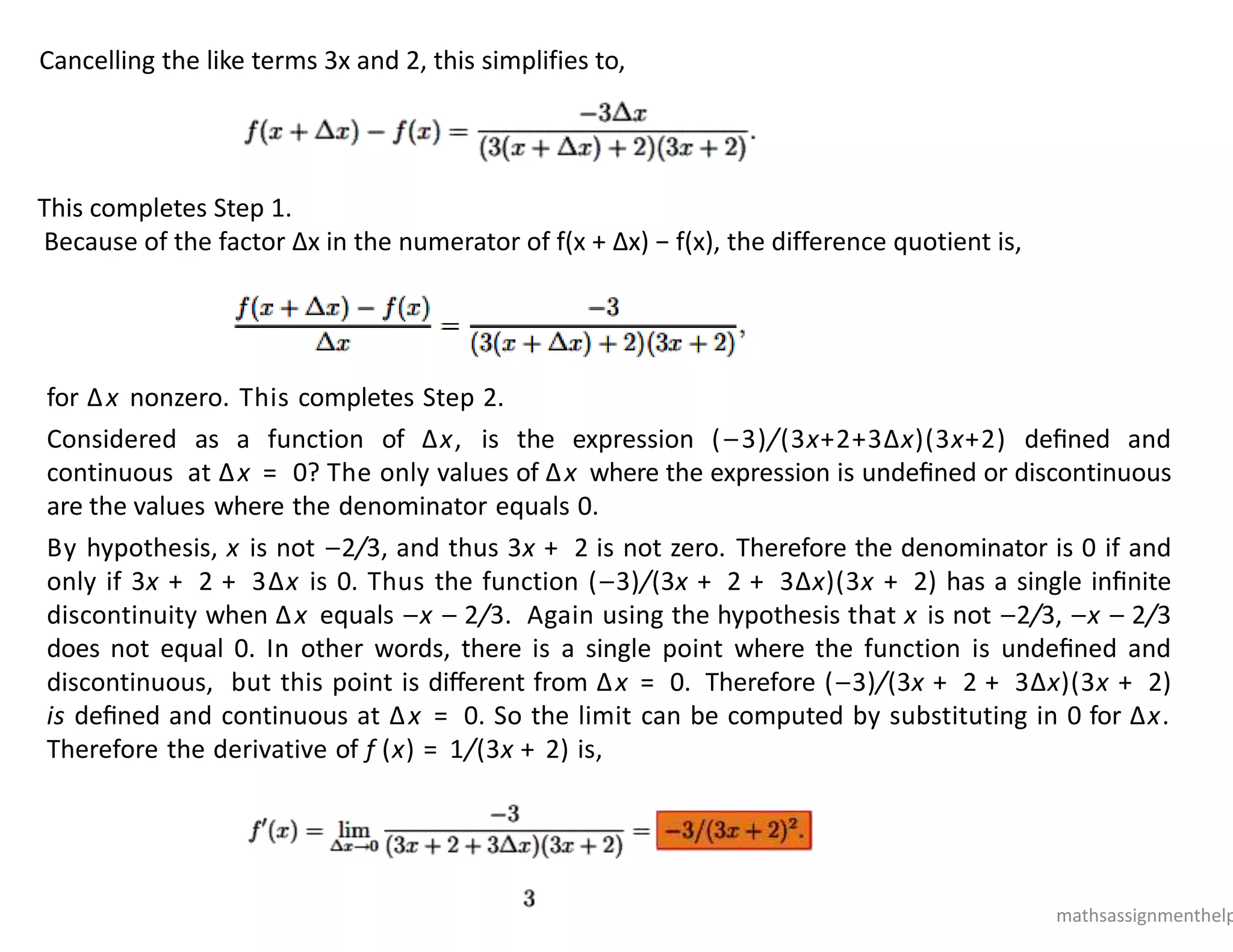
Cancelling the like terms 3x and 2, this simplifies to,
This completes Step 1.
Because of the factor Δx in the numerator of f(x + Δx) − f(x), the difference quotient is,
for Δx nonzero. This completes Step 2.
Considered as a function of Δx, is the expression (−3)/(3x+2+3Δx)(3x+2) defined and
continuous at Δx = 0? The only values of Δx where the expression is undefined or discontinuous
are the values where the denominator equals 0.
By hypothesis, x is not −2/3, and thus 3x + 2 is not zero. Therefore the denominator is 0 if and
only if 3x + 2 + 3Δx is 0. Thus the function (−3)/(3x + 2 + 3Δx)(3x + 2) has a single infinite
discontinuity when Δx equals −x − 2/3. Again using the hypothesis that x is not −2/3, −x − 2/3
does not equal 0. In other words, there is a single point where the function is undefined and
discontinuous, but this point is different from Δx = 0. Therefore (−3)/(3x + 2 + 3Δx)(3x + 2)
is defined and continuous at Δx = 0. So the limit can be computed by substituting in 0 for Δx.
Therefore the derivative of f (x) = 1/(3x + 2) is,
mathsassignmenthelp
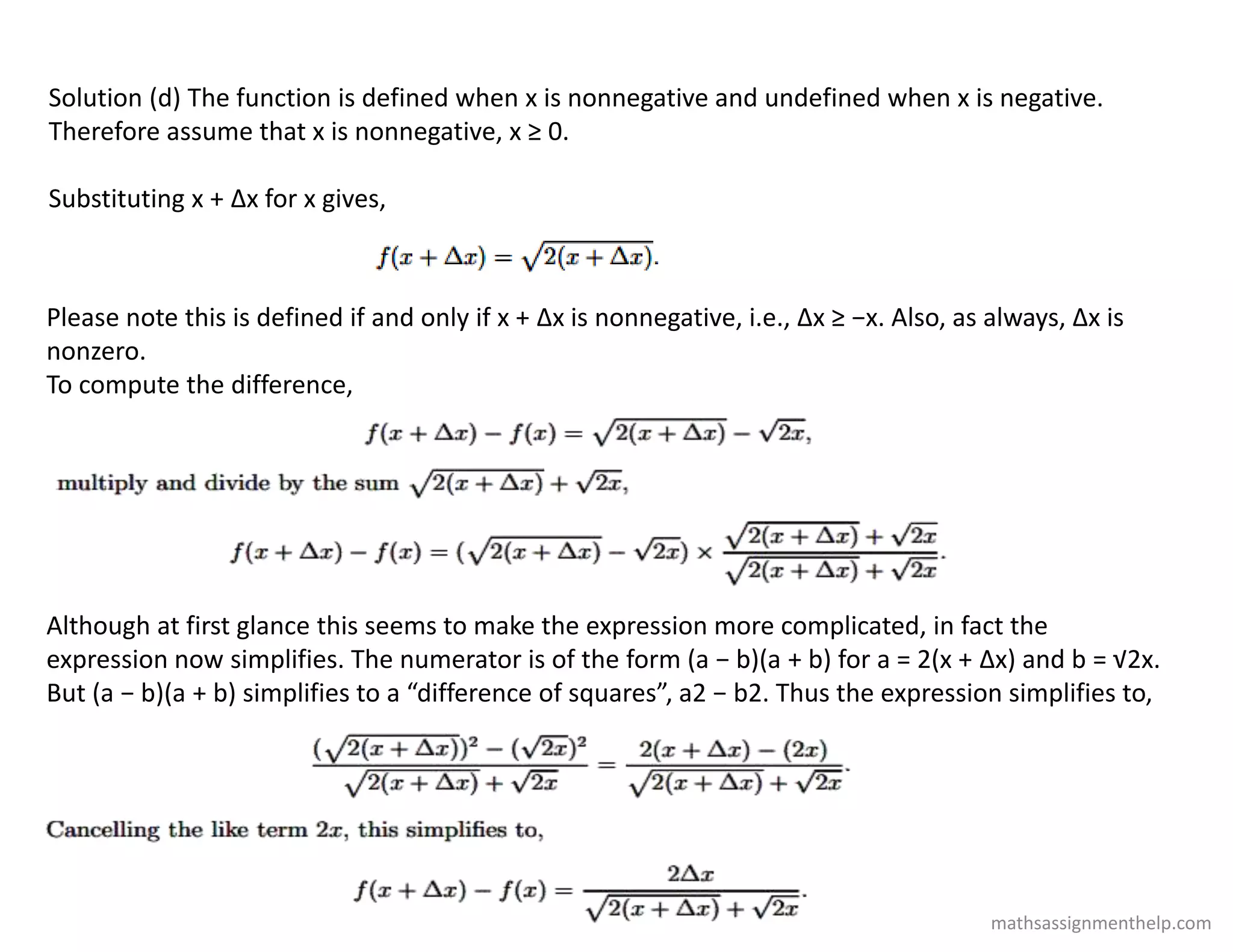
Solution (d) The function is defined when x is nonnegative and undefined when x is negative.
Therefore assume that x is nonnegative, x ≥ 0.
Substituting x + Δx for x gives,
Please note this is defined if and only if x + Δx is nonnegative, i.e., Δx ≥ −x. Also, as always, Δx is
nonzero.
To compute the difference,
Although at first glance this seems to make the expression more complicated, in fact the
expression now simplifies. The numerator is of the form (a − b)(a + b) for a = 2(x + Δx) and b = √2x.
But (a − b)(a + b) simplifies to a “difference of squares”, a2 − b2. Thus the expression simplifies to,
mathsassignmenthelp.com
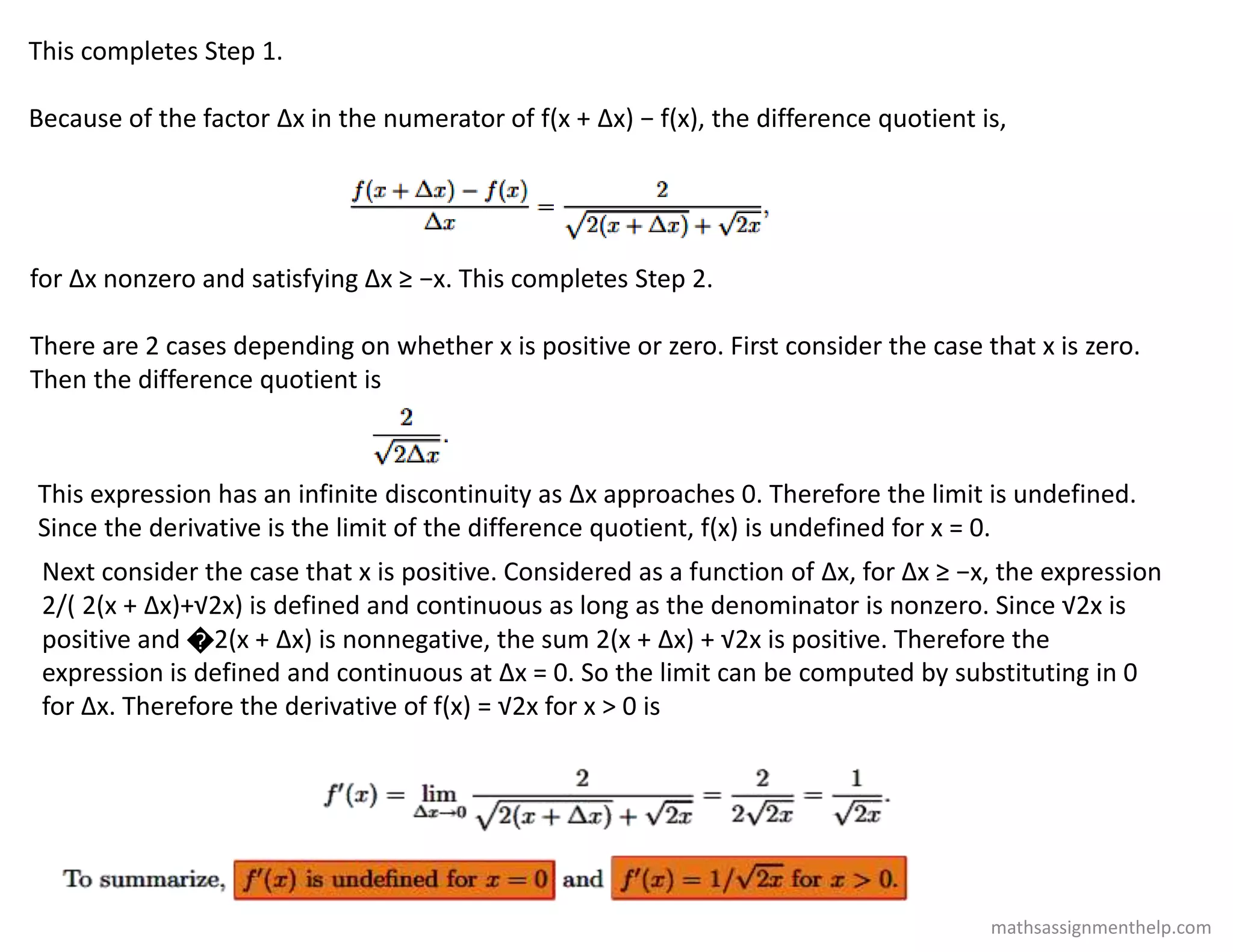
This completes Step 1.
Because of the factor Δx in the numerator of f(x + Δx) − f(x), the difference quotient is,
for Δx nonzero and satisfying Δx ≥ −x. This completes Step 2.
There are 2 cases depending on whether x is positive or zero. First consider the case that x is zero.
Then the difference quotient is
This expression has an infinite discontinuity as Δx approaches 0. Therefore the limit is undefined.
Since the derivative is the limit of the difference quotient, f(x) is undefined for x = 0.
Next consider the case that x is positive. Considered as a function of Δx, for Δx ≥ −x, the expression
2/( 2(x + Δx)+√2x) is defined and continuous as long as the denominator is nonzero. Since √2x is
positive and �2(x + Δx) is nonnegative, the sum 2(x + Δx) + √2x is positive. Therefore the
expression is defined and continuous at Δx = 0. So the limit can be computed by substituting in 0
for Δx. Therefore the derivative of f(x) = √2x for x > 0 is
mathsassignmenthelp.com
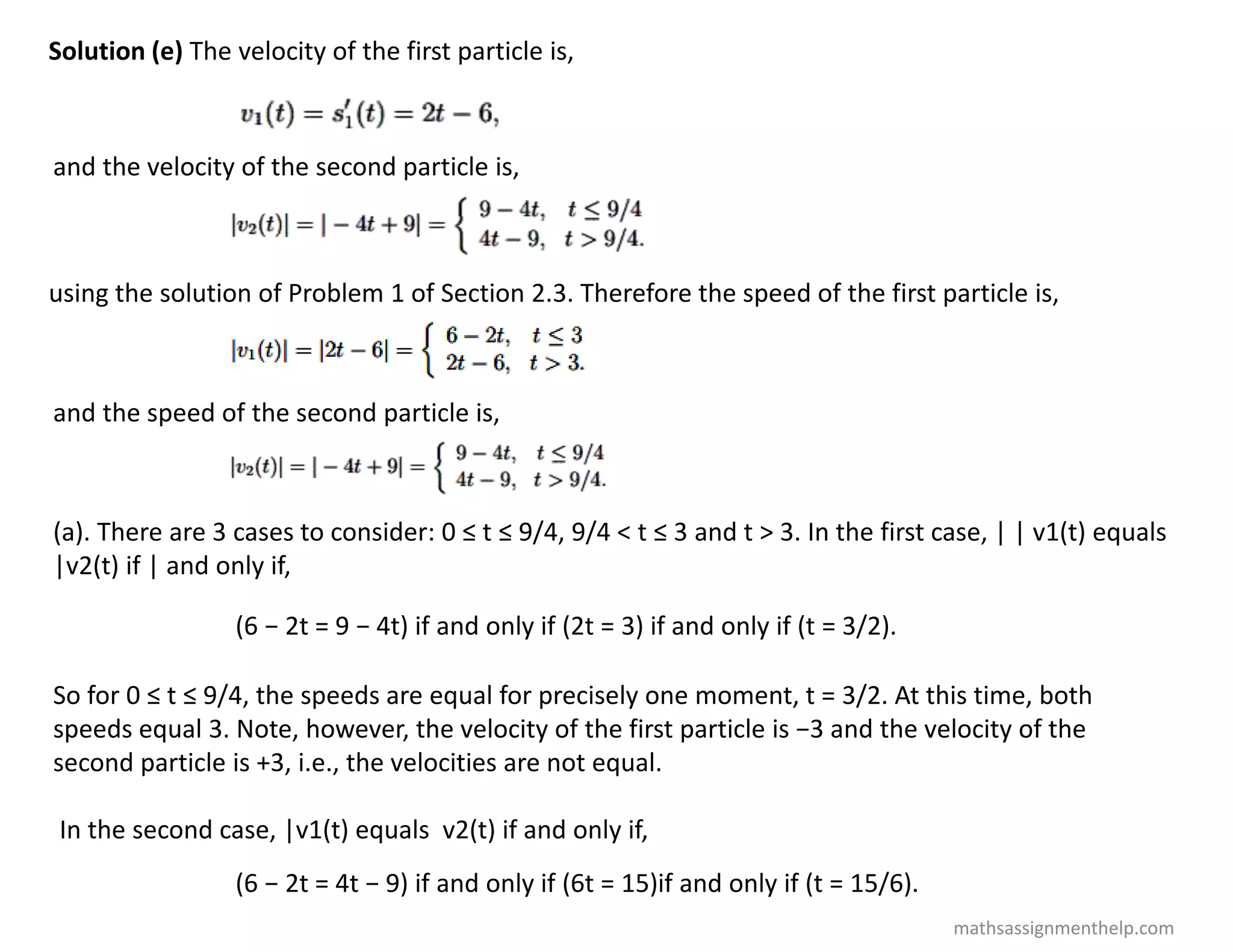
Solution (e) The velocity of the first particle is,
and the velocity of the second particle is,
using the solution of Problem 1 of Section 2.3. Therefore the speed of the first particle is,
and the speed of the second particle is,
(a). There are 3 cases to consider: 0 ≤ t ≤ 9/4, 9/4 < t ≤ 3 and t > 3. In the first case, | | v1(t) equals
|v2(t) if | and only if,
(6 − 2t = 9 − 4t) if and only if (2t = 3) if and only if (t = 3/2).
So for 0 ≤ t ≤ 9/4, the speeds are equal for precisely one moment, t = 3/2. At this time, both
speeds equal 3. Note, however, the velocity of the first particle is −3 and the velocity of the
second particle is +3, i.e., the velocities are not equal.
In the second case, |v1(t) equals v2(t) if and only if,
(6 − 2t = 4t − 9) if and only if (6t = 15)if and only if (t = 15/6).
mathsassignmenthelp.com
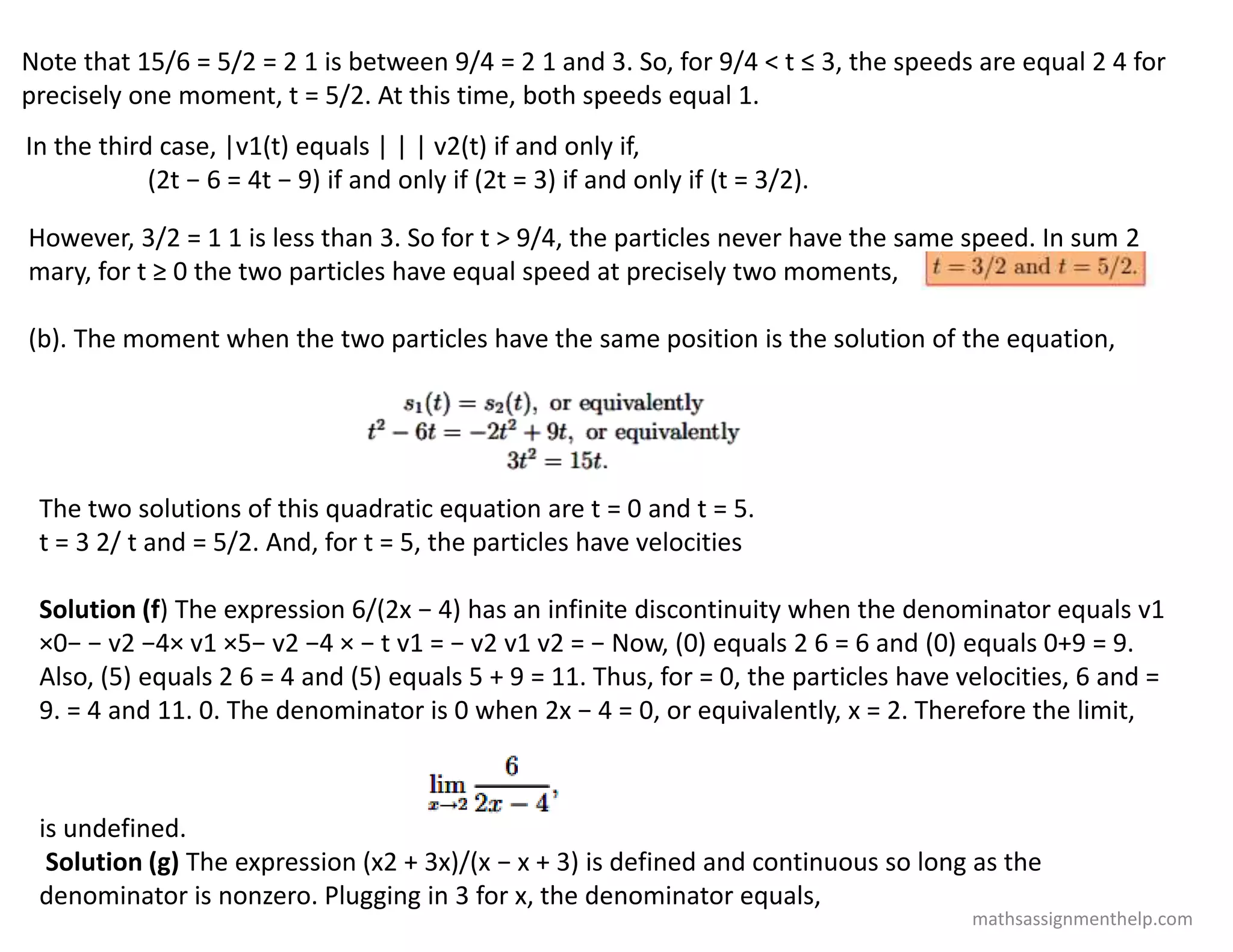
Note that 15/6 = 5/2 = 2 1 is between 9/4 = 2 1 and 3. So, for 9/4 < t ≤ 3, the speeds are equal 2 4 for
precisely one moment, t = 5/2. At this time, both speeds equal 1.
In the third case, |v1(t) equals | | | v2(t) if and only if,
(2t − 6 = 4t − 9) if and only if (2t = 3) if and only if (t = 3/2).
However, 3/2 = 1 1 is less than 3. So for t > 9/4, the particles never have the same speed. In sum 2
mary, for t ≥ 0 the two particles have equal speed at precisely two moments,
(b). The moment when the two particles have the same position is the solution of the equation,
The two solutions of this quadratic equation are t = 0 and t = 5.
t = 3 2/ t and = 5/2. And, for t = 5, the particles have velocities
Solution (f) The expression 6/(2x − 4) has an infinite discontinuity when the denominator equals v1
×0− − v2 −4× v1 ×5− v2 −4 × − t v1 = − v2 v1 v2 = − Now, (0) equals 2 6 = 6 and (0) equals 0+9 = 9.
Also, (5) equals 2 6 = 4 and (5) equals 5 + 9 = 11. Thus, for = 0, the particles have velocities, 6 and =
9. = 4 and 11. 0. The denominator is 0 when 2x − 4 = 0, or equivalently, x = 2. Therefore the limit,
is undefined.
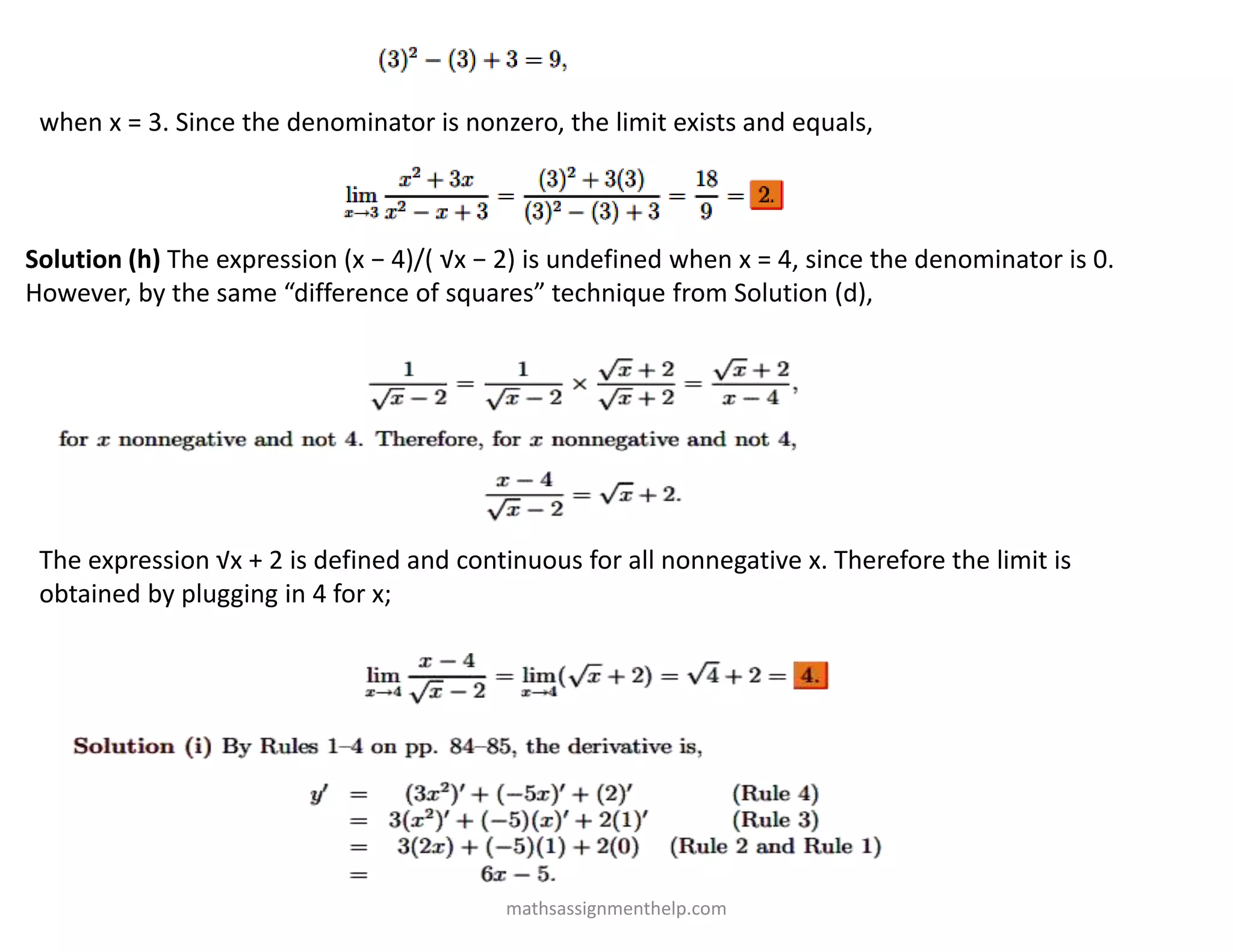
Solution (g) The expression (x2 + 3x)/(x − x + 3) is defined and continuous so long as the
denominator is nonzero. Plugging in 3 for x, the denominator equals,
mathsassignmenthelp.com
when x = 3. Since the denominator is nonzero, the limit exists and equals,
Solution (h) The expression (x − 4)/( √x − 2) is undefined when x = 4, since the denominator is 0.
However, by the same “difference of squares” technique from Solution (d),
The expression √x + 2 is defined and continuous for all nonnegative x. Therefore the limit is
obtained by plugging in 4 for x;
mathsassignmenthelp.com
Of course this is also a special case of Problem 1 from Section 2.3. At x = 2, the derivative is y = 6(2) −
5 = 7. Therefore the equation of the tangent line is,
(y − 4) = 7(x − 2) or equivalently y = 7x − 10
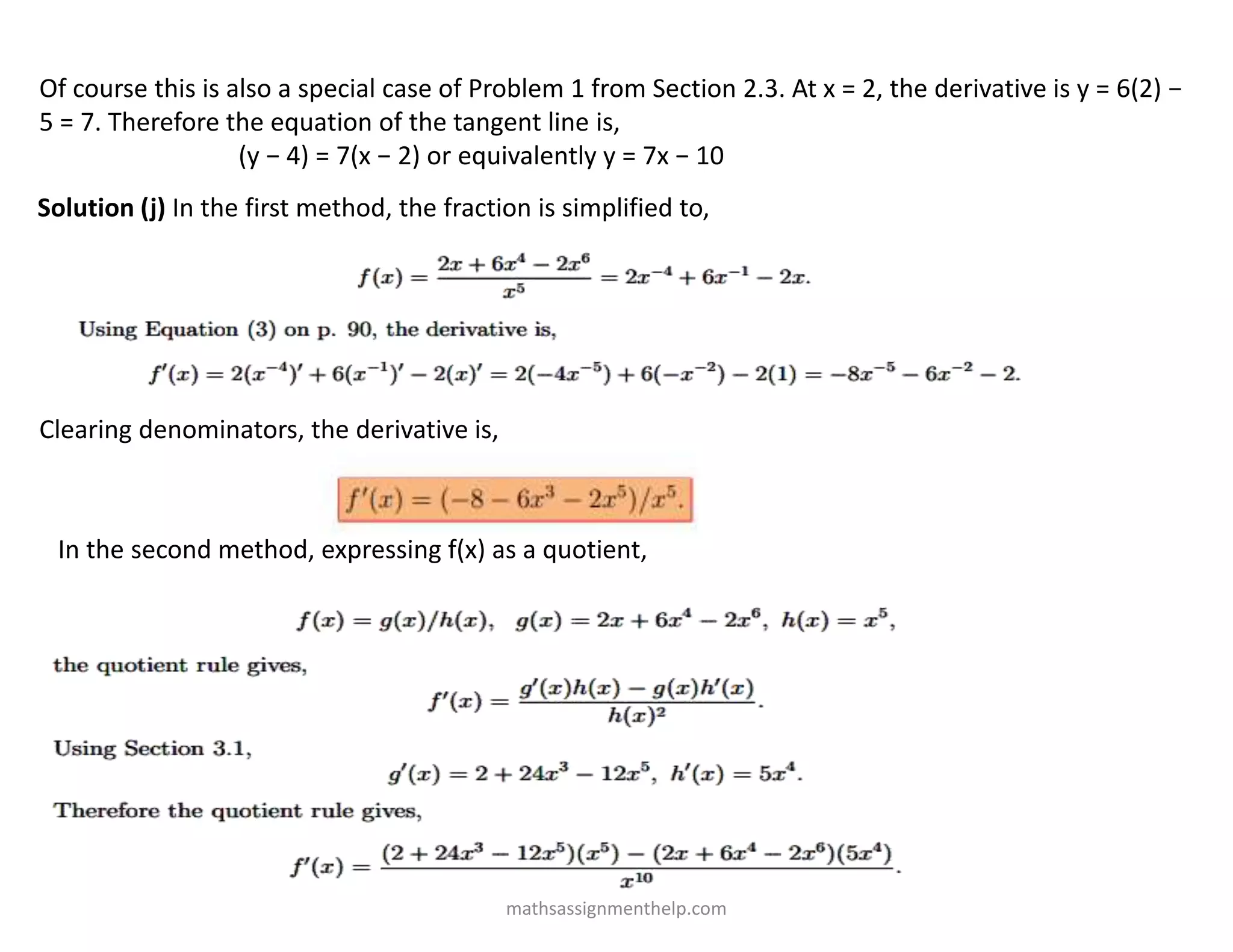
Solution (j) In the first method, the fraction is simplified to,
Clearing denominators, the derivative is,
In the second method, expressing f(x) as a quotient,
mathsassignmenthelp.com
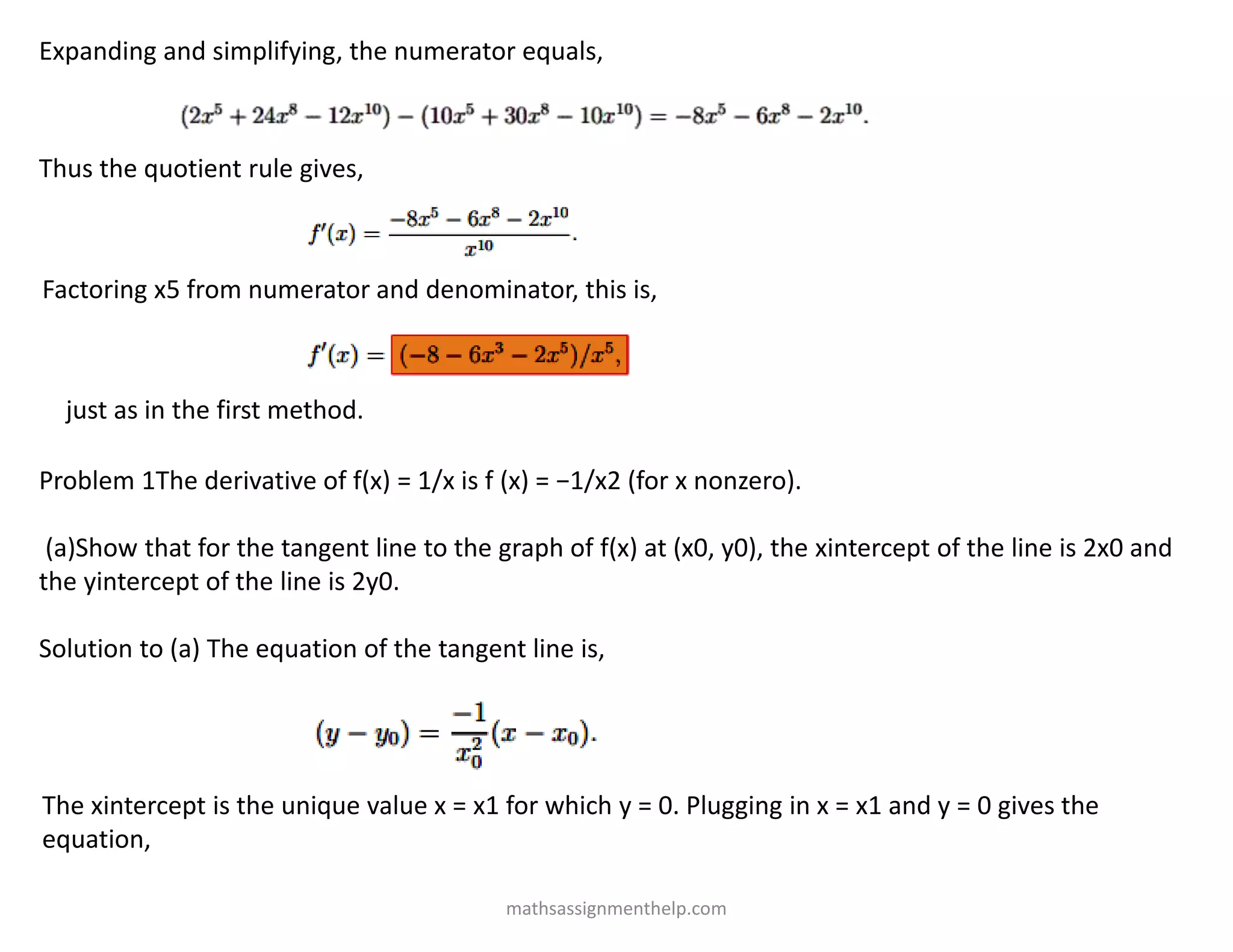
Expanding and simplifying, the numerator equals,
Thus the quotient rule gives,
Factoring x5 from numerator and denominator, this is,
just as in the first method.
Problem 1The derivative of f(x) = 1/x is f (x) = −1/x2 (for x nonzero).
(a)Show that for the tangent line to the graph of f(x) at (x0, y0), the xintercept of the line is 2x0 and
the yintercept of the line is 2y0.
Solution to (a) The equation of the tangent line is,
The xintercept is the unique value x = x1 for which y = 0. Plugging in x = x1 and y = 0 gives the
equation,
mathsassignmenthelp.com
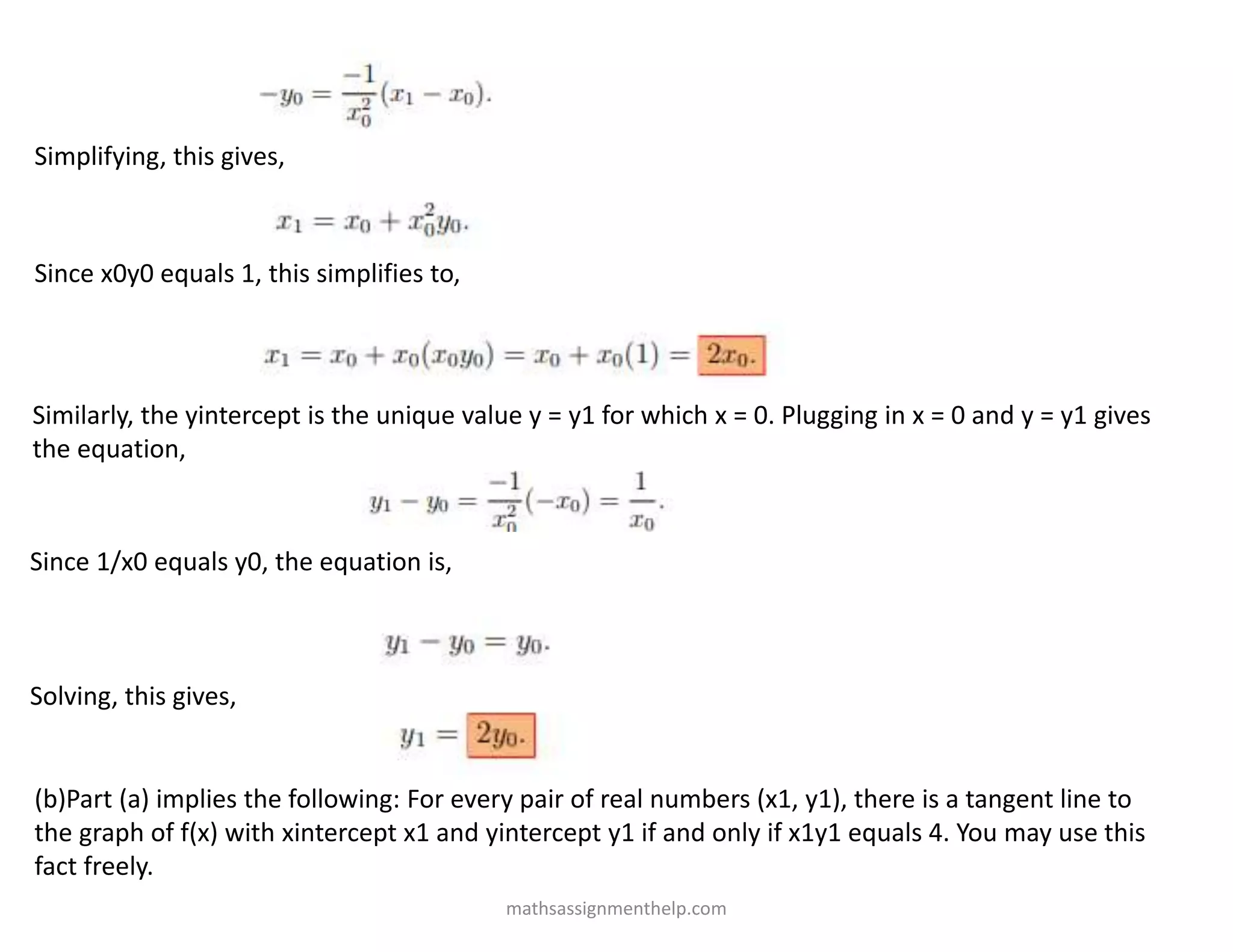
Simplifying, this gives,
Since x0y0 equals 1, this simplifies to,
Similarly, the yintercept is the unique value y = y1 for which x = 0. Plugging in x = 0 and y = y1 gives
the equation,
Since 1/x0 equals y0, the equation is,
Solving, this gives,
(b)Part (a) implies the following: For every pair of real numbers (x1, y1), there is a tangent line to
the graph of f(x) with xintercept x1 and yintercept y1 if and only if x1y1 equals 4. You may use this
fact freely.
mathsassignmenthelp.com
Let (a, b) be a point such that ab is nonzero and less than 1 (possibly negative). Show that a line L
with xintercept x1 and yintercept y1 is a tangent line to the graph of f(x) containing (a, b) if and only
if x1 satisfies,
and y1 satisfies,
Hint. Using Equations 1–5 on pp. 11–12 of the textbook, deduce that L contains (a, b) if and only if
bx1 + ay1 equals x1y1. Then use the fact above to eliminate one of x1 or y1 from this equation, and
simplify.
Solution to (b) The equation of the line L with xintercept x1 and yintercept y1 is,
Therefore (a, b) is on L if and only if,
First, substituting in y1 = 4/x1 to Equation 1 gives,
mathsassignmenthelp.com
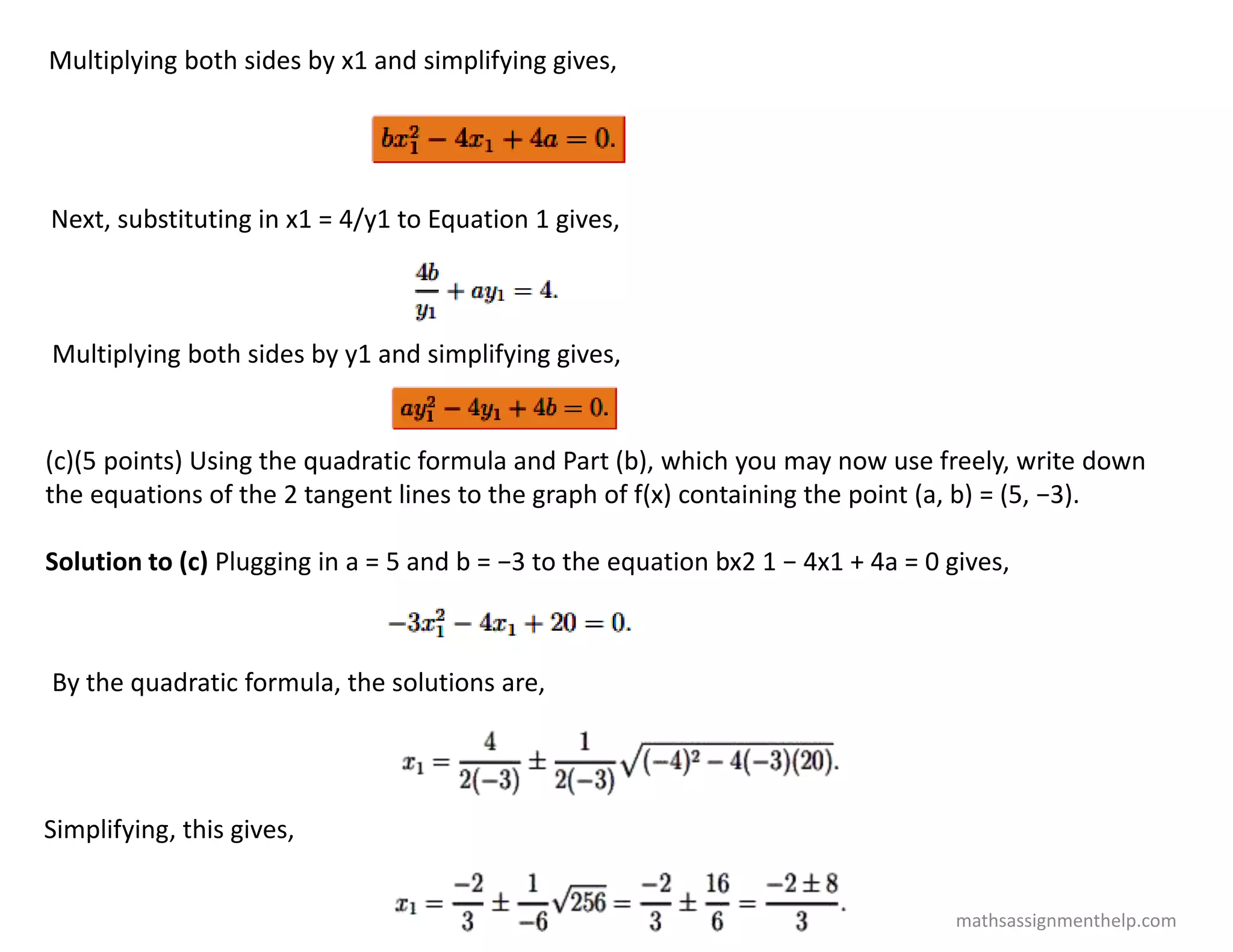
Multiplying both sides by x1 and simplifying gives,
Next, substituting in x1 = 4/y1 to Equation 1 gives,
Multiplying both sides by y1 and simplifying gives,
(c)(5 points) Using the quadratic formula and Part (b), which you may now use freely, write down
the equations of the 2 tangent lines to the graph of f(x) containing the point (a, b) = (5, −3).
Solution to (c) Plugging in a = 5 and b = −3 to the equation bx2 1 − 4x1 + 4a = 0 gives,
By the quadratic formula, the solutions are,
Simplifying, this gives,
mathsassignmenthelp.com
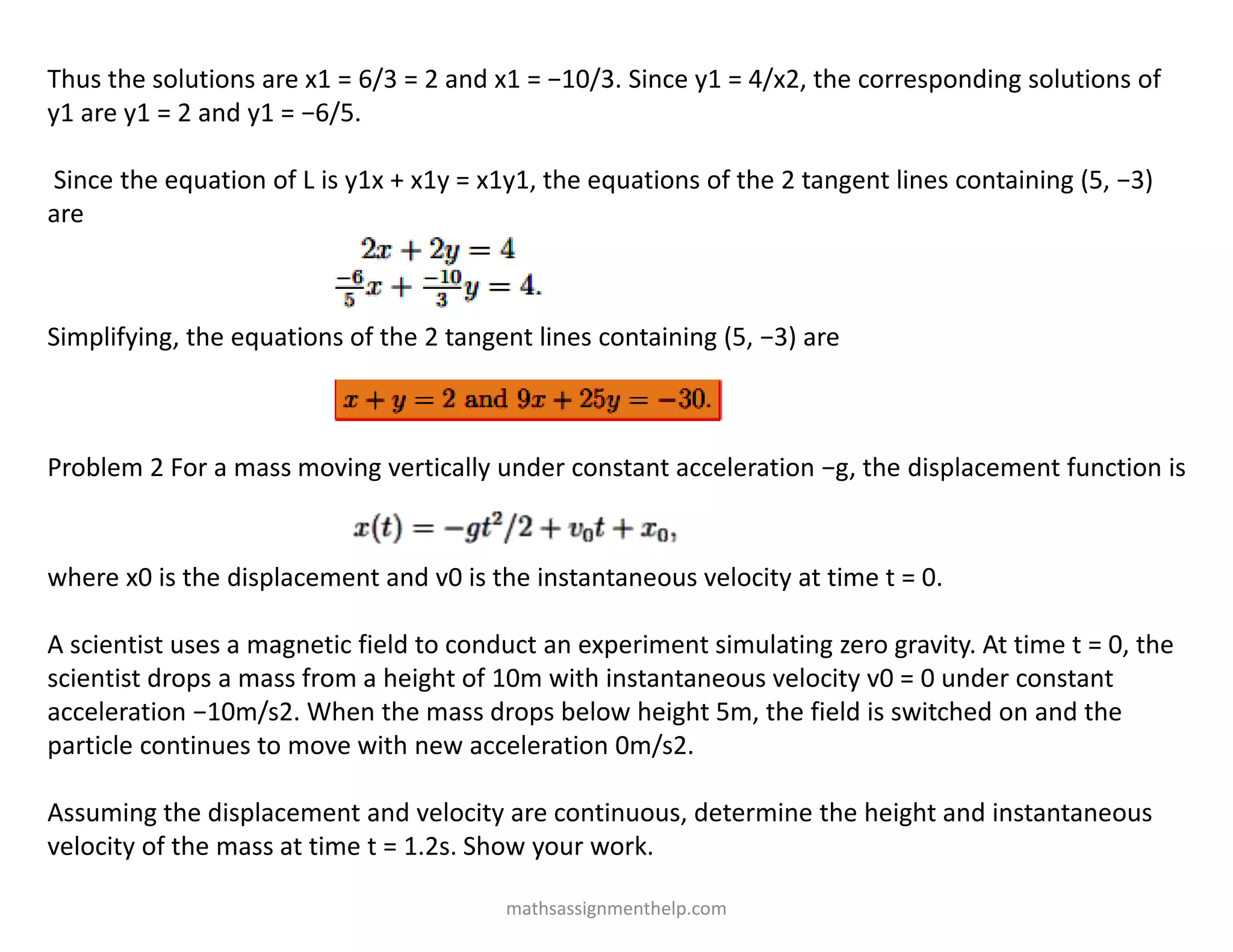
Thus the solutions are x1 = 6/3 = 2 and x1 = −10/3. Since y1 = 4/x2, the corresponding solutions of
y1 are y1 = 2 and y1 = −6/5.
Since the equation of L is y1x + x1y = x1y1, the equations of the 2 tangent lines containing (5, −3)
are
Simplifying, the equations of the 2 tangent lines containing (5, −3) are
Problem 2 For a mass moving vertically under constant acceleration −g, the displacement function is
where x0 is the displacement and v0 is the instantaneous velocity at time t = 0.
A scientist uses a magnetic field to conduct an experiment simulating zero gravity. At time t = 0, the
scientist drops a mass from a height of 10m with instantaneous velocity v0 = 0 under constant
acceleration −10m/s2. When the mass drops below height 5m, the field is switched on and the
particle continues to move with new acceleration 0m/s2.
Assuming the displacement and velocity are continuous, determine the height and instantaneous
velocity of the mass at time t = 1.2s. Show your work.
mathsassignmenthelp.com
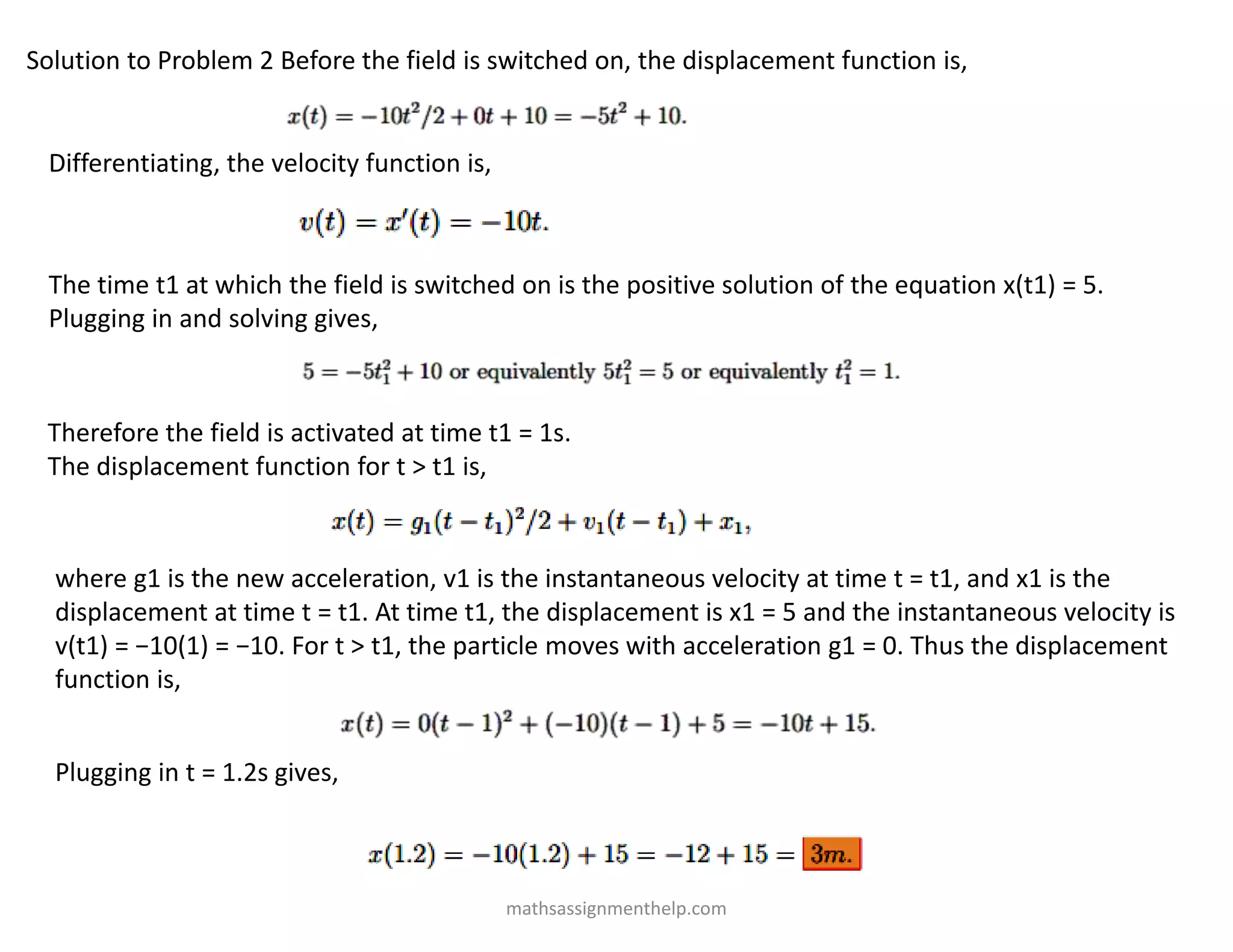
Solution to Problem 2 Before the field is switched on, the displacement function is,
Differentiating, the velocity function is,
The time t1 at which the field is switched on is the positive solution of the equation x(t1) = 5.
Plugging in and solving gives,
Therefore the field is activated at time t1 = 1s.
The displacement function for t > t1 is,
where g1 is the new acceleration, v1 is the instantaneous velocity at time t = t1, and x1 is the
displacement at time t = t1. At time t1, the displacement is x1 = 5 and the instantaneous velocity is
v(t1) = −10(1) = −10. For t > t1, the particle moves with acceleration g1 = 0. Thus the displacement
function is,
Plugging in t = 1.2s gives,
mathsassignmenthelp.com
Problem 3 For a differentiable function f(x) and a real number a, using the difference quotient
definition of the derivative, show that the function g(x) = f(ax) has derivative,
Solution to Problem 3 Plugging in,
mathsassignmenthelp.com

Calculus Assignment Help

  • 1.
    Calculus Homework Help Forany Assignment related queries, Call us at: - +1 678 648 4277 You can mail us at info@mathsassignmenthelp.com or reach us at: https://www.mathsassignmenthelp.com/ mathsassignmenthelp.com
  • 2.
    Problem Single Variable CalculusFall Problem 1 The derivative of f (x) = 1/x is f J(x) = −1/x2 (for x nonzero). (a) Show that for the tangent line to the graph of f (x) at (x0, y0), the xintercept of the line is 2x0 and the y- intercept of the line is 2y0. (b) Part (a) implies the following: For every pair of real numbers (x1, y1), there is a tangent line to the graph of f (x) with xintercept x1 and yintercept y1 if and only if x1y1 equals 4. You may use this fact freely. Let (a, b) be a point such that ab is nonzero and less than 1 (possibly negative). Show that a line L with x- intercept x1 and yintercept y1 is a tangent line to the graph of f (x) containing (a, b) if and only if x1 satisfies, Hint. Using Equations 1–5 on pp. 11–12 of the textbook, deduce that L contains (a, b) if and only if bx1 + ay1 equals x1y1. Then use the fact above to eliminate one of x1 or y1 from this equation, and simplify. (c) Using the quadratic formula and Part (b), which you may now use freely, write down the equations of the 2 tangent lines to the graph of f (x) containing the point (a, b) = (5, −3). Problem 2 For a mass moving vertically under constant acceleration −g, the displace ment function is, x(t) = −gt2 /2 + v0t + x0, where x0 is the displacement and v0 is the instantaneous velocity at time t = 0. A scientist uses a magnetic field to conduct an experiment simulating zero gravity. At time t = 0, the scientist drops a mass from a height of 10m with instantaneous velocity v0 = 0 under constant mathsassignmenthelp.com
  • 3.
    acceleration −10m/s2. Whenthe mass drops below height 5m, the field is switched on and the particle continues to move with new acceleration 0m/s2. Assuming the displacement and velocity are continuous, determine the height and instantaneous velocity of the mass at time t = 1.2s. Show your work. Problem 3 For a differentiable function f (x) and a real number a, using the difference quotient definition of the derivative, show that the function g(x) = f (ax) has derivative, gJ (x) = afJ (ax). mathsassignmenthelp.com
  • 4.
    Solution Solution (a) ByEquation (4) on p. 54, the slope of the tangent line to the parabola at (x0, y0) is 2x0. Thus the equation of the tangent line is, 2 0 (c). If x0 is zero, the tangent line has equation y = 0, i.e., the tangent line is the xaxis. Thus the tangent line does not have a well defined xintercept. Therefore assume that x0 is nonzero. The x- intercept of the tangent line is the value x1 such that y is 0. Plugging in, this gives the equation, Simplifying, this is 2x0x1 = x2. Since x0 is nonzero by hypothesis, also 2x0 is nonzero. Dividing 0 both side by 2x0 gives the equation x1 = x0/2. Thus the xintercept x1 equals 2 if and only if x0 equals 2x1 = 2 × 2 = 4. As computed in (b), the equation of the tangent line is, mathsassignmenthelp.com
  • 5.
    y = 8x− 16. Solution (b) Since f (x) equals ax2 + bx + c, substituting x + Δx for x, f (x + Δx) equals, a(x + Δx)2 + b(x + Δx) + c. Expanding the square, this is, a(x2 + 2xΔx + (Δx)2 ) + b(x + Δx) + c. Therefore f (x + Δ x) − f (x) equals, [a(x2 + 2xΔx + (Δx)2 ) + b(x + Δx) + c] − [ax2 + bx + c]. Cancelling like terms, namely ax2, bx and c, this simplifies to, 2axΔx + a(Δx)2 + bΔx. Separating the common factor Δx from these terms, this simplifies to, f (x + Δ x) − f (x) = (2ax + aΔ x + b)Δx. This complete Step 1. Because of the common factor Δx, the difference quotient is, f (x + Δ x) − f (x) = 2ax + aΔ x + b, Δx for Δx nonzero. This completes Step 2. Holding a, b and x constant and allowing Δx to vary, the expression 2ax + aΔx + b is a linear function in Δx; perhaps this is easier to see if it is written aΔx + (2ax + b). A linear function is continuous. Thus to compute the limit as Δx approaches 0, it suffices to substitute in Δx equals f J(x) = 2ax + b. mathsassignmenthelp.com
  • 6.
    Solution (c) Thefunction is defined when 3x+2 is nonzero, i.e., when x is not −2/3. The function is undefined with x equals −2/3. Therefore assume that x is not −2/3. 0. Therefore, f J (x) = lim [aΔ x + (2ax + b)] = a0 + (2ax + b), Δx→0 which simplifies to 2ax + b. Therefore the derivative of ax2 + bx + c is, Substituting x + Δx for x gives, To compute the difference, we express both fractions with the common denominator (3(x + Δx) + 2)(3x + 2), we express both fractions with the common denominator (3(x + Δx) + 2)(3x + 2) mathsassignmenthelp.com
  • 7.
    Cancelling the liketerms 3x and 2, this simplifies to, This completes Step 1. Because of the factor Δx in the numerator of f(x + Δx) − f(x), the difference quotient is, for Δx nonzero. This completes Step 2. Considered as a function of Δx, is the expression (−3)/(3x+2+3Δx)(3x+2) defined and continuous at Δx = 0? The only values of Δx where the expression is undefined or discontinuous are the values where the denominator equals 0. By hypothesis, x is not −2/3, and thus 3x + 2 is not zero. Therefore the denominator is 0 if and only if 3x + 2 + 3Δx is 0. Thus the function (−3)/(3x + 2 + 3Δx)(3x + 2) has a single infinite discontinuity when Δx equals −x − 2/3. Again using the hypothesis that x is not −2/3, −x − 2/3 does not equal 0. In other words, there is a single point where the function is undefined and discontinuous, but this point is different from Δx = 0. Therefore (−3)/(3x + 2 + 3Δx)(3x + 2) is defined and continuous at Δx = 0. So the limit can be computed by substituting in 0 for Δx. Therefore the derivative of f (x) = 1/(3x + 2) is, mathsassignmenthelp
  • 8.
    Solution (d) Thefunction is defined when x is nonnegative and undefined when x is negative. Therefore assume that x is nonnegative, x ≥ 0. Substituting x + Δx for x gives, Please note this is defined if and only if x + Δx is nonnegative, i.e., Δx ≥ −x. Also, as always, Δx is nonzero. To compute the difference, Although at first glance this seems to make the expression more complicated, in fact the expression now simplifies. The numerator is of the form (a − b)(a + b) for a = 2(x + Δx) and b = √2x. But (a − b)(a + b) simplifies to a “difference of squares”, a2 − b2. Thus the expression simplifies to, mathsassignmenthelp.com
  • 9.
    This completes Step1. Because of the factor Δx in the numerator of f(x + Δx) − f(x), the difference quotient is, for Δx nonzero and satisfying Δx ≥ −x. This completes Step 2. There are 2 cases depending on whether x is positive or zero. First consider the case that x is zero. Then the difference quotient is This expression has an infinite discontinuity as Δx approaches 0. Therefore the limit is undefined. Since the derivative is the limit of the difference quotient, f(x) is undefined for x = 0. Next consider the case that x is positive. Considered as a function of Δx, for Δx ≥ −x, the expression 2/( 2(x + Δx)+√2x) is defined and continuous as long as the denominator is nonzero. Since √2x is positive and �2(x + Δx) is nonnegative, the sum 2(x + Δx) + √2x is positive. Therefore the expression is defined and continuous at Δx = 0. So the limit can be computed by substituting in 0 for Δx. Therefore the derivative of f(x) = √2x for x > 0 is mathsassignmenthelp.com
  • 10.
    Solution (e) Thevelocity of the first particle is, and the velocity of the second particle is, using the solution of Problem 1 of Section 2.3. Therefore the speed of the first particle is, and the speed of the second particle is, (a). There are 3 cases to consider: 0 ≤ t ≤ 9/4, 9/4 < t ≤ 3 and t > 3. In the first case, | | v1(t) equals |v2(t) if | and only if, (6 − 2t = 9 − 4t) if and only if (2t = 3) if and only if (t = 3/2). So for 0 ≤ t ≤ 9/4, the speeds are equal for precisely one moment, t = 3/2. At this time, both speeds equal 3. Note, however, the velocity of the first particle is −3 and the velocity of the second particle is +3, i.e., the velocities are not equal. In the second case, |v1(t) equals v2(t) if and only if, (6 − 2t = 4t − 9) if and only if (6t = 15)if and only if (t = 15/6). mathsassignmenthelp.com
  • 11.
    Note that 15/6= 5/2 = 2 1 is between 9/4 = 2 1 and 3. So, for 9/4 < t ≤ 3, the speeds are equal 2 4 for precisely one moment, t = 5/2. At this time, both speeds equal 1. In the third case, |v1(t) equals | | | v2(t) if and only if, (2t − 6 = 4t − 9) if and only if (2t = 3) if and only if (t = 3/2). However, 3/2 = 1 1 is less than 3. So for t > 9/4, the particles never have the same speed. In sum 2 mary, for t ≥ 0 the two particles have equal speed at precisely two moments, (b). The moment when the two particles have the same position is the solution of the equation, The two solutions of this quadratic equation are t = 0 and t = 5. t = 3 2/ t and = 5/2. And, for t = 5, the particles have velocities Solution (f) The expression 6/(2x − 4) has an infinite discontinuity when the denominator equals v1 ×0− − v2 −4× v1 ×5− v2 −4 × − t v1 = − v2 v1 v2 = − Now, (0) equals 2 6 = 6 and (0) equals 0+9 = 9. Also, (5) equals 2 6 = 4 and (5) equals 5 + 9 = 11. Thus, for = 0, the particles have velocities, 6 and = 9. = 4 and 11. 0. The denominator is 0 when 2x − 4 = 0, or equivalently, x = 2. Therefore the limit, is undefined. Solution (g) The expression (x2 + 3x)/(x − x + 3) is defined and continuous so long as the denominator is nonzero. Plugging in 3 for x, the denominator equals, mathsassignmenthelp.com
  • 12.
    when x =3. Since the denominator is nonzero, the limit exists and equals, Solution (h) The expression (x − 4)/( √x − 2) is undefined when x = 4, since the denominator is 0. However, by the same “difference of squares” technique from Solution (d), The expression √x + 2 is defined and continuous for all nonnegative x. Therefore the limit is obtained by plugging in 4 for x; mathsassignmenthelp.com
  • 13.
    Of course thisis also a special case of Problem 1 from Section 2.3. At x = 2, the derivative is y = 6(2) − 5 = 7. Therefore the equation of the tangent line is, (y − 4) = 7(x − 2) or equivalently y = 7x − 10 Solution (j) In the first method, the fraction is simplified to, Clearing denominators, the derivative is, In the second method, expressing f(x) as a quotient, mathsassignmenthelp.com
  • 14.
    Expanding and simplifying,the numerator equals, Thus the quotient rule gives, Factoring x5 from numerator and denominator, this is, just as in the first method. Problem 1The derivative of f(x) = 1/x is f (x) = −1/x2 (for x nonzero). (a)Show that for the tangent line to the graph of f(x) at (x0, y0), the xintercept of the line is 2x0 and the yintercept of the line is 2y0. Solution to (a) The equation of the tangent line is, The xintercept is the unique value x = x1 for which y = 0. Plugging in x = x1 and y = 0 gives the equation, mathsassignmenthelp.com
  • 15.
    Simplifying, this gives, Sincex0y0 equals 1, this simplifies to, Similarly, the yintercept is the unique value y = y1 for which x = 0. Plugging in x = 0 and y = y1 gives the equation, Since 1/x0 equals y0, the equation is, Solving, this gives, (b)Part (a) implies the following: For every pair of real numbers (x1, y1), there is a tangent line to the graph of f(x) with xintercept x1 and yintercept y1 if and only if x1y1 equals 4. You may use this fact freely. mathsassignmenthelp.com
  • 16.
    Let (a, b)be a point such that ab is nonzero and less than 1 (possibly negative). Show that a line L with xintercept x1 and yintercept y1 is a tangent line to the graph of f(x) containing (a, b) if and only if x1 satisfies, and y1 satisfies, Hint. Using Equations 1–5 on pp. 11–12 of the textbook, deduce that L contains (a, b) if and only if bx1 + ay1 equals x1y1. Then use the fact above to eliminate one of x1 or y1 from this equation, and simplify. Solution to (b) The equation of the line L with xintercept x1 and yintercept y1 is, Therefore (a, b) is on L if and only if, First, substituting in y1 = 4/x1 to Equation 1 gives, mathsassignmenthelp.com
  • 17.
    Multiplying both sidesby x1 and simplifying gives, Next, substituting in x1 = 4/y1 to Equation 1 gives, Multiplying both sides by y1 and simplifying gives, (c)(5 points) Using the quadratic formula and Part (b), which you may now use freely, write down the equations of the 2 tangent lines to the graph of f(x) containing the point (a, b) = (5, −3). Solution to (c) Plugging in a = 5 and b = −3 to the equation bx2 1 − 4x1 + 4a = 0 gives, By the quadratic formula, the solutions are, Simplifying, this gives, mathsassignmenthelp.com
  • 18.
    Thus the solutionsare x1 = 6/3 = 2 and x1 = −10/3. Since y1 = 4/x2, the corresponding solutions of y1 are y1 = 2 and y1 = −6/5. Since the equation of L is y1x + x1y = x1y1, the equations of the 2 tangent lines containing (5, −3) are Simplifying, the equations of the 2 tangent lines containing (5, −3) are Problem 2 For a mass moving vertically under constant acceleration −g, the displacement function is where x0 is the displacement and v0 is the instantaneous velocity at time t = 0. A scientist uses a magnetic field to conduct an experiment simulating zero gravity. At time t = 0, the scientist drops a mass from a height of 10m with instantaneous velocity v0 = 0 under constant acceleration −10m/s2. When the mass drops below height 5m, the field is switched on and the particle continues to move with new acceleration 0m/s2. Assuming the displacement and velocity are continuous, determine the height and instantaneous velocity of the mass at time t = 1.2s. Show your work. mathsassignmenthelp.com
  • 19.
    Solution to Problem2 Before the field is switched on, the displacement function is, Differentiating, the velocity function is, The time t1 at which the field is switched on is the positive solution of the equation x(t1) = 5. Plugging in and solving gives, Therefore the field is activated at time t1 = 1s. The displacement function for t > t1 is, where g1 is the new acceleration, v1 is the instantaneous velocity at time t = t1, and x1 is the displacement at time t = t1. At time t1, the displacement is x1 = 5 and the instantaneous velocity is v(t1) = −10(1) = −10. For t > t1, the particle moves with acceleration g1 = 0. Thus the displacement function is, Plugging in t = 1.2s gives, mathsassignmenthelp.com
  • 20.
    Problem 3 Fora differentiable function f(x) and a real number a, using the difference quotient definition of the derivative, show that the function g(x) = f(ax) has derivative, Solution to Problem 3 Plugging in, mathsassignmenthelp.com