| MCAT | Khan Academy
Prepared by
Yousef Elshrek
THE DIFFERENT TYPES
OF MUTATIONS /
BIOMOLECULES
• In this lesson we're going to talk
about the different types of genetic
mutations that you would find in a
cell.
• But first, I want to review the
central dogma of molecular biology
and how the genetic information of
a cell is stored in the form of DNA,
which is then transcribed to form
RNA and then translated to
generate protein.
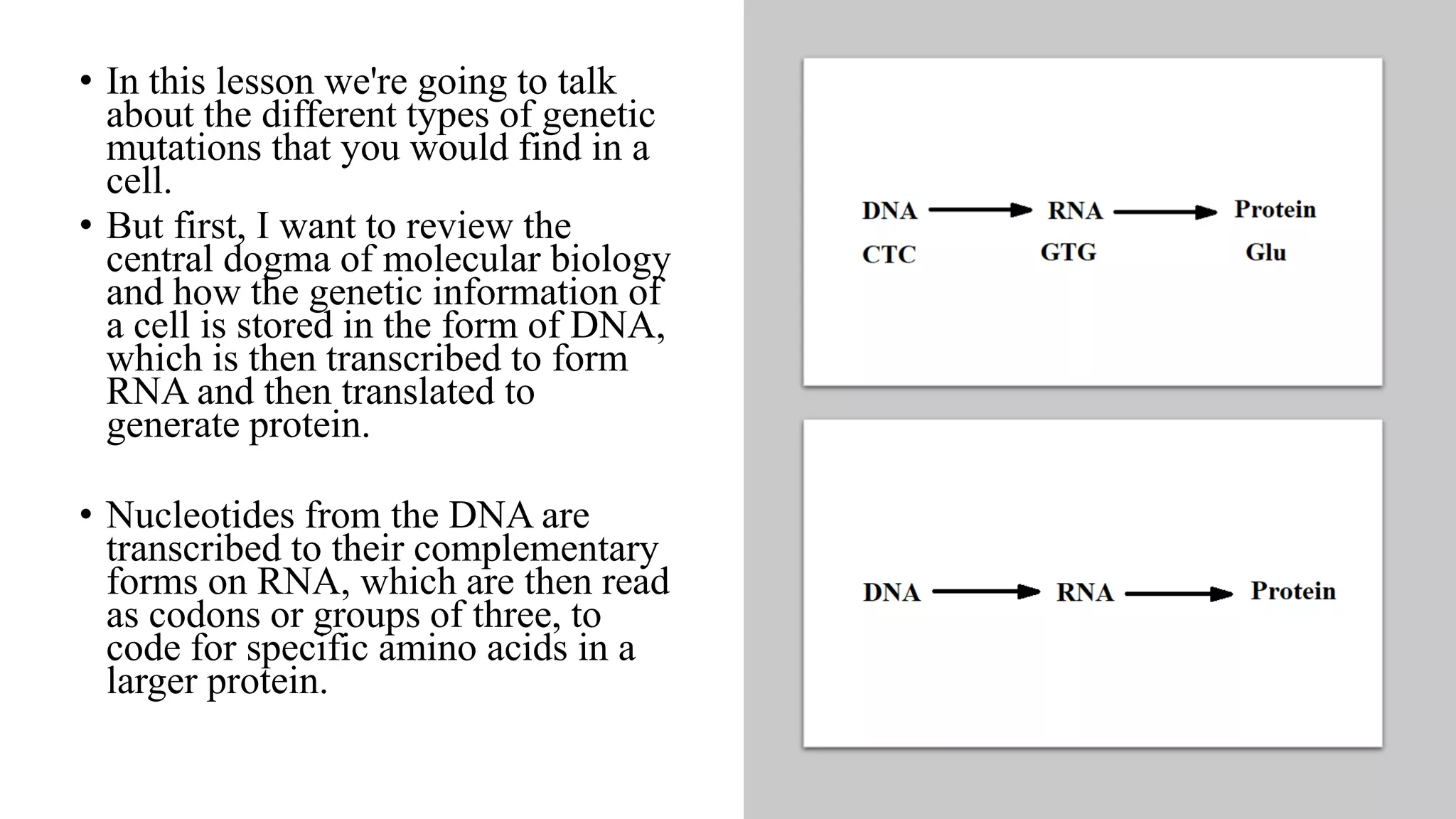
• Nucleotides from the DNA are
transcribed to their complementary
forms on RNA, which are then read
as codons or groups of three, to
code for specific amino acids in a
larger protein.
• Now, if you mutate one
of the nucleotides on
DNA, like let's say
turning this thymine-
based into an adenine-
based, then that will
affect the RNA sequence
and ultimately the
protein that follows.
• So, we say that
mutations are mistakes
in a cell's DNA that
ultimately lead to
abnormal protein
production.
• WHAT ARE THE
DIFFERENT TYPES
OF MUTATIONS?
• The first type of mutations
are called point
mutations
(substitutions).
• If we write out a random
sequence of DNA, which
is just a repeating pattern
of CTC, which would
code for a repeating
sequence of GAG in the
RNA strand, and finally, a
protein sequence of three
glutamate amino acids.
• So, a point mutation is
when one of our DNA
bases is replaced with
another.
• In this example, a
thymine-based is being
replaced with an
adenine-based, which
leads to a change in one
RNA nucleotide and
ultimately a change in
one amino acid
• Another type of mutation is
called frame-shift, which
works a little differently.
• So, first I'll write out the same
DNA, RNA, protein sequences
from before, but now, instead
of changing one base to
another, I'm going to add one to
the sequence, and here I've
thrown in this extra cytosine
base that I've written in blue.
• Point mutation Frame shift mutation
• Now, naturally, this change
would lead to an additional
guanine base being in the
resulting messenger RNA
sequence, but what's interesting
is that this mutation will change
the reading frame of the RNA.
Point mutation Frame shift mutation
• Remember that RNA is read in
groups of three or codons when
being translated to form
protein, but now, since we've
added an extra G here, all the
codons coming after that extra
G will look a little differently.
• Now, instead of having three
GAG codons, we've swapped
out two for GGA codons.
• This means that two of our
amino acids in the final protein
will be changed, and in this
example, they'll be changed
from glutamate to glycine.
Point mutation Frame shift mutation
• So, you can see that
frame-shift mutations
usually have more
significant effects on the
final protein than point
mutations do.
• Now, it's important to
recognize that both
mutations are classified
and named for how they
affect the cell's DNA
structure and aren't
really named for how
they affect the resulting
protein
• Now, our next type of mutations
are non-sense mutations and
missense mutations.
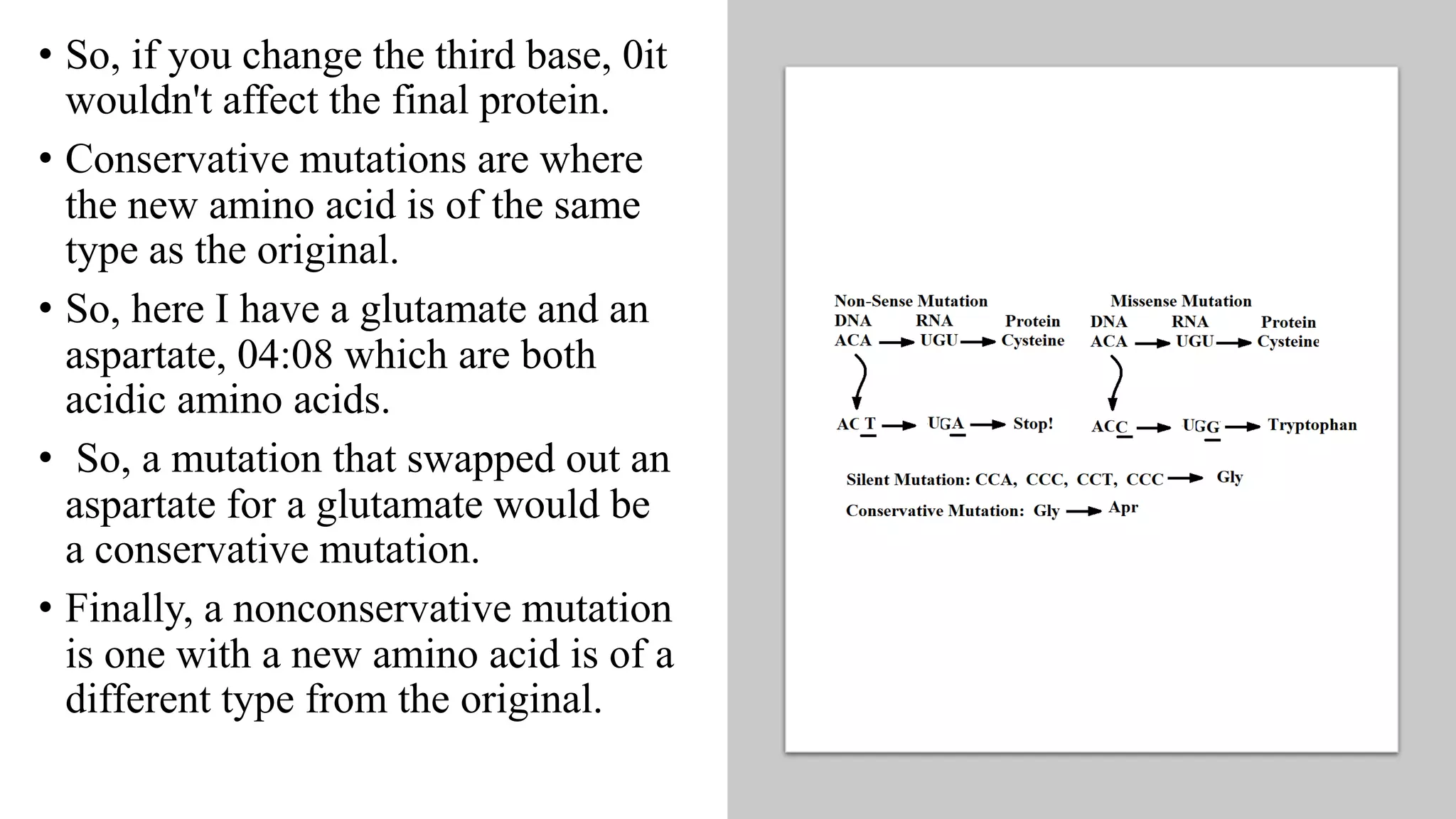
• Let's say we have a DNA sequence
that normally generates RNA and
codes for a cysteine amino acid.
• A non-sense mutation is any
genetic mutation that leads to the
RNA sequence becoming a stop
codon instead.
• Now, missense mutations are a
little different, and they're any
genetic mutation that changes an
amino acid from one to another.
• So, in this example, our mutation is
changing the resulting amino acid
from a cysteine to a tryptophan
• Now, you can see that non-sense
mutations probably affect the
resulting protein a lot more than
missense mutations do, since that new
stop codon that we're creating could
chop off a huge section of the protein,
instead of just changing one amino
acid to another.
• So, now we can divide the missense
mutations even further into a bunch of
smaller categories.
• Silent mutations are when the
mutation doesn't affect the protein at
all.
• Since many different RNA codons can
code for the same amino acid, it's
possible that the mutation might not
affect the protein at all.
• Since many different RNA
codons can code for the same
amino acid, it's possible that the
mutation might not affect the
protein at all.
So, in this example, CCA, CCG,
CCT, and CCC in the section of
DNA will all end up coding for
glycine.
• So, if you change the third base, 0it
wouldn't affect the final protein.
• Conservative mutations are where
the new amino acid is of the same
type as the original.
• So, here I have a glutamate and an
aspartate, 04:08 which are both
acidic amino acids.
• So, a mutation that swapped out an
aspartate for a glutamate would be
a conservative mutation.
• Finally, a nonconservative mutation
is one with a new amino acid is of a
different type from the original.
• So, here we have a serine amino
acid, which is a small polar
amino acid, being replaced with
phenylalanine, which is a large,
nonpolar, aromatic amino acid,
and this would be an example of
a nonconservative mutation,
since serine and phenylalanine
are different types of amino
acids.
• Now, I'll point out again that all of
these mutations are classified and
named for how they affect the
resulting proteins and aren't really
named for how they affect the cell's
DNA.
• So, let's look at a quick example.
• Sickle cell disease is a disorder
where hemoglobin or Hb, which is a
protein found in human blood, is
mutated into a less active form,
which we're going to call HbS, and it
result from a single glutamate
residue being converted into a valine
residue.
• Now, we can classify this
mutation as a point mutation,
since only one DNA base is
affected, but we can also say that
it's a nonconservative missense
mutation, since glutamate is
being swapped out for valine,
and the two are different types of
amino acids, since glutamate is
an acidic amino acid, and valine
is a nonpolar one.
• WHAT DID WE LEARN?
• Well, first we learned that mutations
originate at the DNA level, but show their
effects on the protein level, and second, we
learned that we can, classify different types
of mutations by either their effects on DNA
or their effects o protein.
• In reference to DNA, we have point and
frame-shift mutations, and in reference to
protein, we have missense and non-sense
mutations.
• SUMMARY
1. Mutations originate at the
DNA at the DNA level but
show their effect at the
protein level.
2. Mutations can be classified
by their effects on DNA or
on protein
• https://www.youtube.com/watch?v=xYOK-yzUWSI

The different types of mutations

  • 1.
    | MCAT |Khan Academy Prepared by Yousef Elshrek THE DIFFERENT TYPES OF MUTATIONS / BIOMOLECULES
  • 2.
    • In thislesson we're going to talk about the different types of genetic mutations that you would find in a cell. • But first, I want to review the central dogma of molecular biology and how the genetic information of a cell is stored in the form of DNA, which is then transcribed to form RNA and then translated to generate protein. • Nucleotides from the DNA are transcribed to their complementary forms on RNA, which are then read as codons or groups of three, to code for specific amino acids in a larger protein.
  • 3.
    • Now, ifyou mutate one of the nucleotides on DNA, like let's say turning this thymine- based into an adenine- based, then that will affect the RNA sequence and ultimately the protein that follows. • So, we say that mutations are mistakes in a cell's DNA that ultimately lead to abnormal protein production.
  • 4.
    • WHAT ARETHE DIFFERENT TYPES OF MUTATIONS? • The first type of mutations are called point mutations (substitutions). • If we write out a random sequence of DNA, which is just a repeating pattern of CTC, which would code for a repeating sequence of GAG in the RNA strand, and finally, a protein sequence of three glutamate amino acids.
  • 5.
    • So, apoint mutation is when one of our DNA bases is replaced with another. • In this example, a thymine-based is being replaced with an adenine-based, which leads to a change in one RNA nucleotide and ultimately a change in one amino acid
  • 6.
    • Another typeof mutation is called frame-shift, which works a little differently. • So, first I'll write out the same DNA, RNA, protein sequences from before, but now, instead of changing one base to another, I'm going to add one to the sequence, and here I've thrown in this extra cytosine base that I've written in blue. • Point mutation Frame shift mutation
  • 7.
    • Now, naturally,this change would lead to an additional guanine base being in the resulting messenger RNA sequence, but what's interesting is that this mutation will change the reading frame of the RNA. Point mutation Frame shift mutation
  • 8.
    • Remember thatRNA is read in groups of three or codons when being translated to form protein, but now, since we've added an extra G here, all the codons coming after that extra G will look a little differently. • Now, instead of having three GAG codons, we've swapped out two for GGA codons. • This means that two of our amino acids in the final protein will be changed, and in this example, they'll be changed from glutamate to glycine. Point mutation Frame shift mutation
  • 9.
    • So, youcan see that frame-shift mutations usually have more significant effects on the final protein than point mutations do. • Now, it's important to recognize that both mutations are classified and named for how they affect the cell's DNA structure and aren't really named for how they affect the resulting protein
  • 10.
    • Now, ournext type of mutations are non-sense mutations and missense mutations. • Let's say we have a DNA sequence that normally generates RNA and codes for a cysteine amino acid. • A non-sense mutation is any genetic mutation that leads to the RNA sequence becoming a stop codon instead.
  • 11.
    • Now, missensemutations are a little different, and they're any genetic mutation that changes an amino acid from one to another. • So, in this example, our mutation is changing the resulting amino acid from a cysteine to a tryptophan
  • 12.
    • Now, youcan see that non-sense mutations probably affect the resulting protein a lot more than missense mutations do, since that new stop codon that we're creating could chop off a huge section of the protein, instead of just changing one amino acid to another. • So, now we can divide the missense mutations even further into a bunch of smaller categories. • Silent mutations are when the mutation doesn't affect the protein at all. • Since many different RNA codons can code for the same amino acid, it's possible that the mutation might not affect the protein at all.
  • 13.
    • Since manydifferent RNA codons can code for the same amino acid, it's possible that the mutation might not affect the protein at all. So, in this example, CCA, CCG, CCT, and CCC in the section of DNA will all end up coding for glycine.
  • 14.
    • So, ifyou change the third base, 0it wouldn't affect the final protein. • Conservative mutations are where the new amino acid is of the same type as the original. • So, here I have a glutamate and an aspartate, 04:08 which are both acidic amino acids. • So, a mutation that swapped out an aspartate for a glutamate would be a conservative mutation. • Finally, a nonconservative mutation is one with a new amino acid is of a different type from the original.
  • 15.
    • So, herewe have a serine amino acid, which is a small polar amino acid, being replaced with phenylalanine, which is a large, nonpolar, aromatic amino acid, and this would be an example of a nonconservative mutation, since serine and phenylalanine are different types of amino acids.
  • 16.
    • Now, I'llpoint out again that all of these mutations are classified and named for how they affect the resulting proteins and aren't really named for how they affect the cell's DNA. • So, let's look at a quick example. • Sickle cell disease is a disorder where hemoglobin or Hb, which is a protein found in human blood, is mutated into a less active form, which we're going to call HbS, and it result from a single glutamate residue being converted into a valine residue.
  • 17.
    • Now, wecan classify this mutation as a point mutation, since only one DNA base is affected, but we can also say that it's a nonconservative missense mutation, since glutamate is being swapped out for valine, and the two are different types of amino acids, since glutamate is an acidic amino acid, and valine is a nonpolar one.
  • 18.
    • WHAT DIDWE LEARN? • Well, first we learned that mutations originate at the DNA level, but show their effects on the protein level, and second, we learned that we can, classify different types of mutations by either their effects on DNA or their effects o protein. • In reference to DNA, we have point and frame-shift mutations, and in reference to protein, we have missense and non-sense mutations. • SUMMARY 1. Mutations originate at the DNA at the DNA level but show their effect at the protein level. 2. Mutations can be classified by their effects on DNA or on protein
  • 19.