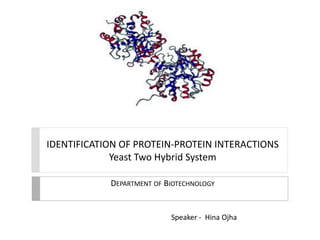
IDENTIFICATION OF PROTEIN-PROTEIN INTERACTIONSYeast Two Hybrid SystemDepartment of BiotechnologySpeaker -  HinaOjha
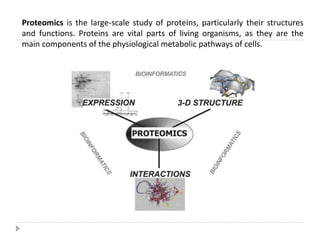
Proteomics is the large-scale study of proteins, particularly their structures and functions. Proteins are vital parts of living organisms, as they are the main components of the physiological metabolic pathways of cells.
Functional proteomicsCritical aspects required to understand the function of a protein include:Protein sequence and structure–used to discover motifs that predict protein function
Expression profile–reveals cell-type specificity and how expression is regulated
Post-translational modifications (e.g., phosphorylation, acylation, glycosylation, ubiquitination)–suggests localization, activation and/or function
Intracellular localization–may allude to the function of the protein
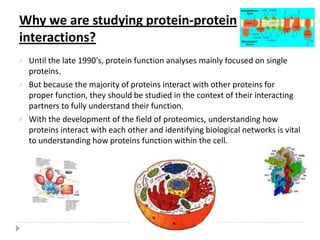
Interactions with other proteins-function may be extrapolated by knowing the function of binding partners.Why we are studying protein-protein interactions?Until the late 1990's, protein function analyses mainly focused on single proteins.
But because the majority of proteins interact with other proteins for proper function, they should be studied in the context of their interacting partners to fully understand their function.
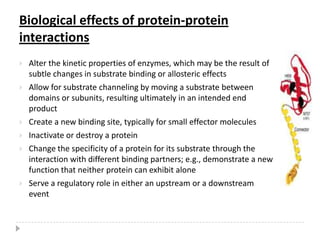
With the development of the field of proteomics, understanding how proteins interact with each other and identifying biological networks is vital to understanding how proteins function within the cell.Biological effects of protein-protein interactionsAlter the kinetic properties of enzymes, which may be the result of subtle changes in substrate binding or allosteric effects
Allow for substrate channeling by moving a substrate between domains or subunits, resulting ultimately in an intended end product
Create a new binding site, typically for small effector molecules
Inactivate or destroy a protein
Change the specificity of a protein for its substrate through the interaction with different binding partners; e.g., demonstrate a new function that neither protein can exhibit alone
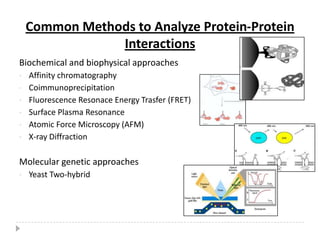
Serve a regulatory role in either an upstream or a downstream eventR0 = 4.9 nmCommon Methods to Analyze Protein-Protein InteractionsBiochemical and biophysical approachesAffinity chromatography
Coimmunoprecipitation
Fluorescence Resonace Energy Trasfer (FRET)
Surface Plasma Resonance
Atomic Force Microscopy (AFM)
X-ray DiffractionMolecular genetic approachesYeast Two-hybridWhy Yeast Two-Hybrid systemThe yeast two hybrid system has a clear advantage over classicalbiochemical or genetic methodsIt is an in vivo technique that uses the yeast cell as a living test-tube.
It bears a greater resemblance to higher eukaryotic systems than a system based on a bacterial host.
With regards to classical biochemical approaches, which can require high quantities of purified proteins or good quality anti-bodies, the two hybrid system has minimal requirements to initiate screening, since only the cDNA of the gene of interest is needed.In signaling cascades, weak and transient interactions are often very important. Such interactions are more readily detected with the two hybrid system since the reporter gene response often leads to significant amplification.
The two hybrid assay is also useful for analysis of known interactions, which can be achieved by modifying important residues or modules and observing this effect on binding.
Interactions can be measured semi-quantitatively using the two hybrid system, allowing discrimination between high, intermediate, and low-affinity bindings, the power of which correlates with that of in vitro approaches Two hybrid screens are sometimes termed "functional screens", since if at least one of the proteins screened has a known function in a well-defined pathway, it might provide a functional hint in the current interaction.
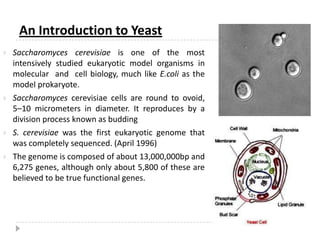
Although there are certain disadvantages involving the two hybrid assay, the most convincing argument for its use is the speed and ease by which the molecular mechanisms of many signaling cascades have been defined using this technique.An Introduction to YeastSaccharomycescerevisiae is one of the most intensively studied eukaryotic model organisms in molecular  and  cell biology, much likeE.coli as the model prokaryote. Saccharomycescerevisiae cells are round to ovoid, 5–10 micrometers in diameter. It reproduces by a division process known as budding S. cerevisiae was the first eukaryoticgenome that was completely sequenced. (April 1996)The genome is composed of about 13,000,000bp and 6,275 genes, although only about 5,800 of these are believed to be true functional genes.
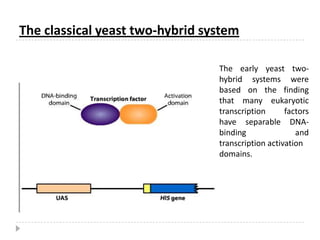
The classical yeast two-hybrid systemThe early yeast two-hybrid systems were based on the finding that many eukaryotic transcription factors have separable DNA-binding and transcription activationdomains.
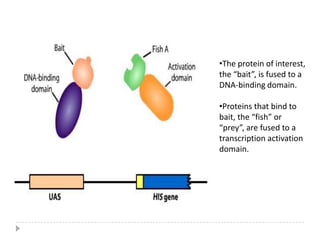
The protein of interest, the “bait”, is fused to a DNA-binding domain.
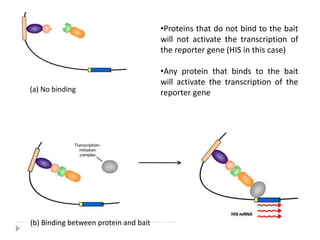
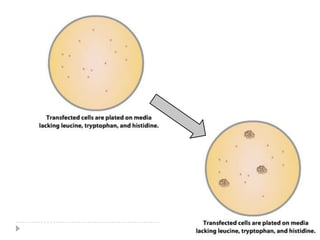
Proteins that bind to bait, the “fish” or “prey”, are fused to a transcription activation domain.Proteins that do not bind to the bait will not activate the transcription of the reporter gene (HIS in this case)
Any protein that binds to the bait will activate the transcription of the reporter gene(a) No binding(b) Binding between protein and bait
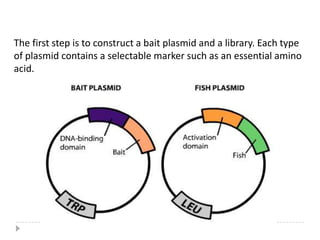
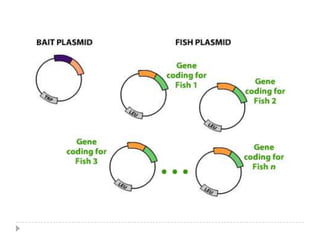
The first step is to construct a bait plasmid and a library. Each type of plasmid contains a selectable marker such as an essential amino acid.
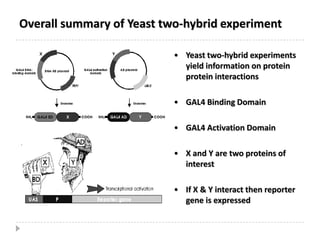
Overall summary of Yeast two-hybrid experimentYeast two-hybrid experiments yield information on protein protein interactions
GAL4 Binding Domain
GAL4 Activation Domain
X and Y are two proteins of interest
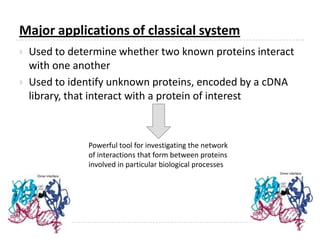
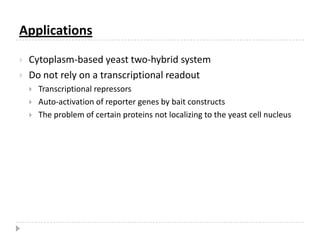
If X & Y interact then reporter gene is expressedMajor applications of classical system Used to determine whether two known proteins interact with one anotherUsed to identify unknown proteins, encoded by a cDNA library, that interact with a protein of interestPowerful tool for investigating the network of interactions that form between proteins involved in particular biological processes
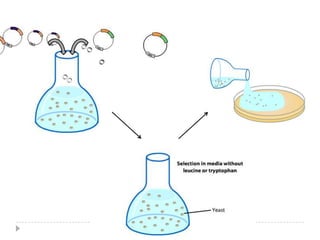
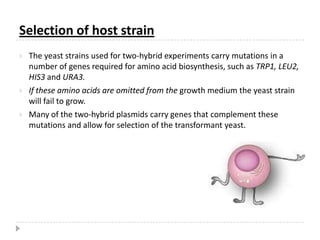
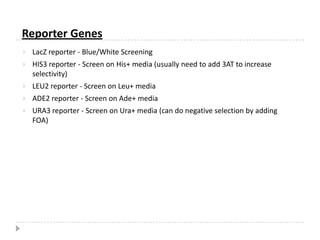
Selection of host strainThe yeast strains used for two-hybrid experiments carry mutations in a number of genes required for amino acid biosynthesis, such as TRP1, LEU2, HIS3 and URA3. If these amino acids are omitted from the growth medium the yeast strain will fail to grow.Many of the two-hybrid plasmids carry genes that complement these mutations and allow for selection of the transformant yeast.

Yeast two hybrid

  • 1.
    IDENTIFICATION OF PROTEIN-PROTEININTERACTIONSYeast Two Hybrid SystemDepartment of BiotechnologySpeaker - HinaOjha
  • 2.
    Proteomics is thelarge-scale study of proteins, particularly their structures and functions. Proteins are vital parts of living organisms, as they are the main components of the physiological metabolic pathways of cells.
  • 3.
    Functional proteomicsCritical aspectsrequired to understand the function of a protein include:Protein sequence and structure–used to discover motifs that predict protein function
  • 4.
    Expression profile–reveals cell-typespecificity and how expression is regulated
  • 5.
    Post-translational modifications (e.g.,phosphorylation, acylation, glycosylation, ubiquitination)–suggests localization, activation and/or function
  • 6.
    Intracellular localization–may alludeto the function of the protein
  • 7.
    Interactions with otherproteins-function may be extrapolated by knowing the function of binding partners.Why we are studying protein-protein interactions?Until the late 1990's, protein function analyses mainly focused on single proteins.
  • 8.
    But because themajority of proteins interact with other proteins for proper function, they should be studied in the context of their interacting partners to fully understand their function.
  • 9.
    With the developmentof the field of proteomics, understanding how proteins interact with each other and identifying biological networks is vital to understanding how proteins function within the cell.Biological effects of protein-protein interactionsAlter the kinetic properties of enzymes, which may be the result of subtle changes in substrate binding or allosteric effects
  • 10.
    Allow for substratechanneling by moving a substrate between domains or subunits, resulting ultimately in an intended end product
  • 11.
    Create a newbinding site, typically for small effector molecules
  • 12.
  • 13.
    Change the specificityof a protein for its substrate through the interaction with different binding partners; e.g., demonstrate a new function that neither protein can exhibit alone
  • 14.
    Serve a regulatoryrole in either an upstream or a downstream eventR0 = 4.9 nmCommon Methods to Analyze Protein-Protein InteractionsBiochemical and biophysical approachesAffinity chromatography
  • 15.
  • 16.
  • 17.
  • 18.
  • 19.
    X-ray DiffractionMolecular geneticapproachesYeast Two-hybridWhy Yeast Two-Hybrid systemThe yeast two hybrid system has a clear advantage over classicalbiochemical or genetic methodsIt is an in vivo technique that uses the yeast cell as a living test-tube.
  • 20.
    It bears agreater resemblance to higher eukaryotic systems than a system based on a bacterial host.
  • 21.
    With regards toclassical biochemical approaches, which can require high quantities of purified proteins or good quality anti-bodies, the two hybrid system has minimal requirements to initiate screening, since only the cDNA of the gene of interest is needed.In signaling cascades, weak and transient interactions are often very important. Such interactions are more readily detected with the two hybrid system since the reporter gene response often leads to significant amplification.
  • 22.
    The two hybridassay is also useful for analysis of known interactions, which can be achieved by modifying important residues or modules and observing this effect on binding.
  • 23.
    Interactions can bemeasured semi-quantitatively using the two hybrid system, allowing discrimination between high, intermediate, and low-affinity bindings, the power of which correlates with that of in vitro approaches Two hybrid screens are sometimes termed "functional screens", since if at least one of the proteins screened has a known function in a well-defined pathway, it might provide a functional hint in the current interaction.
  • 24.
    Although there arecertain disadvantages involving the two hybrid assay, the most convincing argument for its use is the speed and ease by which the molecular mechanisms of many signaling cascades have been defined using this technique.An Introduction to YeastSaccharomycescerevisiae is one of the most intensively studied eukaryotic model organisms in molecular and cell biology, much likeE.coli as the model prokaryote. Saccharomycescerevisiae cells are round to ovoid, 5–10 micrometers in diameter. It reproduces by a division process known as budding S. cerevisiae was the first eukaryoticgenome that was completely sequenced. (April 1996)The genome is composed of about 13,000,000bp and 6,275 genes, although only about 5,800 of these are believed to be true functional genes.
  • 25.
    The classical yeasttwo-hybrid systemThe early yeast two-hybrid systems were based on the finding that many eukaryotic transcription factors have separable DNA-binding and transcription activationdomains.
  • 26.
    The protein ofinterest, the “bait”, is fused to a DNA-binding domain.
  • 27.
    Proteins that bindto bait, the “fish” or “prey”, are fused to a transcription activation domain.Proteins that do not bind to the bait will not activate the transcription of the reporter gene (HIS in this case)
  • 28.
    Any protein thatbinds to the bait will activate the transcription of the reporter gene(a) No binding(b) Binding between protein and bait
  • 29.
    The first stepis to construct a bait plasmid and a library. Each type of plasmid contains a selectable marker such as an essential amino acid.
  • 33.
    Overall summary ofYeast two-hybrid experimentYeast two-hybrid experiments yield information on protein protein interactions
  • 34.
  • 35.
  • 36.
    X and Yare two proteins of interest
  • 37.
    If X &Y interact then reporter gene is expressedMajor applications of classical system Used to determine whether two known proteins interact with one anotherUsed to identify unknown proteins, encoded by a cDNA library, that interact with a protein of interestPowerful tool for investigating the network of interactions that form between proteins involved in particular biological processes
  • 38.
    Selection of hoststrainThe yeast strains used for two-hybrid experiments carry mutations in a number of genes required for amino acid biosynthesis, such as TRP1, LEU2, HIS3 and URA3. If these amino acids are omitted from the growth medium the yeast strain will fail to grow.Many of the two-hybrid plasmids carry genes that complement these mutations and allow for selection of the transformant yeast.