Presented by Creative Proteomics
Brief Introduction of Post-
translational Modifications
Proteome Complexity
The human gene set was estimated at about
25,000 genes, while the total number of proteins
is expected to be much larger and estimated at
over 1 million.
The single genes can encode multiple proteins
Alternative splicing mRNA editing
Post-translational modifications (PTMs) of proteins
Mechanism of action of PTMs
 Proteolytic processing results in the
activation through cleavage of different
sites in the protein.
 PTMs can tag proteins for destruction
like polyubiquitylation-mediated
degradation of proteins.
 PTMs can lead to activation,
interaction, localization, and secretion
by PTM-dependent recognition. PTMs
might induce conformational changes
or form a docking site to mediate
molecular recognition and stabilize
protein–ligand and protein-protein
interactions.
 By reversible multi-site PTMs, they can
rapidly and dynamically regulate or
modulation protein activities, protein-
protein and protein-DNA interactions.
Jensen O N. Interpreting the protein language using proteomics. Nature
reviews Molecular cell biology, 2006, 7(6): 391.
Types of PTMs
1
2
3
4
Phosphorylation
Methylation
Glycosylation
Acetylation
5
Ubiquitination
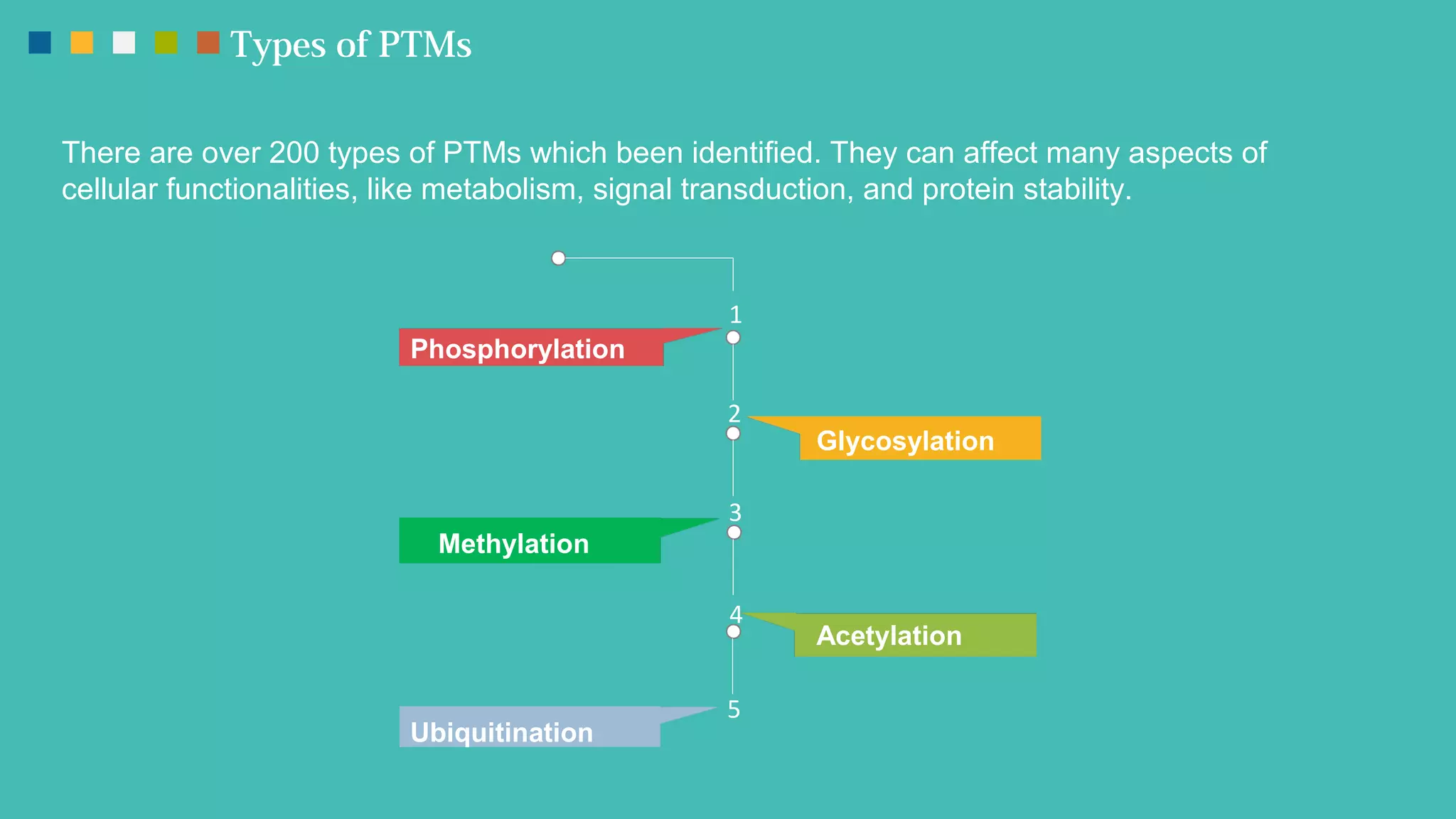
There are over 200 types of PTMs which been identified. They can affect many aspects of
cellular functionalities, like metabolism, signal transduction, and protein stability.
Phosphorylation
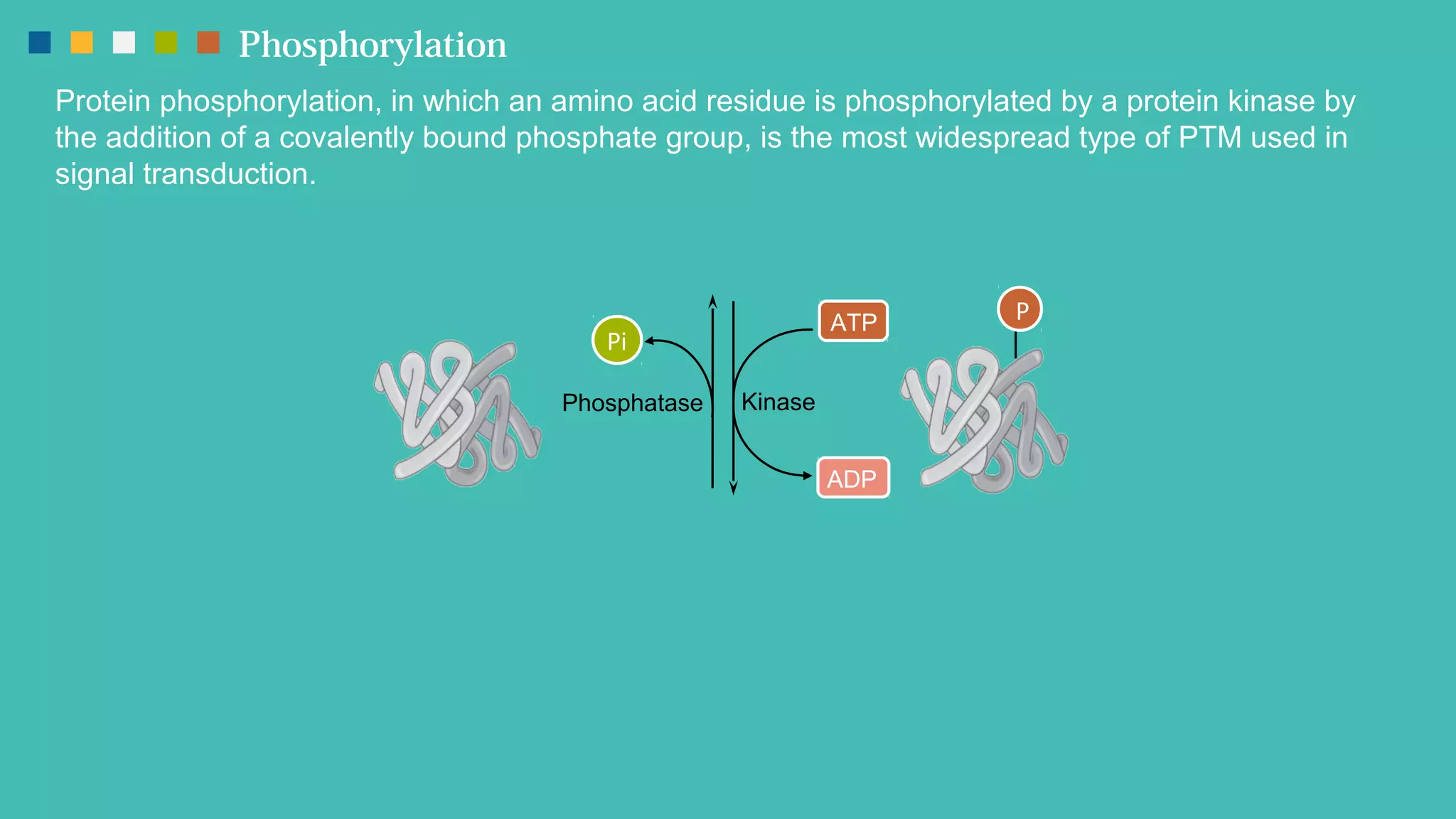
Protein phosphorylation, in which an amino acid residue is phosphorylated by a protein kinase by
the addition of a covalently bound phosphate group, is the most widespread type of PTM used in
signal transduction.
Pi
Phosphatase Kinase
ATP
ADP
P
Phosphorylation
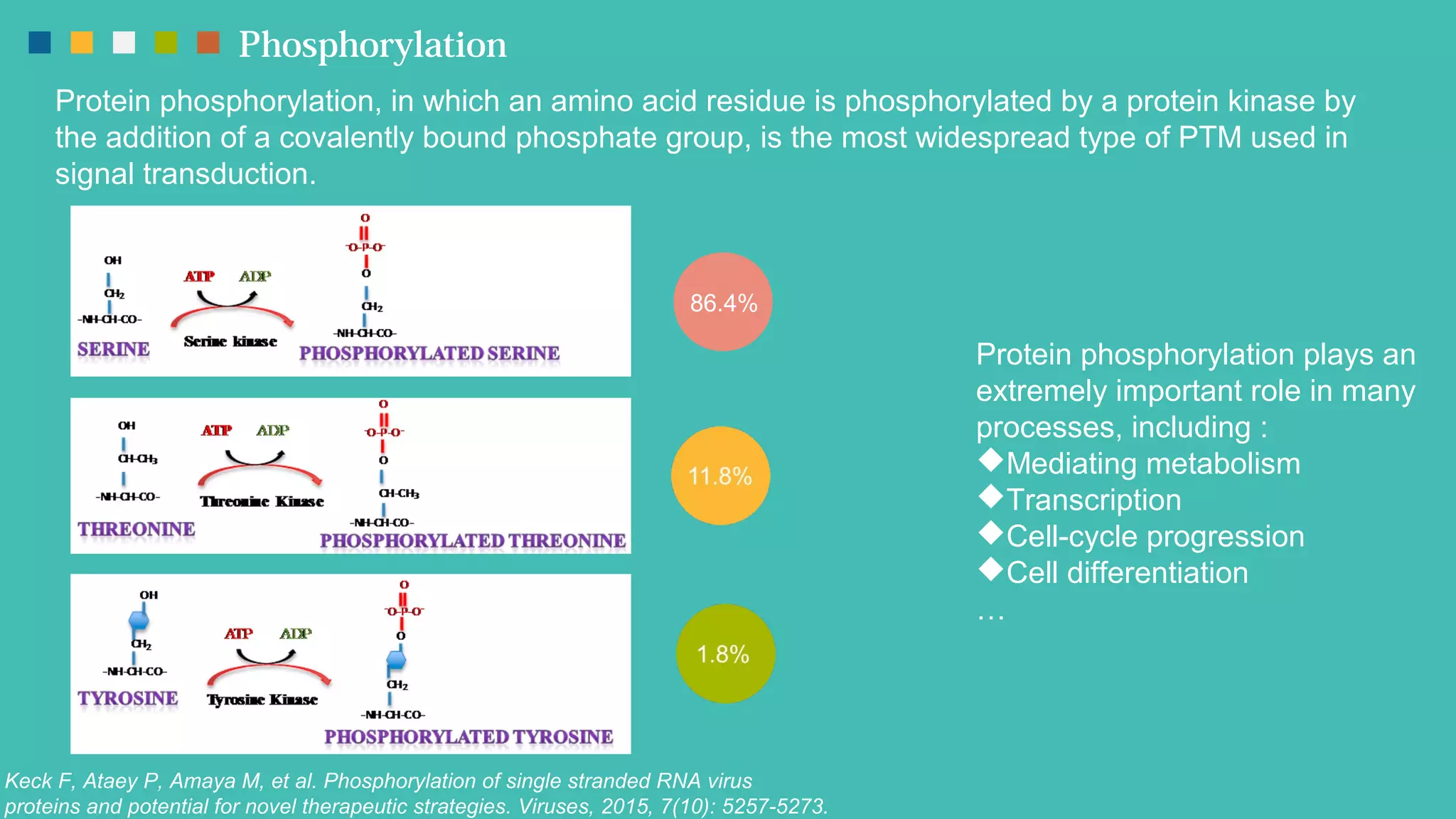
Protein phosphorylation, in which an amino acid residue is phosphorylated by a protein kinase by
the addition of a covalently bound phosphate group, is the most widespread type of PTM used in
signal transduction.
Keck F, Ataey P, Amaya M, et al. Phosphorylation of single stranded RNA virus
proteins and potential for novel therapeutic strategies. Viruses, 2015, 7(10): 5257-5273.
86.4%
Protein phosphorylation plays an
extremely important role in many
processes, including :
Mediating metabolism
Transcription
Cell-cycle progression
Cell differentiation
…
Methylation
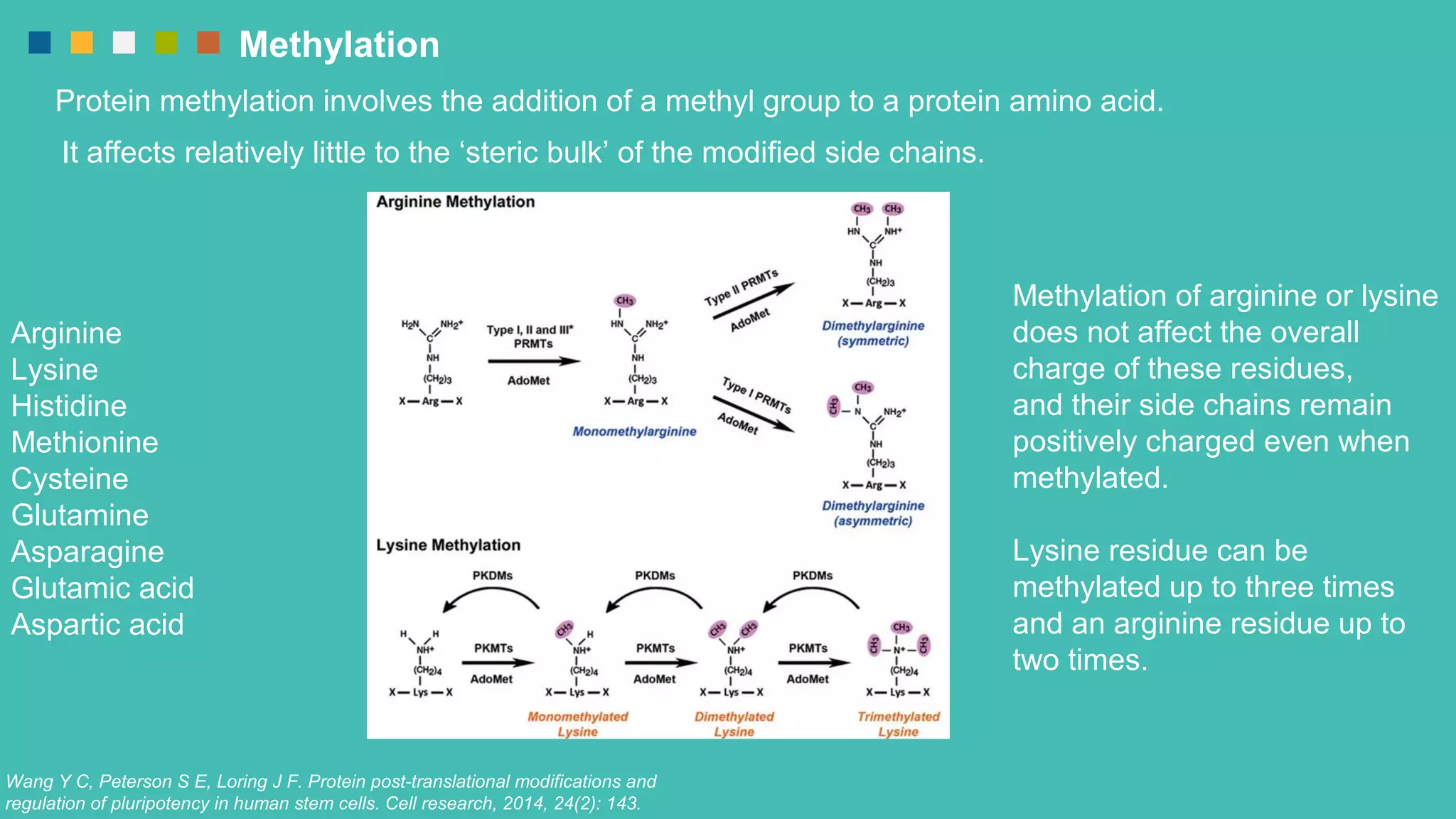
Protein methylation involves the addition of a methyl group to a protein amino acid.
Wang Y C, Peterson S E, Loring J F. Protein post-translational modifications and
regulation of pluripotency in human stem cells. Cell research, 2014, 24(2): 143.
Arginine
Lysine
Histidine
Methionine
Cysteine
Glutamine
Asparagine
Glutamic acid
Aspartic acid
It affects relatively little to the ‘steric bulk’ of the modified side chains.
Methylation of arginine or lysine
does not affect the overall
charge of these residues,
and their side chains remain
positively charged even when
methylated.
Lysine residue can be
methylated up to three times
and an arginine residue up to
two times.
Glycosylation
1
2
3
N-linked glycosylation involves the attachment of the
sugar molecule to a nitrogen atom, which is the amide
nitrogen of an asparagine (Asn) residue of a protein.
O-linked glycosylation is the attachment of a
sugar molecule to an oxygen atom in an amino
acid residue of the protein.
C-mannosylation involve attachment of an α-mannosyl
residue to C-2 of the Trp through a C-C bond.
Glycosylation, the attachment of sugar moieties to proteins, is critical for a wide range of
biological processes in the cell.
Spiro R G. Protein glycosylation: nature, distribution, enzymatic formation, and
disease implications of glycopeptide bonds. Glycobiology, 2002, 12(4): 43R-56R.
4 Phosphoglycosylation involves the attachment of
sugar to protein though a phosphodiester bond.
5 Glypiation is a special form of glycosylation, in which
a protein is attached to a lipid anchor.
Acetylation
1
2
3
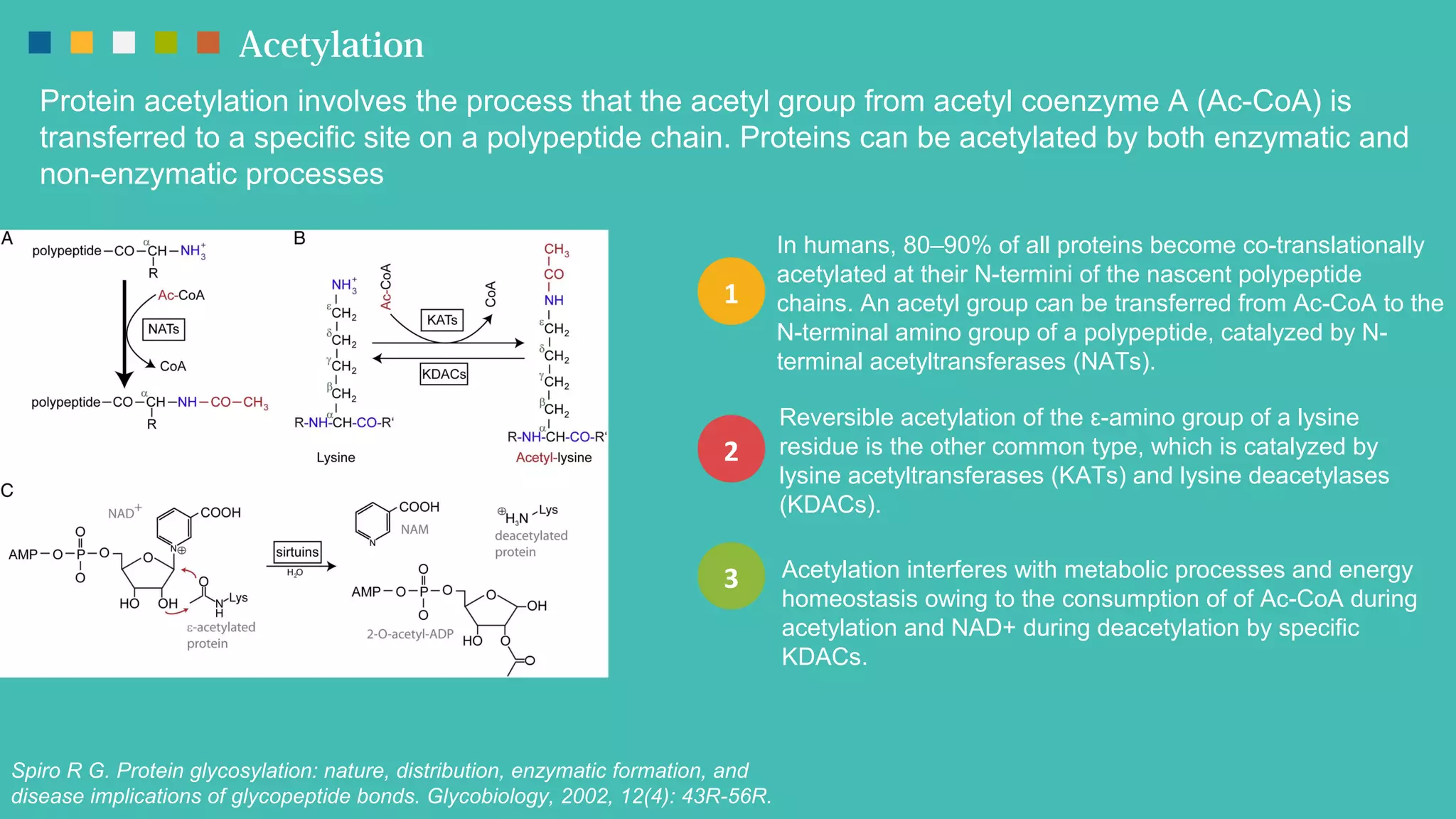
In humans, 80–90% of all proteins become co-translationally
acetylated at their N-termini of the nascent polypeptide
chains. An acetyl group can be transferred from Ac-CoA to the
N-terminal amino group of a polypeptide, catalyzed by N-
terminal acetyltransferases (NATs).
Reversible acetylation of the ε-amino group of a lysine
residue is the other common type, which is catalyzed by
lysine acetyltransferases (KATs) and lysine deacetylases
(KDACs).
Acetylation interferes with metabolic processes and energy
homeostasis owing to the consumption of of Ac-CoA during
acetylation and NAD+ during deacetylation by specific
KDACs.
Protein acetylation involves the process that the acetyl group from acetyl coenzyme A (Ac-CoA) is
transferred to a specific site on a polypeptide chain. Proteins can be acetylated by both enzymatic and
non-enzymatic processes
Spiro R G. Protein glycosylation: nature, distribution, enzymatic formation, and
disease implications of glycopeptide bonds. Glycobiology, 2002, 12(4): 43R-56R.
Ubiquitination involves the attachment of the polypeptide ubiquitin to target proteins by a set of three
enzymes, including ubiquitin-activating enzyme E1, ubiquitin-conjugating enzyme E2, and ubiquitin ligase
E3.
Ubiquitination
Bhogaraju S, Dikic I. Cell biology: Ubiquitination without E1 and E2 enzymes. Nature, 2016, 533(7601):
Our Services
With years’ experience in advanced
experiment equipment, Creative
Proteomics can provide a variety of PTM
services to assist your scientific research.
Phosphorylation analysis
Glycosylation analysis
Methylation analysis
Acetylation analysis
Ubiquitination analysis
Nitrosylation analysis
Di-Sulfide bond localization
Thanks for your watching
Web: www.creative-proteomics.com
Email: info@creative-proteomics.com

Brief introduction of post-translational modifications (PTMs)

  • 1.
    Presented by CreativeProteomics Brief Introduction of Post- translational Modifications
  • 2.
    Proteome Complexity The humangene set was estimated at about 25,000 genes, while the total number of proteins is expected to be much larger and estimated at over 1 million. The single genes can encode multiple proteins Alternative splicing mRNA editing Post-translational modifications (PTMs) of proteins
  • 3.
    Mechanism of actionof PTMs  Proteolytic processing results in the activation through cleavage of different sites in the protein.  PTMs can tag proteins for destruction like polyubiquitylation-mediated degradation of proteins.  PTMs can lead to activation, interaction, localization, and secretion by PTM-dependent recognition. PTMs might induce conformational changes or form a docking site to mediate molecular recognition and stabilize protein–ligand and protein-protein interactions.  By reversible multi-site PTMs, they can rapidly and dynamically regulate or modulation protein activities, protein- protein and protein-DNA interactions. Jensen O N. Interpreting the protein language using proteomics. Nature reviews Molecular cell biology, 2006, 7(6): 391.
  • 4.
    Types of PTMs 1 2 3 4 Phosphorylation Methylation Glycosylation Acetylation 5 Ubiquitination Thereare over 200 types of PTMs which been identified. They can affect many aspects of cellular functionalities, like metabolism, signal transduction, and protein stability.
  • 5.
    Phosphorylation Protein phosphorylation, inwhich an amino acid residue is phosphorylated by a protein kinase by the addition of a covalently bound phosphate group, is the most widespread type of PTM used in signal transduction. Pi Phosphatase Kinase ATP ADP P
  • 6.
    Phosphorylation Protein phosphorylation, inwhich an amino acid residue is phosphorylated by a protein kinase by the addition of a covalently bound phosphate group, is the most widespread type of PTM used in signal transduction. Keck F, Ataey P, Amaya M, et al. Phosphorylation of single stranded RNA virus proteins and potential for novel therapeutic strategies. Viruses, 2015, 7(10): 5257-5273. 86.4% Protein phosphorylation plays an extremely important role in many processes, including : Mediating metabolism Transcription Cell-cycle progression Cell differentiation …
  • 7.
    Methylation Protein methylation involvesthe addition of a methyl group to a protein amino acid. Wang Y C, Peterson S E, Loring J F. Protein post-translational modifications and regulation of pluripotency in human stem cells. Cell research, 2014, 24(2): 143. Arginine Lysine Histidine Methionine Cysteine Glutamine Asparagine Glutamic acid Aspartic acid It affects relatively little to the ‘steric bulk’ of the modified side chains. Methylation of arginine or lysine does not affect the overall charge of these residues, and their side chains remain positively charged even when methylated. Lysine residue can be methylated up to three times and an arginine residue up to two times.
  • 8.
    Glycosylation 1 2 3 N-linked glycosylation involvesthe attachment of the sugar molecule to a nitrogen atom, which is the amide nitrogen of an asparagine (Asn) residue of a protein. O-linked glycosylation is the attachment of a sugar molecule to an oxygen atom in an amino acid residue of the protein. C-mannosylation involve attachment of an α-mannosyl residue to C-2 of the Trp through a C-C bond. Glycosylation, the attachment of sugar moieties to proteins, is critical for a wide range of biological processes in the cell. Spiro R G. Protein glycosylation: nature, distribution, enzymatic formation, and disease implications of glycopeptide bonds. Glycobiology, 2002, 12(4): 43R-56R. 4 Phosphoglycosylation involves the attachment of sugar to protein though a phosphodiester bond. 5 Glypiation is a special form of glycosylation, in which a protein is attached to a lipid anchor.
  • 9.
    Acetylation 1 2 3 In humans, 80–90%of all proteins become co-translationally acetylated at their N-termini of the nascent polypeptide chains. An acetyl group can be transferred from Ac-CoA to the N-terminal amino group of a polypeptide, catalyzed by N- terminal acetyltransferases (NATs). Reversible acetylation of the ε-amino group of a lysine residue is the other common type, which is catalyzed by lysine acetyltransferases (KATs) and lysine deacetylases (KDACs). Acetylation interferes with metabolic processes and energy homeostasis owing to the consumption of of Ac-CoA during acetylation and NAD+ during deacetylation by specific KDACs. Protein acetylation involves the process that the acetyl group from acetyl coenzyme A (Ac-CoA) is transferred to a specific site on a polypeptide chain. Proteins can be acetylated by both enzymatic and non-enzymatic processes Spiro R G. Protein glycosylation: nature, distribution, enzymatic formation, and disease implications of glycopeptide bonds. Glycobiology, 2002, 12(4): 43R-56R.
  • 10.
    Ubiquitination involves theattachment of the polypeptide ubiquitin to target proteins by a set of three enzymes, including ubiquitin-activating enzyme E1, ubiquitin-conjugating enzyme E2, and ubiquitin ligase E3. Ubiquitination Bhogaraju S, Dikic I. Cell biology: Ubiquitination without E1 and E2 enzymes. Nature, 2016, 533(7601):
  • 11.
    Our Services With years’experience in advanced experiment equipment, Creative Proteomics can provide a variety of PTM services to assist your scientific research. Phosphorylation analysis Glycosylation analysis Methylation analysis Acetylation analysis Ubiquitination analysis Nitrosylation analysis Di-Sulfide bond localization
  • 12.
    Thanks for yourwatching Web: www.creative-proteomics.com Email: info@creative-proteomics.com

Editor's Notes

  • #2 Hello, welcome to watch Creative Proteomics’Video. Today, we are going to briefly introduce Post-translational Modifications.
  • #3 As we know, the human gene set was estimated at about 25,000 genes, while the total number of proteins is expected to be much larger and estimated at over 1 million. The single genes can encode multiple proteins. In addition to alternative splicing mRNA editing as a source of protein complexity, post-translational modifications of proteins can further facilitate the complexity from the level of the genome to the proteome.
  • #4 PTMs have a role in different ways. Proteolytic processing results in the activation through cleavage of different sites in the protein. In addition, PTMs can tag proteins for destruction like polyubiquitylation-mediated degradation of proteins. Moreover, PTMs can lead to activation, interaction, localization, and secretion by PTM-dependent recognition. PTMs might induce conformational changes or form a docking site to mediate molecular recognition and stabilize protein–ligand and protein-protein interactions. By reversible multi-site PTMs, they can rapidly and dynamically regulate or modulation protein activities, protein-protein and protein-DNA interactions.
  • #5 There are over 200 types of PTMs which been identified. They can affect many aspects of cellular functionalities, like metabolism, signal transduction, and protein stability. Next, we will briefly introduce some common PTMs, including phosphorylation, glycosylation, methylation, acetylation, and ubiquitination.
  • #6 Protein phosphorylation, in which an amino acid residue is phosphorylated by a protein kinase by the addition of a covalently bound phosphate group, is the most widespread type of PTM used in signal transduction. Phosphorylation is done by the kinases and dephosphorylation is done by phosphatases that play opposite roles.
  • #7 In eukaryotic cells, about 86.4% of the protein phosphorylation events occur on serine (Ser or S), while 11.8% protein phosphorylation events occur on  threonine whereas only 1.8% on tyrosine residues. Protein phosphorylation plays an extremely important role in many processes, including mediating metabolism, transcription, cell-cycle progression, differentiation, and so on.
  • #8 Protein methylation involves the addition of a methyl group to a protein amino acid. The methyl group is one of the smallest PTMs and affects relatively little to the ‘steric bulk’ of the modified side chains. It is reported that methylation can occur on the side chains of at least nine of the twenty common amino acid residues, including arginine, lysine, histidine, methionine, cysteine, glutamine, asparagine, glutamic acid, and aspartic acid. Among them, arginine and lysine are by far the most commonly methylated residues. In addition, methylation of arginine or lysine does not affect the overall charge of these residues, and their side chains remain positively charged even when methylated. Lysine residue can be methylated up to three times and an arginine residue up to two times.
  • #9 Glycosylation, the attachment of sugar moieties to proteins, is critical for a wide range of biological processes in the cell. There are different types of glycosylation. N-linked glycosylation involves the attachment of the sugar molecule to a nitrogen atom, which is the amide nitrogen of an asparagine (Asn) residue of a protein. O-linked glycosylation is the attachment of a sugar molecule to an oxygen atom in an amino acid residue of the protein. C-mannosylation involve attachment of an α-mannosyl residue to C-2 of the Trp through a C-C bond. Phosphoglycosylation involves the attachment of sugar to protein though a phosphodiester bond. Glypiation is a special form of glycosylation, in which a protein is attached to a lipid anchor.
  • #10 Protein acetylation involves the process that the acetyl group from acetyl coenzyme A (Ac-CoA) is transferred to a specific site on a polypeptide chain. Proteins can be acetylated by both enzymatic and non-enzymatic processes. In humans, 80–90% of all proteins become co-translationally acetylated at their N-termini of the nascent polypeptide chains. An acetyl group can be transferred from Ac-CoA to the N-terminal amino group of a polypeptide, catalyzed by N-terminal acetyltransferases (NATs). Reversible acetylation of the ε-amino group of a lysine residue is the other common type, which is catalyzed by lysine acetyltransferases (KATs) and lysine deacetylases (KDACs). In addition, acetylation interferes with metabolic processes and energy homeostasis owing to the consumption of of Ac-CoA during acetylation and NAD+ during deacetylation by specific KDACs.
  • #11 Ubiquitination involves the attachment of the polypeptide ubiquitin to target proteins by a set of three enzymes, including ubiquitin-activating enzyme E1, ubiquitin-conjugating enzyme E2, and ubiquitin ligase E3. The E1 enzyme first activates the carboxy terminus of the ubiquitin molecule, using the energy from converting an ATP molecule to AMP and pyrophosphate (PPi). The activated ubiquitin is attached to the sulfur of the E1 active-site cysteine residue. Ubiquitin is then transferred from E1 to E2, and E3 facilitates the transfer of ubiquitin from E2 to the substrate protein. Ubiquitination can mark proteins for degradation via the proteasome, alter their cellular location, affect their activity, and promote or prevent protein interactions.
  • #12 With years’ experience in advanced experiment equipment, Creative Proteomics can provide a variety of PTM services to assist your scientific research. We can provide Phosphorylation analysis, Glycosylation analysis, Methylation analysis, Acetylation analysis, Ubiquitination analysis, Nitrosylation analysis, Di-Sulfide bond localization.
  • #13 Thanks for watching our video. At creative proteomics, we provide the most reliable serivices. If you have any questions or specific requirements. Please do not hesitate to contact us. We are very glad to cooperate with you.