Science
Quarter 3 – Module 5:
Mutation
Department of Education ● Republic of the Philippines
10
SCIENCE - Grade 10
Alternative Delivery Mode
Quarter 3: Module 7
First Edition, 2020
Republic Act 8293, Section 176 states that: No copyright shall subsist in any work
of the Government of the Philippines. However, prior approval of the government agency or
office wherein the work is created shall be necessary for exploitation of such work for profit.
Such agency or office may, among other things, impose as a condition the payment of royalty.
Borrowed materials (i.e. songs, stories, poems, pictures, photos, brand names,
trademarks, etc.) included in this book are owned by their respective copyright holders. Every
effort has been exerted to locate and seek permission to use these materials from their
respective copyright owners. The publisher and authors do not represent nor claim ownership
over them.
Published by the Department of Education – Division of Bukidnon
Development Team of the Module
Author: Monaliza S. Agsalog, MAED
Content Editor:
Language Editor:
Reviewers:
Said M. Macabago, PhD
Cecilia Casipong Damayan
Ellen A. Azuelo, PhD
Rejynne Mary L. Ruiz, PhD
Illustrator and Layout Artist: Ma. Eliza Joy Agsalog
Management Team
Chairperson: Dr. Arturo B. Bayocot, CESO III
Regional Director
Co-Chairpersons: Dr. Victor G. De Gracia Jr. CESO V
Asst. Regional Director
Randolph B. Tortola, PhD, CESO IV
Schools Division Superintendent
Shambaeh A. Usman, PhD
Assistant Schools Division Superintendent
Mala Epra B. Magnaong, Chief ES, CLMD
Neil A. Improgo, EPS-LRMS
Bienvenido U. Tagolimot, Jr., EPS-ADM
Members Elbert R. Francisco, PhD, Chief EPS, CID
Ellen A. Azuelo, PhD, EPS in Science
Rejynne Mary L. Ruiz, PhD, LRMDS Manager
Jeny B. Timbal, PDO II
Shella O. Bolasco, Division Librarian II
Printed in the Philippines by
Department of Education – Division of Bukidnon
Office Address: Sumpong, Malaybalay City
Telephone: (088) 813-3634
E-mail Address: bukidnon@deped.gov.ph
1
Lesson
1 Gene Mutation
What’s New
Mutation is a permanent change of the nucleotide sequence of the genome of
an organism, virus, or extrachromosomal DNA or other genetic elements. It results
in damage to DNA that is not repaired or to RNA genomes (typically caused by
radiation or chemical mutagens), errors in the process of replication, or from the
insertion or deletion of segments of DNA by mobile genetic elements. (1)
If you take the analogy that the information in DNA is a series of sentences,
mutations are mistakes in spelling of words that make up those sentences.
Sometimes, mutations are insignificant, like a misspelled word whose meaning is
still quite clear. Sometimes, mutations have stronger implications, like a sentence
whose meaning is completely changed.
These alterations can be caused by random mistakes in DNA replication or by
environmental influences such as UV rays and chemicals. Changes at the nucleotide
level go on to influence the transcription and translation from gene to protein
expression. Changing even just one nitrogen base in a sequence can alter the amino
acid that is expressed by that DNA codon, which can lead to a completely different
protein being expressed. These mutations can be completely harmless, potentially
fatal, or somewhere in between. (2)
What is It
The sequence of a gene can be altered in a number of ways. DNA mutations
have varying effects on health depending on where they occur and whether they alter
the function of essential proteins. In the structure of genes, mutation can be
classified into Small-Scale and Large-Scale . In this lesson, we will discuss the
Small-scale mutation.
What is a Gene?
2
Genes are segments of DNA located on chromosomes. A gene mutation is
defined as an alteration in the sequence of nucleotides in DNA. This change can affect
a single nucleotide pair or larger gene segments of a chromosome. DNA consists of
a polymer of nucleotides joined together. During protein synthesis, DNA
is transcribed into RNA and then translated to produce proteins. Altering nucleotide
sequences most often results in nonfunctioning proteins. Mutations cause changes
in the genetic code that lead to genetic variation and the potential to develop the
disease. Gene mutations can be generally categorized into two types: point mutations
and base-pair insertions or deletions. (3)
Small-Scale Mutation
Small-scale mutations are types of gene mutations, such as those affecting a small
gene in one or a few nucleotides. There are 2 types of gene mutations: Point
Mutation and Frame-Shift Mutation.
a. Point Mutation
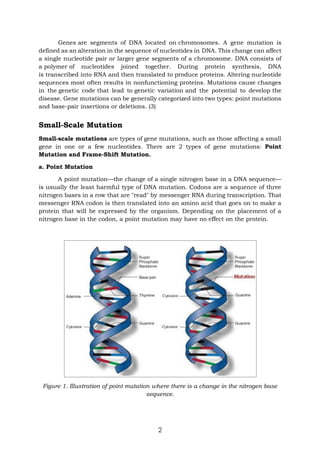
A point mutation—the change of a single nitrogen base in a DNA sequence—
is usually the least harmful type of DNA mutation. Codons are a sequence of three
nitrogen bases in a row that are "read" by messenger RNA during transcription. That
messenger RNA codon is then translated into an amino acid that goes on to make a
protein that will be expressed by the organism. Depending on the placement of a
nitrogen base in the codon, a point mutation may have no effect on the protein.
Figure 1. Illustration of point mutation where there is a change in the nitrogen base
sequence.
3
Since there are only 20 amino acids and a total of 64 possible combinations
of codons, some amino acids are coded for by more than one codon. Often, if the
third nitrogen base in the codon is changed, the amino acid won't be affected. This
is called the wobble effect. If the point mutation occurs in the third nitrogen base in
a codon, then it has no effect on the amino acid or subsequent protein and the
mutation does not change the organism.
At most, a point mutation will cause a single amino acid in a protein to change.
While this usually is not a deadly mutation, it may cause issues with that protein's
folding pattern and the tertiary and quaternary structures of the protein.
One example of a point mutation that is not harmless is the incurable blood
disorder sickle cell anemia. This happens when a point mutation causes a single
nitrogen base in a codon for one amino acid in the protein glutamic acid to code for
the amino acid valine instead. This single small change causes a normally round red
blood cell to instead be sickle-shaped. (2)
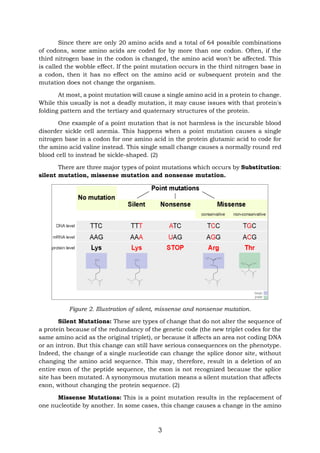
There are three major types of point mutations which occurs by Substitution:
silent mutation, missense mutation and nonsense mutation.
Figure 2. Illustration of silent, missense and nonsense mutation.
Silent Mutations: These are types of change that do not alter the sequence of
a protein because of the redundancy of the genetic code (the new triplet codes for the
same amino acid as the original triplet), or because it affects an area not coding DNA
or an intron. But this change can still have serious consequences on the phenotype.
Indeed, the change of a single nucleotide can change the splice donor site, without
changing the amino acid sequence. This may, therefore, result in a deletion of an
entire exon of the peptide sequence, the exon is not recognized because the splice
site has been mutated. A synonymous mutation means a silent mutation that affects
exon, without changing the protein sequence. (2)
Missense Mutations: This is a point mutation results in the replacement of
one nucleotide by another. In some cases, this change causes a change in the amino
4
acid encoded, which may or may not have an impact on the function of the protein
produced by the gene in the case of a gene encoding, or the affinity for a transcription
factor, in the case of a promoter region of the DNA. We speak of
mutation transition when there is a substitution of a purine base to another base
purine (or pyrimidine base to another pyrimidine base). In contrast, a
mutation transversion is a mutation caused by the replacement of a purine by a
pyrimidine base (or pyrimidine base by a purine base). (2)
Nonsense Mutation: Change of a nucleotide causes the replacement of a
codon specifying an amino acid by a stop codon. This results in the production of a
truncated protein. (2)
b. Frame-Shift Mutation
Frame-shift Mutations are generally much more serious and often more
deadly than point mutations. Even though only a single nitrogen base is affected, as
with point mutations, in this instance, the single base is either completely deleted or
an extra one is inserted into the middle of the DNA sequence. This change in
sequence causes the reading frame to shift—hence the name "frameshift" mutation.
A reading frame shift changes the three-letter codon sequence for messenger RNA to
transcribe and translate. That not only changes the original amino acid but all
subsequent amino acids as well. This significantly alters the protein and can cause
severe problems, even possibly leading to death. Frame-shift mutations occur by
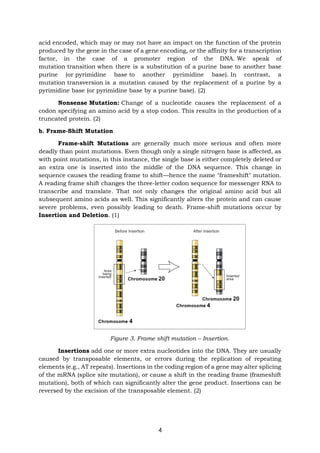
Insertion and Deletion. (1)
Figure 3. Frame shift mutation – Insertion.
Insertions add one or more extra nucleotides into the DNA. They are usually
caused by transposable elements, or errors during the replication of repeating
elements (e.g., AT repeats). Insertions in the coding region of a gene may alter splicing
of the mRNA (splice site mutation), or cause a shift in the reading frame (frameshift
mutation), both of which can significantly alter the gene product. Insertions can be
reversed by the excision of the transposable element. (2)
5
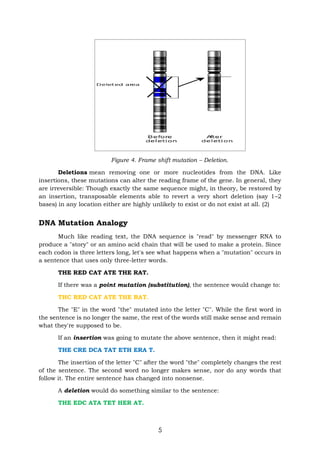
Figure 4. Frame shift mutation – Deletion.
Deletions mean removing one or more nucleotides from the DNA. Like
insertions, these mutations can alter the reading frame of the gene. In general, they
are irreversible: Though exactly the same sequence might, in theory, be restored by
an insertion, transposable elements able to revert a very short deletion (say 1–2
bases) in any location either are highly unlikely to exist or do not exist at all. (2)
DNA Mutation Analogy
Much like reading text, the DNA sequence is "read" by messenger RNA to
produce a "story" or an amino acid chain that will be used to make a protein. Since
each codon is three letters long, let's see what happens when a "mutation" occurs in
a sentence that uses only three-letter words.
THE RED CAT ATE THE RAT.
If there was a point mutation (substitution), the sentence would change to:
THC RED CAT ATE THE RAT.
The "E" in the word "the" mutated into the letter "C". While the first word in
the sentence is no longer the same, the rest of the words still make sense and remain
what they're supposed to be.
If an insertion was going to mutate the above sentence, then it might read:
THE CRE DCA TAT ETH ERA T.
The insertion of the letter "C" after the word "the" completely changes the rest
of the sentence. The second word no longer makes sense, nor do any words that
follow it. The entire sentence has changed into nonsense.
A deletion would do something similar to the sentence:
THE EDC ATA TET HER AT.
6
In the example above, the "R" that should have come after the word "THE" has
been deleted. Again, it changes the entire sentence. While some of the subsequent
words remain intelligible, the meaning of the sentence has completely changed. This
demonstrates that even when codons are changed into something that isn't total
nonsense, it still completely changes the protein into something that is no longer
functionally viable. (2)
What’s More
Activity 1.1
Complete the boxes below. Classify each as either Frameshift or Point Mutation, then
specify further if it is Substitution, Deletion or Insertion. Use the given data in order
to determine the amino acid sequence. Remember, RNA has Uracil instead of
Thymine.
Original DNA Sequence: TAC-ACC-TTG-GCG-ACG-ACT
mRNA Sequence: AUG-UGG-AAC-CGC-UGC-UGA
Amino Acid Sequence: Met-Tryp-Asn-Arg-Cys-STOP
Mutated DNA Sequence #1: TAC-ATC-TTG-GCG-ACG-ACT
mRNA Sequence: ________________________________________
Amino Acid Sequence: ________________________________________
Kind of Mutation: ________________________________________
Mutated DNA Sequence #2: TAC-GAC-CTT-GGC-GAC-GAC-T
mRNA Sequence: ________________________________________
Amino Acid Sequence: ________________________________________
Kind of Mutation: ________________________________________
Mutated DNA Sequence #3: TAC-ACC-TTA-GCG-ACG-ACT
mRNA Sequence: ________________________________________
Amino Acid Sequence: ________________________________________
Kind of Mutation: ________________________________________
Mutated DNA Sequence #4: TAC-ACC-TTG-GCG-ACT-ACT
mRNA Sequence: ________________________________________
Amino Acid Sequence: ________________________________________
Kind of Mutation: ________________________________________
Mutated DNA Sequence #4: TAC-ACC-TTG-GGA-CGA-CT
mRNA Sequence: ________________________________________
Amino Acid Sequence: ________________________________________
Kind of Mutation: ________________________________________
7
Use this Codon Chart for the Activity.
What I Have Learned (Lesson Summary)
1. How will you describe a mutation? (3 pts.)
2. What is a gene? (3 pts.)
3. What are the two general classification of mutations? (3 pts.)
4. How is point mutation different from frame-shift mutation?(3 pts.)
5. What are the three types of point mutation? Describe each.( 3 pts.)
What I Can Do
Activity 1. X-Men Genetic Mutations
X-Men Character Mutant Characteristics
8
Wolverine's primary mutant power is an
accelerated healing process that enables him
to regenerate damaged or destroyed tissue
with far greater efficiency than an ordinary
human. He can regenerate great damage or
destroyed tissue with few seconds.
Storm is a mutant with the ability to control
weather.
Rogue can absorb the powers, energies,
memories, knowledge, talents, personality and
physical abilities (whether superhuman or
not) of another human being (or members of
some sentient alien races) through physical
contact of her skin with the skin of the other
person.
Magneto is a mutant with the ability to
manipulate magnetic fields to his will and
control metallic objects.
Questions:
1. What could have been the cause of mutations of these characters?
2. What do you think are the pros and cons of having mutations?
3. If you were an X-Men character, what would you be and why?
9
Lesson 1: Assessment
Choose the letter of the best answer. Write the chosen letter on a separate sheet of
paper.
1. Frame shift Mutations are generally much more serious and often more deadly
than point mutations.
A. The statement above is true.
B. The statement above is false.
C. It depends upon the condition of the DNA.
D. It is much more serious but not deadly.
2. Frame shift mutations are the result of what occurrence?
A. Insertions or deletions that are not a multiple of three.
B. A mutation that changes an amino acid codon to a stop codon
C. A mutation that changes one amino acid to another.
D. A nucleotide-pair substitution
3. A DNA strand that originally reads 5’-GATATC-3’ undergoes a mutation that
changes it to 5’- GATCATC-3’. This is an example of what type of mutation?
A. Insertion B. Point mutation
C. Nonsense mutation D. Deletion
4. What type of point mutation results in a frameshift mutation?
A.Substitution B.Insertion
C.Deletion D. Both B and C
5. Which is NOT a type of substitution mutation?
A. Missense B. Conservation
C. Nonsense D. Silent
6. Which is an example of a stop codon in RNA?
A. UAG B. UAA
C. UGA D. All of the above
7. Which type of mutations can result in a frameshift?
A. Nonsense and missense B. Nonsense and insertions
C. Insertions and deletions D. Missense and deletions
8. Which type of mutation does NOT change the overall function of the protein?
A. Missense B. Nonsense
C. Insertion D. Silent
9. Which type of mutation results in the replacement of one nucleotide by another?
A. Missense B. Nonsense
C. Insertion D. Silent
10. Which of the following is not an example of a point mutation?
A. Silent mutation B. Nonsense mutation
C. Missense mutation D. Frame shift mutation
10
Lesson
2 Chromosomal Mutation
What’s New
A chromosome mutation is an unpredictable change that occurs in
a chromosome. These changes are most often brought on by problems that occur
during meiosis (division process of gametes) or by mutagens (chemicals, radiation,
etc.). Chromosome mutations can result in changes in the number of chromosomes
in a cell or changes in the structure of a chromosome. Unlike a gene mutation which
alters a single gene or larger segment of DNA on a chromosome, chromosome
mutations change and impact the entire chromosome.
What is It
Chromosomes are long, stringy aggregates of genes that carry heredity
information (DNA). They are formed from chromatin, a mass of genetic material
consisting of DNA that is tightly coiled around proteins called histones.
Chromosomes are located in the nucleus of our cells and condense prior to the
process of cell division. A non-duplicated chromosome is single-stranded and is
comprised of a centromere region that connects two arm regions. The short arm
region is called the p arm and the long arm region is called the q arm.
In preparation for the division of the nucleus, chromosomes must be
duplicated to ensure that the resulting daughter cells end up with the appropriate
number of chromosomes. An identical copy of each chromosome is therefore
produced through DNA replication. Each duplicated chromosome is comprised of two
identical chromosomes called sister chromatids that are connected at the
centromere region. Sister chromatids separate prior to the completion of cell division.
What Causes Chromosomal Mutation?
11
Duplications and breakages of chromosomes are responsible for a type of
chromosome mutation that alters chromosome structure. These changes
affect protein production by changing the genes on the chromosome. Chromosome
structure changes are often harmful to an individual leading to developmental
difficulties and even death. Some changes are not as harmful and may have no
significant effect on an individual. There are several types of chromosome structure
changes that can occur. Some of them include: (4)
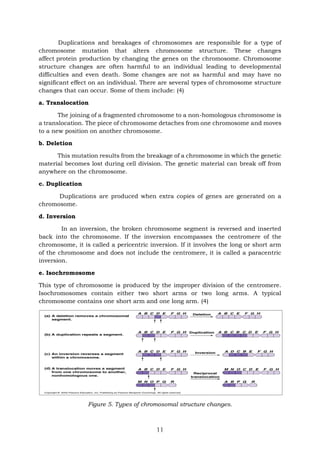
a. Translocation
The joining of a fragmented chromosome to a non-homologous chromosome is
a translocation. The piece of chromosome detaches from one chromosome and moves
to a new position on another chromosome.
b. Deletion
This mutation results from the breakage of a chromosome in which the genetic
material becomes lost during cell division. The genetic material can break off from
anywhere on the chromosome.
c. Duplication
Duplications are produced when extra copies of genes are generated on a
chromosome.
d. Inversion
In an inversion, the broken chromosome segment is reversed and inserted
back into the chromosome. If the inversion encompasses the centromere of the
chromosome, it is called a pericentric inversion. If it involves the long or short arm
of the chromosome and does not include the centromere, it is called a paracentric
inversion.
e. Isochromosome
This type of chromosome is produced by the improper division of the centromere.
Isochromosomes contain either two short arms or two long arms. A typical
chromosome contains one short arm and one long arm. (4)
Figure 5. Types of chromosomal structure changes.
12
Types of Chromosomal Mutation
A chromosome mutation that causes individuals to have an abnormal number of
chromosomes is termed aneuploidy. Aneuploid cells occur as a result of
chromosome breakage or nondisjunction errors that happen during meiosis
or mitosis. Nondisjunction is the failure of homologous chromosomes to separate
properly during cell division. It produces individuals with either extra or missing
chromosomes. Sex chromosome abnormalities that result from nondisjunction can
lead to conditions such as Klinefelter and Turner syndromes. In Klinefelter
syndrome, males have one or more extra X sex chromosomes. In Turner syndrome,
females have only one X sex chromosome. Down syndrome is an example of a
condition that occurs due to nondisjunction in autosomal (non-sex) cells. Individuals
with Down syndrome have an extra chromosome on autosomal chromosome 21.
A chromosome mutation that results in individuals with more than one haploid set
of chromosomes in a cell is termed polyploidy. A haploid cell is a cell that contains
one complete set of chromosomes. Our sex cells are considered haploid and contain
1 complete set of 23 chromosomes. Our autosomal cells are diploid and contain 2
complete sets of 23 chromosomes. If a mutation causes a cell to have three haploid
sets, it is called triploidy. If the cell has four haploid sets, it is called tetraploidy. (4)
What’s More
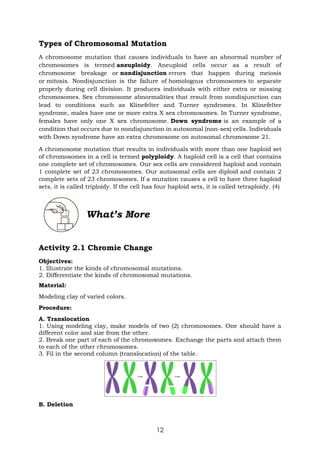
Activity 2.1 Chromie Change
Objectives:
1. Illustrate the kinds of chromosomal mutations.
2. Differentiate the kinds of chromosomal mutations.
Material:
Modeling clay of varied colors.
Procedure:
A. Translocation
1. Using modeling clay, make models of two (2) chromosomes. One should have a
different color and size from the other.
2. Break one part of each of the chromosomes. Exchange the parts and attach them
to each of the other chromosomes.
3. Fil in the second column (translocation) of the table.
B. Deletion
13
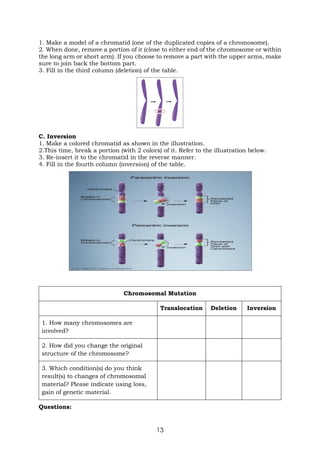
1. Make a model of a chromatid (one of the duplicated copies of a chromosome).
2. When done, remove a portion of it (close to either end of the chromosome or within
the long arm or short arm). If you choose to remove a part with the upper arms, make
sure to join back the bottom part.
3. Fill in the third column (deletion) of the table.
C. Inversion
1. Make a colored chromatid as shown in the illustration.
2.This time, break a portion (with 2 colors) of it. Refer to the illustration below.
3. Re-insert it to the chromatid in the reverse manner.
4. Fill in the fourth column (inversion) of the table.
Chromosomal Mutation
Translocation Deletion Inversion
1. How many chromosomes are
involved?
2. How did you change the original
structure of the chromosome?
3. Which condition(s) do you think
result(s) to changes of chromosomal
material? Please indicate using loss,
gain of genetic material.
Questions:
14
1. How do the three chromosomal aberrations different from each other? How do they
show similar?
2. Do you think the normal genetic content of the chromosome is affected?
3. Which condition results to gain of chromosome material? Loss of chromosomal
material?
4. What are some possible effects of these chromosomal mutations?
What I Have Learned (Lesson Summary)
1. What causes chromosomal mutations? ( 5 pts.)
2. What are the types of chromosomal mutations? Describe each.(10 pts.)
What I Can Do
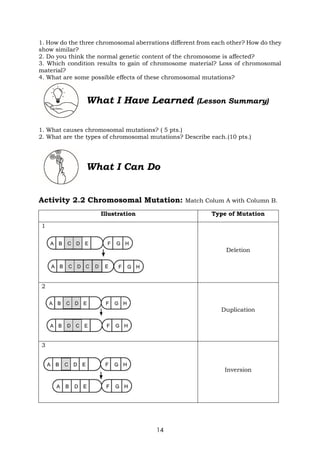
Activity 2.2 Chromosomal Mutation: Match Colum A with Column B.
Illustration Type of Mutation
1
Deletion
2
Duplication
3
Inversion
15
Lesson 2: Assessment
Choose the letter of the best answer. Write the chosen letter on a separate sheet of
paper.
1. Which karyotyping technique is used to detect abnormalities?
A. Blood and Urine B. Ribosomes
C. Chromosomes D. Amniotic Fluid
2. Which of the following is a possible result of chromosomal breakage that a
fragment can be reattached to the original chromosome in a reverse orientation?
A. Deletion B. Inversion C. Disjunction D. Translocation
3. Which of the following is the result when a segment of a chromosome has been
copied?
A. Deletion B. Inversion C. Duplication D. Translocation
4. Which of the following results that has an error in the DNA base sequence?
A. Deletion B. Inversion
C. Chromosomal Mutation D. Gene Mutation
5. Which results show, when there is an error during meiosis?
A. Disjunction B. Translocation
C. Chromosomal Mutation D. Gene Mutation
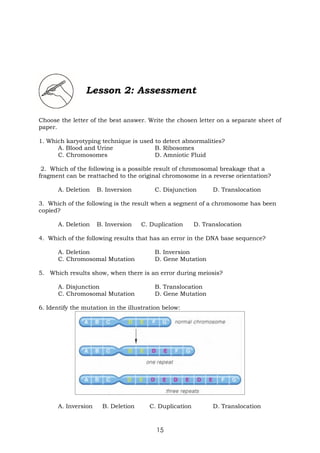
6. Identify the mutation in the illustration below:
A. Inversion B. Deletion C. Duplication D. Translocation
16
7. During the process of meiosis, part of one chromosome detaches and reattaches
to a different chromosome in the parent cell of an individual. Which of the following
is true regarding this mutation?
A. The mutation could get passed on to the individual’s offspring.
B. The mutation could cause cancer in the individual.
C. The mutation could affect the protein production of cells in the body.
D. The mutation will affect only the somatic cells in the body.
8. Which of the following identifies the type of chromosomal mutation that has
occurred on chromosome 18?
A. Inversion B. Translocation
C. Duplication D. Deletion
9. What type of chromosomal mutation has occurred?
A. Substitution B. Insertion C. Deletion D. Non-disjunction
10. Which of these is the correct order for the chromosome mutation in the image
from top to bottom?
A. Duplication-Inversion-Substitution-Translocation
B. Deletion-Duplication-Inversion-Translocation
C. Deletion-Insertion-Translocation-Inversion
D. Substitution-Duplication-Translocation-Inversion
17
Lesson
3
Diseases and Abnormalities
Caused by Mutation
What’s New
Gene mutations are most commonly caused as a result of two types of
occurrences. Environmental factors such as chemicals, radiation, and ultraviolet
light from the sun can cause mutations. These mutagens alter DNA by changing
nucleotide bases and can even change the shape of DNA. These changes result in
errors in DNA replication and transcription.
Other mutations are caused by errors made during mitosis and meiosis.
Common errors that occur during cell division can result in point mutations
and frame-shift mutations. Mutations during cell division can lead to replication
errors which can result in the deletion of genes, translocation of portions of
chromosomes, missing chromosomes, and extra copies of chromosomes. (3)
What is It
Genetic Disorders
According to the National Human Genome Institute, almost all disease has some
sort of genetic factor. These disorders can be caused by a mutation in a single gene,
multiple gene mutations, combined gene mutation, and environmental factors, or
by chromosome mutation or damage. Gene mutations have been identified as the
cause of several disorders including sickle cell anemia, cystic fibrosis, Tay-Sachs
disease, Huntington disease, hemophilia, and some cancers. (4)
a. Sickle Cell Anemia
Sickle cell anemia is a genetic disease common among those who are from
Africa. This genetic disease is the result of a point mutation where there is a change
in just one nucleotide in the gene for hemoglobin. The mutation causes the
hemoglobin in red blood cells to transform to a sickle shape when de-oxygenated.
Since the shape is altered, it cuts of blood circulation and clogs the capillaries.
18
Figure 6. Difference between a sickle cell and a normal red blood cell. (6)
Two copies of the mutated genes cause sickle cell anemia, while having just one copy
does not. One copy of it in facts protects against malaria. This is an example of how
mutations can sometimes be advantageous. (5)
b. Cystic Fibrosis
Cystic fibrosis (CF) is a progressive, genetic disease that affects the secretory glands,
including the mucus and sweat glands. Cystic fibrosis causes persistent lung
infections and limits the ability to breathe over time.
Figure 7. Difference between a normal airway and an airway with cystic fibrosis. (7)
There is no cure for CF but treatments have greatly improved in recent years.
Medication, exercise, nutritional and respiratory therapies are some of the treatment
options. (5)
c. Tay-Sachs Disease
Tay-Sachs disease is a rare inherited disorder that causes progressive damage to the
nervous system and most commonly affects infants. It is mainly caused by the
19
absence of a vital enzyme called hexosaminidase-A (Hex-A). Symptoms usually
appear between three to five months of age. The development slows down and they
gradually lose their ability to move. (5)
Tay-Sachs is a recessively inherited disease that only occurs when both parents carry
a Tay-Sachs gene and each parent transmits the defective gene to their child. A child
who inherits two Tay-Sachs genes (one from each parent) produces no functional
Hex-A enzyme and is certain to develop Tay-Sachs disease. The Tay-Sachs genes are
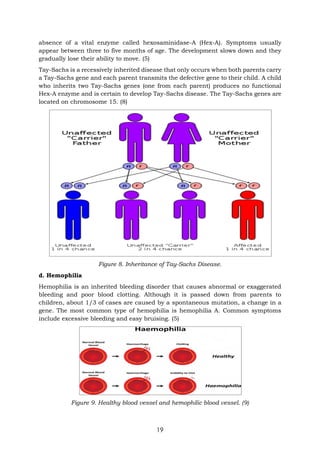
located on chromosome 15. (8)
Figure 8. Inheritance of Tay-Sachs Disease.
d. Hemophilia
Hemophilia is an inherited bleeding disorder that causes abnormal or exaggerated
bleeding and poor blood clotting. Although it is passed down from parents to
children, about 1/3 of cases are caused by a spontaneous mutation, a change in a
gene. The most common type of hemophilia is hemophilia A. Common symptoms
include excessive bleeding and easy bruising. (5)
Figure 9. Healthy blood vessel and hemophilic blood vessel. (9)
20
e. Down Syndrome
Down syndrome or trisomy 21 is the most common chromosomal disorder.
People with Down syndrome have 47 chromosomes in their cells instead of 46, and
suffer from mild to moderate disabilities. Delayed development and behavioral
problems are often reported in children with down syndrome. Common physical
traits include a flat face, small head and short neck, and upward slanting eyes. (5)
There are three main types of Down syndrome: trisomy 21, mosaicism,
and translocation. (10)
Trisomy 21 is the most common form of Down syndrome, accounting for
about 95% of cases.^11start superscript, 1, end superscript This type of Down
syndrome is caused by uneven separation of chromosome 21 during the creation of
sex cells (this can happen in either the sperm or the egg cell), which leads to a
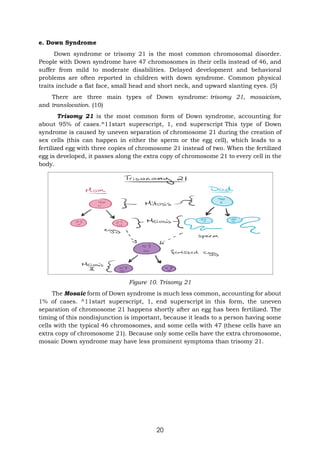
fertilized egg with three copies of chromosome 21 instead of two. When the fertilized
egg is developed, it passes along the extra copy of chromosome 21 to every cell in the
body.
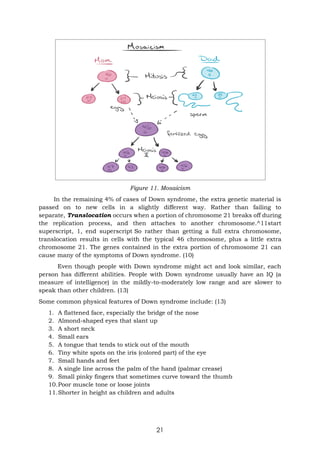
Figure 10. Trisomy 21
The Mosaic form of Down syndrome is much less common, accounting for about
1% of cases. ^11start superscript, 1, end superscript in this form, the uneven
separation of chromosome 21 happens shortly after an egg has been fertilized. The
timing of this nondisjunction is important, because it leads to a person having some
cells with the typical 46 chromosomes, and some cells with 47 (these cells have an
extra copy of chromosome 21). Because only some cells have the extra chromosome,
mosaic Down syndrome may have less prominent symptoms than trisomy 21.
21
Figure 11. Mosaicism
In the remaining 4% of cases of Down syndrome, the extra genetic material is
passed on to new cells in a slightly different way. Rather than failing to
separate, Translocation occurs when a portion of chromosome 21 breaks off during
the replication process, and then attaches to another chromosome.^11start
superscript, 1, end superscript So rather than getting a full extra chromosome,
translocation results in cells with the typical 46 chromosome, plus a little extra
chromosome 21. The genes contained in the extra portion of chromosome 21 can
cause many of the symptoms of Down syndrome. (10)
Even though people with Down syndrome might act and look similar, each
person has different abilities. People with Down syndrome usually have an IQ (a
measure of intelligence) in the mildly-to-moderately low range and are slower to
speak than other children. (13)
Some common physical features of Down syndrome include: (13)
1. A flattened face, especially the bridge of the nose
2. Almond-shaped eyes that slant up
3. A short neck
4. Small ears
5. A tongue that tends to stick out of the mouth
6. Tiny white spots on the iris (colored part) of the eye
7. Small hands and feet
8. A single line across the palm of the hand (palmar crease)
9. Small pinky fingers that sometimes curve toward the thumb
10.Poor muscle tone or loose joints
11.Shorter in height as children and adults
22
Down syndrome is a lifelong condition. Services early in life will often help
babies and children with Down syndrome to improve their physical and intellectual
abilities. Most of these services focus on helping children with Down syndrome
develop to their full potential. These services include speech, occupational, and
physical therapy, and they are typically offered through early intervention programs
in each state. Children with Down syndrome may also need extra help or attention
in school, although many children are included in regular classes. (13)
f. Klinefelter Syndrome
Klinefelter syndrome also known as XXY condition is a chromosomal condition
that affects male physical and cognitive development. The most common symptom
of Klinefelter syndrome is infertility. Some common symptoms include small penis,
small firm testes, less pubic, armpit and facial hair, enlarged breasts, tall stature
and abnormal body proportions. (5)
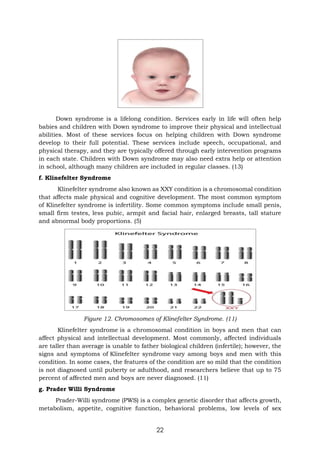
Figure 12. Chromosomes of Klinefelter Syndrome. (11)
Klinefelter syndrome is a chromosomal condition in boys and men that can
affect physical and intellectual development. Most commonly, affected individuals
are taller than average is unable to father biological children (infertile); however, the
signs and symptoms of Klinefelter syndrome vary among boys and men with this
condition. In some cases, the features of the condition are so mild that the condition
is not diagnosed until puberty or adulthood, and researchers believe that up to 75
percent of affected men and boys are never diagnosed. (11)
g. Prader Willi Syndrome
Prader-Willi syndrome (PWS) is a complex genetic disorder that affects growth,
metabolism, appetite, cognitive function, behavioral problems, low levels of sex
23
hormones and a constant feeling of hunger. It is caused by the loss of genes in a
specific region of chromosome 15. There is no cure for PWS, growth hormone,
exercise, and dietary supervision can help build muscle mass and control weight. (5)
h. Turner Syndrome
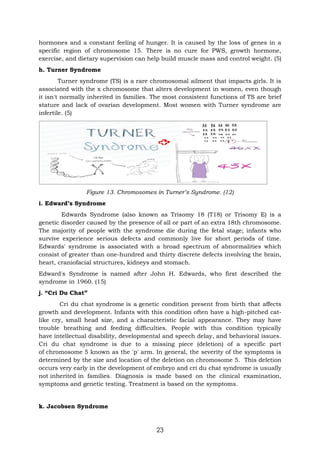
Turner syndrome (TS) is a rare chromosomal ailment that impacts girls. It is
associated with the x chromosome that alters development in women, even though
it isn't normally inherited in families. The most consistent functions of TS are brief
stature and lack of ovarian development. Most women with Turner syndrome are
infertile. (5)
Figure 13. Chromosomes in Turner’s Syndrome. (12)
i. Edward’s Syndrome
Edwards Syndrome (also known as Trisomy 18 (T18) or Trisomy E) is a
genetic disorder caused by the presence of all or part of an extra 18th chromosome.
The majority of people with the syndrome die during the fetal stage; infants who
survive experience serious defects and commonly live for short periods of time.
Edwards' syndrome is associated with a broad spectrum of abnormalities which
consist of greater than one-hundred and thirty discrete defects involving the brain,
heart, craniofacial structures, kidneys and stomach.
Edward's Syndrome is named after John H. Edwards, who first described the
syndrome in 1960. (15)
j. “Cri Du Chat”
Cri du chat syndrome is a genetic condition present from birth that affects
growth and development. Infants with this condition often have a high-pitched cat-
like cry, small head size, and a characteristic facial appearance. They may have
trouble breathing and feeding difficulties. People with this condition typically
have intellectual disability, developmental and speech delay, and behavioral issues.
Cri du chat syndrome is due to a missing piece (deletion) of a specific part
of chromosome 5 known as the 'p' arm. In general, the severity of the symptoms is
determined by the size and location of the deletion on chromosome 5. This deletion
occurs very early in the development of embryo and cri du chat syndrome is usually
not inherited in families. Diagnosis is made based on the clinical examination,
symptoms and genetic testing. Treatment is based on the symptoms.
k. Jacobsen Syndrome
24
Jacobsen syndrome is a condition caused by a loss of genetic material
from chromosome 11. Because this deletion occurs at the end (terminus) of the long
(q) arm of chromosome 11, Jacobsen syndrome is also known as 11q terminal
deletion disorder.
The signs and symptoms of Jacobsen syndrome vary considerably. Most
affected individuals have delayed development, including the development of speech
and motor skills (such as sitting, standing, and walking). Most also have cognitive
impairment and learning difficulties. Behavioral problems have been reported,
including compulsive behavior (such as shredding paper), a short attention span,
and easy distractibility. Many people with Jacobsen syndrome have been diagnosed
with attention-deficit/hyperactivity disorder (ADHD). Jacobsen syndrome is also
associated with an increased likelihood of autism spectrum disorders, which are
characterized by impaired communication and socialization skills.
Jacobsen syndrome is also characterized by distinctive facial features. These
include small and low-set ears, widely set eyes (hypertelorism) with droopy eyelids
(ptosis), skin folds covering the inner corner of the eyes (epicanthal folds), a broad
nasal bridge, downturned corners of the mouth, a thin upper lip, and a small
lower jaw. Affected individuals often have a large head size (macrocephaly) and a
skull abnormality called trigonocephaly, which gives the forehead a pointed
appearance. (17)
l. Klinefelter’s Syndrome
Klinefelter syndrome is a genetic condition in which a boy is born with an extra
X chromosome. Instead of the typical XY chromosomes in men, they have XXY, so
this condition is sometimes called XXY syndrome.
Men with Klinefelter usually don’t know they have it until they run into
problems trying to have a child. There’s no cure, but it can be treated.
You get the extra X chromosome by chance. Either the egg or the sperm that
came together to create you had an extra X chromosome. Older women have a slightly
higher chance of having a boy with XXY syndrome, but the chance is small. (18)
Men with Klinefelter may have:
a. An extra X chromosome in every cell, which is the most common
b. An extra X chromosome in only some cells, called mosaic Klinefelter, in
which you don’t have as many symptoms
c. More than one extra X chromosome, which is very rare and more severe
Karyotyping
Karyotyping is a laboratory procedure that allows your doctor to examine your
set of chromosomes. “Karyotype” also refers to the actual collection of chromosomes
being examined. Examining chromosomes through karyotyping allows your doctor
to determine whether there are any abnormalities or structural problems within the
chromosomes.
25
Chromosomes are in almost every cell of your body. They contain the genetic
material inherited from your parents. They’re composed of DNA and determine the
way every human develops.
When a cell divides, it needs to pass on a complete set of genetic instructions
to each new cell it forms. When a cell isn’t in the process of division, the
chromosomes are arranged in a spread out, unorganized way. During division, the
chromosomes in these new cells line up in pairs.
A karyotype test examines these dividing cells. The pairs of chromosomes are
arranged by their size and appearance. This helps your doctor easily determine if any
chromosomes are missing or damaged.
Why is the test useful?
An unusual number of chromosomes, incorrectly arranged chromosomes, or
malformed chromosomes can all be signs of a genetic condition. Genetic conditions
vary greatly, but two examples are Down syndrome and Turner syndrome.
Karyotyping can be used to detect a variety of genetic disorders. For example,
a woman who has premature ovarian failure may have a chromosomal defect that
karyotyping can pinpoint. The test is also useful for identifying the Philadelphia
chromosome. Having this chromosome can signal chronic myelogenous leukemia
(CML).
Babies can be karyotype tested before they’re born to diagnose genetic
abnormalities that indicate serious birth defects, such as Klinefelter syndrome. In
Klinefelter syndrome, a boy is born with an extra X chromosome.
What do test results mean?
A normal test result will show 46 chromosomes. Two of these 46 chromosomes
are sex chromosomes, which determine the sex of the person being tested, and 44 of
them are autosomes. The autosomes are unrelated to determining the sex of the
person being tested. Females have two X chromosomes, while males have one X
chromosome and one Y chromosome.
Abnormalities that appear in a test sample could be the result of any number
of genetic syndromes or conditions. Sometimes, an abnormality will occur in the lab
sample that’s not reflected in your body. The karyotype test may be repeated to
confirm that there’s an abnormality. (19)
26
What’s More
Activity 3.1 Observing Mutations
Look around you or surf the web and identify mutations found in animals or humans.
Create a data sheet for your observed mutations. Describe each observation as
detailed as you can. Also indicate the advantages and disadvantages of these
observed mutations.
What I Have Learned (Lesson Summary)
1. What are the diseases caused by DNA mutations? (10 pts.)
2. Are mutations generally disadvantageous? Why or why not? (5 pts.)
What I Can Do
Activity 3.2 Factors Affecting DNA Mutations
A mutation, or an alteration in the sequence of chemical bases that make up
a section of DNA, can occur naturally. All it takes to produce a mutation is for a base
to be inserted, removed, or switched to a different location during replication. Yet
sometimes influences beyond the cell can cause mutations by damaging the DNA.
Chemicals, radiation and even biological agents can work as mutagens, factors that
create changes in genetic code.
1. Chemical Factors
Certain man-made chemicals have been known to cause mutations, in most
cases by revising the basic chemical composition of a cell's DNA. Ethyl methane
sulfonate, a compound used in laboratory research, affects the way that one of DNA's
four component bases behaves chemically, resulting in mutant cells with sequences
of DNA different from the parent cells. Benzopyrene, a component of cigarette smoke,
and vinyl chloride, an ingredient in plastics, affect DNA similarly.
2. Radiative Factors
Our world contains different kinds of radiation, both occurring naturally and
resulting from human activity, that also encourage mutations. Ultraviolet radiation
from the sun creates bonds between bases that otherwise would not exist, causing
the cell to synthesize abnormal proteins when that section of DNA is read. Ionizing
radiation, such as that emitted as X-rays, breaks strands of DNA apart, which can
lead to mutations when the cell tries to repair its DNA using free-floating molecules.
27
3. Biological Factors
Similar to chemicals and radiation, biological agents can cause mutations by
attacking DNA's structure. Retroviruses like HIV can insert their genetic material
into a host cell's DNA. But some viruses and bacteria also produce mutations less
directly. The long-lingering hepatitis B virus can make the body secrete defensive
chemicals that, over time, cause mutations, while the prolonged cell damage and
ongoing repair resulting from Helicobacter pylori infections may increase mutations
in cells lining the stomach.
4. Identifying Factors
To identify substances that may cause mutations, several biochemical tests
exist, including one that has been in use since 1973. That year, scientist Bruce Ames
demonstrated that a kind of Salmonella bacteria would grow only in the presence of
mutation-causing materials. The Ames test, in which substances are exposed to this
strain of Salmonella, is still used to identify mutagens today. (14)
Question
Among the four factors affecting mutations, choose one factor which you think
affects the majority of mutations observed nowadays. Explain your choice.
Lesson 3: Assessment
Choose the letter of the best answer. Write the chosen letter on a separate sheet of
paper.
1. A woman with one gene of hemophilia and one gene of color blindness on one of
the X chromosomes marries a normal man. How will the progeny be?
A. 50% hemophilic color-blind sons and 50% color blind daughters
B. 50% hemophilic and color-blind sons and 50% normal sons
C. All sons and daughters are hemophilic and color blind
D. Hemophilic and color-blind daughters
2. Which of the following is known as the Royal disease?
A. Alzheimer’s disease B. Sickle cell anemia
C. Hemophilia D. Color blindness
3. The most important example of point mutation is found in a disease called?
A. Thalassemia B. Down’s syndrome
C. Sickle cell anemia D. Night blindness
4. Patau’s syndrome occurs due to:
A. 13 Trisomy B. 18 Trisomy
C. 21 Trisomy D. 22 Trisomy
5. Identify a Mandelian disorder from the following:
A. Phenylketonuria B. Turner’s syndrome
C. Down’s syndrome D. Klinefelter’s syndrome
6. The syndrome in which individual somatic cell contains three sex chromosomes
XXX is called:
28
A. Downs syndrome B. Klinefelter’s syndrome
C. Turner’s syndrome D. Super female
7. A man has enlarged breasts, spare head on body and sex complement as XXY.
He suffers from:
A. Edward’s syndrome B. Turner’s syndrome
C. Down’s syndrome D. Klinefelter’s syndrome
8. In a man, which of the following genotypes and phenotypes may be the correct
result of aneuploidy in sex chromosomes?
A. 22 pairs + Y females B. 22 pairs + XX females
C. 22 pairs + XXY males D. 22 pairs + XXXY females
9. In a family, a father is having a disease and the mother is normal. The disease is
inherited to only daughters and not to the sons. What type of disease is this?
A. Autosomal recessive B. Autosomal dominant
C. Sex linked recessive D. Sex linked dominant
10. Down’s syndrome is characterized by.
A. 19 Trisomy B. 21 Trisomy
C. Only one X chromosome D. Two X and one Y chromosome
Answer Key
29
Lesson 1
Assessment
1. A
2. A
3. A
4. D
5. B
6. D
7. C
8. D
9. A
10. D
Lesson 2
Assessment
1. C
2. B
3. C
4. D
5. C
6. C
7. A
8. B
9. C
10. B
Lesson 3
Assessment
1. B
2. C
3. C
4. A
5. A
6. D
7. D
8. C
9. D
10. B
Science10_Q3_ver4_Mod5.pdf

Science10_Q3_ver4_Mod5.pdf

  • 1.
    Science Quarter 3 –Module 5: Mutation Department of Education ● Republic of the Philippines 10
  • 2.
    SCIENCE - Grade10 Alternative Delivery Mode Quarter 3: Module 7 First Edition, 2020 Republic Act 8293, Section 176 states that: No copyright shall subsist in any work of the Government of the Philippines. However, prior approval of the government agency or office wherein the work is created shall be necessary for exploitation of such work for profit. Such agency or office may, among other things, impose as a condition the payment of royalty. Borrowed materials (i.e. songs, stories, poems, pictures, photos, brand names, trademarks, etc.) included in this book are owned by their respective copyright holders. Every effort has been exerted to locate and seek permission to use these materials from their respective copyright owners. The publisher and authors do not represent nor claim ownership over them. Published by the Department of Education – Division of Bukidnon Development Team of the Module Author: Monaliza S. Agsalog, MAED Content Editor: Language Editor: Reviewers: Said M. Macabago, PhD Cecilia Casipong Damayan Ellen A. Azuelo, PhD Rejynne Mary L. Ruiz, PhD Illustrator and Layout Artist: Ma. Eliza Joy Agsalog Management Team Chairperson: Dr. Arturo B. Bayocot, CESO III Regional Director Co-Chairpersons: Dr. Victor G. De Gracia Jr. CESO V Asst. Regional Director Randolph B. Tortola, PhD, CESO IV Schools Division Superintendent Shambaeh A. Usman, PhD Assistant Schools Division Superintendent Mala Epra B. Magnaong, Chief ES, CLMD Neil A. Improgo, EPS-LRMS Bienvenido U. Tagolimot, Jr., EPS-ADM Members Elbert R. Francisco, PhD, Chief EPS, CID Ellen A. Azuelo, PhD, EPS in Science Rejynne Mary L. Ruiz, PhD, LRMDS Manager Jeny B. Timbal, PDO II Shella O. Bolasco, Division Librarian II Printed in the Philippines by Department of Education – Division of Bukidnon Office Address: Sumpong, Malaybalay City Telephone: (088) 813-3634 E-mail Address: bukidnon@deped.gov.ph
  • 3.
    1 Lesson 1 Gene Mutation What’sNew Mutation is a permanent change of the nucleotide sequence of the genome of an organism, virus, or extrachromosomal DNA or other genetic elements. It results in damage to DNA that is not repaired or to RNA genomes (typically caused by radiation or chemical mutagens), errors in the process of replication, or from the insertion or deletion of segments of DNA by mobile genetic elements. (1) If you take the analogy that the information in DNA is a series of sentences, mutations are mistakes in spelling of words that make up those sentences. Sometimes, mutations are insignificant, like a misspelled word whose meaning is still quite clear. Sometimes, mutations have stronger implications, like a sentence whose meaning is completely changed. These alterations can be caused by random mistakes in DNA replication or by environmental influences such as UV rays and chemicals. Changes at the nucleotide level go on to influence the transcription and translation from gene to protein expression. Changing even just one nitrogen base in a sequence can alter the amino acid that is expressed by that DNA codon, which can lead to a completely different protein being expressed. These mutations can be completely harmless, potentially fatal, or somewhere in between. (2) What is It The sequence of a gene can be altered in a number of ways. DNA mutations have varying effects on health depending on where they occur and whether they alter the function of essential proteins. In the structure of genes, mutation can be classified into Small-Scale and Large-Scale . In this lesson, we will discuss the Small-scale mutation. What is a Gene?
  • 4.
    2 Genes are segmentsof DNA located on chromosomes. A gene mutation is defined as an alteration in the sequence of nucleotides in DNA. This change can affect a single nucleotide pair or larger gene segments of a chromosome. DNA consists of a polymer of nucleotides joined together. During protein synthesis, DNA is transcribed into RNA and then translated to produce proteins. Altering nucleotide sequences most often results in nonfunctioning proteins. Mutations cause changes in the genetic code that lead to genetic variation and the potential to develop the disease. Gene mutations can be generally categorized into two types: point mutations and base-pair insertions or deletions. (3) Small-Scale Mutation Small-scale mutations are types of gene mutations, such as those affecting a small gene in one or a few nucleotides. There are 2 types of gene mutations: Point Mutation and Frame-Shift Mutation. a. Point Mutation A point mutation—the change of a single nitrogen base in a DNA sequence— is usually the least harmful type of DNA mutation. Codons are a sequence of three nitrogen bases in a row that are "read" by messenger RNA during transcription. That messenger RNA codon is then translated into an amino acid that goes on to make a protein that will be expressed by the organism. Depending on the placement of a nitrogen base in the codon, a point mutation may have no effect on the protein. Figure 1. Illustration of point mutation where there is a change in the nitrogen base sequence.
  • 5.
    3 Since there areonly 20 amino acids and a total of 64 possible combinations of codons, some amino acids are coded for by more than one codon. Often, if the third nitrogen base in the codon is changed, the amino acid won't be affected. This is called the wobble effect. If the point mutation occurs in the third nitrogen base in a codon, then it has no effect on the amino acid or subsequent protein and the mutation does not change the organism. At most, a point mutation will cause a single amino acid in a protein to change. While this usually is not a deadly mutation, it may cause issues with that protein's folding pattern and the tertiary and quaternary structures of the protein. One example of a point mutation that is not harmless is the incurable blood disorder sickle cell anemia. This happens when a point mutation causes a single nitrogen base in a codon for one amino acid in the protein glutamic acid to code for the amino acid valine instead. This single small change causes a normally round red blood cell to instead be sickle-shaped. (2) There are three major types of point mutations which occurs by Substitution: silent mutation, missense mutation and nonsense mutation. Figure 2. Illustration of silent, missense and nonsense mutation. Silent Mutations: These are types of change that do not alter the sequence of a protein because of the redundancy of the genetic code (the new triplet codes for the same amino acid as the original triplet), or because it affects an area not coding DNA or an intron. But this change can still have serious consequences on the phenotype. Indeed, the change of a single nucleotide can change the splice donor site, without changing the amino acid sequence. This may, therefore, result in a deletion of an entire exon of the peptide sequence, the exon is not recognized because the splice site has been mutated. A synonymous mutation means a silent mutation that affects exon, without changing the protein sequence. (2) Missense Mutations: This is a point mutation results in the replacement of one nucleotide by another. In some cases, this change causes a change in the amino
  • 6.
    4 acid encoded, whichmay or may not have an impact on the function of the protein produced by the gene in the case of a gene encoding, or the affinity for a transcription factor, in the case of a promoter region of the DNA. We speak of mutation transition when there is a substitution of a purine base to another base purine (or pyrimidine base to another pyrimidine base). In contrast, a mutation transversion is a mutation caused by the replacement of a purine by a pyrimidine base (or pyrimidine base by a purine base). (2) Nonsense Mutation: Change of a nucleotide causes the replacement of a codon specifying an amino acid by a stop codon. This results in the production of a truncated protein. (2) b. Frame-Shift Mutation Frame-shift Mutations are generally much more serious and often more deadly than point mutations. Even though only a single nitrogen base is affected, as with point mutations, in this instance, the single base is either completely deleted or an extra one is inserted into the middle of the DNA sequence. This change in sequence causes the reading frame to shift—hence the name "frameshift" mutation. A reading frame shift changes the three-letter codon sequence for messenger RNA to transcribe and translate. That not only changes the original amino acid but all subsequent amino acids as well. This significantly alters the protein and can cause severe problems, even possibly leading to death. Frame-shift mutations occur by Insertion and Deletion. (1) Figure 3. Frame shift mutation – Insertion. Insertions add one or more extra nucleotides into the DNA. They are usually caused by transposable elements, or errors during the replication of repeating elements (e.g., AT repeats). Insertions in the coding region of a gene may alter splicing of the mRNA (splice site mutation), or cause a shift in the reading frame (frameshift mutation), both of which can significantly alter the gene product. Insertions can be reversed by the excision of the transposable element. (2)
  • 7.
    5 Figure 4. Frameshift mutation – Deletion. Deletions mean removing one or more nucleotides from the DNA. Like insertions, these mutations can alter the reading frame of the gene. In general, they are irreversible: Though exactly the same sequence might, in theory, be restored by an insertion, transposable elements able to revert a very short deletion (say 1–2 bases) in any location either are highly unlikely to exist or do not exist at all. (2) DNA Mutation Analogy Much like reading text, the DNA sequence is "read" by messenger RNA to produce a "story" or an amino acid chain that will be used to make a protein. Since each codon is three letters long, let's see what happens when a "mutation" occurs in a sentence that uses only three-letter words. THE RED CAT ATE THE RAT. If there was a point mutation (substitution), the sentence would change to: THC RED CAT ATE THE RAT. The "E" in the word "the" mutated into the letter "C". While the first word in the sentence is no longer the same, the rest of the words still make sense and remain what they're supposed to be. If an insertion was going to mutate the above sentence, then it might read: THE CRE DCA TAT ETH ERA T. The insertion of the letter "C" after the word "the" completely changes the rest of the sentence. The second word no longer makes sense, nor do any words that follow it. The entire sentence has changed into nonsense. A deletion would do something similar to the sentence: THE EDC ATA TET HER AT.
  • 8.
    6 In the exampleabove, the "R" that should have come after the word "THE" has been deleted. Again, it changes the entire sentence. While some of the subsequent words remain intelligible, the meaning of the sentence has completely changed. This demonstrates that even when codons are changed into something that isn't total nonsense, it still completely changes the protein into something that is no longer functionally viable. (2) What’s More Activity 1.1 Complete the boxes below. Classify each as either Frameshift or Point Mutation, then specify further if it is Substitution, Deletion or Insertion. Use the given data in order to determine the amino acid sequence. Remember, RNA has Uracil instead of Thymine. Original DNA Sequence: TAC-ACC-TTG-GCG-ACG-ACT mRNA Sequence: AUG-UGG-AAC-CGC-UGC-UGA Amino Acid Sequence: Met-Tryp-Asn-Arg-Cys-STOP Mutated DNA Sequence #1: TAC-ATC-TTG-GCG-ACG-ACT mRNA Sequence: ________________________________________ Amino Acid Sequence: ________________________________________ Kind of Mutation: ________________________________________ Mutated DNA Sequence #2: TAC-GAC-CTT-GGC-GAC-GAC-T mRNA Sequence: ________________________________________ Amino Acid Sequence: ________________________________________ Kind of Mutation: ________________________________________ Mutated DNA Sequence #3: TAC-ACC-TTA-GCG-ACG-ACT mRNA Sequence: ________________________________________ Amino Acid Sequence: ________________________________________ Kind of Mutation: ________________________________________ Mutated DNA Sequence #4: TAC-ACC-TTG-GCG-ACT-ACT mRNA Sequence: ________________________________________ Amino Acid Sequence: ________________________________________ Kind of Mutation: ________________________________________ Mutated DNA Sequence #4: TAC-ACC-TTG-GGA-CGA-CT mRNA Sequence: ________________________________________ Amino Acid Sequence: ________________________________________ Kind of Mutation: ________________________________________
  • 9.
    7 Use this CodonChart for the Activity. What I Have Learned (Lesson Summary) 1. How will you describe a mutation? (3 pts.) 2. What is a gene? (3 pts.) 3. What are the two general classification of mutations? (3 pts.) 4. How is point mutation different from frame-shift mutation?(3 pts.) 5. What are the three types of point mutation? Describe each.( 3 pts.) What I Can Do Activity 1. X-Men Genetic Mutations X-Men Character Mutant Characteristics
  • 10.
    8 Wolverine's primary mutantpower is an accelerated healing process that enables him to regenerate damaged or destroyed tissue with far greater efficiency than an ordinary human. He can regenerate great damage or destroyed tissue with few seconds. Storm is a mutant with the ability to control weather. Rogue can absorb the powers, energies, memories, knowledge, talents, personality and physical abilities (whether superhuman or not) of another human being (or members of some sentient alien races) through physical contact of her skin with the skin of the other person. Magneto is a mutant with the ability to manipulate magnetic fields to his will and control metallic objects. Questions: 1. What could have been the cause of mutations of these characters? 2. What do you think are the pros and cons of having mutations? 3. If you were an X-Men character, what would you be and why?
  • 11.
    9 Lesson 1: Assessment Choosethe letter of the best answer. Write the chosen letter on a separate sheet of paper. 1. Frame shift Mutations are generally much more serious and often more deadly than point mutations. A. The statement above is true. B. The statement above is false. C. It depends upon the condition of the DNA. D. It is much more serious but not deadly. 2. Frame shift mutations are the result of what occurrence? A. Insertions or deletions that are not a multiple of three. B. A mutation that changes an amino acid codon to a stop codon C. A mutation that changes one amino acid to another. D. A nucleotide-pair substitution 3. A DNA strand that originally reads 5’-GATATC-3’ undergoes a mutation that changes it to 5’- GATCATC-3’. This is an example of what type of mutation? A. Insertion B. Point mutation C. Nonsense mutation D. Deletion 4. What type of point mutation results in a frameshift mutation? A.Substitution B.Insertion C.Deletion D. Both B and C 5. Which is NOT a type of substitution mutation? A. Missense B. Conservation C. Nonsense D. Silent 6. Which is an example of a stop codon in RNA? A. UAG B. UAA C. UGA D. All of the above 7. Which type of mutations can result in a frameshift? A. Nonsense and missense B. Nonsense and insertions C. Insertions and deletions D. Missense and deletions 8. Which type of mutation does NOT change the overall function of the protein? A. Missense B. Nonsense C. Insertion D. Silent 9. Which type of mutation results in the replacement of one nucleotide by another? A. Missense B. Nonsense C. Insertion D. Silent 10. Which of the following is not an example of a point mutation? A. Silent mutation B. Nonsense mutation C. Missense mutation D. Frame shift mutation
  • 12.
    10 Lesson 2 Chromosomal Mutation What’sNew A chromosome mutation is an unpredictable change that occurs in a chromosome. These changes are most often brought on by problems that occur during meiosis (division process of gametes) or by mutagens (chemicals, radiation, etc.). Chromosome mutations can result in changes in the number of chromosomes in a cell or changes in the structure of a chromosome. Unlike a gene mutation which alters a single gene or larger segment of DNA on a chromosome, chromosome mutations change and impact the entire chromosome. What is It Chromosomes are long, stringy aggregates of genes that carry heredity information (DNA). They are formed from chromatin, a mass of genetic material consisting of DNA that is tightly coiled around proteins called histones. Chromosomes are located in the nucleus of our cells and condense prior to the process of cell division. A non-duplicated chromosome is single-stranded and is comprised of a centromere region that connects two arm regions. The short arm region is called the p arm and the long arm region is called the q arm. In preparation for the division of the nucleus, chromosomes must be duplicated to ensure that the resulting daughter cells end up with the appropriate number of chromosomes. An identical copy of each chromosome is therefore produced through DNA replication. Each duplicated chromosome is comprised of two identical chromosomes called sister chromatids that are connected at the centromere region. Sister chromatids separate prior to the completion of cell division. What Causes Chromosomal Mutation?
  • 13.
    11 Duplications and breakagesof chromosomes are responsible for a type of chromosome mutation that alters chromosome structure. These changes affect protein production by changing the genes on the chromosome. Chromosome structure changes are often harmful to an individual leading to developmental difficulties and even death. Some changes are not as harmful and may have no significant effect on an individual. There are several types of chromosome structure changes that can occur. Some of them include: (4) a. Translocation The joining of a fragmented chromosome to a non-homologous chromosome is a translocation. The piece of chromosome detaches from one chromosome and moves to a new position on another chromosome. b. Deletion This mutation results from the breakage of a chromosome in which the genetic material becomes lost during cell division. The genetic material can break off from anywhere on the chromosome. c. Duplication Duplications are produced when extra copies of genes are generated on a chromosome. d. Inversion In an inversion, the broken chromosome segment is reversed and inserted back into the chromosome. If the inversion encompasses the centromere of the chromosome, it is called a pericentric inversion. If it involves the long or short arm of the chromosome and does not include the centromere, it is called a paracentric inversion. e. Isochromosome This type of chromosome is produced by the improper division of the centromere. Isochromosomes contain either two short arms or two long arms. A typical chromosome contains one short arm and one long arm. (4) Figure 5. Types of chromosomal structure changes.
  • 14.
    12 Types of ChromosomalMutation A chromosome mutation that causes individuals to have an abnormal number of chromosomes is termed aneuploidy. Aneuploid cells occur as a result of chromosome breakage or nondisjunction errors that happen during meiosis or mitosis. Nondisjunction is the failure of homologous chromosomes to separate properly during cell division. It produces individuals with either extra or missing chromosomes. Sex chromosome abnormalities that result from nondisjunction can lead to conditions such as Klinefelter and Turner syndromes. In Klinefelter syndrome, males have one or more extra X sex chromosomes. In Turner syndrome, females have only one X sex chromosome. Down syndrome is an example of a condition that occurs due to nondisjunction in autosomal (non-sex) cells. Individuals with Down syndrome have an extra chromosome on autosomal chromosome 21. A chromosome mutation that results in individuals with more than one haploid set of chromosomes in a cell is termed polyploidy. A haploid cell is a cell that contains one complete set of chromosomes. Our sex cells are considered haploid and contain 1 complete set of 23 chromosomes. Our autosomal cells are diploid and contain 2 complete sets of 23 chromosomes. If a mutation causes a cell to have three haploid sets, it is called triploidy. If the cell has four haploid sets, it is called tetraploidy. (4) What’s More Activity 2.1 Chromie Change Objectives: 1. Illustrate the kinds of chromosomal mutations. 2. Differentiate the kinds of chromosomal mutations. Material: Modeling clay of varied colors. Procedure: A. Translocation 1. Using modeling clay, make models of two (2) chromosomes. One should have a different color and size from the other. 2. Break one part of each of the chromosomes. Exchange the parts and attach them to each of the other chromosomes. 3. Fil in the second column (translocation) of the table. B. Deletion
  • 15.
    13 1. Make amodel of a chromatid (one of the duplicated copies of a chromosome). 2. When done, remove a portion of it (close to either end of the chromosome or within the long arm or short arm). If you choose to remove a part with the upper arms, make sure to join back the bottom part. 3. Fill in the third column (deletion) of the table. C. Inversion 1. Make a colored chromatid as shown in the illustration. 2.This time, break a portion (with 2 colors) of it. Refer to the illustration below. 3. Re-insert it to the chromatid in the reverse manner. 4. Fill in the fourth column (inversion) of the table. Chromosomal Mutation Translocation Deletion Inversion 1. How many chromosomes are involved? 2. How did you change the original structure of the chromosome? 3. Which condition(s) do you think result(s) to changes of chromosomal material? Please indicate using loss, gain of genetic material. Questions:
  • 16.
    14 1. How dothe three chromosomal aberrations different from each other? How do they show similar? 2. Do you think the normal genetic content of the chromosome is affected? 3. Which condition results to gain of chromosome material? Loss of chromosomal material? 4. What are some possible effects of these chromosomal mutations? What I Have Learned (Lesson Summary) 1. What causes chromosomal mutations? ( 5 pts.) 2. What are the types of chromosomal mutations? Describe each.(10 pts.) What I Can Do Activity 2.2 Chromosomal Mutation: Match Colum A with Column B. Illustration Type of Mutation 1 Deletion 2 Duplication 3 Inversion
  • 17.
    15 Lesson 2: Assessment Choosethe letter of the best answer. Write the chosen letter on a separate sheet of paper. 1. Which karyotyping technique is used to detect abnormalities? A. Blood and Urine B. Ribosomes C. Chromosomes D. Amniotic Fluid 2. Which of the following is a possible result of chromosomal breakage that a fragment can be reattached to the original chromosome in a reverse orientation? A. Deletion B. Inversion C. Disjunction D. Translocation 3. Which of the following is the result when a segment of a chromosome has been copied? A. Deletion B. Inversion C. Duplication D. Translocation 4. Which of the following results that has an error in the DNA base sequence? A. Deletion B. Inversion C. Chromosomal Mutation D. Gene Mutation 5. Which results show, when there is an error during meiosis? A. Disjunction B. Translocation C. Chromosomal Mutation D. Gene Mutation 6. Identify the mutation in the illustration below: A. Inversion B. Deletion C. Duplication D. Translocation
  • 18.
    16 7. During theprocess of meiosis, part of one chromosome detaches and reattaches to a different chromosome in the parent cell of an individual. Which of the following is true regarding this mutation? A. The mutation could get passed on to the individual’s offspring. B. The mutation could cause cancer in the individual. C. The mutation could affect the protein production of cells in the body. D. The mutation will affect only the somatic cells in the body. 8. Which of the following identifies the type of chromosomal mutation that has occurred on chromosome 18? A. Inversion B. Translocation C. Duplication D. Deletion 9. What type of chromosomal mutation has occurred? A. Substitution B. Insertion C. Deletion D. Non-disjunction 10. Which of these is the correct order for the chromosome mutation in the image from top to bottom? A. Duplication-Inversion-Substitution-Translocation B. Deletion-Duplication-Inversion-Translocation C. Deletion-Insertion-Translocation-Inversion D. Substitution-Duplication-Translocation-Inversion
  • 19.
    17 Lesson 3 Diseases and Abnormalities Causedby Mutation What’s New Gene mutations are most commonly caused as a result of two types of occurrences. Environmental factors such as chemicals, radiation, and ultraviolet light from the sun can cause mutations. These mutagens alter DNA by changing nucleotide bases and can even change the shape of DNA. These changes result in errors in DNA replication and transcription. Other mutations are caused by errors made during mitosis and meiosis. Common errors that occur during cell division can result in point mutations and frame-shift mutations. Mutations during cell division can lead to replication errors which can result in the deletion of genes, translocation of portions of chromosomes, missing chromosomes, and extra copies of chromosomes. (3) What is It Genetic Disorders According to the National Human Genome Institute, almost all disease has some sort of genetic factor. These disorders can be caused by a mutation in a single gene, multiple gene mutations, combined gene mutation, and environmental factors, or by chromosome mutation or damage. Gene mutations have been identified as the cause of several disorders including sickle cell anemia, cystic fibrosis, Tay-Sachs disease, Huntington disease, hemophilia, and some cancers. (4) a. Sickle Cell Anemia Sickle cell anemia is a genetic disease common among those who are from Africa. This genetic disease is the result of a point mutation where there is a change in just one nucleotide in the gene for hemoglobin. The mutation causes the hemoglobin in red blood cells to transform to a sickle shape when de-oxygenated. Since the shape is altered, it cuts of blood circulation and clogs the capillaries.
  • 20.
    18 Figure 6. Differencebetween a sickle cell and a normal red blood cell. (6) Two copies of the mutated genes cause sickle cell anemia, while having just one copy does not. One copy of it in facts protects against malaria. This is an example of how mutations can sometimes be advantageous. (5) b. Cystic Fibrosis Cystic fibrosis (CF) is a progressive, genetic disease that affects the secretory glands, including the mucus and sweat glands. Cystic fibrosis causes persistent lung infections and limits the ability to breathe over time. Figure 7. Difference between a normal airway and an airway with cystic fibrosis. (7) There is no cure for CF but treatments have greatly improved in recent years. Medication, exercise, nutritional and respiratory therapies are some of the treatment options. (5) c. Tay-Sachs Disease Tay-Sachs disease is a rare inherited disorder that causes progressive damage to the nervous system and most commonly affects infants. It is mainly caused by the
  • 21.
    19 absence of avital enzyme called hexosaminidase-A (Hex-A). Symptoms usually appear between three to five months of age. The development slows down and they gradually lose their ability to move. (5) Tay-Sachs is a recessively inherited disease that only occurs when both parents carry a Tay-Sachs gene and each parent transmits the defective gene to their child. A child who inherits two Tay-Sachs genes (one from each parent) produces no functional Hex-A enzyme and is certain to develop Tay-Sachs disease. The Tay-Sachs genes are located on chromosome 15. (8) Figure 8. Inheritance of Tay-Sachs Disease. d. Hemophilia Hemophilia is an inherited bleeding disorder that causes abnormal or exaggerated bleeding and poor blood clotting. Although it is passed down from parents to children, about 1/3 of cases are caused by a spontaneous mutation, a change in a gene. The most common type of hemophilia is hemophilia A. Common symptoms include excessive bleeding and easy bruising. (5) Figure 9. Healthy blood vessel and hemophilic blood vessel. (9)
  • 22.
    20 e. Down Syndrome Downsyndrome or trisomy 21 is the most common chromosomal disorder. People with Down syndrome have 47 chromosomes in their cells instead of 46, and suffer from mild to moderate disabilities. Delayed development and behavioral problems are often reported in children with down syndrome. Common physical traits include a flat face, small head and short neck, and upward slanting eyes. (5) There are three main types of Down syndrome: trisomy 21, mosaicism, and translocation. (10) Trisomy 21 is the most common form of Down syndrome, accounting for about 95% of cases.^11start superscript, 1, end superscript This type of Down syndrome is caused by uneven separation of chromosome 21 during the creation of sex cells (this can happen in either the sperm or the egg cell), which leads to a fertilized egg with three copies of chromosome 21 instead of two. When the fertilized egg is developed, it passes along the extra copy of chromosome 21 to every cell in the body. Figure 10. Trisomy 21 The Mosaic form of Down syndrome is much less common, accounting for about 1% of cases. ^11start superscript, 1, end superscript in this form, the uneven separation of chromosome 21 happens shortly after an egg has been fertilized. The timing of this nondisjunction is important, because it leads to a person having some cells with the typical 46 chromosomes, and some cells with 47 (these cells have an extra copy of chromosome 21). Because only some cells have the extra chromosome, mosaic Down syndrome may have less prominent symptoms than trisomy 21.
  • 23.
    21 Figure 11. Mosaicism Inthe remaining 4% of cases of Down syndrome, the extra genetic material is passed on to new cells in a slightly different way. Rather than failing to separate, Translocation occurs when a portion of chromosome 21 breaks off during the replication process, and then attaches to another chromosome.^11start superscript, 1, end superscript So rather than getting a full extra chromosome, translocation results in cells with the typical 46 chromosome, plus a little extra chromosome 21. The genes contained in the extra portion of chromosome 21 can cause many of the symptoms of Down syndrome. (10) Even though people with Down syndrome might act and look similar, each person has different abilities. People with Down syndrome usually have an IQ (a measure of intelligence) in the mildly-to-moderately low range and are slower to speak than other children. (13) Some common physical features of Down syndrome include: (13) 1. A flattened face, especially the bridge of the nose 2. Almond-shaped eyes that slant up 3. A short neck 4. Small ears 5. A tongue that tends to stick out of the mouth 6. Tiny white spots on the iris (colored part) of the eye 7. Small hands and feet 8. A single line across the palm of the hand (palmar crease) 9. Small pinky fingers that sometimes curve toward the thumb 10.Poor muscle tone or loose joints 11.Shorter in height as children and adults
  • 24.
    22 Down syndrome isa lifelong condition. Services early in life will often help babies and children with Down syndrome to improve their physical and intellectual abilities. Most of these services focus on helping children with Down syndrome develop to their full potential. These services include speech, occupational, and physical therapy, and they are typically offered through early intervention programs in each state. Children with Down syndrome may also need extra help or attention in school, although many children are included in regular classes. (13) f. Klinefelter Syndrome Klinefelter syndrome also known as XXY condition is a chromosomal condition that affects male physical and cognitive development. The most common symptom of Klinefelter syndrome is infertility. Some common symptoms include small penis, small firm testes, less pubic, armpit and facial hair, enlarged breasts, tall stature and abnormal body proportions. (5) Figure 12. Chromosomes of Klinefelter Syndrome. (11) Klinefelter syndrome is a chromosomal condition in boys and men that can affect physical and intellectual development. Most commonly, affected individuals are taller than average is unable to father biological children (infertile); however, the signs and symptoms of Klinefelter syndrome vary among boys and men with this condition. In some cases, the features of the condition are so mild that the condition is not diagnosed until puberty or adulthood, and researchers believe that up to 75 percent of affected men and boys are never diagnosed. (11) g. Prader Willi Syndrome Prader-Willi syndrome (PWS) is a complex genetic disorder that affects growth, metabolism, appetite, cognitive function, behavioral problems, low levels of sex
  • 25.
    23 hormones and aconstant feeling of hunger. It is caused by the loss of genes in a specific region of chromosome 15. There is no cure for PWS, growth hormone, exercise, and dietary supervision can help build muscle mass and control weight. (5) h. Turner Syndrome Turner syndrome (TS) is a rare chromosomal ailment that impacts girls. It is associated with the x chromosome that alters development in women, even though it isn't normally inherited in families. The most consistent functions of TS are brief stature and lack of ovarian development. Most women with Turner syndrome are infertile. (5) Figure 13. Chromosomes in Turner’s Syndrome. (12) i. Edward’s Syndrome Edwards Syndrome (also known as Trisomy 18 (T18) or Trisomy E) is a genetic disorder caused by the presence of all or part of an extra 18th chromosome. The majority of people with the syndrome die during the fetal stage; infants who survive experience serious defects and commonly live for short periods of time. Edwards' syndrome is associated with a broad spectrum of abnormalities which consist of greater than one-hundred and thirty discrete defects involving the brain, heart, craniofacial structures, kidneys and stomach. Edward's Syndrome is named after John H. Edwards, who first described the syndrome in 1960. (15) j. “Cri Du Chat” Cri du chat syndrome is a genetic condition present from birth that affects growth and development. Infants with this condition often have a high-pitched cat- like cry, small head size, and a characteristic facial appearance. They may have trouble breathing and feeding difficulties. People with this condition typically have intellectual disability, developmental and speech delay, and behavioral issues. Cri du chat syndrome is due to a missing piece (deletion) of a specific part of chromosome 5 known as the 'p' arm. In general, the severity of the symptoms is determined by the size and location of the deletion on chromosome 5. This deletion occurs very early in the development of embryo and cri du chat syndrome is usually not inherited in families. Diagnosis is made based on the clinical examination, symptoms and genetic testing. Treatment is based on the symptoms. k. Jacobsen Syndrome
  • 26.
    24 Jacobsen syndrome isa condition caused by a loss of genetic material from chromosome 11. Because this deletion occurs at the end (terminus) of the long (q) arm of chromosome 11, Jacobsen syndrome is also known as 11q terminal deletion disorder. The signs and symptoms of Jacobsen syndrome vary considerably. Most affected individuals have delayed development, including the development of speech and motor skills (such as sitting, standing, and walking). Most also have cognitive impairment and learning difficulties. Behavioral problems have been reported, including compulsive behavior (such as shredding paper), a short attention span, and easy distractibility. Many people with Jacobsen syndrome have been diagnosed with attention-deficit/hyperactivity disorder (ADHD). Jacobsen syndrome is also associated with an increased likelihood of autism spectrum disorders, which are characterized by impaired communication and socialization skills. Jacobsen syndrome is also characterized by distinctive facial features. These include small and low-set ears, widely set eyes (hypertelorism) with droopy eyelids (ptosis), skin folds covering the inner corner of the eyes (epicanthal folds), a broad nasal bridge, downturned corners of the mouth, a thin upper lip, and a small lower jaw. Affected individuals often have a large head size (macrocephaly) and a skull abnormality called trigonocephaly, which gives the forehead a pointed appearance. (17) l. Klinefelter’s Syndrome Klinefelter syndrome is a genetic condition in which a boy is born with an extra X chromosome. Instead of the typical XY chromosomes in men, they have XXY, so this condition is sometimes called XXY syndrome. Men with Klinefelter usually don’t know they have it until they run into problems trying to have a child. There’s no cure, but it can be treated. You get the extra X chromosome by chance. Either the egg or the sperm that came together to create you had an extra X chromosome. Older women have a slightly higher chance of having a boy with XXY syndrome, but the chance is small. (18) Men with Klinefelter may have: a. An extra X chromosome in every cell, which is the most common b. An extra X chromosome in only some cells, called mosaic Klinefelter, in which you don’t have as many symptoms c. More than one extra X chromosome, which is very rare and more severe Karyotyping Karyotyping is a laboratory procedure that allows your doctor to examine your set of chromosomes. “Karyotype” also refers to the actual collection of chromosomes being examined. Examining chromosomes through karyotyping allows your doctor to determine whether there are any abnormalities or structural problems within the chromosomes.
  • 27.
    25 Chromosomes are inalmost every cell of your body. They contain the genetic material inherited from your parents. They’re composed of DNA and determine the way every human develops. When a cell divides, it needs to pass on a complete set of genetic instructions to each new cell it forms. When a cell isn’t in the process of division, the chromosomes are arranged in a spread out, unorganized way. During division, the chromosomes in these new cells line up in pairs. A karyotype test examines these dividing cells. The pairs of chromosomes are arranged by their size and appearance. This helps your doctor easily determine if any chromosomes are missing or damaged. Why is the test useful? An unusual number of chromosomes, incorrectly arranged chromosomes, or malformed chromosomes can all be signs of a genetic condition. Genetic conditions vary greatly, but two examples are Down syndrome and Turner syndrome. Karyotyping can be used to detect a variety of genetic disorders. For example, a woman who has premature ovarian failure may have a chromosomal defect that karyotyping can pinpoint. The test is also useful for identifying the Philadelphia chromosome. Having this chromosome can signal chronic myelogenous leukemia (CML). Babies can be karyotype tested before they’re born to diagnose genetic abnormalities that indicate serious birth defects, such as Klinefelter syndrome. In Klinefelter syndrome, a boy is born with an extra X chromosome. What do test results mean? A normal test result will show 46 chromosomes. Two of these 46 chromosomes are sex chromosomes, which determine the sex of the person being tested, and 44 of them are autosomes. The autosomes are unrelated to determining the sex of the person being tested. Females have two X chromosomes, while males have one X chromosome and one Y chromosome. Abnormalities that appear in a test sample could be the result of any number of genetic syndromes or conditions. Sometimes, an abnormality will occur in the lab sample that’s not reflected in your body. The karyotype test may be repeated to confirm that there’s an abnormality. (19)
  • 28.
    26 What’s More Activity 3.1Observing Mutations Look around you or surf the web and identify mutations found in animals or humans. Create a data sheet for your observed mutations. Describe each observation as detailed as you can. Also indicate the advantages and disadvantages of these observed mutations. What I Have Learned (Lesson Summary) 1. What are the diseases caused by DNA mutations? (10 pts.) 2. Are mutations generally disadvantageous? Why or why not? (5 pts.) What I Can Do Activity 3.2 Factors Affecting DNA Mutations A mutation, or an alteration in the sequence of chemical bases that make up a section of DNA, can occur naturally. All it takes to produce a mutation is for a base to be inserted, removed, or switched to a different location during replication. Yet sometimes influences beyond the cell can cause mutations by damaging the DNA. Chemicals, radiation and even biological agents can work as mutagens, factors that create changes in genetic code. 1. Chemical Factors Certain man-made chemicals have been known to cause mutations, in most cases by revising the basic chemical composition of a cell's DNA. Ethyl methane sulfonate, a compound used in laboratory research, affects the way that one of DNA's four component bases behaves chemically, resulting in mutant cells with sequences of DNA different from the parent cells. Benzopyrene, a component of cigarette smoke, and vinyl chloride, an ingredient in plastics, affect DNA similarly. 2. Radiative Factors Our world contains different kinds of radiation, both occurring naturally and resulting from human activity, that also encourage mutations. Ultraviolet radiation from the sun creates bonds between bases that otherwise would not exist, causing the cell to synthesize abnormal proteins when that section of DNA is read. Ionizing radiation, such as that emitted as X-rays, breaks strands of DNA apart, which can lead to mutations when the cell tries to repair its DNA using free-floating molecules.
  • 29.
    27 3. Biological Factors Similarto chemicals and radiation, biological agents can cause mutations by attacking DNA's structure. Retroviruses like HIV can insert their genetic material into a host cell's DNA. But some viruses and bacteria also produce mutations less directly. The long-lingering hepatitis B virus can make the body secrete defensive chemicals that, over time, cause mutations, while the prolonged cell damage and ongoing repair resulting from Helicobacter pylori infections may increase mutations in cells lining the stomach. 4. Identifying Factors To identify substances that may cause mutations, several biochemical tests exist, including one that has been in use since 1973. That year, scientist Bruce Ames demonstrated that a kind of Salmonella bacteria would grow only in the presence of mutation-causing materials. The Ames test, in which substances are exposed to this strain of Salmonella, is still used to identify mutagens today. (14) Question Among the four factors affecting mutations, choose one factor which you think affects the majority of mutations observed nowadays. Explain your choice. Lesson 3: Assessment Choose the letter of the best answer. Write the chosen letter on a separate sheet of paper. 1. A woman with one gene of hemophilia and one gene of color blindness on one of the X chromosomes marries a normal man. How will the progeny be? A. 50% hemophilic color-blind sons and 50% color blind daughters B. 50% hemophilic and color-blind sons and 50% normal sons C. All sons and daughters are hemophilic and color blind D. Hemophilic and color-blind daughters 2. Which of the following is known as the Royal disease? A. Alzheimer’s disease B. Sickle cell anemia C. Hemophilia D. Color blindness 3. The most important example of point mutation is found in a disease called? A. Thalassemia B. Down’s syndrome C. Sickle cell anemia D. Night blindness 4. Patau’s syndrome occurs due to: A. 13 Trisomy B. 18 Trisomy C. 21 Trisomy D. 22 Trisomy 5. Identify a Mandelian disorder from the following: A. Phenylketonuria B. Turner’s syndrome C. Down’s syndrome D. Klinefelter’s syndrome 6. The syndrome in which individual somatic cell contains three sex chromosomes XXX is called:
  • 30.
    28 A. Downs syndromeB. Klinefelter’s syndrome C. Turner’s syndrome D. Super female 7. A man has enlarged breasts, spare head on body and sex complement as XXY. He suffers from: A. Edward’s syndrome B. Turner’s syndrome C. Down’s syndrome D. Klinefelter’s syndrome 8. In a man, which of the following genotypes and phenotypes may be the correct result of aneuploidy in sex chromosomes? A. 22 pairs + Y females B. 22 pairs + XX females C. 22 pairs + XXY males D. 22 pairs + XXXY females 9. In a family, a father is having a disease and the mother is normal. The disease is inherited to only daughters and not to the sons. What type of disease is this? A. Autosomal recessive B. Autosomal dominant C. Sex linked recessive D. Sex linked dominant 10. Down’s syndrome is characterized by. A. 19 Trisomy B. 21 Trisomy C. Only one X chromosome D. Two X and one Y chromosome Answer Key
  • 31.
    29 Lesson 1 Assessment 1. A 2.A 3. A 4. D 5. B 6. D 7. C 8. D 9. A 10. D Lesson 2 Assessment 1. C 2. B 3. C 4. D 5. C 6. C 7. A 8. B 9. C 10. B Lesson 3 Assessment 1. B 2. C 3. C 4. A 5. A 6. D 7. D 8. C 9. D 10. B