What are Proteins?
Prepared by
Yousef Elshrek
• Proteins are the workhorses of our bodies
• Proteins make up about 42% of the dry weight of our bodies.
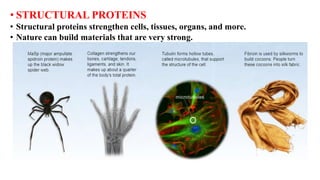
• The protein collagen—which holds our skin, tendons, muscles, and bones together—makes up about a quarter
of the body's total protein.
• All our cells and even blood are packed with protein molecules.
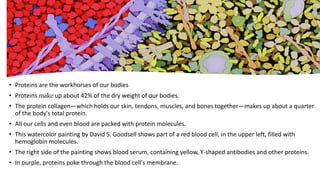
• This watercolor painting by David S. Goodsell shows part of a red blood cell, in the upper left, filled with
hemoglobin molecules.
• The right side of the painting shows blood serum, containing yellow, Y-shaped antibodies and other proteins.
• In purple, proteins poke through the blood cell's membrane.
• PROTEINS ARE VERSATILE
• Different arrangements of amino acids can make proteins that are extremely
strong, as in silk fibers, or flexible and elastic, as in the elastin in our skin.
• And like pieces of a jigsaw (Panorama) puzzle, proteins can interlock with
other molecules.
• For example, each type of antibody in our blood has a unique arrangement of
amino acids at its tips that can attach to a specific pathogen, marking it for
destruction by the immune system.
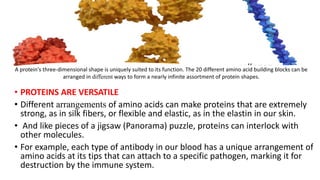
A protein's three-dimensional shape is uniquely suited to its function. The 20 different amino acid building blocks can be
arranged in different ways to form a nearly infinite assortment of protein shapes.
• PROTEINS WORK TOGETHER
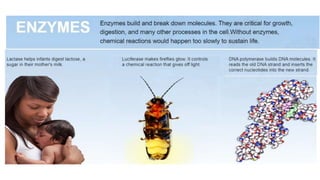
• Proteins need to physically interact with each other and with other molecules to do their
work.
• These interactions might activate an enzyme, turn on a gene, or communicate a message
from one cell to another.
• Interactions between proteins depend not just on their shape but also on their chemical
properties: positively and negatively charged amino acids are attracted to each other;
hydrophobic residues cluster together, away from water.
• These physical properties allow proteins to interact in specific ways.
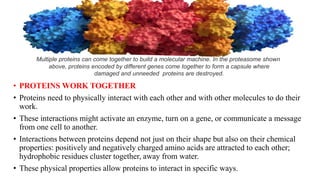
Multiple proteins can come together to build a molecular machine. In the proteasome shown
above, proteins encoded by different genes come together to form a capsule where
damaged and unneeded proteins are destroyed.
• PROTEINS CHANGE SHAPE
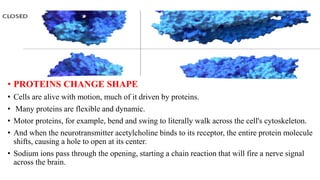
• Cells are alive with motion, much of it driven by proteins.
• Many proteins are flexible and dynamic.
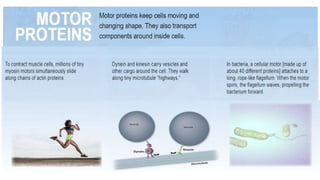
• Motor proteins, for example, bend and swing to literally walk across the cell's cytoskeleton.
• And when the neurotransmitter acetylcholine binds to its receptor, the entire protein molecule
shifts, causing a hole to open at its center.
• Sodium ions pass through the opening, starting a chain reaction that will fire a nerve signal
across the brain.
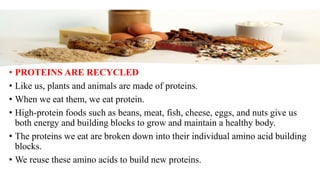
• PROTEINS ARE RECYCLED
• Like us, plants and animals are made of proteins.
• When we eat them, we eat protein.
• High-protein foods such as beans, meat, fish, cheese, eggs, and nuts give us
both energy and building blocks to grow and maintain a healthy body.
• The proteins we eat are broken down into their individual amino acid building
blocks.
• We reuse these amino acids to build new proteins.
• STRUCTURAL PROTEINS
• Structural proteins strengthen cells, tissues, organs, and more.
• Nature can build materials that are very strong.
• References
• https://learn.genetics.utah.edu/content/basics/proteintypes/
• https://learn.genetics.utah.edu/content/basics/proteins/

What are proteins

  • 1.
    What are Proteins? Preparedby Yousef Elshrek
  • 2.
    • Proteins arethe workhorses of our bodies • Proteins make up about 42% of the dry weight of our bodies. • The protein collagen—which holds our skin, tendons, muscles, and bones together—makes up about a quarter of the body's total protein. • All our cells and even blood are packed with protein molecules. • This watercolor painting by David S. Goodsell shows part of a red blood cell, in the upper left, filled with hemoglobin molecules. • The right side of the painting shows blood serum, containing yellow, Y-shaped antibodies and other proteins. • In purple, proteins poke through the blood cell's membrane.
  • 3.
    • PROTEINS AREVERSATILE • Different arrangements of amino acids can make proteins that are extremely strong, as in silk fibers, or flexible and elastic, as in the elastin in our skin. • And like pieces of a jigsaw (Panorama) puzzle, proteins can interlock with other molecules. • For example, each type of antibody in our blood has a unique arrangement of amino acids at its tips that can attach to a specific pathogen, marking it for destruction by the immune system. A protein's three-dimensional shape is uniquely suited to its function. The 20 different amino acid building blocks can be arranged in different ways to form a nearly infinite assortment of protein shapes.
  • 4.
    • PROTEINS WORKTOGETHER • Proteins need to physically interact with each other and with other molecules to do their work. • These interactions might activate an enzyme, turn on a gene, or communicate a message from one cell to another. • Interactions between proteins depend not just on their shape but also on their chemical properties: positively and negatively charged amino acids are attracted to each other; hydrophobic residues cluster together, away from water. • These physical properties allow proteins to interact in specific ways. Multiple proteins can come together to build a molecular machine. In the proteasome shown above, proteins encoded by different genes come together to form a capsule where damaged and unneeded proteins are destroyed.
  • 5.
    • PROTEINS CHANGESHAPE • Cells are alive with motion, much of it driven by proteins. • Many proteins are flexible and dynamic. • Motor proteins, for example, bend and swing to literally walk across the cell's cytoskeleton. • And when the neurotransmitter acetylcholine binds to its receptor, the entire protein molecule shifts, causing a hole to open at its center. • Sodium ions pass through the opening, starting a chain reaction that will fire a nerve signal across the brain.
  • 6.
    • PROTEINS ARERECYCLED • Like us, plants and animals are made of proteins. • When we eat them, we eat protein. • High-protein foods such as beans, meat, fish, cheese, eggs, and nuts give us both energy and building blocks to grow and maintain a healthy body. • The proteins we eat are broken down into their individual amino acid building blocks. • We reuse these amino acids to build new proteins.
  • 8.
    • STRUCTURAL PROTEINS •Structural proteins strengthen cells, tissues, organs, and more. • Nature can build materials that are very strong.
  • 15.
    • References • https://learn.genetics.utah.edu/content/basics/proteintypes/ •https://learn.genetics.utah.edu/content/basics/proteins/