YEAST TWO-HYBRID SYSTEM
Sheetal Mehla
PhD Molecular biology, Biotechnology and Bioinformatics
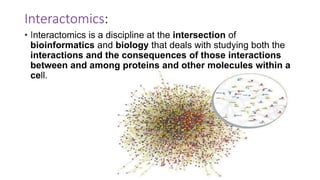
Interactomics:
• Interactomics is a discipline at the intersection of
bioinformatics and biology that deals with studying both the
interactions and the consequences of those interactions
between and among proteins and other molecules within a
cell.
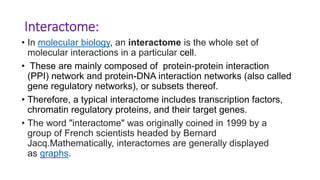
Interactome:
• In molecular biology, an interactome is the whole set of
molecular interactions in a particular cell.
• These are mainly composed of protein-protein interaction
(PPI) network and protein-DNA interaction networks (also called
gene regulatory networks), or subsets thereof.
• Therefore, a typical interactome includes transcription factors,
chromatin regulatory proteins, and their target genes.
• The word "interactome" was originally coined in 1999 by a
group of French scientists headed by Bernard
Jacq.Mathematically, interactomes are generally displayed
as graphs.
Interactomics:
• Interactomics thus aims to compare such networks of
interactions (i.e., interactomes) between and within species in
order to find how the traits of such networks are either
preserved or varied.
• Interactomics is an example of "top-down" systems biology,
which takes an overhead, as well as overall, view of a
biosystem or organism. Large sets of genome-wide and
proteomic data are collected, and correlations between different
molecules are inferred. From the data new hypothesis are
formulated about feedbacks between these molecules. These
hypothesis can then be tested by new experiments.
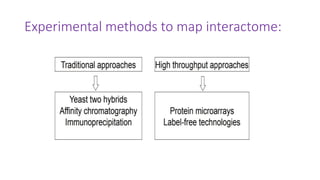
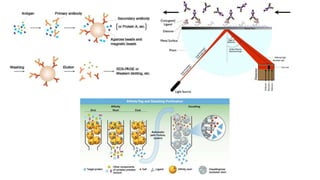
Experimental methods to map interactome:
Computational methods to study
interactome:
• Once an interactome has been created, there are numerous
ways to analyze its properties.
• Validation
• Predicting PPIs
• Text mining of PPIs
• Protein function prediction
• Perturbations and disease
• Network structure and topology
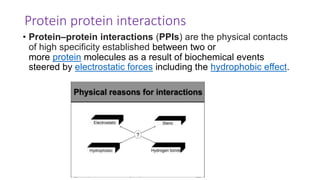
Protein protein interactions
• Protein–protein interactions (PPIs) are the physical contacts
of high specificity established between two or
more protein molecules as a result of biochemical events
steered by electrostatic forces including the hydrophobic effect.
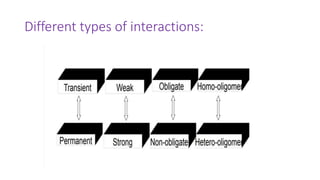
Different types of interactions:
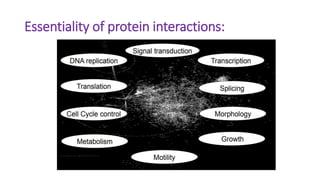
Essentiality of protein interactions:
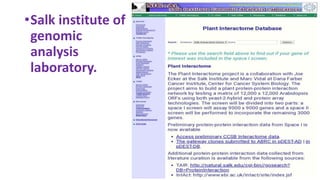
•Salk institute of
genomic
analysis
laboratory.
The First Plant Interactome
Protein interaction networks in
Arabidopsis give clues to plant evolution
and immunity.
In the first study, Braun and colleagues expressed
8,000 Arabidopsis proteins—representing 30 percent of the plant’s
protein-coding genes—in yeast cells.
“The real challenge is to determine what the targeted plant proteins
are doing in the innate immune response and how modifying the
targets will modify the disease,” said Cyril Zipfel, group leader in
molecular and microbe interactions at The Sainsbury Laboratory.
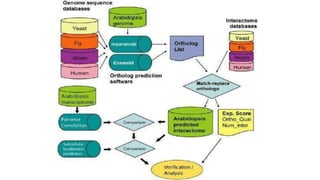
Arabidopsis interactome module database:
• The database contains almost 250 000 modules that were generated
using multiple analysis methods and integration of microarray
expression data. All the modules in AIM are well annotated using
multiple gene function knowledge databases. AIM provides a user-
friendly interface for different types of searches and offers a powerful
graphical viewer for displaying module networks linked to the
enrichment annotation terms. Both interactive Venn diagram and
power graph viewer are integrated into the database for easy
comparison of modules. In addition, predicted interologs from other
plant species (homologous proteins from different species that share
a conserved interaction module) are available for each Arabidopsis
module. AIM is a powerful systems biology platform for obtaining
valuable insights into the function of proteins in Arabidopsis and
other plants using the modules of the Arabidopsis interactome.
Two hybrid Screening:
• Two-hybrid screening (originally known as yeast two-hybrid
system or Y2H) is a molecular biology technique used to
discover protein–protein interactions (PPIs) and protein–DNA
interactions by testing for physical interactions (such as binding)
between two proteins or a single protein and a DNA molecule,
respectively.
Need of yeast two hybrid system:
• Identifies novel protein-protein interactions
• Can identify protein cascades
• Identifies mutations that affect protein-protein binding
• Can identify interfering proteins in known interactions (Reverse Two-
Hybrid System)
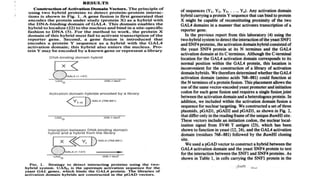
Yeast two- hybrid system:
• Yeast two-hybrid is based on the reconstitution of a functional
transcription factor (TF) when two proteins or polypeptides of interest
interact.
• In 1989, Fields and Song revolutionized protein interaction analysis by
describing a genetic system to detect direct protein-protein interactions in
the yeast Saccharomyces cerevisiae.
• This takes place in genetically modified yeast strains, in which the
transcription of a reporter gene leads to a specific phenotype, usually
growth on a selective medium or change in the color of the yeast
colonies.
• The most popular reporter genes are HIS3 to select yeast on a
medium lacking histidine, and LacZ to screen yeast in a colorimetric
assay.
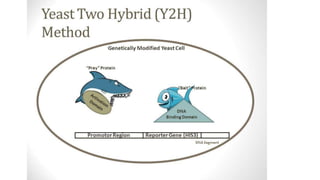
• Two fusions (‘hybrids’) are constructed between each protein of
interest and either the DNA Binding Domain (DBD) or the
Activation Domain (AD) of the TF.
• The protein fused to the DBD is referred to as the ‘bait’, and the
protein fused to the AD as the ‘prey’.
• Upon interaction between the bait and the prey, the DBD and
AD are brought in close proximity and a functional TF is
reconstituted upstream of the reporter gene. The most popular
fusions use the DBD and AD of the yeast TF Gal4. The bacterial
protein LexA is also frequently used as a DBD in combination
with Gal4 AD.
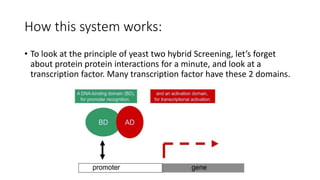
How this system works:
• To look at the principle of yeast two hybrid Screening, let’s forget
about protein protein interactions for a minute, and look at a
transcription factor. Many transcription factor have these 2 domains.
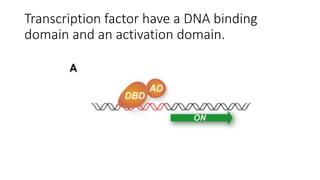
Transcription factor have a DNA binding
domain and an activation domain.
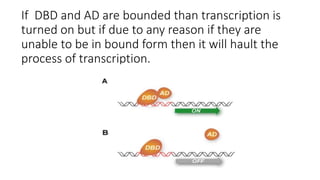
If DBD and AD are bounded than transcription is
turned on but if due to any reason if they are
unable to be in bound form then it will hault the
process of transcription.
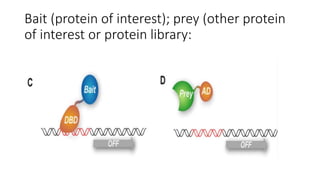
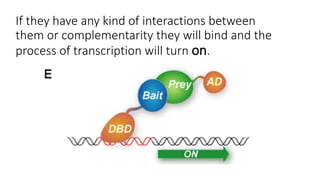
Bait (protein of interest); prey (other protein
of interest or protein library:
If they have any kind of interactions between
them or complementarity they will bind and the
process of transcription will turn on.
Yeast auxotrophies and their exploitation for
transformation:
• Wild type yeast does not need amino acids and nucleotides for
growth.
• Lab wild type yeast are auxotrophs for specific amino Acids and
nucleotides.
• For eg. Leu2∆ trp1∆ ura3∆ these cells do not grows if leucine,
tryptophan and uracyl are not added to the medium.
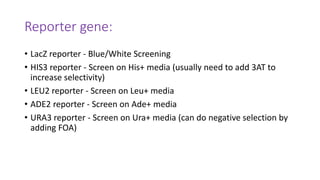
Reporter gene:
• LacZ reporter - Blue/White Screening
• HIS3 reporter - Screen on His+ media (usually need to add 3AT to
increase selectivity)
• LEU2 reporter - Screen on Leu+ media
• ADE2 reporter - Screen on Ade+ media
• URA3 reporter - Screen on Ura+ media (can do negative selection by
adding FOA)
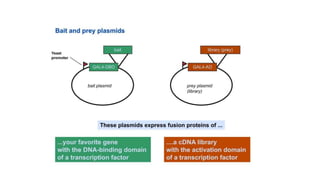
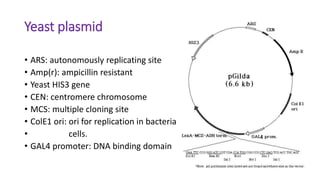
Yeast plasmid
• ARS: autonomously replicating site
• Amp(r): ampicillin resistant
• Yeast HIS3 gene
• CEN: centromere chromosome
• MCS: multiple cloning site
• ColE1 ori: ori for replication in bacterial
• cells.
• GAL4 promoter: DNA binding domain
4
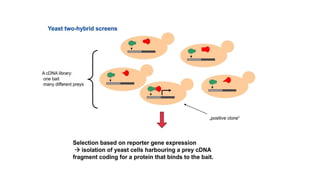
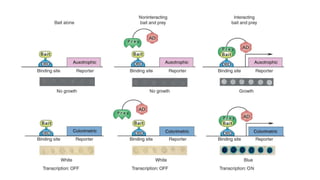
Yeast two hybrid system readouts
• Employed leu2∆trp1∆ura3∆ strains are also:
• GAL1 promoter + HIS3
• If interaction is there, cells grow in the absence of histidine in the
medium.
• GAL1 promoter+ ADE2
• If interaction is there, cells grow in the medium without adenine.
• GAL1 promoter+ LacZ
• If interaction is there cells will become blue in medium containing X-
gal.
False positive results:
• False positives are the largest problem with the yeast two-hybrid
system
• Can be caused by:
• Non-specific binding of the prey
• Ability to induce transcription without interaction with the bait
(Majority of false positives)
How it can be corrected:
• Sequence Analysis
• Plasmid Loss Assays
• Retransformation of both strain with bait plasmid and strain without
bait plasmid
• Test for interaction with an unrelated protein as bait
• Two (or more) step selections
Present and future modifications in Y2H :
• Variations of the yeast two-hybrid were developed to conduct
screens in the presence of a co-factor, or an enzyme required
for a given post-translational modification of the protein
partners. Other versions allow to screen integral membrane
proteins and the technique was adapted to detect protein-
protein interactions in mammalian cells. Finally, yeast n-hybrid
protocols were also devised to screen for novel DNA-protein,
RNA-protein and small molecule-protein interactions.
Reverse yeast two hybrid assay.
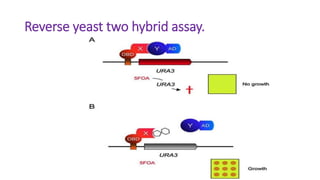
• (A) Co-expression of an interacting DBD-X bait and an AD-Y
prey activates expression of the URA3 gene, which converts
5FOA into a metabolite that is toxic to the cell. Consequently,
yeast co-expressing the interaction partners will be unable to
grow on 5FOA containing medium.
• (B) Addition of a small molecule that disrupts the interaction
between DBD-X and AD- Y abolishes the hybrid transcription
factor and silences expression of URA3. Yeast which has been
treated with this small molecule is therefore able to grow on
5FOA containing plates.
Reverse yeast two hybrid assay.
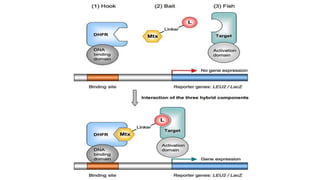
Yeast three hybrid system:
• The yeast three-hybrid system for target identification. The
principle components of the Y3H system are
• (1) the hook, a fusion protein consisting of a DNA-binding
domain and the Mtx-binding enzyme DHFR,
• (2) the bait, a hybrid ligand of Mtx chemically linked to a small
molecule ligand (L) of interest, and
• (3) the fish, a transcriptional activation domain fused to a
protein from a cDNA library (a potential target). The
transcriptional activation of the reporter gene (LEU2 or lacZ)
only occurs upon formation of the trimeric complex. To validate
the Y3H system, the Mtx–Dex hybrid ligand can be used in
combination with the high-affinity Dex-binding glucocorticoid
receptor (GR) fused to the activation domain. DHFR,
dihydrofolate reductase; Mtx, methotrexate.
Advantages of yeast two hybrid system:
• An invivo technique.
• Higher eukaryotic system.
• Only the cDNA of the gene
• Sensitive : weak and transient interactions.
• Semi quantitatively : discrimination between high, intermediate, and
low affinety binding.
• Functional screens
Limitations of yeast two hybrid system:
• The binding occurs in the nucleus, which could not have not the
optimal conditions for the binding
=pH, ion concentration, membrane proximity.
• Transmembrane proteins cannot be targeted to chromosomes.
2nd case study
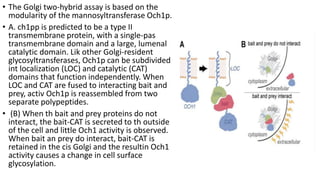
• The Golgi two-hybrid assay is based on the
modularity of the mannosyltransferase Och1p.
• A. ch1pp is predicted to be a type II
transmembrane protein, with a single-pas
transmembrane domain and a large, lumenal
catalytic domain. Lik other Golgi-resident
glycosyltransferases, Och1p can be subdivided
int localization (LOC) and catalytic (CAT)
domains that function independently. When
LOC and CAT are fused to interacting bait and
prey, activ Och1p is reassembled from two
separate polypeptides.
• (B) When th bait and prey proteins do not
interact, the bait-CAT is secreted to th outside
of the cell and little Och1 activity is observed.
When bait an prey do interact, bait-CAT is
retained in the cis Golgi and the resultin Och1
activity causes a change in cell surface
glycosylation.
Thank you...

yeast two hybrid system

  • 1.
    YEAST TWO-HYBRID SYSTEM SheetalMehla PhD Molecular biology, Biotechnology and Bioinformatics
  • 2.
    Interactomics: • Interactomics isa discipline at the intersection of bioinformatics and biology that deals with studying both the interactions and the consequences of those interactions between and among proteins and other molecules within a cell.
  • 3.
    Interactome: • In molecularbiology, an interactome is the whole set of molecular interactions in a particular cell. • These are mainly composed of protein-protein interaction (PPI) network and protein-DNA interaction networks (also called gene regulatory networks), or subsets thereof. • Therefore, a typical interactome includes transcription factors, chromatin regulatory proteins, and their target genes. • The word "interactome" was originally coined in 1999 by a group of French scientists headed by Bernard Jacq.Mathematically, interactomes are generally displayed as graphs.
  • 4.
    Interactomics: • Interactomics thusaims to compare such networks of interactions (i.e., interactomes) between and within species in order to find how the traits of such networks are either preserved or varied. • Interactomics is an example of "top-down" systems biology, which takes an overhead, as well as overall, view of a biosystem or organism. Large sets of genome-wide and proteomic data are collected, and correlations between different molecules are inferred. From the data new hypothesis are formulated about feedbacks between these molecules. These hypothesis can then be tested by new experiments.
  • 5.
    Experimental methods tomap interactome:
  • 7.
    Computational methods tostudy interactome: • Once an interactome has been created, there are numerous ways to analyze its properties. • Validation • Predicting PPIs • Text mining of PPIs • Protein function prediction • Perturbations and disease • Network structure and topology
  • 8.
    Protein protein interactions •Protein–protein interactions (PPIs) are the physical contacts of high specificity established between two or more protein molecules as a result of biochemical events steered by electrostatic forces including the hydrophobic effect.
  • 9.
    Different types ofinteractions:
  • 10.
  • 11.
  • 12.
    The First PlantInteractome Protein interaction networks in Arabidopsis give clues to plant evolution and immunity. In the first study, Braun and colleagues expressed 8,000 Arabidopsis proteins—representing 30 percent of the plant’s protein-coding genes—in yeast cells. “The real challenge is to determine what the targeted plant proteins are doing in the innate immune response and how modifying the targets will modify the disease,” said Cyril Zipfel, group leader in molecular and microbe interactions at The Sainsbury Laboratory.
  • 13.
    Arabidopsis interactome moduledatabase: • The database contains almost 250 000 modules that were generated using multiple analysis methods and integration of microarray expression data. All the modules in AIM are well annotated using multiple gene function knowledge databases. AIM provides a user- friendly interface for different types of searches and offers a powerful graphical viewer for displaying module networks linked to the enrichment annotation terms. Both interactive Venn diagram and power graph viewer are integrated into the database for easy comparison of modules. In addition, predicted interologs from other plant species (homologous proteins from different species that share a conserved interaction module) are available for each Arabidopsis module. AIM is a powerful systems biology platform for obtaining valuable insights into the function of proteins in Arabidopsis and other plants using the modules of the Arabidopsis interactome.
  • 15.
    Two hybrid Screening: •Two-hybrid screening (originally known as yeast two-hybrid system or Y2H) is a molecular biology technique used to discover protein–protein interactions (PPIs) and protein–DNA interactions by testing for physical interactions (such as binding) between two proteins or a single protein and a DNA molecule, respectively.
  • 16.
    Need of yeasttwo hybrid system: • Identifies novel protein-protein interactions • Can identify protein cascades • Identifies mutations that affect protein-protein binding • Can identify interfering proteins in known interactions (Reverse Two- Hybrid System)
  • 17.
    Yeast two- hybridsystem: • Yeast two-hybrid is based on the reconstitution of a functional transcription factor (TF) when two proteins or polypeptides of interest interact. • In 1989, Fields and Song revolutionized protein interaction analysis by describing a genetic system to detect direct protein-protein interactions in the yeast Saccharomyces cerevisiae. • This takes place in genetically modified yeast strains, in which the transcription of a reporter gene leads to a specific phenotype, usually growth on a selective medium or change in the color of the yeast colonies. • The most popular reporter genes are HIS3 to select yeast on a medium lacking histidine, and LacZ to screen yeast in a colorimetric assay.
  • 18.
    • Two fusions(‘hybrids’) are constructed between each protein of interest and either the DNA Binding Domain (DBD) or the Activation Domain (AD) of the TF. • The protein fused to the DBD is referred to as the ‘bait’, and the protein fused to the AD as the ‘prey’. • Upon interaction between the bait and the prey, the DBD and AD are brought in close proximity and a functional TF is reconstituted upstream of the reporter gene. The most popular fusions use the DBD and AD of the yeast TF Gal4. The bacterial protein LexA is also frequently used as a DBD in combination with Gal4 AD.
  • 19.
    How this systemworks: • To look at the principle of yeast two hybrid Screening, let’s forget about protein protein interactions for a minute, and look at a transcription factor. Many transcription factor have these 2 domains.
  • 20.
    Transcription factor havea DNA binding domain and an activation domain.
  • 21.
    If DBD andAD are bounded than transcription is turned on but if due to any reason if they are unable to be in bound form then it will hault the process of transcription.
  • 22.
    Bait (protein ofinterest); prey (other protein of interest or protein library:
  • 24.
    If they haveany kind of interactions between them or complementarity they will bind and the process of transcription will turn on.
  • 27.
    Yeast auxotrophies andtheir exploitation for transformation: • Wild type yeast does not need amino acids and nucleotides for growth. • Lab wild type yeast are auxotrophs for specific amino Acids and nucleotides. • For eg. Leu2∆ trp1∆ ura3∆ these cells do not grows if leucine, tryptophan and uracyl are not added to the medium.
  • 28.
    Reporter gene: • LacZreporter - Blue/White Screening • HIS3 reporter - Screen on His+ media (usually need to add 3AT to increase selectivity) • LEU2 reporter - Screen on Leu+ media • ADE2 reporter - Screen on Ade+ media • URA3 reporter - Screen on Ura+ media (can do negative selection by adding FOA)
  • 29.
    Yeast plasmid • ARS:autonomously replicating site • Amp(r): ampicillin resistant • Yeast HIS3 gene • CEN: centromere chromosome • MCS: multiple cloning site • ColE1 ori: ori for replication in bacterial • cells. • GAL4 promoter: DNA binding domain 4
  • 32.
    Yeast two hybridsystem readouts • Employed leu2∆trp1∆ura3∆ strains are also: • GAL1 promoter + HIS3 • If interaction is there, cells grow in the absence of histidine in the medium. • GAL1 promoter+ ADE2 • If interaction is there, cells grow in the medium without adenine. • GAL1 promoter+ LacZ • If interaction is there cells will become blue in medium containing X- gal.
  • 33.
    False positive results: •False positives are the largest problem with the yeast two-hybrid system • Can be caused by: • Non-specific binding of the prey • Ability to induce transcription without interaction with the bait (Majority of false positives)
  • 34.
    How it canbe corrected: • Sequence Analysis • Plasmid Loss Assays • Retransformation of both strain with bait plasmid and strain without bait plasmid • Test for interaction with an unrelated protein as bait • Two (or more) step selections
  • 35.
    Present and futuremodifications in Y2H : • Variations of the yeast two-hybrid were developed to conduct screens in the presence of a co-factor, or an enzyme required for a given post-translational modification of the protein partners. Other versions allow to screen integral membrane proteins and the technique was adapted to detect protein- protein interactions in mammalian cells. Finally, yeast n-hybrid protocols were also devised to screen for novel DNA-protein, RNA-protein and small molecule-protein interactions.
  • 36.
    Reverse yeast twohybrid assay. • (A) Co-expression of an interacting DBD-X bait and an AD-Y prey activates expression of the URA3 gene, which converts 5FOA into a metabolite that is toxic to the cell. Consequently, yeast co-expressing the interaction partners will be unable to grow on 5FOA containing medium. • (B) Addition of a small molecule that disrupts the interaction between DBD-X and AD- Y abolishes the hybrid transcription factor and silences expression of URA3. Yeast which has been treated with this small molecule is therefore able to grow on 5FOA containing plates.
  • 37.
    Reverse yeast twohybrid assay.
  • 38.
    Yeast three hybridsystem: • The yeast three-hybrid system for target identification. The principle components of the Y3H system are • (1) the hook, a fusion protein consisting of a DNA-binding domain and the Mtx-binding enzyme DHFR, • (2) the bait, a hybrid ligand of Mtx chemically linked to a small molecule ligand (L) of interest, and • (3) the fish, a transcriptional activation domain fused to a protein from a cDNA library (a potential target). The transcriptional activation of the reporter gene (LEU2 or lacZ) only occurs upon formation of the trimeric complex. To validate the Y3H system, the Mtx–Dex hybrid ligand can be used in combination with the high-affinity Dex-binding glucocorticoid receptor (GR) fused to the activation domain. DHFR, dihydrofolate reductase; Mtx, methotrexate.
  • 40.
    Advantages of yeasttwo hybrid system: • An invivo technique. • Higher eukaryotic system. • Only the cDNA of the gene • Sensitive : weak and transient interactions. • Semi quantitatively : discrimination between high, intermediate, and low affinety binding. • Functional screens
  • 41.
    Limitations of yeasttwo hybrid system: • The binding occurs in the nucleus, which could not have not the optimal conditions for the binding =pH, ion concentration, membrane proximity. • Transmembrane proteins cannot be targeted to chromosomes.
  • 42.
  • 43.
    • The Golgitwo-hybrid assay is based on the modularity of the mannosyltransferase Och1p. • A. ch1pp is predicted to be a type II transmembrane protein, with a single-pas transmembrane domain and a large, lumenal catalytic domain. Lik other Golgi-resident glycosyltransferases, Och1p can be subdivided int localization (LOC) and catalytic (CAT) domains that function independently. When LOC and CAT are fused to interacting bait and prey, activ Och1p is reassembled from two separate polypeptides. • (B) When th bait and prey proteins do not interact, the bait-CAT is secreted to th outside of the cell and little Och1 activity is observed. When bait an prey do interact, bait-CAT is retained in the cis Golgi and the resultin Och1 activity causes a change in cell surface glycosylation.
  • 44.