CHEMICAL NATURE AND
GROSS FEATURES OF
HORMONES
 The word hormone comes from the Greek word hormon, which means “to bring
into action.”
 Hormones have a role in every physiological activity that occurs in our bodies.
 Generally speaking, a hormone may be described as a specific product of an
endocrine gland that is produced into the bloodstream and then transported to a
specific portion of the body.
 This impact can have either an excitatory or an inhibitory effect on the body.
 Endocrine glands do not have any ducts, thus the hormones they produce are released
straight into the circulation. As a result, the endocrine glands are often referred to as
“ductless glands”.
 The holocrine glands are endocrine glands release hormones, and they are found in
the reproductive system (e.g., thyroid, parathyroid, adrenals, and pituitary glands).
 Heterocrine glands are glands that perform two or more tasks at the same time (e.g.,
pancreas, testes ovaries, etc.).
INTRODUCTION
PROPERTIES OF HORMONES
 The hormones are created by specific glands and released directly
into the bloodstream.
 The hormones are delivered by the bloodstream from the
endocrine cells to the target cells or organs where they operate as
a ‘chemical message’ by controlling the rates of certain metabolic
events.
 The hormones have their impact on different tissues of the body
rather than the tissues where they are created in a certain area.
 Hormones have diverse molecular structures that distinguish them
from one another. Steroids, proteins, peptides, and amino acid
derivatives are all examples of anabolic steroids.
 Hormones serve as the second line
of communication and control in
the body, after the nervous system.
 They are produced by endocrine
glands.
 They are sluggish to react when it
comes to controlling organs and
coordinating actions amongst
them.
 They are chemical in nature, and
as a result, they communicate
through a chemical network.
CHEMICAL NATURE OF HORMONES
1. Steroid hormones
2. Amine hormones
3. Peptide hormones
4. Protein hormones
They can be classified into the
following categories based on their
chemical composition:
1.Steroid hormones: These are composed of lipids, which are mostly
generated from cholesterol, and are produced by the adrenal glands.
Eg:-Testosterone, oestrogen
and progesterone
2. Amine hormones: These hormones are derived from the amino acid
tyrosine and are composed of amines, which are derivatives of that amino
acid.
Eg:-T3, T4, Epinephrine
and Norepinephrine
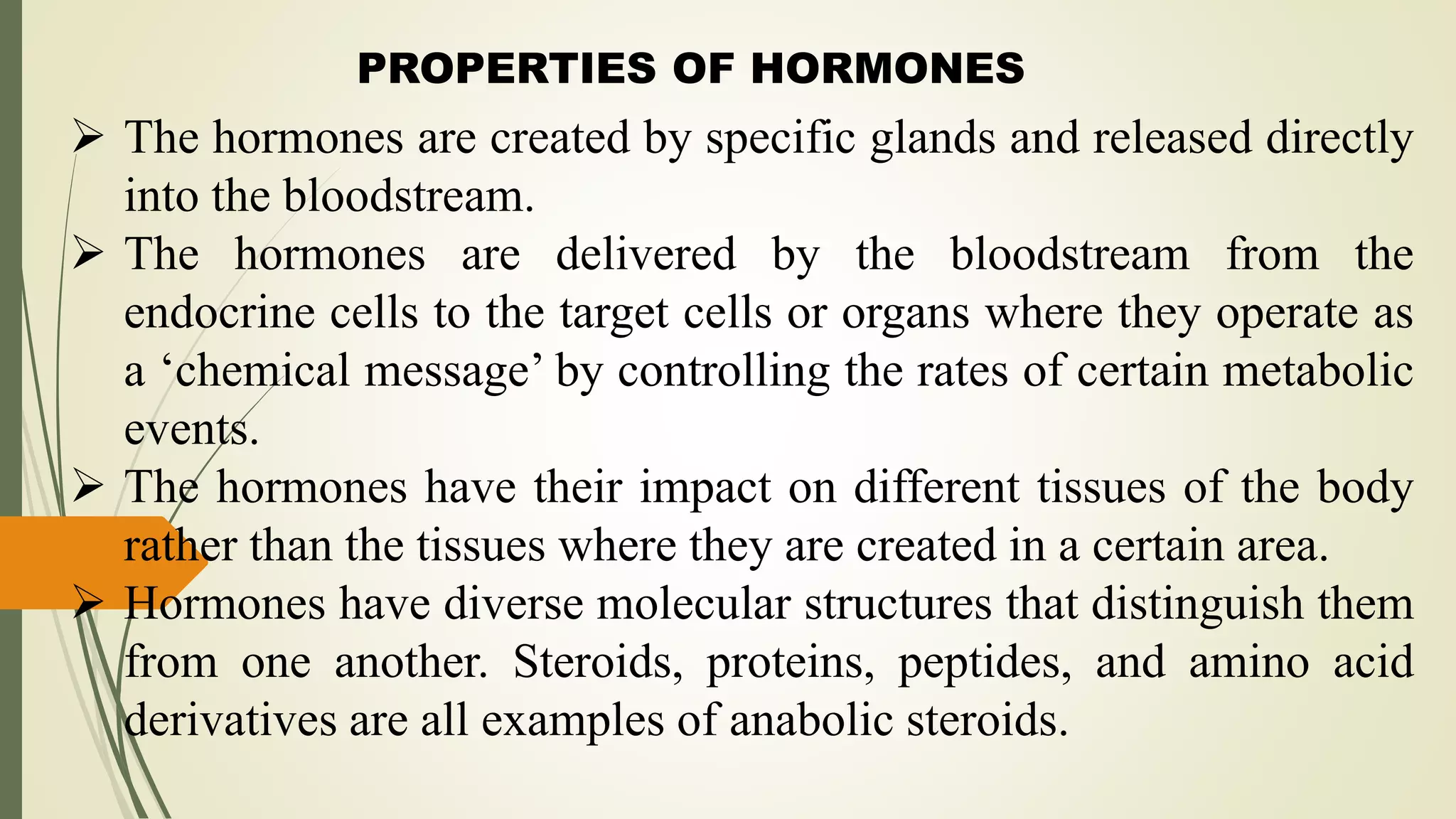
3. Peptide hormones: These hormones are made up of only a few amino
acid residues and are found in a linear chain form, similar to insulin.
Eg:- Oxytocin and vasopressin
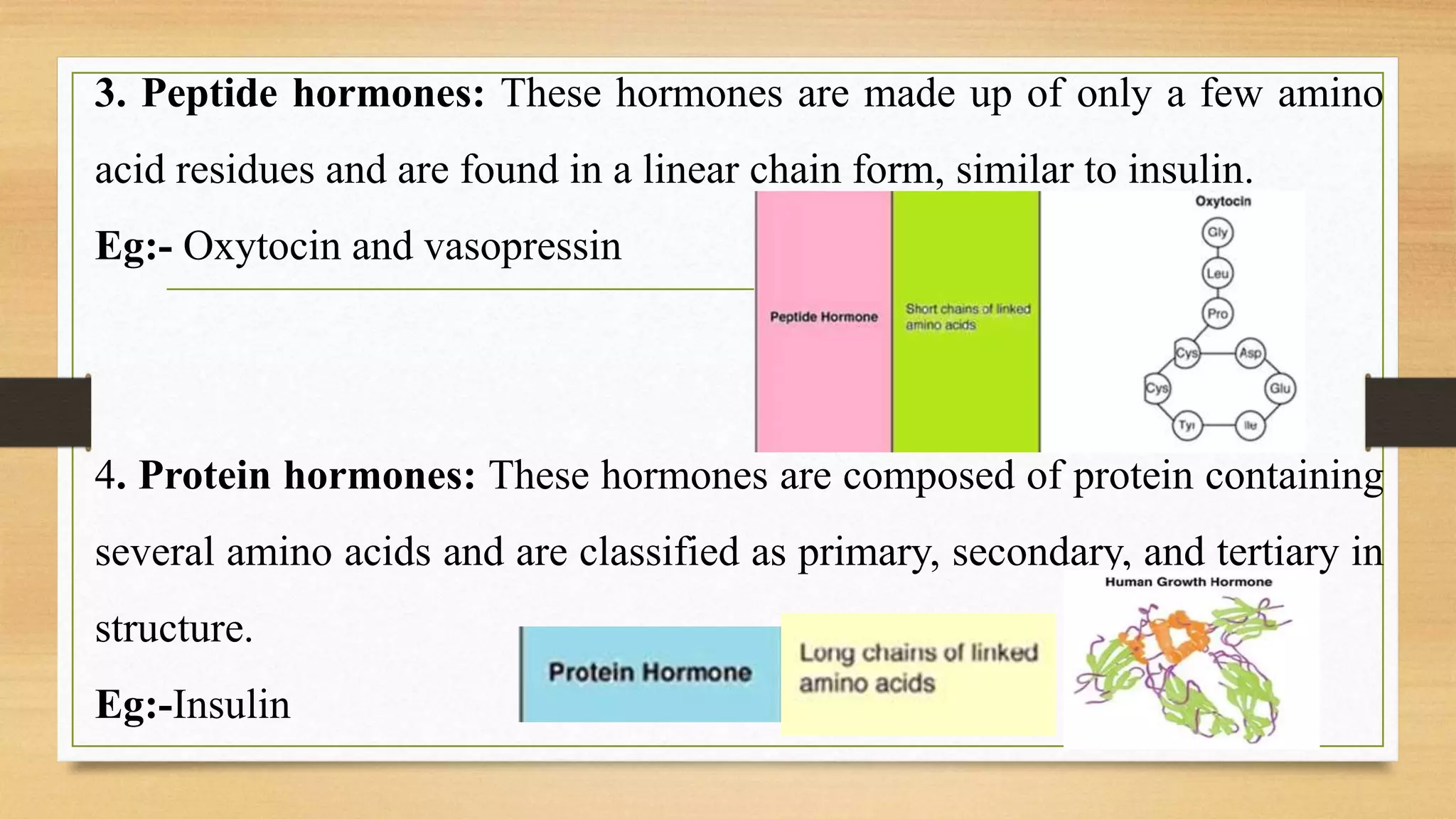
4. Protein hormones: These hormones are composed of protein containing
several amino acids and are classified as primary, secondary, and tertiary in
structure.
Eg:-Insulin
In terms of chemical makeup of hormones, which determines their chemical
activity hormones are divided into two groups:
lipid-soluble hormones and water-soluble hormones.
• This difference is made based on the chemical makeup of hormones, which
determines their chemical activity.
• Hormones can be subdivided into groups depending on the chemical structures
of their hormones within each of the two chemical categories.
• Among the hormones produced by the body are steroid hormones, thyroid
hormones produced by the body from the amino acid tyrosine, and other
hormones that are amino acid derivatives, peptides, or proteins.
CONCLUSION
Chemical nature and gross features of hormones - pptx

Chemical nature and gross features of hormones - pptx

  • 1.
    CHEMICAL NATURE AND GROSSFEATURES OF HORMONES
  • 2.
     The wordhormone comes from the Greek word hormon, which means “to bring into action.”  Hormones have a role in every physiological activity that occurs in our bodies.  Generally speaking, a hormone may be described as a specific product of an endocrine gland that is produced into the bloodstream and then transported to a specific portion of the body.  This impact can have either an excitatory or an inhibitory effect on the body.  Endocrine glands do not have any ducts, thus the hormones they produce are released straight into the circulation. As a result, the endocrine glands are often referred to as “ductless glands”.  The holocrine glands are endocrine glands release hormones, and they are found in the reproductive system (e.g., thyroid, parathyroid, adrenals, and pituitary glands).  Heterocrine glands are glands that perform two or more tasks at the same time (e.g., pancreas, testes ovaries, etc.). INTRODUCTION
  • 3.
    PROPERTIES OF HORMONES The hormones are created by specific glands and released directly into the bloodstream.  The hormones are delivered by the bloodstream from the endocrine cells to the target cells or organs where they operate as a ‘chemical message’ by controlling the rates of certain metabolic events.  The hormones have their impact on different tissues of the body rather than the tissues where they are created in a certain area.  Hormones have diverse molecular structures that distinguish them from one another. Steroids, proteins, peptides, and amino acid derivatives are all examples of anabolic steroids.
  • 4.
     Hormones serveas the second line of communication and control in the body, after the nervous system.  They are produced by endocrine glands.  They are sluggish to react when it comes to controlling organs and coordinating actions amongst them.  They are chemical in nature, and as a result, they communicate through a chemical network. CHEMICAL NATURE OF HORMONES
  • 5.
    1. Steroid hormones 2.Amine hormones 3. Peptide hormones 4. Protein hormones They can be classified into the following categories based on their chemical composition:
  • 6.
    1.Steroid hormones: Theseare composed of lipids, which are mostly generated from cholesterol, and are produced by the adrenal glands. Eg:-Testosterone, oestrogen and progesterone 2. Amine hormones: These hormones are derived from the amino acid tyrosine and are composed of amines, which are derivatives of that amino acid. Eg:-T3, T4, Epinephrine and Norepinephrine
  • 7.
    3. Peptide hormones:These hormones are made up of only a few amino acid residues and are found in a linear chain form, similar to insulin. Eg:- Oxytocin and vasopressin 4. Protein hormones: These hormones are composed of protein containing several amino acids and are classified as primary, secondary, and tertiary in structure. Eg:-Insulin
  • 8.
    In terms ofchemical makeup of hormones, which determines their chemical activity hormones are divided into two groups: lipid-soluble hormones and water-soluble hormones. • This difference is made based on the chemical makeup of hormones, which determines their chemical activity. • Hormones can be subdivided into groups depending on the chemical structures of their hormones within each of the two chemical categories. • Among the hormones produced by the body are steroid hormones, thyroid hormones produced by the body from the amino acid tyrosine, and other hormones that are amino acid derivatives, peptides, or proteins. CONCLUSION