Shri Shankaracharya Mahavidyalaya, Junwani , Bhilai
Fish Scales
Dr. Sonia Bajaj
(Head of Department)
I. Taxonomic Classes of Fish
A. Agnatha–jawless fish (lampreys and hagfish)
B. Chronrichthyes–cartilage fish (sharks, skates, rays)
C. Osteichthyes –bony fish(soft rayed and spiny rayed)
II. Skin Anatomy
A. Divided into Two Layers
1.Epidermis.
a. Epithelial cells –arranged one above the other
b. Slime cells–interspaced between the epithelial cells
2.Dermis
a. Made of fibroblasts, collagen, and blood vessels
b. Scales in pockets in the dermis
B. Scales –Four Types
1.Placoid –also called dermal denticles.
Similar to teeth; made of dentin and covered by enamel. (sharks and rays)
2.Ganoid –flat, basal–looking scales; little overlapping.(gar & bichirs)
3.Cycloid –small, oval-shaped with growth rings.(bowfin & remora)
4.Ctenoid –similar to cycloid scales; growth rings; spines covering one edge.(Halibut)
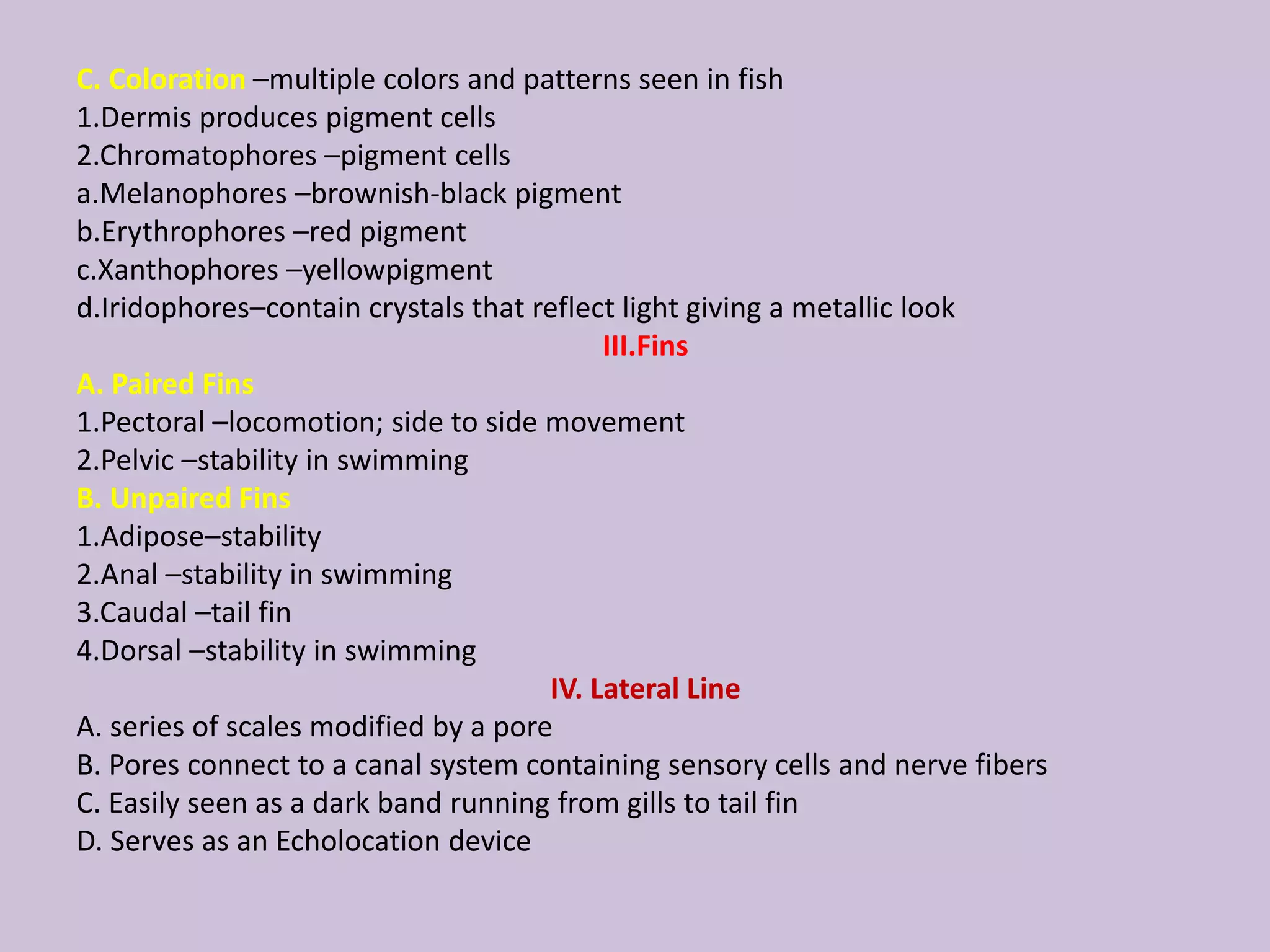
C. Coloration –multiple colors and patterns seen in fish
1.Dermis produces pigment cells
2.Chromatophores –pigment cells
a.Melanophores –brownish-black pigment
b.Erythrophores –red pigment
c.Xanthophores –yellowpigment
d.Iridophores–contain crystals that reflect light giving a metallic look
III.Fins
A. Paired Fins
1.Pectoral –locomotion; side to side movement
2.Pelvic –stability in swimming
B. Unpaired Fins
1.Adipose–stability
2.Anal –stability in swimming
3.Caudal –tail fin
4.Dorsal –stability in swimming
IV. Lateral Line
A. series of scales modified by a pore
B. Pores connect to a canal system containing sensory cells and nerve fibers
C. Easily seen as a dark band running from gills to tail fin
D. Serves as an Echolocation device
Introduction
fish scale - scale of the kind that covers the bodies of fish.
scale - a flattened rigid plate forming part of the body covering of many animals.
fish - any of various mostly cold-
blooded aquatic vertebrates usually having scales and breathing through gills; "the shark is a
large fish“.
The term scale derives from the Old French "escale", meaning a shell pod.
The skin of most fishes is covered with these protective scales.
Fish scales are part of the fish's integumentary system, and are produced from
the mesoderm layer of the dermis.
The skin is made up of two levels; External epidermis or epidermis and internal dermis or
dermis. In fish, the lactate level plays an important part in the production of scales; hence
their charges are called charcoal scales. In reptiles, birds and mammalian terrestrial
creatures, the shells of the shells are derived from the superficial, so their scales are called
the epidermal scales.
Types of Fish Scales
Development of Placoid scales
Placoid scales are found in elasmobranch fishes. The placoid scales consist of a
basal plate of a circular or quadrangular shape, which is firmly attached to the
skin with the help of sharpe and other connective tissues. The basal outer layer
protruding from the back of the basal plate, similar to the enamel of the tooth, is
made of a rigid, transparent material, vitrodentine. Beneath the vitrodentine is a
level of dentine that surrounds the medulla-cavity. Blood vessels from the
medulla-cavity enter the blood vessels, neural sutures and lymph vessels. There
are numerous, branched microscopic tubes found in dentin, in which many long
bioclasts of odontoblasts are found. The function of odontoblast cells is the
formation of dentin.
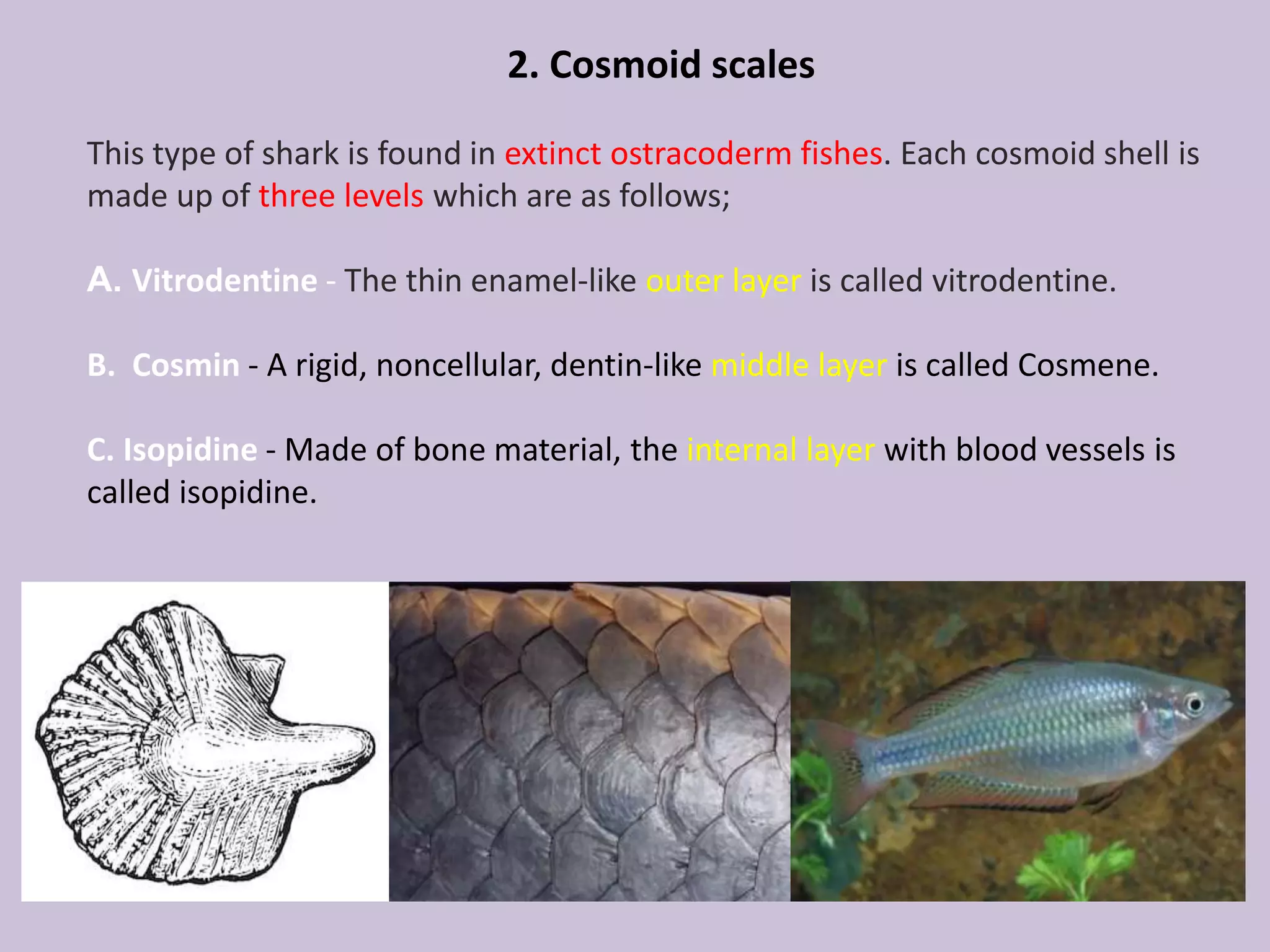
2. Cosmoid scales
This type of shark is found in extinct ostracoderm fishes. Each cosmoid shell is
made up of three levels which are as follows;
A. Vitrodentine - The thin enamel-like outer layer is called vitrodentine.
B. Cosmin - A rigid, noncellular, dentin-like middle layer is called Cosmene.
C. Isopidine - Made of bone material, the internal layer with blood vessels is
called isopidine.
3. Ganoid scales
Ganoid shells are found in primitive actinopteris fishes. These scales are
generally similar to tetragonal plates that join together like tiles to form
external skeletons. Ganoid scales develop exclusively in chondrostian and
holostean fishes.(ex.Ger,Paddelfish) Ganoid scales are also made up of three
levels, which are as follows-
a. Genoyan - The outer layer of ganoid scale is made of a hard, inorganic,
enamel-like material called genoyan.
B. Cosmene - The dentin-like substance makes Cosmene the middle layer.
C. Isopidine - This level is the inner most thick and unstable.
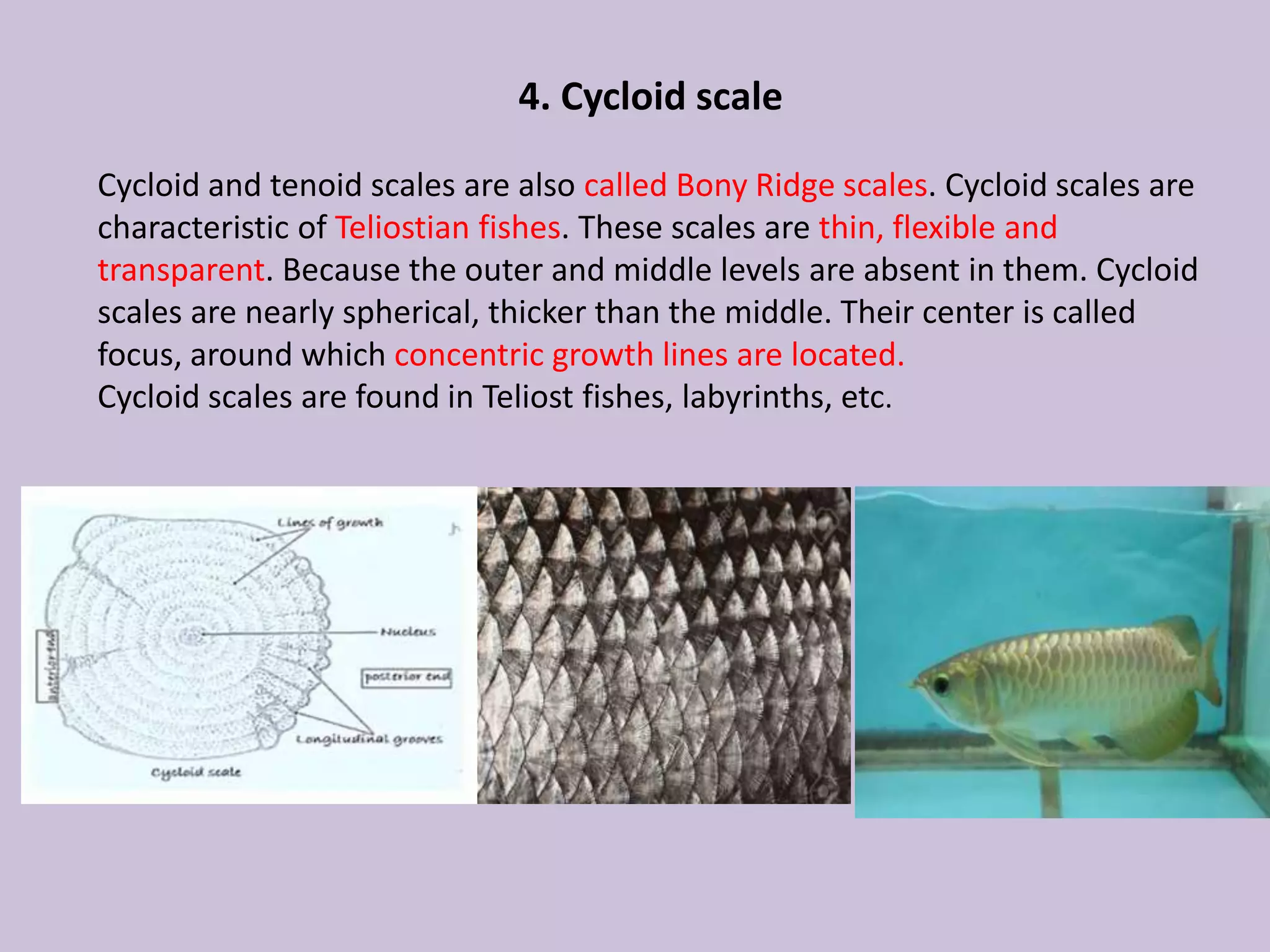
4. Cycloid scale
Cycloid and tenoid scales are also called Bony Ridge scales. Cycloid scales are
characteristic of Teliostian fishes. These scales are thin, flexible and
transparent. Because the outer and middle levels are absent in them. Cycloid
scales are nearly spherical, thicker than the middle. Their center is called
focus, around which concentric growth lines are located.
Cycloid scales are found in Teliost fishes, labyrinths, etc.
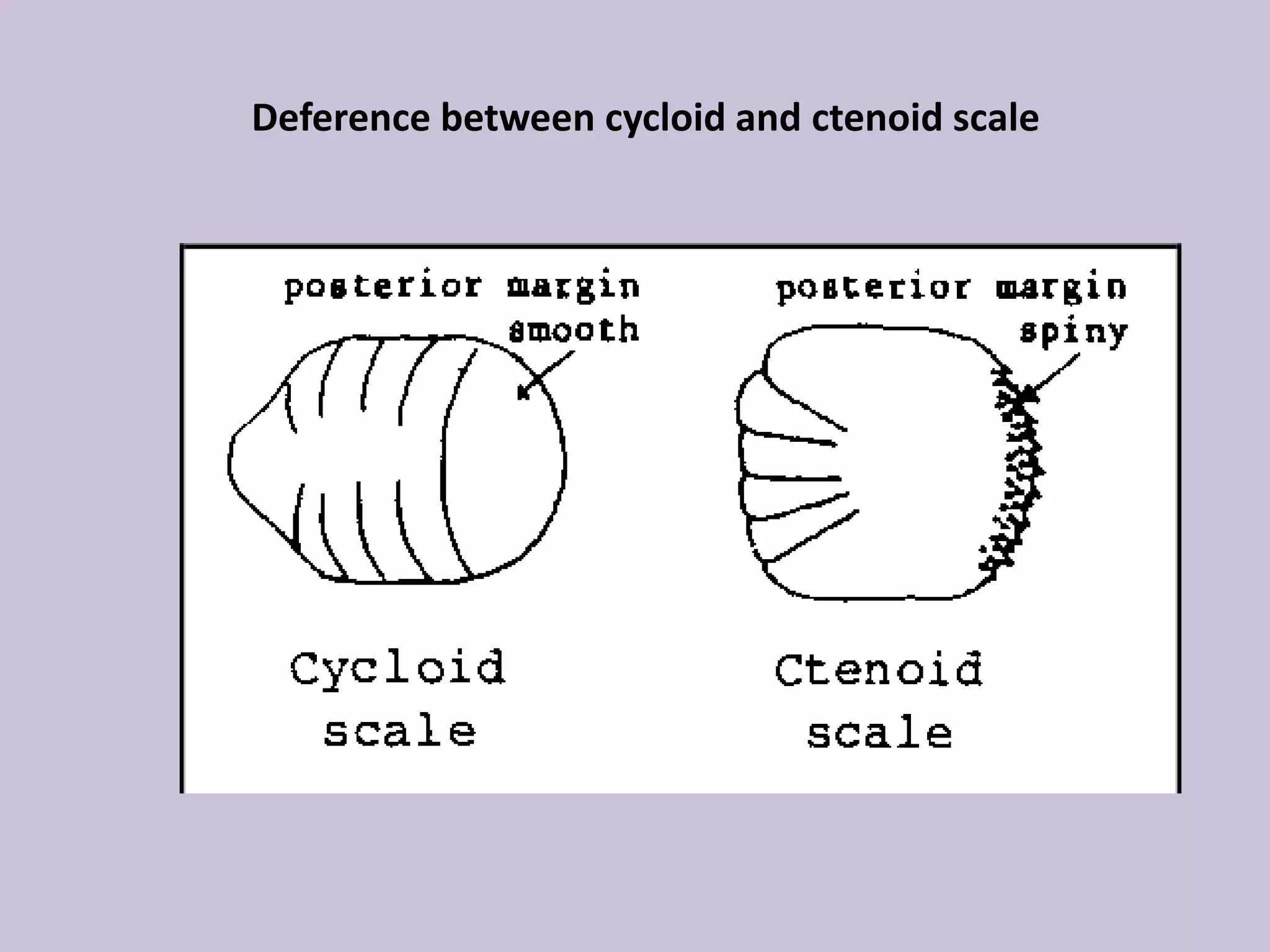
5. Ctenoid scale
Ctenoid scales are almost like cycloid scales in shape and structure, but on
their independent back are numerous, small, comb-like teeth. This type of
shark is found in modern Teliost fishes like perch etc. Cycloids, ctenoids and
secondary types of scales can be seen on the body of some fish, such as
flounders.
Deference between cycloid and ctenoid scale
Variation and variation in scales
Many variations are found in fish shells. Sharks are the transfusions of dentin present
in the jaws of fish. Priestis's Sa-Teeth and Sting Ray's sting are all modified scales. In
tetradon and diodon, the shells grow long and take the form of thorns. In sea horses
and pipe fish, the scales are attached and make a shield of bone plates.
Use of Scales
1. In classification and identification -
The types of shells, their configuration, number, shape and structure are different
in different species of fish, which is important in identification and classification.
2. To find the number of eggs -
Androgen mark is found in some migratory fish. These fish do not take food during
the overseas migration and due to lack of calcium; there is erosion of calcium
from their shells. This leaves scars on calcium erosion scales, which is called the
Androgen mark. Based on the number of these scars, how many times the spawn
has occurred can be determined.
3. In determining age -
Growth in fish is not constant, that is, in summer, when food is abundant; the
growth rate is higher than in winter. In this way, the open lines on the scales
indicate the growth in summer and the tight lines show the growth in winter.
References-
Modern text book -Kotpal
Jantu Vigyan- S.M. sexsena
Jantu Vigyan- Dr.H.N. Baijal

Fish scales

  • 1.
    Shri Shankaracharya Mahavidyalaya,Junwani , Bhilai Fish Scales Dr. Sonia Bajaj (Head of Department)
  • 2.
    I. Taxonomic Classesof Fish A. Agnatha–jawless fish (lampreys and hagfish) B. Chronrichthyes–cartilage fish (sharks, skates, rays) C. Osteichthyes –bony fish(soft rayed and spiny rayed) II. Skin Anatomy A. Divided into Two Layers 1.Epidermis. a. Epithelial cells –arranged one above the other b. Slime cells–interspaced between the epithelial cells 2.Dermis a. Made of fibroblasts, collagen, and blood vessels b. Scales in pockets in the dermis B. Scales –Four Types 1.Placoid –also called dermal denticles. Similar to teeth; made of dentin and covered by enamel. (sharks and rays) 2.Ganoid –flat, basal–looking scales; little overlapping.(gar & bichirs) 3.Cycloid –small, oval-shaped with growth rings.(bowfin & remora) 4.Ctenoid –similar to cycloid scales; growth rings; spines covering one edge.(Halibut)
  • 3.
    C. Coloration –multiplecolors and patterns seen in fish 1.Dermis produces pigment cells 2.Chromatophores –pigment cells a.Melanophores –brownish-black pigment b.Erythrophores –red pigment c.Xanthophores –yellowpigment d.Iridophores–contain crystals that reflect light giving a metallic look III.Fins A. Paired Fins 1.Pectoral –locomotion; side to side movement 2.Pelvic –stability in swimming B. Unpaired Fins 1.Adipose–stability 2.Anal –stability in swimming 3.Caudal –tail fin 4.Dorsal –stability in swimming IV. Lateral Line A. series of scales modified by a pore B. Pores connect to a canal system containing sensory cells and nerve fibers C. Easily seen as a dark band running from gills to tail fin D. Serves as an Echolocation device
  • 4.
    Introduction fish scale -scale of the kind that covers the bodies of fish. scale - a flattened rigid plate forming part of the body covering of many animals. fish - any of various mostly cold- blooded aquatic vertebrates usually having scales and breathing through gills; "the shark is a large fish“. The term scale derives from the Old French "escale", meaning a shell pod. The skin of most fishes is covered with these protective scales. Fish scales are part of the fish's integumentary system, and are produced from the mesoderm layer of the dermis. The skin is made up of two levels; External epidermis or epidermis and internal dermis or dermis. In fish, the lactate level plays an important part in the production of scales; hence their charges are called charcoal scales. In reptiles, birds and mammalian terrestrial creatures, the shells of the shells are derived from the superficial, so their scales are called the epidermal scales.
  • 6.
  • 8.
    Development of Placoidscales Placoid scales are found in elasmobranch fishes. The placoid scales consist of a basal plate of a circular or quadrangular shape, which is firmly attached to the skin with the help of sharpe and other connective tissues. The basal outer layer protruding from the back of the basal plate, similar to the enamel of the tooth, is made of a rigid, transparent material, vitrodentine. Beneath the vitrodentine is a level of dentine that surrounds the medulla-cavity. Blood vessels from the medulla-cavity enter the blood vessels, neural sutures and lymph vessels. There are numerous, branched microscopic tubes found in dentin, in which many long bioclasts of odontoblasts are found. The function of odontoblast cells is the formation of dentin.
  • 9.
    2. Cosmoid scales Thistype of shark is found in extinct ostracoderm fishes. Each cosmoid shell is made up of three levels which are as follows; A. Vitrodentine - The thin enamel-like outer layer is called vitrodentine. B. Cosmin - A rigid, noncellular, dentin-like middle layer is called Cosmene. C. Isopidine - Made of bone material, the internal layer with blood vessels is called isopidine.
  • 10.
    3. Ganoid scales Ganoidshells are found in primitive actinopteris fishes. These scales are generally similar to tetragonal plates that join together like tiles to form external skeletons. Ganoid scales develop exclusively in chondrostian and holostean fishes.(ex.Ger,Paddelfish) Ganoid scales are also made up of three levels, which are as follows- a. Genoyan - The outer layer of ganoid scale is made of a hard, inorganic, enamel-like material called genoyan. B. Cosmene - The dentin-like substance makes Cosmene the middle layer. C. Isopidine - This level is the inner most thick and unstable.
  • 11.
    4. Cycloid scale Cycloidand tenoid scales are also called Bony Ridge scales. Cycloid scales are characteristic of Teliostian fishes. These scales are thin, flexible and transparent. Because the outer and middle levels are absent in them. Cycloid scales are nearly spherical, thicker than the middle. Their center is called focus, around which concentric growth lines are located. Cycloid scales are found in Teliost fishes, labyrinths, etc.
  • 12.
    5. Ctenoid scale Ctenoidscales are almost like cycloid scales in shape and structure, but on their independent back are numerous, small, comb-like teeth. This type of shark is found in modern Teliost fishes like perch etc. Cycloids, ctenoids and secondary types of scales can be seen on the body of some fish, such as flounders.
  • 13.
    Deference between cycloidand ctenoid scale
  • 14.
    Variation and variationin scales Many variations are found in fish shells. Sharks are the transfusions of dentin present in the jaws of fish. Priestis's Sa-Teeth and Sting Ray's sting are all modified scales. In tetradon and diodon, the shells grow long and take the form of thorns. In sea horses and pipe fish, the scales are attached and make a shield of bone plates. Use of Scales 1. In classification and identification - The types of shells, their configuration, number, shape and structure are different in different species of fish, which is important in identification and classification. 2. To find the number of eggs - Androgen mark is found in some migratory fish. These fish do not take food during the overseas migration and due to lack of calcium; there is erosion of calcium from their shells. This leaves scars on calcium erosion scales, which is called the Androgen mark. Based on the number of these scars, how many times the spawn has occurred can be determined. 3. In determining age - Growth in fish is not constant, that is, in summer, when food is abundant; the growth rate is higher than in winter. In this way, the open lines on the scales indicate the growth in summer and the tight lines show the growth in winter.
  • 15.
    References- Modern text book-Kotpal Jantu Vigyan- S.M. sexsena Jantu Vigyan- Dr.H.N. Baijal