Kingdom AnimaliaKingdom Animalia
~ Characteristics ~~ Characteristics ~
 MulticellularMulticellular
 Eukaryotic withEukaryotic with no cell wallsno cell walls
 Heterotrophs (consumers)Heterotrophs (consumers)
~ Characteristics ~~ Characteristics ~
 Have a nervous system to respond to theirHave a nervous system to respond to their
environmentenvironment
 Locomotion relates to ability to obtain foodLocomotion relates to ability to obtain food
 Most animals develop from aMost animals develop from a zygotezygote
becoming abecoming a
 A single layer of cells surrounding a fluid-A single layer of cells surrounding a fluid-
filled space forming a hollow ball of cellsfilled space forming a hollow ball of cells
called acalled a gastrulagastrula.
~ Developmental Characteristics ~~ Developmental Characteristics ~
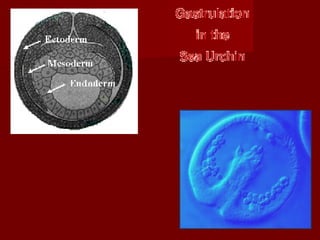
 The gastrula isThe gastrula is made up of three parts:made up of three parts:
– EctodermEctoderm, a layer of cells on the outer surfacea layer of cells on the outer surface
of theof the gastrulagastrula,, grows and divides developinggrows and divides developing
into skin and nervous tissue.into skin and nervous tissue.
– EndodermEndoderm, a layer of cells lining the innera layer of cells lining the inner
surface of thesurface of the gastrulagastrula,, develops into thedevelops into the
lining of the animal’s digestive tract.lining of the animal’s digestive tract.
– MesodermMesoderm, made up of two layers of cells, made up of two layers of cells
lying between thelying between the ectodermectoderm andand endodermendoderm,,
forms muscles, reproductive organs andforms muscles, reproductive organs and
circulatory vessels.circulatory vessels.
~ Developmental Characteristics ~~ Developmental Characteristics ~
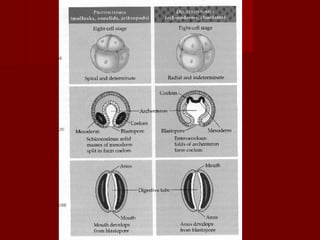
 Animals that develop a mouth from theAnimals that develop a mouth from the
indented space in the gastrula areindented space in the gastrula are
protostomesprotostomes..
 Animals that develop an anus from theAnimals that develop an anus from the
opening in the gastrula areopening in the gastrula are
deuterostomesdeuterostomes..
~~ Body Plans ~Body Plans ~
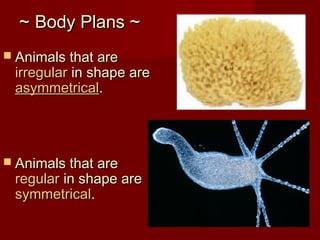
 Animals that areAnimals that are
irregularirregular in shape arein shape are
asymmetricalasymmetrical..
 Animals that areAnimals that are
regularregular in shape arein shape are
symmetricalsymmetrical..
~ Body Plans ~~ Body Plans ~
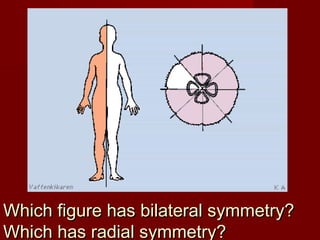
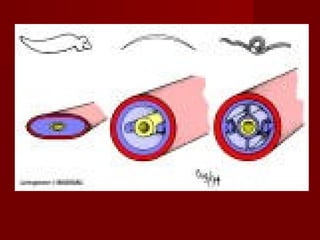
 An animal hasAn animal has radial symmetryradial symmetry if itif it
can be divided along any plane,can be divided along any plane,
through a central axis, into equalthrough a central axis, into equal
halves.halves.
 An animal hasAn animal has bilateral symmetrybilateral symmetry if itif it
can be divided down its length intocan be divided down its length into
similar right and left halves formingsimilar right and left halves forming
mirror images of each other.mirror images of each other.
Which figure has bilateral symmetry?Which figure has bilateral symmetry?
Which has radial symmetry?Which has radial symmetry?
~ Body Plans ~~ Body Plans ~
 AcoelomatesAcoelomates – animals have three cell– animals have three cell
layers with a digestive tract but no bodylayers with a digestive tract but no body
cavities.cavities.
 PseudocoelomatesPseudocoelomates – animals with a fluid-– animals with a fluid-
filled body cavity partly lined withfilled body cavity partly lined with
mesoderm.mesoderm.
 CoelomatesCoelomates – animals with a body cavity– animals with a body cavity
completely surrounded by mesoderm.completely surrounded by mesoderm.
~ Protection and Support ~~ Protection and Support ~
 Though not all animals have a skeleton,Though not all animals have a skeleton,
those that do can be divided into twothose that do can be divided into two
groups:groups:
– Those with anThose with an exoskeletonexoskeleton – a hard,– a hard,
waxy coating on the outside of the bodywaxy coating on the outside of the body
that protects internal organs, provides athat protects internal organs, provides a
framework for support, and a place forframework for support, and a place for
muscle attachment.muscle attachment.
– Those with anThose with an endoskeletonendoskeleton – support– support
framework within the body that protectsframework within the body that protects
some organs and a brace for muscles tosome organs and a brace for muscles to
pull against.pull against.
~Invertebrates~~Invertebrates~
 8 main phyla8 main phyla
 No backbonesNo backbones
 95% of all animals are in this group95% of all animals are in this group
~Invertebrate~Invertebrate
Phylum Porifera~Phylum Porifera~
 SpongesSponges
 simplest form of animal lifesimplest form of animal life
 live in waterlive in water
 Do not move aroundDo not move around
 no symmetryno symmetry
 Pores (holes) all over bodyPores (holes) all over body

~Invertebrate~Invertebrate
Phylum Porifera~Phylum Porifera~
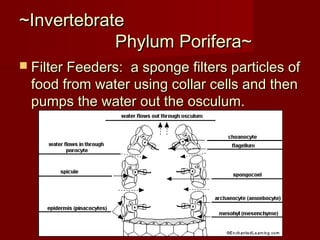
 Filter Feeders: a sponge filters particles ofFilter Feeders: a sponge filters particles of
food from water using collar cells and thenfood from water using collar cells and then
pumps the water out the osculum.pumps the water out the osculum.
~Invertebrate~Invertebrate
Phylum Porifera~Phylum Porifera~
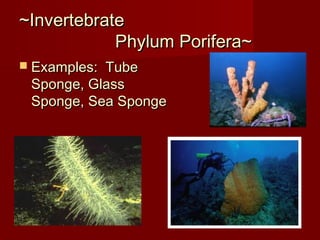
 Examples: TubeExamples: Tube
Sponge, GlassSponge, Glass
Sponge, Sea SpongeSponge, Sea Sponge
~Invertebrate~Invertebrate
Phylum Cnidaria~Phylum Cnidaria~
 Live in waterLive in water
 Most have tentaclesMost have tentacles
 catch food with stinging cellscatch food with stinging cells
 gut for digestinggut for digesting
~Invertebrate~Invertebrate
Phylum Cnidaria~Phylum Cnidaria~
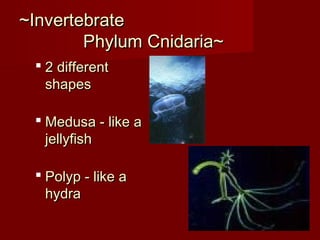
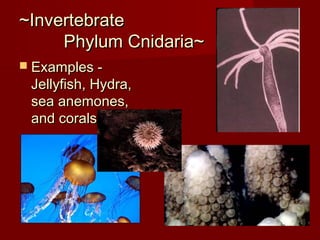
 2 different2 different
shapesshapes
 Medusa - like aMedusa - like a
jellyfishjellyfish
 Polyp - like aPolyp - like a
hydrahydra
~Invertebrate~Invertebrate
Phylum Cnidaria~Phylum Cnidaria~
 Examples -Examples -
Jellyfish, Hydra,Jellyfish, Hydra,
sea anemones,sea anemones,
and coralsand corals
~Invertebrate~Invertebrate
Phylum Platyhelminthes ~Phylum Platyhelminthes ~
 FlatwormsFlatworms
 Flat, ribbon-like bodyFlat, ribbon-like body
 Live in water or are parasitesLive in water or are parasites
 bilateral symmetrybilateral symmetry
~Invertebrate~Invertebrate
Phylum Platyhelminthes ~Phylum Platyhelminthes ~
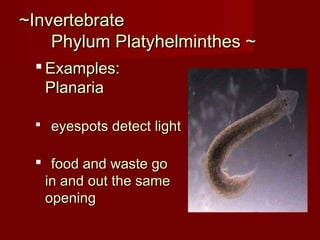
 Examples:Examples:
PlanariaPlanaria
 eyespots detect lighteyespots detect light
 food and waste gofood and waste go
in and out the samein and out the same
openingopening
~Invertebrate~Invertebrate
Phylum Platyhelminthes ~Phylum Platyhelminthes ~
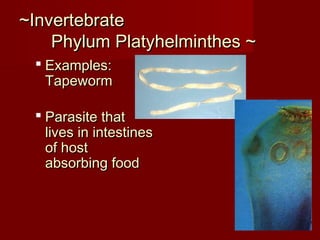
 Examples:Examples:
TapewormTapeworm
 Parasite thatParasite that
lives in intestineslives in intestines
of hostof host
absorbing foodabsorbing food
~Invertebrate~Invertebrate
Phylum Platyhelminthes ~Phylum Platyhelminthes ~
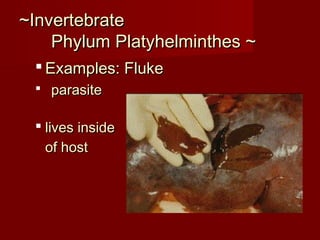
 Examples: FlukeExamples: Fluke
 parasiteparasite
 lives insidelives inside
of hostof host
~Invertebrate~Invertebrate
Phylum Nematoda ~Nematoda ~
 RoundwormsRoundworms
– Round, tubular bodyRound, tubular body
– small or microscopicsmall or microscopic
– bilateral symmetrybilateral symmetry
– have both a mouth and anushave both a mouth and anus
– Live in water or are parasitesLive in water or are parasites
~Invertebrate~Invertebrate
Phylum Nematoda ~Phylum Nematoda ~
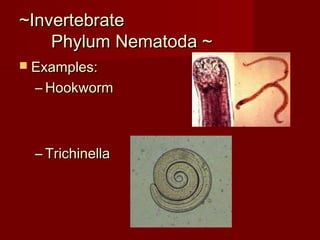
 Examples:Examples:
– HookwormHookworm
– TrichinellaTrichinella
~Invertebrate~Invertebrate
Phylum Mollusca ~Phylum Mollusca ~
 Soft bodiesSoft bodies
 Hard ShellsHard Shells
 Live on land or in waterLive on land or in water
 have a circulatory system and a complexhave a circulatory system and a complex
nervous system.nervous system.
 Important food source for humansImportant food source for humans
~Invertebrate~Invertebrate
Phylum Mollusca ~Phylum Mollusca ~
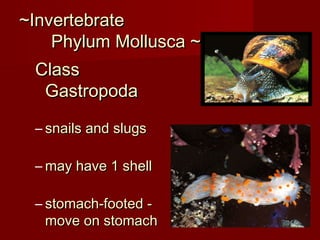
ClassClass
GastropodaGastropoda
– snails and slugssnails and slugs
– may have 1 shellmay have 1 shell
– stomach-footed -stomach-footed -
move on stomachmove on stomach
~Invertebrate~Invertebrate
Phylum Mollusca ~Phylum Mollusca ~
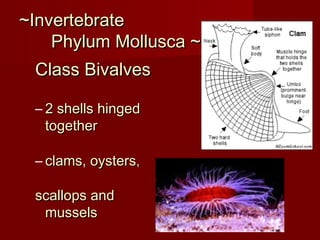
Class BivalvesClass Bivalves
– 2 shells hinged2 shells hinged
togethertogether
– clams, oystersclams, oysters,,
scallops andscallops and
musselsmussels
~Invertebrate~Invertebrate
Phylum Mollusca ~Mollusca ~
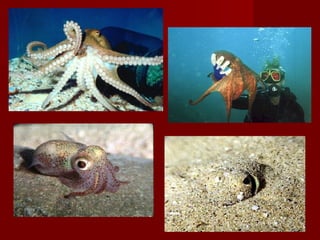
Class CephalopodsClass Cephalopods
– squids and octopusessquids and octopuses
– internal mantelinternal mantel
~Invertebrate~Invertebrate
Phylum Annelida ~Phylum Annelida ~
– Segemented wormsSegemented worms
– Body divided intoBody divided into
segments(sections)segments(sections)
– Live in water orLive in water or
undergroundunderground
– have a nervous and circulatory systemhave a nervous and circulatory system
~Invertebrate~Invertebrate
Phylum Annelida ~Phylum Annelida ~
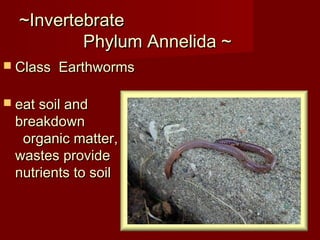
 Class EarthwormsClass Earthworms
 eat soil andeat soil and
breakdownbreakdown
organic matter,organic matter,
wastes providewastes provide
nutrients to soilnutrients to soil
~Invertebrate
Phylum Annelida ~
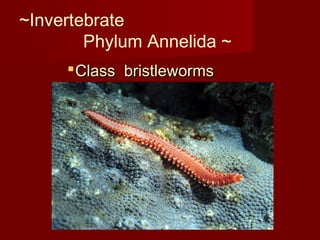
Class bristlewormsClass bristleworms
~Invertebrate
Phylum Annelida ~
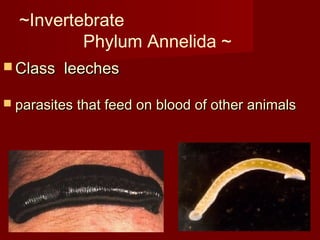
 Class leechesClass leeches
 parasites that feed on blood of other animalsparasites that feed on blood of other animals
~Invertebrate
Phylum Echinodermata ~
 Hard, spiny skinHard, spiny skin
 Live in salt waterLive in salt water
 Radial symmetryRadial symmetry
 name means ‘spiney skinned’name means ‘spiney skinned’
 endoskeletonendoskeleton
~Invertebrate
Phylum Echinodermata ~
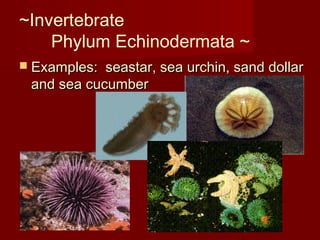
 Examples: seastar, sea urchin, sand dollarExamples: seastar, sea urchin, sand dollar
and sea cucumberand sea cucumber
~Invertebrate
Phylum Arthropoda ~
 Body divided into sections/segmentsBody divided into sections/segments
 ExoskeletonExoskeleton
 Jointed legsJointed legs
 well developed nervous systemwell developed nervous system
 largest group of organisms on earthlargest group of organisms on earth
~Invertebrate~Invertebrate
Phylum Arthropoda ~Phylum Arthropoda ~
 3 subphylums:3 subphylums:
 Classified into classes according to theClassified into classes according to the
number of legs, eyes and antennae theynumber of legs, eyes and antennae they
have.have.
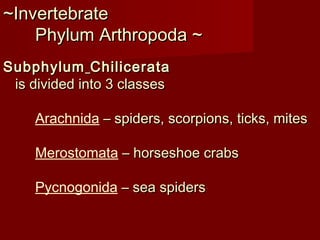
SubphylumSubphylum ChilicerataChilicerata
is divided into 3 classesis divided into 3 classes
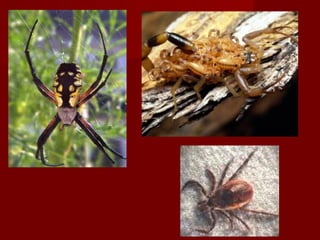
Arachnida – spiders, scorpions, ticks, mites– spiders, scorpions, ticks, mites
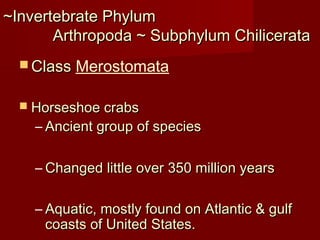
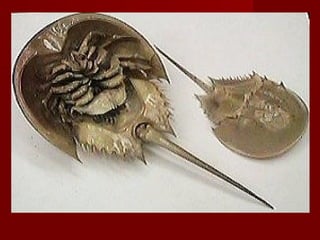
Merostomata – horseshoe crabs– horseshoe crabs
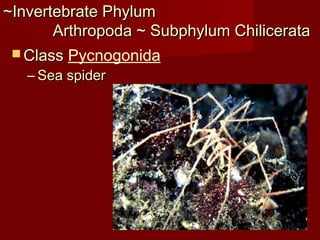
Pycnogonida – sea spiders– sea spiders
~Invertebrate~Invertebrate
Phylum Arthropoda ~Phylum Arthropoda ~
~Invertebrate Phylum~Invertebrate Phylum
Arthropoda ~ Subphylum ChilicerataArthropoda ~ Subphylum Chilicerata
 Class –Class – ArachnidaArachnida
 no antennaeno antennae
 4 pairs of legs4 pairs of legs
 2 body regions - cephalothorax & abdomen2 body regions - cephalothorax & abdomen
 spiders, scorpions, mites & ticksspiders, scorpions, mites & ticks
~Invertebrate Phylum~Invertebrate Phylum
Arthropoda ~ Subphylum ChilicerataArthropoda ~ Subphylum Chilicerata
 ClassClass Merostomata
 Horseshoe crabsHorseshoe crabs
– Ancient group of speciesAncient group of species
– Changed little over 350 million yearsChanged little over 350 million years
– Aquatic, mostly found on Atlantic & gulfAquatic, mostly found on Atlantic & gulf
coasts of United States.coasts of United States.
~Invertebrate Phylum~Invertebrate Phylum
Arthropoda ~ Subphylum ChilicerataArthropoda ~ Subphylum Chilicerata
 ClassClass Pycnogonida
– Sea spiderSea spider
~Invertebrate Phylum~Invertebrate Phylum
Arthropoda ~Arthropoda ~ Subphylum - CrustaceaSubphylum - Crustacea
5 Classes5 Classes
 Aquatic ones have gillsAquatic ones have gills
 2 antennae2 antennae
 2 body regions or segmented2 body regions or segmented
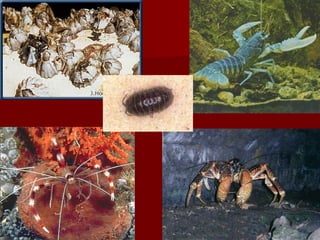
 Shrimp, lobsters, crabs, barnacles,Shrimp, lobsters, crabs, barnacles,
isopodsisopods
 SubphylumSubphylum UniramiaUniramia: 3 classes: 3 classes
 ClassClass InsectaInsecta (insects)(insects)
 ClassClass ChilopodaChilopoda (Centipedes)(Centipedes)
 ClassClass DiplopodaDiplopoda (Millipedes)(Millipedes)
~Invertebrate Phylum~Invertebrate Phylum
Arthropoda ~Arthropoda ~ Subphylum UniramiaSubphylum Uniramia
 ClassClass InsectaInsecta
 no antennaeno antennae
 3 pairs of legs3 pairs of legs
 2 body regions - head, thorax & abdomen2 body regions - head, thorax & abdomen
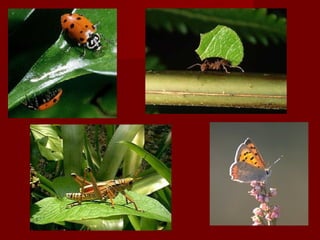
 grasshoppers, ants, butterflies, beesgrasshoppers, ants, butterflies, bees
~Invertebrate~Invertebrate
Phylum Arthropoda ~Phylum Arthropoda ~ Subphylum UniramiaSubphylum Uniramia
 ClassClass Diplopoda
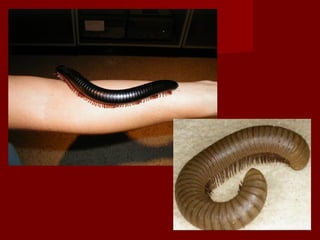
 MillipedesMillipedes
 segmented animalssegmented animals
 Have 2 pairs of legs per segmentHave 2 pairs of legs per segment
 Primarily herbivores & decomposersPrimarily herbivores & decomposers
~Invertebrate Phylum~Invertebrate Phylum
Arthropoda ~Arthropoda ~ Subphylum UniramiaSubphylum Uniramia
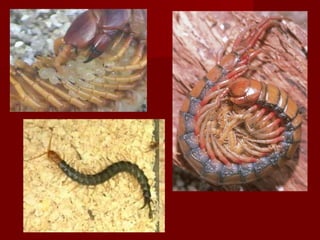
 ClassClass Chiopoda
 Centipedes Usually terrestrial carnivoresCentipedes Usually terrestrial carnivores
 Have 1 pair of antennaeHave 1 pair of antennae
 Are often poisonous, using modified frontAre often poisonous, using modified front
claws to immobilize preyclaws to immobilize prey
~ Phylum Chordata ~~ Phylum Chordata ~ subphylumsubphylum VertebrataVertebrata
5 classes5 classes
 FishFish
 MammalsMammals
 ReptilesReptiles
 AmphibiansAmphibians
 BirdsBirds

Animalia

  • 1.
  • 2.
    ~ Characteristics ~~Characteristics ~  MulticellularMulticellular  Eukaryotic withEukaryotic with no cell wallsno cell walls  Heterotrophs (consumers)Heterotrophs (consumers)
  • 3.
    ~ Characteristics ~~Characteristics ~  Have a nervous system to respond to theirHave a nervous system to respond to their environmentenvironment  Locomotion relates to ability to obtain foodLocomotion relates to ability to obtain food  Most animals develop from aMost animals develop from a zygotezygote becoming abecoming a  A single layer of cells surrounding a fluid-A single layer of cells surrounding a fluid- filled space forming a hollow ball of cellsfilled space forming a hollow ball of cells called acalled a gastrulagastrula.
  • 4.
    ~ Developmental Characteristics~~ Developmental Characteristics ~  The gastrula isThe gastrula is made up of three parts:made up of three parts: – EctodermEctoderm, a layer of cells on the outer surfacea layer of cells on the outer surface of theof the gastrulagastrula,, grows and divides developinggrows and divides developing into skin and nervous tissue.into skin and nervous tissue. – EndodermEndoderm, a layer of cells lining the innera layer of cells lining the inner surface of thesurface of the gastrulagastrula,, develops into thedevelops into the lining of the animal’s digestive tract.lining of the animal’s digestive tract. – MesodermMesoderm, made up of two layers of cells, made up of two layers of cells lying between thelying between the ectodermectoderm andand endodermendoderm,, forms muscles, reproductive organs andforms muscles, reproductive organs and circulatory vessels.circulatory vessels.
  • 6.
    ~ Developmental Characteristics~~ Developmental Characteristics ~  Animals that develop a mouth from theAnimals that develop a mouth from the indented space in the gastrula areindented space in the gastrula are protostomesprotostomes..  Animals that develop an anus from theAnimals that develop an anus from the opening in the gastrula areopening in the gastrula are deuterostomesdeuterostomes..
  • 8.
    ~~ Body Plans~Body Plans ~  Animals that areAnimals that are irregularirregular in shape arein shape are asymmetricalasymmetrical..  Animals that areAnimals that are regularregular in shape arein shape are symmetricalsymmetrical..
  • 9.
    ~ Body Plans~~ Body Plans ~  An animal hasAn animal has radial symmetryradial symmetry if itif it can be divided along any plane,can be divided along any plane, through a central axis, into equalthrough a central axis, into equal halves.halves.  An animal hasAn animal has bilateral symmetrybilateral symmetry if itif it can be divided down its length intocan be divided down its length into similar right and left halves formingsimilar right and left halves forming mirror images of each other.mirror images of each other.
  • 10.
    Which figure hasbilateral symmetry?Which figure has bilateral symmetry? Which has radial symmetry?Which has radial symmetry?
  • 11.
    ~ Body Plans~~ Body Plans ~  AcoelomatesAcoelomates – animals have three cell– animals have three cell layers with a digestive tract but no bodylayers with a digestive tract but no body cavities.cavities.  PseudocoelomatesPseudocoelomates – animals with a fluid-– animals with a fluid- filled body cavity partly lined withfilled body cavity partly lined with mesoderm.mesoderm.  CoelomatesCoelomates – animals with a body cavity– animals with a body cavity completely surrounded by mesoderm.completely surrounded by mesoderm.
  • 13.
    ~ Protection andSupport ~~ Protection and Support ~  Though not all animals have a skeleton,Though not all animals have a skeleton, those that do can be divided into twothose that do can be divided into two groups:groups: – Those with anThose with an exoskeletonexoskeleton – a hard,– a hard, waxy coating on the outside of the bodywaxy coating on the outside of the body that protects internal organs, provides athat protects internal organs, provides a framework for support, and a place forframework for support, and a place for muscle attachment.muscle attachment. – Those with anThose with an endoskeletonendoskeleton – support– support framework within the body that protectsframework within the body that protects some organs and a brace for muscles tosome organs and a brace for muscles to pull against.pull against.
  • 14.
    ~Invertebrates~~Invertebrates~  8 mainphyla8 main phyla  No backbonesNo backbones  95% of all animals are in this group95% of all animals are in this group
  • 15.
    ~Invertebrate~Invertebrate Phylum Porifera~Phylum Porifera~ SpongesSponges  simplest form of animal lifesimplest form of animal life  live in waterlive in water  Do not move aroundDo not move around  no symmetryno symmetry  Pores (holes) all over bodyPores (holes) all over body 
  • 16.
    ~Invertebrate~Invertebrate Phylum Porifera~Phylum Porifera~ Filter Feeders: a sponge filters particles ofFilter Feeders: a sponge filters particles of food from water using collar cells and thenfood from water using collar cells and then pumps the water out the osculum.pumps the water out the osculum.
  • 17.
    ~Invertebrate~Invertebrate Phylum Porifera~Phylum Porifera~ Examples: TubeExamples: Tube Sponge, GlassSponge, Glass Sponge, Sea SpongeSponge, Sea Sponge
  • 18.
    ~Invertebrate~Invertebrate Phylum Cnidaria~Phylum Cnidaria~ Live in waterLive in water  Most have tentaclesMost have tentacles  catch food with stinging cellscatch food with stinging cells  gut for digestinggut for digesting
  • 19.
    ~Invertebrate~Invertebrate Phylum Cnidaria~Phylum Cnidaria~ 2 different2 different shapesshapes  Medusa - like aMedusa - like a jellyfishjellyfish  Polyp - like aPolyp - like a hydrahydra
  • 20.
    ~Invertebrate~Invertebrate Phylum Cnidaria~Phylum Cnidaria~ Examples -Examples - Jellyfish, Hydra,Jellyfish, Hydra, sea anemones,sea anemones, and coralsand corals
  • 21.
    ~Invertebrate~Invertebrate Phylum Platyhelminthes ~PhylumPlatyhelminthes ~  FlatwormsFlatworms  Flat, ribbon-like bodyFlat, ribbon-like body  Live in water or are parasitesLive in water or are parasites  bilateral symmetrybilateral symmetry
  • 22.
    ~Invertebrate~Invertebrate Phylum Platyhelminthes ~PhylumPlatyhelminthes ~  Examples:Examples: PlanariaPlanaria  eyespots detect lighteyespots detect light  food and waste gofood and waste go in and out the samein and out the same openingopening
  • 23.
    ~Invertebrate~Invertebrate Phylum Platyhelminthes ~PhylumPlatyhelminthes ~  Examples:Examples: TapewormTapeworm  Parasite thatParasite that lives in intestineslives in intestines of hostof host absorbing foodabsorbing food
  • 24.
    ~Invertebrate~Invertebrate Phylum Platyhelminthes ~PhylumPlatyhelminthes ~  Examples: FlukeExamples: Fluke  parasiteparasite  lives insidelives inside of hostof host
  • 25.
    ~Invertebrate~Invertebrate Phylum Nematoda ~Nematoda~  RoundwormsRoundworms – Round, tubular bodyRound, tubular body – small or microscopicsmall or microscopic – bilateral symmetrybilateral symmetry – have both a mouth and anushave both a mouth and anus – Live in water or are parasitesLive in water or are parasites
  • 26.
    ~Invertebrate~Invertebrate Phylum Nematoda ~PhylumNematoda ~  Examples:Examples: – HookwormHookworm – TrichinellaTrichinella
  • 27.
    ~Invertebrate~Invertebrate Phylum Mollusca ~PhylumMollusca ~  Soft bodiesSoft bodies  Hard ShellsHard Shells  Live on land or in waterLive on land or in water  have a circulatory system and a complexhave a circulatory system and a complex nervous system.nervous system.  Important food source for humansImportant food source for humans
  • 28.
    ~Invertebrate~Invertebrate Phylum Mollusca ~PhylumMollusca ~ ClassClass GastropodaGastropoda – snails and slugssnails and slugs – may have 1 shellmay have 1 shell – stomach-footed -stomach-footed - move on stomachmove on stomach
  • 29.
    ~Invertebrate~Invertebrate Phylum Mollusca ~PhylumMollusca ~ Class BivalvesClass Bivalves – 2 shells hinged2 shells hinged togethertogether – clams, oystersclams, oysters,, scallops andscallops and musselsmussels
  • 30.
    ~Invertebrate~Invertebrate Phylum Mollusca ~Mollusca~ Class CephalopodsClass Cephalopods – squids and octopusessquids and octopuses – internal mantelinternal mantel
  • 32.
    ~Invertebrate~Invertebrate Phylum Annelida ~PhylumAnnelida ~ – Segemented wormsSegemented worms – Body divided intoBody divided into segments(sections)segments(sections) – Live in water orLive in water or undergroundunderground – have a nervous and circulatory systemhave a nervous and circulatory system
  • 33.
    ~Invertebrate~Invertebrate Phylum Annelida ~PhylumAnnelida ~  Class EarthwormsClass Earthworms  eat soil andeat soil and breakdownbreakdown organic matter,organic matter, wastes providewastes provide nutrients to soilnutrients to soil
  • 34.
    ~Invertebrate Phylum Annelida ~ ClassbristlewormsClass bristleworms
  • 35.
    ~Invertebrate Phylum Annelida ~ Class leechesClass leeches  parasites that feed on blood of other animalsparasites that feed on blood of other animals
  • 36.
    ~Invertebrate Phylum Echinodermata ~ Hard, spiny skinHard, spiny skin  Live in salt waterLive in salt water  Radial symmetryRadial symmetry  name means ‘spiney skinned’name means ‘spiney skinned’  endoskeletonendoskeleton
  • 37.
    ~Invertebrate Phylum Echinodermata ~ Examples: seastar, sea urchin, sand dollarExamples: seastar, sea urchin, sand dollar and sea cucumberand sea cucumber
  • 38.
    ~Invertebrate Phylum Arthropoda ~ Body divided into sections/segmentsBody divided into sections/segments  ExoskeletonExoskeleton  Jointed legsJointed legs  well developed nervous systemwell developed nervous system  largest group of organisms on earthlargest group of organisms on earth
  • 39.
    ~Invertebrate~Invertebrate Phylum Arthropoda ~PhylumArthropoda ~  3 subphylums:3 subphylums:  Classified into classes according to theClassified into classes according to the number of legs, eyes and antennae theynumber of legs, eyes and antennae they have.have.
  • 40.
    SubphylumSubphylum ChilicerataChilicerata is dividedinto 3 classesis divided into 3 classes Arachnida – spiders, scorpions, ticks, mites– spiders, scorpions, ticks, mites Merostomata – horseshoe crabs– horseshoe crabs Pycnogonida – sea spiders– sea spiders ~Invertebrate~Invertebrate Phylum Arthropoda ~Phylum Arthropoda ~
  • 41.
    ~Invertebrate Phylum~Invertebrate Phylum Arthropoda~ Subphylum ChilicerataArthropoda ~ Subphylum Chilicerata  Class –Class – ArachnidaArachnida  no antennaeno antennae  4 pairs of legs4 pairs of legs  2 body regions - cephalothorax & abdomen2 body regions - cephalothorax & abdomen  spiders, scorpions, mites & ticksspiders, scorpions, mites & ticks
  • 43.
    ~Invertebrate Phylum~Invertebrate Phylum Arthropoda~ Subphylum ChilicerataArthropoda ~ Subphylum Chilicerata  ClassClass Merostomata  Horseshoe crabsHorseshoe crabs – Ancient group of speciesAncient group of species – Changed little over 350 million yearsChanged little over 350 million years – Aquatic, mostly found on Atlantic & gulfAquatic, mostly found on Atlantic & gulf coasts of United States.coasts of United States.
  • 45.
    ~Invertebrate Phylum~Invertebrate Phylum Arthropoda~ Subphylum ChilicerataArthropoda ~ Subphylum Chilicerata  ClassClass Pycnogonida – Sea spiderSea spider
  • 46.
    ~Invertebrate Phylum~Invertebrate Phylum Arthropoda~Arthropoda ~ Subphylum - CrustaceaSubphylum - Crustacea 5 Classes5 Classes  Aquatic ones have gillsAquatic ones have gills  2 antennae2 antennae  2 body regions or segmented2 body regions or segmented  Shrimp, lobsters, crabs, barnacles,Shrimp, lobsters, crabs, barnacles, isopodsisopods
  • 48.
     SubphylumSubphylum UniramiaUniramia:3 classes: 3 classes  ClassClass InsectaInsecta (insects)(insects)  ClassClass ChilopodaChilopoda (Centipedes)(Centipedes)  ClassClass DiplopodaDiplopoda (Millipedes)(Millipedes)
  • 49.
    ~Invertebrate Phylum~Invertebrate Phylum Arthropoda~Arthropoda ~ Subphylum UniramiaSubphylum Uniramia  ClassClass InsectaInsecta  no antennaeno antennae  3 pairs of legs3 pairs of legs  2 body regions - head, thorax & abdomen2 body regions - head, thorax & abdomen  grasshoppers, ants, butterflies, beesgrasshoppers, ants, butterflies, bees
  • 51.
    ~Invertebrate~Invertebrate Phylum Arthropoda ~PhylumArthropoda ~ Subphylum UniramiaSubphylum Uniramia  ClassClass Diplopoda  MillipedesMillipedes  segmented animalssegmented animals  Have 2 pairs of legs per segmentHave 2 pairs of legs per segment  Primarily herbivores & decomposersPrimarily herbivores & decomposers
  • 53.
    ~Invertebrate Phylum~Invertebrate Phylum Arthropoda~Arthropoda ~ Subphylum UniramiaSubphylum Uniramia  ClassClass Chiopoda  Centipedes Usually terrestrial carnivoresCentipedes Usually terrestrial carnivores  Have 1 pair of antennaeHave 1 pair of antennae  Are often poisonous, using modified frontAre often poisonous, using modified front claws to immobilize preyclaws to immobilize prey
  • 55.
    ~ Phylum Chordata~~ Phylum Chordata ~ subphylumsubphylum VertebrataVertebrata 5 classes5 classes  FishFish  MammalsMammals  ReptilesReptiles  AmphibiansAmphibians  BirdsBirds