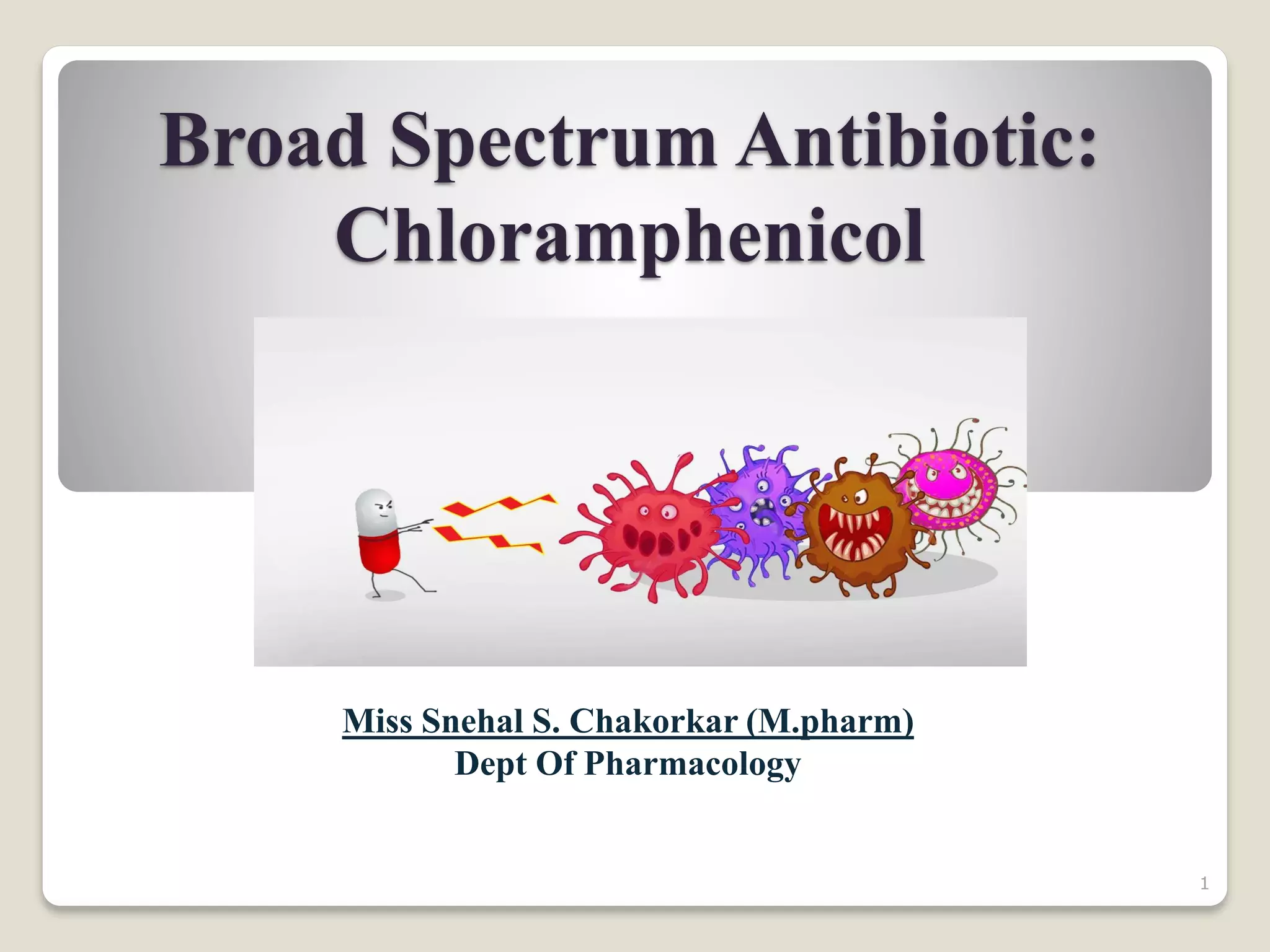
Broad Spectrum Antibiotic:
Chloramphenicol
Miss Snehal S. Chakorkar (M.pharm)
Dept Of Pharmacology
1
2
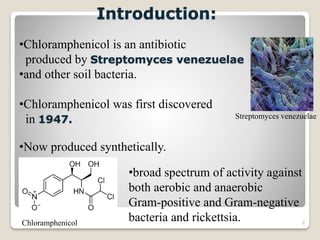
•Chloramphenicol is an antibiotic
produced by Streptomyces venezuelae
•and other soil bacteria.
•Chloramphenicol was first discovered
in 1947.
•Now produced synthetically.
Streptomyces venezuelae
Introduction:
Chloramphenicol
•broad spectrum of activity against
both aerobic and anaerobic
Gram-positive and Gram-negative
bacteria and rickettsia.
3
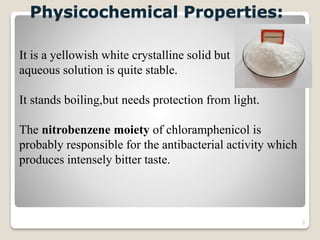
Physicochemical Properties:
It is a yellowish white crystalline solid but
aqueous solution is quite stable.
It stands boiling,but needs protection from light.
The nitrobenzene moiety of chloramphenicol is
probably responsible for the antibacterial activity which
produces intensely bitter taste.
4
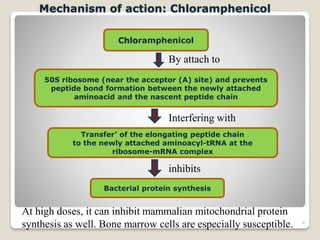
Mechanism of action: Chloramphenicol
Transfer’ of the elongating peptide chain
to the newly attached aminoacyl-tRNA at the
ribosome-mRNA complex
50S ribosome (near the acceptor (A) site) and prevents
peptide bond formation between the newly attached
aminoacid and the nascent peptide chain
Bacterial protein synthesis
Chloramphenicol
By attach to
Interfering with
inhibits
At high doses, it can inhibit mammalian mitochondrial protein
synthesis as well. Bone marrow cells are especially susceptible.
5
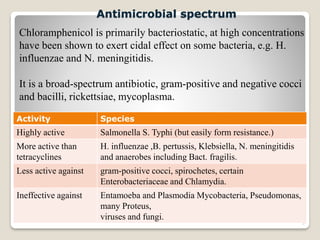
Antimicrobial spectrum
Chloramphenicol is primarily bacteriostatic, at high concentrations
have been shown to exert cidal effect on some bacteria, e.g. H.
influenzae and N. meningitidis.
It is a broad-spectrum antibiotic, gram-positive and negative cocci
and bacilli, rickettsiae, mycoplasma.
Activity Species
Highly active Salmonella S. Typhi (but easily form resistance.)
More active than
tetracyclines
H. influenzae ,B. pertussis, Klebsiella, N. meningitidis
and anaerobes including Bact. fragilis.
Less active against gram-positive cocci, spirochetes, certain
Enterobacteriaceae and Chlamydia.
Ineffective against Entamoeba and Plasmodia Mycobacteria, Pseudomonas,
many Proteus,
viruses and fungi.
6
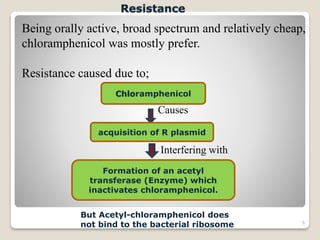
Resistance
Being orally active, broad spectrum and relatively cheap,
chloramphenicol was mostly prefer.
Resistance caused due to;
Chloramphenicol
Causes
Formation of an acetyl
transferase (Enzyme) which
inactivates chloramphenicol.
acquisition of R plasmid
Interfering with
But Acetyl-chloramphenicol does
not bind to the bacterial ribosome
7
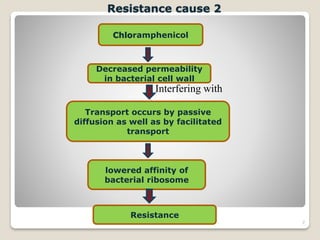
Chloramphenicol
Transport occurs by passive
diffusion as well as by facilitated
transport
Decreased permeability
in bacterial cell wall
Interfering with
lowered affinity of
bacterial ribosome
Resistance
Resistance cause 2
8
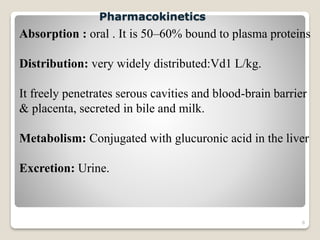
Absorption : oral . It is 50–60% bound to plasma proteins
Distribution: very widely distributed:Vd1 L/kg.
It freely penetrates serous cavities and blood-brain barrier
& placenta, secreted in bile and milk.
Metabolism: Conjugated with glucuronic acid in the liver
Excretion: Urine.
Pharmacokinetics
9
1. Bone marrow depression: chloramphenicol causes
of aplastic anaemia, agranulocytosis, thrombocytopenia
or pancytopenia.
(a) Non-dose related idiosyncratic reaction.
(b) Dose and duration of therapy related
myelosuppression:
Adverse effects
10
(a) Non-dose related idiosyncratic reaction:
Rare (1 in 40,000), unpredictable, but serious, often
fatal, & has a genetic basis occurs after repeated
courses.
Aplastic anaemia is the most common with higher
mortality.
Many victims after some times develop leukaemia's.
(b) Dose and duration of therapy related
myelosuppression: a direct toxic effect, predictable and
probably due to inhibition of mitochondrial enzyme
synthesis in the erythropoietic cells.
Reversible without long-term sequelae. Liver and kidney
disease predisposes to such toxicity.
11
2. Hypersensitivity reactions Rashes, fever, atrophic
glossitis, angioedema are infrequent.
3. Irritative effects Nausea, vomiting, diarrhoea,
pain on injection.
4. Superinfections .
5. Gray baby syndrome It occurred when high doses
(~100 mg/kg) were given prophylactically to neonates,
especially premature..
12
Chloramphenicol inhibits metabolism of tolbutamide,
chlorpropamide, warfarin, cyclophosphamide and
phenytoin.
If dose adjustments are not done toxicity can occur .
Phenobarbitone, phenytoin, rifampin enhance
chloramphenicol metabolism → reduce its concentration
→ failure of therapy may occur.
Being bacteriostatic, chloramphenicol can antagonize
the cidal action of β-lactams/aminoglycosides.
Interactions
13
Clinical use of chloramphenicol for systemic infections
is highly restricted due to fear of fatal toxicity due to
risk of bone marrow aplasia.
Never use chloramphenicol in;
(a) Minor infections.
(b) Infections treatable by other safer antimicrobials.
(c) Avoid repeated courses.
(d) Daily dose not to exceed 2–3 g; duration of therapy
to be < 2 weeks, total dose in a course < 28 g.
(e) Regular blood counts (especially reticulocyte
count) may detect dose-related bone marrow toxicity
but not the idiosyncratic type.
(f) Combined formulation of chloramphenicol
with any drug meant for internal use.
Restrict Uses of chloramphenicol
14
Indications of chloramphenicol are:
1. Pyogenic meningitis.
2. Anaerobic infections.
3. Intraocular infections.
4. Enteric fever
5. Drug of choice in some conditions.
6. Urinary tract infections
7. Topically In conjunctivitis & external ear Infections.
Uses
15
1. Pyogenic meningitis:
Third generation cephalosporins (± vancomycin) are
presently the first line drugs for bacterial meningitis
Chloramphenicol in a dose of 50–75 mg/kg/day may be
used as a second line drug for H. influenzae and
meningococcal meningitis, in young children and
cephalosporin allergic patients, because it has
excellent penetration into CSF.
2. Anaerobic infections : Bact. fragilis and others
(wound infections, intraabdominal infections, pelvic
abscess, and brain abscess, etc.) respond well to
chloramphenicol.
16
3. Intraocular infections: Chloramphenicol
given systemically to attains high concentration in
ocular fluid in condition of endophthalmitis caused by
sensitive bacteria.
4. Enteric fever: Chloramphenicol was the first
antibiotic and the drug of choice for typhoid fever till the
1980s
when resistant S. typhi emerged then it became clinically
unreliable; 50– 80% isolates showed in vitro resistance.
Being orally active and inexpensive, it may be used only
if the local strain is known to be sensitive and responsive
clinically. The dose is 0.5 g 6 hourly (children 50
mg/kg/day) till fever subsides, then 0.25 g 6 hourly for
another 5–7 days.
17
5. As second choice drug
Brucellosis and rickettsial infections, in whom
tetracyclines are contraindicated.
In whooping cough.
6. Urinary tract infections: It should be used only
when the organism is found to be sensitive only to
choramphenicol.
7. Topically In conjunctivitis & external ear
Infections: chloramphenicol 0.5–5.0% is highly
effective.
18
Reference:
 Rang H.P. and Dale M.M.: Pharmacology, Churchill
Livingstone, Edinbergh.
 Katzung B.G.: Basic and Clinical Pharmacology,
Lange Medical Publications, California.
 Craig C.R. and Stitzel R.E.: Modern Pharmacology,
Little Brown and Co., Boston.
 Bowman W.C. and Rand M.J.: Textbook of
Pharmacology, Blackwell Scientific Publications,
Oxford.
 P.N Bennett & M J Brown: Clinical Pharmacology,
Churchill Livingstone, Edinburgh.
 Tripathi K.D.: Essentials of Medical Pharmacology,
Jaypee Brothers, Medical Publishers, New Delhi.
Any query don’t hesitate to contact & If like then comment in box 19

Broad spectrum antibiotics chloramphenicol

  • 1.
    Broad Spectrum Antibiotic: Chloramphenicol MissSnehal S. Chakorkar (M.pharm) Dept Of Pharmacology 1
  • 2.
    2 •Chloramphenicol is anantibiotic produced by Streptomyces venezuelae •and other soil bacteria. •Chloramphenicol was first discovered in 1947. •Now produced synthetically. Streptomyces venezuelae Introduction: Chloramphenicol •broad spectrum of activity against both aerobic and anaerobic Gram-positive and Gram-negative bacteria and rickettsia.
  • 3.
    3 Physicochemical Properties: It isa yellowish white crystalline solid but aqueous solution is quite stable. It stands boiling,but needs protection from light. The nitrobenzene moiety of chloramphenicol is probably responsible for the antibacterial activity which produces intensely bitter taste.
  • 4.
    4 Mechanism of action:Chloramphenicol Transfer’ of the elongating peptide chain to the newly attached aminoacyl-tRNA at the ribosome-mRNA complex 50S ribosome (near the acceptor (A) site) and prevents peptide bond formation between the newly attached aminoacid and the nascent peptide chain Bacterial protein synthesis Chloramphenicol By attach to Interfering with inhibits At high doses, it can inhibit mammalian mitochondrial protein synthesis as well. Bone marrow cells are especially susceptible.
  • 5.
    5 Antimicrobial spectrum Chloramphenicol isprimarily bacteriostatic, at high concentrations have been shown to exert cidal effect on some bacteria, e.g. H. influenzae and N. meningitidis. It is a broad-spectrum antibiotic, gram-positive and negative cocci and bacilli, rickettsiae, mycoplasma. Activity Species Highly active Salmonella S. Typhi (but easily form resistance.) More active than tetracyclines H. influenzae ,B. pertussis, Klebsiella, N. meningitidis and anaerobes including Bact. fragilis. Less active against gram-positive cocci, spirochetes, certain Enterobacteriaceae and Chlamydia. Ineffective against Entamoeba and Plasmodia Mycobacteria, Pseudomonas, many Proteus, viruses and fungi.
  • 6.
    6 Resistance Being orally active,broad spectrum and relatively cheap, chloramphenicol was mostly prefer. Resistance caused due to; Chloramphenicol Causes Formation of an acetyl transferase (Enzyme) which inactivates chloramphenicol. acquisition of R plasmid Interfering with But Acetyl-chloramphenicol does not bind to the bacterial ribosome
  • 7.
    7 Chloramphenicol Transport occurs bypassive diffusion as well as by facilitated transport Decreased permeability in bacterial cell wall Interfering with lowered affinity of bacterial ribosome Resistance Resistance cause 2
  • 8.
    8 Absorption : oral. It is 50–60% bound to plasma proteins Distribution: very widely distributed:Vd1 L/kg. It freely penetrates serous cavities and blood-brain barrier & placenta, secreted in bile and milk. Metabolism: Conjugated with glucuronic acid in the liver Excretion: Urine. Pharmacokinetics
  • 9.
    9 1. Bone marrowdepression: chloramphenicol causes of aplastic anaemia, agranulocytosis, thrombocytopenia or pancytopenia. (a) Non-dose related idiosyncratic reaction. (b) Dose and duration of therapy related myelosuppression: Adverse effects
  • 10.
    10 (a) Non-dose relatedidiosyncratic reaction: Rare (1 in 40,000), unpredictable, but serious, often fatal, & has a genetic basis occurs after repeated courses. Aplastic anaemia is the most common with higher mortality. Many victims after some times develop leukaemia's. (b) Dose and duration of therapy related myelosuppression: a direct toxic effect, predictable and probably due to inhibition of mitochondrial enzyme synthesis in the erythropoietic cells. Reversible without long-term sequelae. Liver and kidney disease predisposes to such toxicity.
  • 11.
    11 2. Hypersensitivity reactionsRashes, fever, atrophic glossitis, angioedema are infrequent. 3. Irritative effects Nausea, vomiting, diarrhoea, pain on injection. 4. Superinfections . 5. Gray baby syndrome It occurred when high doses (~100 mg/kg) were given prophylactically to neonates, especially premature..
  • 12.
    12 Chloramphenicol inhibits metabolismof tolbutamide, chlorpropamide, warfarin, cyclophosphamide and phenytoin. If dose adjustments are not done toxicity can occur . Phenobarbitone, phenytoin, rifampin enhance chloramphenicol metabolism → reduce its concentration → failure of therapy may occur. Being bacteriostatic, chloramphenicol can antagonize the cidal action of β-lactams/aminoglycosides. Interactions
  • 13.
    13 Clinical use ofchloramphenicol for systemic infections is highly restricted due to fear of fatal toxicity due to risk of bone marrow aplasia. Never use chloramphenicol in; (a) Minor infections. (b) Infections treatable by other safer antimicrobials. (c) Avoid repeated courses. (d) Daily dose not to exceed 2–3 g; duration of therapy to be < 2 weeks, total dose in a course < 28 g. (e) Regular blood counts (especially reticulocyte count) may detect dose-related bone marrow toxicity but not the idiosyncratic type. (f) Combined formulation of chloramphenicol with any drug meant for internal use. Restrict Uses of chloramphenicol
  • 14.
    14 Indications of chloramphenicolare: 1. Pyogenic meningitis. 2. Anaerobic infections. 3. Intraocular infections. 4. Enteric fever 5. Drug of choice in some conditions. 6. Urinary tract infections 7. Topically In conjunctivitis & external ear Infections. Uses
  • 15.
    15 1. Pyogenic meningitis: Thirdgeneration cephalosporins (± vancomycin) are presently the first line drugs for bacterial meningitis Chloramphenicol in a dose of 50–75 mg/kg/day may be used as a second line drug for H. influenzae and meningococcal meningitis, in young children and cephalosporin allergic patients, because it has excellent penetration into CSF. 2. Anaerobic infections : Bact. fragilis and others (wound infections, intraabdominal infections, pelvic abscess, and brain abscess, etc.) respond well to chloramphenicol.
  • 16.
    16 3. Intraocular infections:Chloramphenicol given systemically to attains high concentration in ocular fluid in condition of endophthalmitis caused by sensitive bacteria. 4. Enteric fever: Chloramphenicol was the first antibiotic and the drug of choice for typhoid fever till the 1980s when resistant S. typhi emerged then it became clinically unreliable; 50– 80% isolates showed in vitro resistance. Being orally active and inexpensive, it may be used only if the local strain is known to be sensitive and responsive clinically. The dose is 0.5 g 6 hourly (children 50 mg/kg/day) till fever subsides, then 0.25 g 6 hourly for another 5–7 days.
  • 17.
    17 5. As secondchoice drug Brucellosis and rickettsial infections, in whom tetracyclines are contraindicated. In whooping cough. 6. Urinary tract infections: It should be used only when the organism is found to be sensitive only to choramphenicol. 7. Topically In conjunctivitis & external ear Infections: chloramphenicol 0.5–5.0% is highly effective.
  • 18.
    18 Reference:  Rang H.P.and Dale M.M.: Pharmacology, Churchill Livingstone, Edinbergh.  Katzung B.G.: Basic and Clinical Pharmacology, Lange Medical Publications, California.  Craig C.R. and Stitzel R.E.: Modern Pharmacology, Little Brown and Co., Boston.  Bowman W.C. and Rand M.J.: Textbook of Pharmacology, Blackwell Scientific Publications, Oxford.  P.N Bennett & M J Brown: Clinical Pharmacology, Churchill Livingstone, Edinburgh.  Tripathi K.D.: Essentials of Medical Pharmacology, Jaypee Brothers, Medical Publishers, New Delhi.
  • 19.
    Any query don’thesitate to contact & If like then comment in box 19