
DRY CHEMISTRY
By: Sivaranjini N
HISTORY
 The first dry chemistry system to attain significant
clinical use appeared in 1941.
 This reagent composition, called Clinitest, tested urine
for sugar
 Diabetics had previously tested themselves by boiling a
few drops of urine with a teaspoonful of Benedict's
solution.
 Compton and Treneer created a tablet that contained
citric acid, sodium hydroxide, sodium bicarbonate, and
copper sulfate.
 The key was to use extensively dried ingredients, to
perform all the manufacturing steps in controlled rooms
with very low humidity, and to protect the tablets from
exposure to the ordinary humidity in the air.
PRINCIPLE
 The main principle of dry chemistry is based upon
the reflectance spectrophotometry.
 Reflectance spectrophotometry measures the
reflectance of materials.
 They provide a reference standard for the
comparison of the color of different samples.
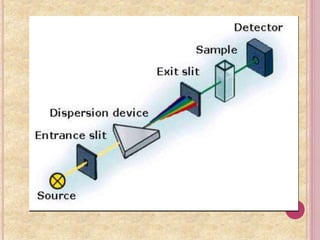
 Spectrophotometer is a device that measure the light intensities as a
function of wave length.
 It does it by diffracting the light beam into a spectrum of wavelength,
detecting the light intensities with charged couple device.
COMPONENTS OF SPECTROPHOTOMETER
 Light source
 Device to isolate light of a desired wavelength
 Cuvet
 Photodetector
 Readout device
 Data system.
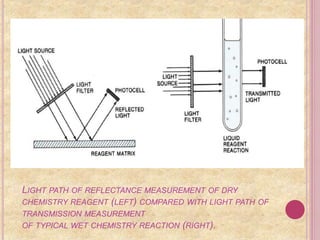
LIGHT PATH OF REFLECTANCE MEASUREMENT OF DRY
CHEMISTRY REAGENT (LEFT) COMPARED WITH LIGHT PATH OF
TRANSMISSION MEASUREMENT
OF TYPICAL WET CHEMISTRY REACTION (RIGHT).
DIFFERENCE BETWEEN ABSORBANCE AND
REFLECTANCE METHODS
The electro-optical components used in reflectance
photometry are essentially the same as those
required for absorbance photometry,
except that the geometry of the system is modified so
that the light source and the detector are located
next to each other on one side of the sample, as
opposed to on opposite sides of the sample cuvet, as
in absorption photometry.
LIGHT SOURCES
 Incandescent, Arc, and Cathode Lamps: The light
source for measurements in the visible portion of the
spectrum is usually a tungsten light bulb.
 In the UV region of the spectrum, hydrogen and
deuterium lamps, as well as high-pressure mercury
and xenon arc lamps, are sources of continuous
spectra.
 Low pressure mercury vapor lamps also provide
spectra in the UV region and are useful for calibration
purposes, but because of their limited wavelengths, they
are not practical for absorbance measurements.
 Laser Sources: Light Amplification by Stimulated
Emission of Radiation
 Lasers are used as light sources in
spectrophotometers because they provide intense
light of a narrow wavelength.
 Through selection of different materials, different
wavelength(s) of light are emitted by different types
of lasers.
THREE PROPERTIES OF LASER SOURCES
DISTINGUISH THEM FROM CONVENTIONAL
SOURCES
 Spatial coherence is a property of lasers that
allows beam diameters in the range of several
micrometers
 Lasers produce monochromatic light; and
 Lasers have pulse widths that vary from
microseconds to nanoseconds to picoseconds or
less in duration.
SPECTRAL ISOLATION
 Radiant energy of a desired wavelength has to be
isolated and that of other wavelengths excluded in
various ways
 Combinations of lenses and slits may be inserted
before or after the monochromatic device to render
light rays parallel or to isolate narrow portions of the
light beam.
SPECTRAL BANDWIDTH
The spectral purity of a filter or other monochromator is
usually described in terms of its spectral bandwidth.
This is defined as the width, in nanometers, of the spectral
transmittance curve at a point equal to one half the peak
transmittance.
FILTERS
 Certain metal complexes or salts, dissolved or suspended in
glass, produce colors corresponding to the predominant
wavelengths transmitted.
 Types of filters used: wide bandpass filters, Cutoff filters
and narrow bandpass interference or dichroic filter
PRISMS AND DIFFRACTION GRATINGS : USED AS MONOCHROMATORS.
 A diffraction grating is prepared by depositing a thin
layer of aluminum-copper alloy on the surface of a flat
glass plate, and then fabricating many small parallel
grooves into the metal coating..
PHOTODETECTORS
 A photodetector is a device that converts light into
an electric signal that is proportional to the number of
photons striking its photosensitive surface.
 The photomultiplier tube is a commonly used
photodetector for measuring light intensity in the UV
and visible regions of the spectrum.
PHOTOMULTIPLIER TUBES
 Extremely rapid response
times,
 Very sensitive over a wide
range of wavelengths
 Slow to fatigue.
Because these tubes are very
sensitive and have a rapid
response, they must be
carefully shielded from all
stray light.
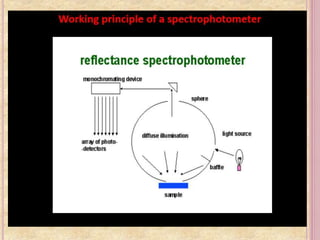
IN REFLECTANCE PHOTOMETRY, DIFFUSE
REFLECTED LIGHT IS MEASURED.
 The reaction mixture in a carrier is illuminated with
diffused light, and the intensity of the reflected light
from the chromogen is compared with the intensity
of light reflected from a reference surface.
THE COMMONLY USED PERCENT REFLECTION (%R) CAN BE EXPRESSED AS:
%R =IS/IR X R.
WHERE IS, IR., AND R, REPRESENT THE REFLECTED LIGHT FROM THE REAGENT
CARRIER, THE REFLECTED LIGHT FROM THE REFERENCE,
AND THE PERCENT REFLECTIVITY OF THE REFERENCE, RESPECTIVELY.
REFLECTANCE SPECTROPHOTOMETER
 Should have a bandwidth narrow enough to provide
well resolved visible spectra yet wide enough to
provide a good energy level for diffuse reflectance
measurements.
 Optics and electronics systems of high sensitivity,
and should be able to physically accommodate
reflectance and transmission accessories.
 Make measurements both at selected fixed
wavelengths or perform scans over the complete
wavelength range.
PRINCIPLE
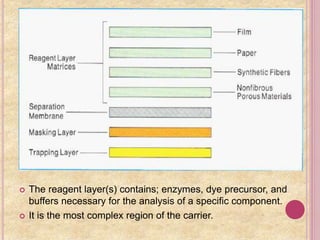
 Reagent slides are
composed of several
layers
 1-spreading layer
 2-scavenger layer
 3-reagent layer(s)
 4-plastic or support layer
The presence of
spreading layer reduces
the interference to the
reaction seen in
hemolysed and lipemic
samples
 The reagent layer(s) contains; enzymes, dye precursor, and
buffers necessary for the analysis of a specific component.
 It is the most complex region of the carrier.
 The support material usually consists of a thin, rigid
plastic or a plastic like material that may be
transparent or reflective.
 The reflective zone is usually constructed with
pigments such as TiO2 or BaS04 or reflective
materials such as metal foils.
I
• Sample, control, or standard is deposited on the spreading layer.
II
• Selected components are allowed to penetrate to the reaction layer(s),
which in turn activate the dehydrated reagents.
III
• A chemical reaction is initiated to produce a colour.
IV
• Light is passed from beneath the support or plastic layer and is
directed through the reagent layer (s).
V
• As the light hits the white spreading layer, some of the light reflects
back through the reagent layer(s) to a photocell.
VI
• The amount of reflected light, which is in proportion to colour intensity,
is used to determine the concentration of the analyte.
DRY CHEMISTRY IN URINE ANALYSIS: REAGENT
STRIP (“DIPSTICK”) TESTING
 Urine samples for
reagent strip testing
should be collected in
sterile containers, and
testing should be
performed on the fresh
urine.
 In addition to manual
reading of reagent strips,
automated readers have
come into routine use
PRECAUTIONS
 Collect fresh urine specimen in a clean dry
container with labeling
 Mix well immediately before testing.
 Completely immerse reagent areas of strip in fresh
urine and remove immediately to avoid dissolving
out of the reagent
 Hold the strip in a horizontal to prevent possible
mixing of chemicals from adjacent reagent or
contaminating the hands with urine.
DETECTION OF HEMOGLOBIN IN URINE
 For this test, the reagent pad is impregnated with
buffered tetramethyl benzidine (TMB) and an
organic peroxide.
 The color change ranges from orange to pale to
dark green, and red cells or free hemoglobin are
detected together with myoglobin.
 The test is equally sensitive to hemoglobin and
myoglobin, and thus a negative result excludes
myoglobinuria.
 Water must not be used as a negative control with
this test: A false-positive result will be obtained.
MEASUREMENT OF GLUCOSE
 The reagent pad is impregnated with glucose
oxidase, peroxidase, potassium iodide, and a blue
dye.
 The reaction employs glucose oxidase and
peroxidase to produce hydrogen peroxide, which is
subsequently reduced with concurrent oxidation of
potassium iodide to release iodine.
 The free iodine blends with the background color to
produce a range of colors from green to dark
brown.
MEASUREMENT OF PH
 Methyl red in a diluted form is red at pH values below
4.2 and yellow at values above 6.2.
 Bromthymol blue is yellow at pH values below 6.0 and
blue at values above 7.6.
 On standing, urine pH tends to rise because of loss of
carbon dioxide and production of ammonia from urea by
bacterial growth
URINE ALBUMIN
 The test area is impregnated with tetrabromophenol
blue.
 The area is yellow in absence of protein but at
same pH changes to green to blue in presence of
protein depending on type and concentration of
protein present.
 The result is read in plus system as negative trace,
and 1+ to 4+.
DRY CHEMISTRY IN BLOOD SAMPLES
MEASUREMENT OF CREATININE
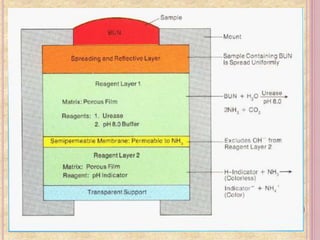
 Creatinine deaminase catalyzes the conversion of
creatinine to N-methylhydantoin and ammonia.
 Ammonia diffuses through a semipermeable and
optically opaque layer reacts with bromophenol
blue to obtain an increase in absorbance at 600
nm.
 The color produced in the film is quantitated by
reflectance.
MEASUREMENT OF URIC ACID
 Uricase acts on uric acid to produce allantoin,
hydrogen peroxide, and carbon dioxide.
 A multilayer film system employs uricase and
peroxidase separated by a semipermeable
membrane from a leuco dye that is oxidized to form
a colored product.
 A hexokinase and a glucose- 6-phosphate dehydrogenase
reaction are combined to the ATP produced by creatine
kinase to generate a creatine kinase assay.
 This results in the generation of NADPH that can be
monitored at 340 nm by reflectance spectroscopy
 Presence of a masking layer excludes undesirable
absorption of light by reagents
Advantages
 Minimum storage costs.
 Allows a sample to be analysed for multiple analytes
simultaneously
 Faster process
 Dry reagent systems obviate the need for mixing
because the serum completely interacts with the dry
chemicals as it flows through the matrix of the reaction
unit.
Disadvantages
 Expensive
MAINTENANCE
 Dust may change the whiteness of sphere so keep the
room dust free and clean the sphere from time to time.
 Proper electric stabilization is required.
 The ambient temperature and humidity should be
properly regulated.
 Do not touch used slides with bare hands as this may
cause contamination.
 The slides should be stored in a refrigerator [2-8 ºC
(35.6-46.4 ºF)] without unwrapping to avoid humidity,
light, and heat.
 Measurement should be completed within 30 minutes
after unwrapping the individual package.
 A new slide must be used for each measurement.
REFERENCES
 Dry Chemistry. Analytical Chemistry.
1983;55(4):532A-532A.
 Free A, Free H. Dry Chemistry Reagent Systems.
Laboratory Medicine. 1984;15(9):595-601.
 Rifai N. Tietz Textbook of Clinical Chemistry and
Molecular Diagnostics - E-Book. Saintt Louis:
Elsevier Health Sciences; 2017.

Dry chemistry

  • 1.
  • 2.
    HISTORY  The firstdry chemistry system to attain significant clinical use appeared in 1941.  This reagent composition, called Clinitest, tested urine for sugar  Diabetics had previously tested themselves by boiling a few drops of urine with a teaspoonful of Benedict's solution.  Compton and Treneer created a tablet that contained citric acid, sodium hydroxide, sodium bicarbonate, and copper sulfate.  The key was to use extensively dried ingredients, to perform all the manufacturing steps in controlled rooms with very low humidity, and to protect the tablets from exposure to the ordinary humidity in the air.
  • 3.
    PRINCIPLE  The mainprinciple of dry chemistry is based upon the reflectance spectrophotometry.  Reflectance spectrophotometry measures the reflectance of materials.  They provide a reference standard for the comparison of the color of different samples.
  • 4.
     Spectrophotometer isa device that measure the light intensities as a function of wave length.  It does it by diffracting the light beam into a spectrum of wavelength, detecting the light intensities with charged couple device.
  • 5.
    COMPONENTS OF SPECTROPHOTOMETER Light source  Device to isolate light of a desired wavelength  Cuvet  Photodetector  Readout device  Data system.
  • 8.
    LIGHT PATH OFREFLECTANCE MEASUREMENT OF DRY CHEMISTRY REAGENT (LEFT) COMPARED WITH LIGHT PATH OF TRANSMISSION MEASUREMENT OF TYPICAL WET CHEMISTRY REACTION (RIGHT).
  • 9.
    DIFFERENCE BETWEEN ABSORBANCEAND REFLECTANCE METHODS The electro-optical components used in reflectance photometry are essentially the same as those required for absorbance photometry, except that the geometry of the system is modified so that the light source and the detector are located next to each other on one side of the sample, as opposed to on opposite sides of the sample cuvet, as in absorption photometry.
  • 10.
    LIGHT SOURCES  Incandescent,Arc, and Cathode Lamps: The light source for measurements in the visible portion of the spectrum is usually a tungsten light bulb.  In the UV region of the spectrum, hydrogen and deuterium lamps, as well as high-pressure mercury and xenon arc lamps, are sources of continuous spectra.  Low pressure mercury vapor lamps also provide spectra in the UV region and are useful for calibration purposes, but because of their limited wavelengths, they are not practical for absorbance measurements.
  • 11.
     Laser Sources:Light Amplification by Stimulated Emission of Radiation  Lasers are used as light sources in spectrophotometers because they provide intense light of a narrow wavelength.  Through selection of different materials, different wavelength(s) of light are emitted by different types of lasers.
  • 12.
    THREE PROPERTIES OFLASER SOURCES DISTINGUISH THEM FROM CONVENTIONAL SOURCES  Spatial coherence is a property of lasers that allows beam diameters in the range of several micrometers  Lasers produce monochromatic light; and  Lasers have pulse widths that vary from microseconds to nanoseconds to picoseconds or less in duration.
  • 14.
    SPECTRAL ISOLATION  Radiantenergy of a desired wavelength has to be isolated and that of other wavelengths excluded in various ways  Combinations of lenses and slits may be inserted before or after the monochromatic device to render light rays parallel or to isolate narrow portions of the light beam.
  • 15.
    SPECTRAL BANDWIDTH The spectralpurity of a filter or other monochromator is usually described in terms of its spectral bandwidth. This is defined as the width, in nanometers, of the spectral transmittance curve at a point equal to one half the peak transmittance.
  • 16.
    FILTERS  Certain metalcomplexes or salts, dissolved or suspended in glass, produce colors corresponding to the predominant wavelengths transmitted.  Types of filters used: wide bandpass filters, Cutoff filters and narrow bandpass interference or dichroic filter
  • 17.
    PRISMS AND DIFFRACTIONGRATINGS : USED AS MONOCHROMATORS.  A diffraction grating is prepared by depositing a thin layer of aluminum-copper alloy on the surface of a flat glass plate, and then fabricating many small parallel grooves into the metal coating..
  • 18.
    PHOTODETECTORS  A photodetectoris a device that converts light into an electric signal that is proportional to the number of photons striking its photosensitive surface.  The photomultiplier tube is a commonly used photodetector for measuring light intensity in the UV and visible regions of the spectrum.
  • 19.
    PHOTOMULTIPLIER TUBES  Extremelyrapid response times,  Very sensitive over a wide range of wavelengths  Slow to fatigue. Because these tubes are very sensitive and have a rapid response, they must be carefully shielded from all stray light.
  • 20.
    IN REFLECTANCE PHOTOMETRY,DIFFUSE REFLECTED LIGHT IS MEASURED.  The reaction mixture in a carrier is illuminated with diffused light, and the intensity of the reflected light from the chromogen is compared with the intensity of light reflected from a reference surface.
  • 21.
    THE COMMONLY USEDPERCENT REFLECTION (%R) CAN BE EXPRESSED AS: %R =IS/IR X R. WHERE IS, IR., AND R, REPRESENT THE REFLECTED LIGHT FROM THE REAGENT CARRIER, THE REFLECTED LIGHT FROM THE REFERENCE, AND THE PERCENT REFLECTIVITY OF THE REFERENCE, RESPECTIVELY.
  • 22.
    REFLECTANCE SPECTROPHOTOMETER  Shouldhave a bandwidth narrow enough to provide well resolved visible spectra yet wide enough to provide a good energy level for diffuse reflectance measurements.  Optics and electronics systems of high sensitivity, and should be able to physically accommodate reflectance and transmission accessories.  Make measurements both at selected fixed wavelengths or perform scans over the complete wavelength range.
  • 23.
    PRINCIPLE  Reagent slidesare composed of several layers  1-spreading layer  2-scavenger layer  3-reagent layer(s)  4-plastic or support layer The presence of spreading layer reduces the interference to the reaction seen in hemolysed and lipemic samples
  • 24.
     The reagentlayer(s) contains; enzymes, dye precursor, and buffers necessary for the analysis of a specific component.  It is the most complex region of the carrier.
  • 25.
     The supportmaterial usually consists of a thin, rigid plastic or a plastic like material that may be transparent or reflective.  The reflective zone is usually constructed with pigments such as TiO2 or BaS04 or reflective materials such as metal foils.
  • 26.
    I • Sample, control,or standard is deposited on the spreading layer. II • Selected components are allowed to penetrate to the reaction layer(s), which in turn activate the dehydrated reagents. III • A chemical reaction is initiated to produce a colour. IV • Light is passed from beneath the support or plastic layer and is directed through the reagent layer (s). V • As the light hits the white spreading layer, some of the light reflects back through the reagent layer(s) to a photocell. VI • The amount of reflected light, which is in proportion to colour intensity, is used to determine the concentration of the analyte.
  • 27.
    DRY CHEMISTRY INURINE ANALYSIS: REAGENT STRIP (“DIPSTICK”) TESTING  Urine samples for reagent strip testing should be collected in sterile containers, and testing should be performed on the fresh urine.  In addition to manual reading of reagent strips, automated readers have come into routine use
  • 28.
    PRECAUTIONS  Collect freshurine specimen in a clean dry container with labeling  Mix well immediately before testing.  Completely immerse reagent areas of strip in fresh urine and remove immediately to avoid dissolving out of the reagent  Hold the strip in a horizontal to prevent possible mixing of chemicals from adjacent reagent or contaminating the hands with urine.
  • 29.
    DETECTION OF HEMOGLOBININ URINE  For this test, the reagent pad is impregnated with buffered tetramethyl benzidine (TMB) and an organic peroxide.  The color change ranges from orange to pale to dark green, and red cells or free hemoglobin are detected together with myoglobin.  The test is equally sensitive to hemoglobin and myoglobin, and thus a negative result excludes myoglobinuria.  Water must not be used as a negative control with this test: A false-positive result will be obtained.
  • 30.
    MEASUREMENT OF GLUCOSE The reagent pad is impregnated with glucose oxidase, peroxidase, potassium iodide, and a blue dye.  The reaction employs glucose oxidase and peroxidase to produce hydrogen peroxide, which is subsequently reduced with concurrent oxidation of potassium iodide to release iodine.  The free iodine blends with the background color to produce a range of colors from green to dark brown.
  • 32.
    MEASUREMENT OF PH Methyl red in a diluted form is red at pH values below 4.2 and yellow at values above 6.2.  Bromthymol blue is yellow at pH values below 6.0 and blue at values above 7.6.  On standing, urine pH tends to rise because of loss of carbon dioxide and production of ammonia from urea by bacterial growth
  • 33.
    URINE ALBUMIN  Thetest area is impregnated with tetrabromophenol blue.  The area is yellow in absence of protein but at same pH changes to green to blue in presence of protein depending on type and concentration of protein present.  The result is read in plus system as negative trace, and 1+ to 4+.
  • 34.
    DRY CHEMISTRY INBLOOD SAMPLES
  • 36.
    MEASUREMENT OF CREATININE Creatinine deaminase catalyzes the conversion of creatinine to N-methylhydantoin and ammonia.  Ammonia diffuses through a semipermeable and optically opaque layer reacts with bromophenol blue to obtain an increase in absorbance at 600 nm.  The color produced in the film is quantitated by reflectance.
  • 37.
    MEASUREMENT OF URICACID  Uricase acts on uric acid to produce allantoin, hydrogen peroxide, and carbon dioxide.  A multilayer film system employs uricase and peroxidase separated by a semipermeable membrane from a leuco dye that is oxidized to form a colored product.
  • 38.
     A hexokinaseand a glucose- 6-phosphate dehydrogenase reaction are combined to the ATP produced by creatine kinase to generate a creatine kinase assay.  This results in the generation of NADPH that can be monitored at 340 nm by reflectance spectroscopy
  • 39.
     Presence ofa masking layer excludes undesirable absorption of light by reagents
  • 40.
    Advantages  Minimum storagecosts.  Allows a sample to be analysed for multiple analytes simultaneously  Faster process  Dry reagent systems obviate the need for mixing because the serum completely interacts with the dry chemicals as it flows through the matrix of the reaction unit. Disadvantages  Expensive
  • 41.
    MAINTENANCE  Dust maychange the whiteness of sphere so keep the room dust free and clean the sphere from time to time.  Proper electric stabilization is required.  The ambient temperature and humidity should be properly regulated.  Do not touch used slides with bare hands as this may cause contamination.  The slides should be stored in a refrigerator [2-8 ºC (35.6-46.4 ºF)] without unwrapping to avoid humidity, light, and heat.  Measurement should be completed within 30 minutes after unwrapping the individual package.  A new slide must be used for each measurement.
  • 42.
    REFERENCES  Dry Chemistry.Analytical Chemistry. 1983;55(4):532A-532A.  Free A, Free H. Dry Chemistry Reagent Systems. Laboratory Medicine. 1984;15(9):595-601.  Rifai N. Tietz Textbook of Clinical Chemistry and Molecular Diagnostics - E-Book. Saintt Louis: Elsevier Health Sciences; 2017.