Presented By:
Md. Sohrab Ali Mollah
Reg. no. 13-05-3052
Course Title: Clinical Pathology and Necropsy
Course Code: PBL 501
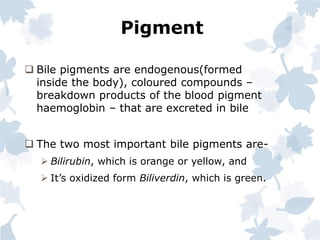
Pigment
 Bile pigments are endogenous(formed
inside the body), coloured compounds –
breakdown products of the blood pigment
haemoglobin – that are excreted in bile
 The two most important bile pigments are-
 Bilirubin, which is orange or yellow, and
 It’s oxidized form Biliverdin, which is green.
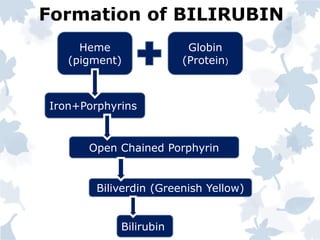
Formation of BILIRUBIN
Globin
(Protein)
Heme
(pigment)
Iron+Porphyrins
Open Chained Porphyrin
Biliverdin (Greenish Yellow)
Bilirubin
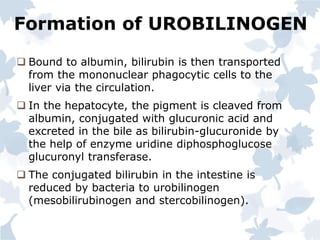
Formation of UROBILINOGEN
 Bound to albumin, bilirubin is then transported
from the mononuclear phagocytic cells to the
liver via the circulation.
 In the hepatocyte, the pigment is cleaved from
albumin, conjugated with glucuronic acid and
excreted in the bile as bilirubin-glucuronide by
the help of enzyme uridine diphosphoglucose
glucuronyl transferase.
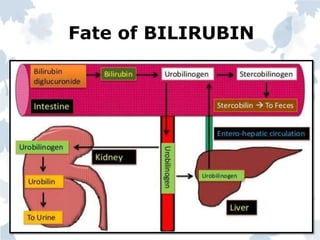
 The conjugated bilirubin in the intestine is
reduced by bacteria to urobilinogen
(mesobilirubinogen and stercobilinogen).
Fate of BILIRUBIN
CLINICAL OCCURRENCE
 Normal Serum Bilirubin: 0.3-1.0 mg/dL
(SI Units: 5.1-17 mmol/L).
 Increased Bilirubin: Hyperbilirubinemia
 Unconjugated Hyperbilirubinemia
 Conjugated Hyperbilirubinemia
 Decreased Bilirubin: Hypobilirubinemia
Hyperbilirubinemia
(Jaundice)
 It is an important disorder clinically and
postmortem in which the levels of bilirubin
reach such a high concentration in the blood
that all tissues of the body have yellow
tinge.
Hyperbilirubinemia
(Jaundice)
General Signs and symptoms
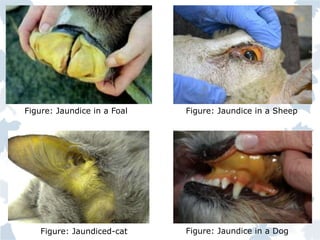
 The main symptom of jaundice is a yellow
discoloration of the white part of the eyes and of the
skin.
 The conjunctiva of the eye are one of the first tissues
to change color as bilirubin levels rise in jaundice.
This is sometimes referred to as scleral icterus.
However, the sclera themselves are not "icteric"
(stained with bile pigment) but rather the
conjunctival membranes that overlie them.
Figure: Jaundice in a Foal Figure: Jaundice in a Sheep
Figure: Jaundice in a DogFigure: Jaundiced-cat
Hyperbilirubinemia
(Jaundice)
 Depending on the causative mechanism,
Jaundice (Hyperbilirubinemia) is divided
into 3 types:
i. Hemolytic Jaundice (Prehepatic)
ii. Toxic icterus (hepatic) and
iii.Obstructive icterus (posthepatic)
Hyperbilirubinemia
(Jaundice)
 Hemolytic Jaundice (Prehepatic)
Hemolytic jaundice results from excessive
hemolysis of erythrocytes, ordinarily in the
circulating blood
Hyperbilirubinemia
(Jaundice)
 Toxic Jaundice (Hepatic)
Toxic jaundice is caused by toxic
substances acting on cells of the liver and
producing hydropic changes, fatty
changes, and necrosis and subsequent
release of conjugated and unconjugated
bilirubin into the bloodstream
Hyperbilirubinemia
(Jaundice)
 Obstructive Jaundice (Post-hepatic)
Occurs subsequent to obstruction to
the normal flow of bile anywhere in the
biliary system. This results in the
accumulation of conjugated bilirubin in
the bloodstream and in the urine
Hypobilirubinemia
 Lower than normal bilirubin levels are
usually not a concern
DIAGNOSIS OF ICTERUS
 The hyperbilirubinemia subsequently causes
increased levels of bilirubin in the extracellular
fluid. Concentration of bilirubin in blood plasmosis
normally below 1.2mg/dL (<25µmol/L). A
concentration higher than 2.5mg/dL (>50µmol/dL)
leads to Jaundice
DIAGNOSIS OF ICTERUS
 In mild cases the clinical discoloration may
be equivocal; therefore, laboratory tests
are often required to establish a definitive
diagnosis of jaundice. No single test can
differentiate between various
classifications of Jaundice. A combination
of liver function tests is essential to arrive
at a diagnosis
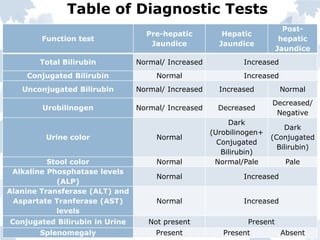
Table of Diagnostic Tests
Function test
Pre-hepatic
Jaundice
Hepatic
Jaundice
Post-
hepatic
Jaundice
Total Bilirubin Normal/ Increased Increased
Conjugated Bilirubin Normal Increased
Unconjugated Bilirubin Normal/ Increased Increased Normal
Urobilinogen Normal/ Increased Decreased
Decreased/
Negative
Urine color Normal
Dark
(Urobilinogen+
Conjugated
Bilirubin)
Dark
(Conjugated
Bilirubin)
Stool color Normal Normal/Pale Pale
Alkaline Phosphatase levels
(ALP)
Normal Increased
Alanine Transferase (ALT) and
Aspartate Tranferase (AST)
levels
Normal Increased
Conjugated Bilirubin in Urine Not present Present
Splenomegaly Present Present Absent
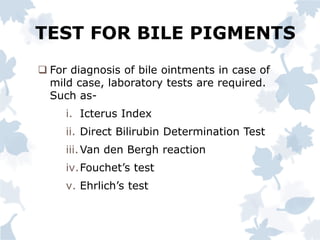
TEST FOR BILE PIGMENTS
 For diagnosis of bile ointments in case of
mild case, laboratory tests are required.
Such as-
i. Icterus Index
ii. Direct Bilirubin Determination Test
iii.Van den Bergh reaction
iv.Fouchet’s test
v. Ehrlich’s test
Bile pigments

Bile pigments

  • 2.
    Presented By: Md. SohrabAli Mollah Reg. no. 13-05-3052 Course Title: Clinical Pathology and Necropsy Course Code: PBL 501
  • 3.
    Pigment  Bile pigmentsare endogenous(formed inside the body), coloured compounds – breakdown products of the blood pigment haemoglobin – that are excreted in bile  The two most important bile pigments are-  Bilirubin, which is orange or yellow, and  It’s oxidized form Biliverdin, which is green.
  • 4.
    Formation of BILIRUBIN Globin (Protein) Heme (pigment) Iron+Porphyrins OpenChained Porphyrin Biliverdin (Greenish Yellow) Bilirubin
  • 5.
    Formation of UROBILINOGEN Bound to albumin, bilirubin is then transported from the mononuclear phagocytic cells to the liver via the circulation.  In the hepatocyte, the pigment is cleaved from albumin, conjugated with glucuronic acid and excreted in the bile as bilirubin-glucuronide by the help of enzyme uridine diphosphoglucose glucuronyl transferase.  The conjugated bilirubin in the intestine is reduced by bacteria to urobilinogen (mesobilirubinogen and stercobilinogen).
  • 6.
  • 7.
    CLINICAL OCCURRENCE  NormalSerum Bilirubin: 0.3-1.0 mg/dL (SI Units: 5.1-17 mmol/L).  Increased Bilirubin: Hyperbilirubinemia  Unconjugated Hyperbilirubinemia  Conjugated Hyperbilirubinemia  Decreased Bilirubin: Hypobilirubinemia
  • 8.
    Hyperbilirubinemia (Jaundice)  It isan important disorder clinically and postmortem in which the levels of bilirubin reach such a high concentration in the blood that all tissues of the body have yellow tinge.
  • 9.
    Hyperbilirubinemia (Jaundice) General Signs andsymptoms  The main symptom of jaundice is a yellow discoloration of the white part of the eyes and of the skin.  The conjunctiva of the eye are one of the first tissues to change color as bilirubin levels rise in jaundice. This is sometimes referred to as scleral icterus. However, the sclera themselves are not "icteric" (stained with bile pigment) but rather the conjunctival membranes that overlie them.
  • 10.
    Figure: Jaundice ina Foal Figure: Jaundice in a Sheep Figure: Jaundice in a DogFigure: Jaundiced-cat
  • 11.
    Hyperbilirubinemia (Jaundice)  Depending onthe causative mechanism, Jaundice (Hyperbilirubinemia) is divided into 3 types: i. Hemolytic Jaundice (Prehepatic) ii. Toxic icterus (hepatic) and iii.Obstructive icterus (posthepatic)
  • 12.
    Hyperbilirubinemia (Jaundice)  Hemolytic Jaundice(Prehepatic) Hemolytic jaundice results from excessive hemolysis of erythrocytes, ordinarily in the circulating blood
  • 13.
    Hyperbilirubinemia (Jaundice)  Toxic Jaundice(Hepatic) Toxic jaundice is caused by toxic substances acting on cells of the liver and producing hydropic changes, fatty changes, and necrosis and subsequent release of conjugated and unconjugated bilirubin into the bloodstream
  • 14.
    Hyperbilirubinemia (Jaundice)  Obstructive Jaundice(Post-hepatic) Occurs subsequent to obstruction to the normal flow of bile anywhere in the biliary system. This results in the accumulation of conjugated bilirubin in the bloodstream and in the urine
  • 15.
    Hypobilirubinemia  Lower thannormal bilirubin levels are usually not a concern
  • 16.
    DIAGNOSIS OF ICTERUS The hyperbilirubinemia subsequently causes increased levels of bilirubin in the extracellular fluid. Concentration of bilirubin in blood plasmosis normally below 1.2mg/dL (<25µmol/L). A concentration higher than 2.5mg/dL (>50µmol/dL) leads to Jaundice
  • 17.
    DIAGNOSIS OF ICTERUS In mild cases the clinical discoloration may be equivocal; therefore, laboratory tests are often required to establish a definitive diagnosis of jaundice. No single test can differentiate between various classifications of Jaundice. A combination of liver function tests is essential to arrive at a diagnosis
  • 18.
    Table of DiagnosticTests Function test Pre-hepatic Jaundice Hepatic Jaundice Post- hepatic Jaundice Total Bilirubin Normal/ Increased Increased Conjugated Bilirubin Normal Increased Unconjugated Bilirubin Normal/ Increased Increased Normal Urobilinogen Normal/ Increased Decreased Decreased/ Negative Urine color Normal Dark (Urobilinogen+ Conjugated Bilirubin) Dark (Conjugated Bilirubin) Stool color Normal Normal/Pale Pale Alkaline Phosphatase levels (ALP) Normal Increased Alanine Transferase (ALT) and Aspartate Tranferase (AST) levels Normal Increased Conjugated Bilirubin in Urine Not present Present Splenomegaly Present Present Absent
  • 19.
    TEST FOR BILEPIGMENTS  For diagnosis of bile ointments in case of mild case, laboratory tests are required. Such as- i. Icterus Index ii. Direct Bilirubin Determination Test iii.Van den Bergh reaction iv.Fouchet’s test v. Ehrlich’s test