Testicular Disorders and
 Erectile Dysfunction
          Patrick Carter MPAS, PA-C
                   Clinical Medicine I
                       March 4, 2011
Objectives
    For each of the following diseases describe the
     etiology, epidemiology, pathophysiology, risk
     factors, signs and symptoms, diagnostic work-up, and
     treatment:
       Testicular torsion
       Hypogonadism
       Hypospadias
       Epispadias
       Cryptorchidism
       Hydroceles
       Varicoceles
       Erectile dysfunction
Testicular Torsion
Testicular Torsion
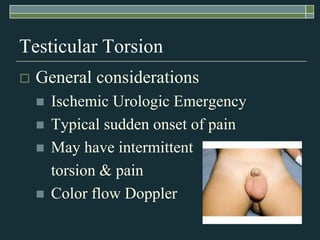
   General considerations
       Ischemic Urologic Emergency
       Typical sudden onset of pain
       May have intermittent
        torsion & pain
       Color flow Doppler
Testicular Torsion
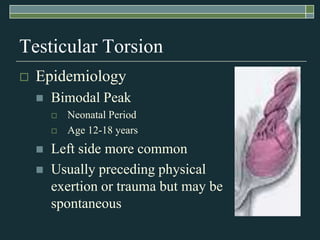
   Epidemiology
       Bimodal Peak
           Neonatal Period
           Age 12-18 years
       Left side more common
       Usually preceding physical
        exertion or trauma but may be
        spontaneous
Testicular Torsion
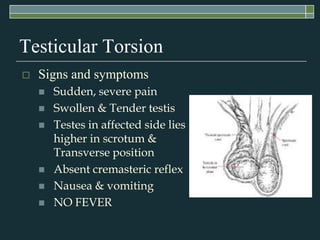
   Signs and symptoms
       Sudden, severe pain
       Swollen & Tender testis
       Testes in affected side lies
        higher in scrotum &
        Transverse position
       Absent cremasteric reflex
       Nausea & vomiting
       NO FEVER
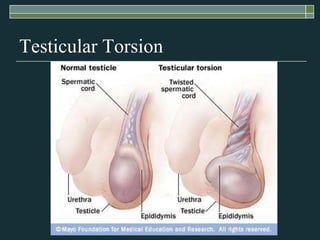
Testicular Torsion
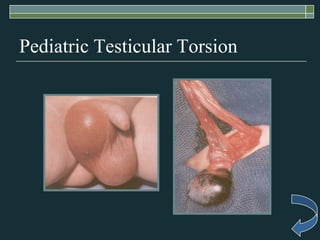
Pediatric Testicular Torsion
Testicular Torsion
   Treatment
       Immediate urologic consultation
       Prepare patient for the OR
       Doppler ultrasound if it will not delay surgery
       Detorsion may be attempted if the patient is seen
        within a few hours of onset
           ―Open book‖ method
           Pain relief should be immediate
           Do not delay operative intervention, since testicular
            infarction will occur within 6 to 12 h after torsion
Testicular Torsion
   Prognosis
       Less than 6 hours – salvage rate is excellent
       Beyond 6 hours – salvage rate becomes worse
       After 48 hours – salvage rate is zero
Testicular Torsion
   Clinical Pearls
       Patients may report similar, less severe episodes
        that spontaneously resolved in the recent past
       Half of all torsions occur during sleep
       Abdominal or inguinal pain is sometimes present
        without pain to the scrotum
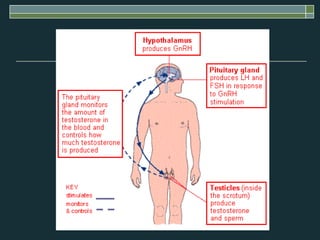
Hypogonadism
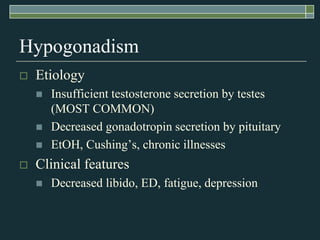
Hypogonadism
   Etiology
       Insufficient testosterone secretion by testes
        (MOST COMMON)
       Decreased gonadotropin secretion by pituitary
       EtOH, Cushing’s, chronic illnesses
   Clinical features
       Decreased libido, ED, fatigue, depression
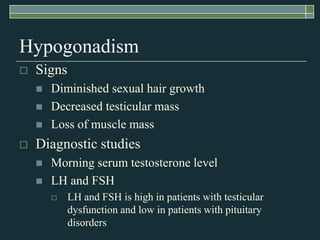
Hypogonadism
   Signs
       Diminished sexual hair growth
       Decreased testicular mass
       Loss of muscle mass
   Diagnostic studies
       Morning serum testosterone level
       LH and FSH
           LH and FSH is high in patients with testicular
            dysfunction and low in patients with pituitary
            disorders
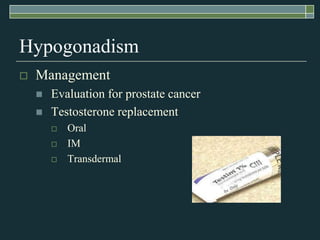
Hypogonadism
   Management
       Evaluation for prostate cancer
       Testosterone replacement
           Oral
           IM
           Transdermal
Hypospadias
Hypospadias
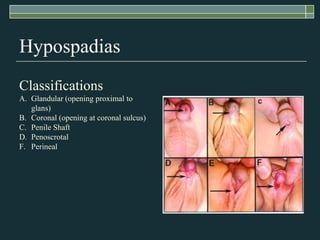
Classifications
A. Glandular (opening proximal to
   glans)
B. Coronal (opening at coronal sulcus)
C. Penile Shaft
D. Penoscrotal
F. Perineal
Hypospadias
   Testing
       Patients with ―Penoscrotal‖ and ―Perineal‖
        openings should be considered to have potential
        intersex problems and should be karotyping to
        establish genetic sex
   Treatment
       Surgical repair preferred before school age
       Over 150 procedures
Epispadias
Epispadias


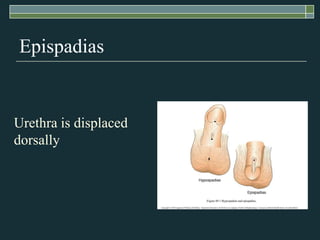
Urethra is displaced
dorsally
Epispadias
   Classification
       Glandular – opens on dorsal aspect of glans
       Penile – borad and gaping on dorsum of penile shaft
       Penopubic – junction with groove extending through
        glans
   Females will have bifid clitoris & separation
    of labia. Most are incontinent
   Penile & Penopubic will usually have urinary
    incontinence
   Surgery is required to correct incontinence
Cryptorchidism
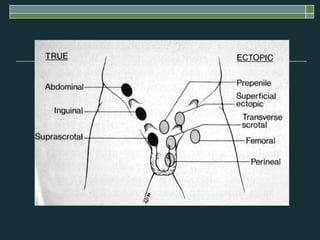
CRYPTORCHIDISM

DEFINITION:
A condition in which one or both testes fail to descend
into the scrotum.

FACTS & FIGURES
• Most common congenital condition involving the
  testes
• 3% of all full-term males at birth
• 20% of all premature males at birth
• Less than 1% of males by 3 months of age
CRYPTORCHIDISM

CLINICAL:
No testis detected with palpation of scrotum.
CONCERNS:
• Impaired fertility
• Risk of testicular cancer 35-50% higher than in
  men who have descended testes
DX:
• CT scan
• Ultrasound
CRYPTORCHIDISM

TREATMENT:
Administration of HCG (given IM biweekly),
which may initiate descent.
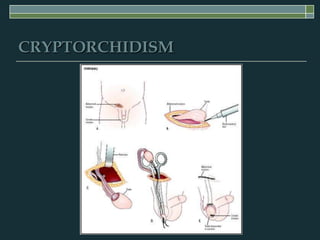
Referral to urologist by 6 months, surgery by age
1 or 2 at the latest

Orchiopexy DOES NOT reduce risk of cancer, but
does facilitate examination and early detection
CRYPTORCHIDISM
Hydrocele
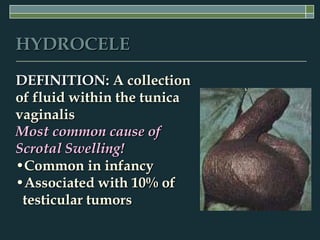
HYDROCELE
DEFINITION: A collection
of fluid within the tunica
vaginalis
Most common cause of
Scrotal Swelling!
•Common in infancy
•Associated with 10% of
 testicular tumors
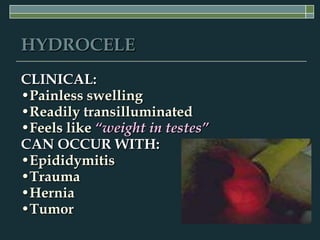
HYDROCELE
CLINICAL:
•Painless swelling
•Readily transilluminated
•Feels like “weight in testes”
CAN OCCUR WITH:
•Epididymitis
•Trauma
•Hernia
•Tumor
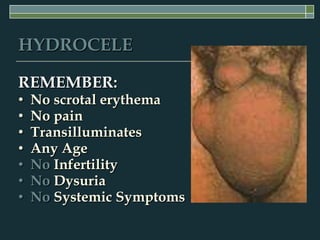
HYDROCELE

REMEMBER:
•   No scrotal erythema
•   No pain
•   Transilluminates
•   Any Age
•   No Infertility
•   No Dysuria
•   No Systemic Symptoms
Varicocele
VARICOCELE

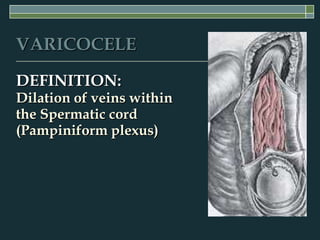
DEFINITION:
Dilation of veins within
the Spermatic cord
(Pampiniform plexus)
VARICOCELE

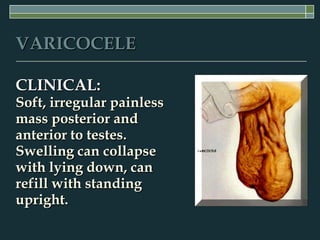
CLINICAL:
Soft, irregular painless
mass posterior and
anterior to testes.
Swelling can collapse
with lying down, can
refill with standing
upright.
VARICOCELE

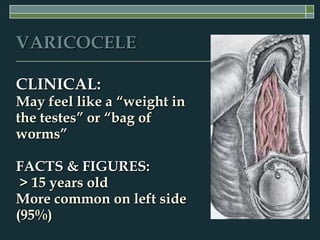
CLINICAL:
May feel like a “weight in
the testes” or “bag of
worms”

FACTS & FIGURES:
 > 15 years old
More common on left side
(95%)
VARICOCELE

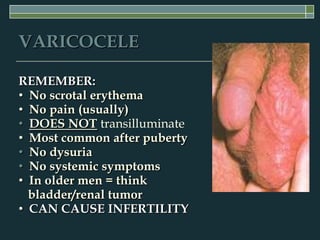
REMEMBER:
• No scrotal erythema
• No pain (usually)
• DOES NOT transilluminate
• Most common after puberty
• No dysuria
• No systemic symptoms
• In older men = think
  bladder/renal tumor
• CAN CAUSE INFERTILITY
Erectile Dysfunction
   Essentials of Diagnosis
       Most causes are organic and not
        psychogenic
       Increasing incidence with older age
       Variety of treatment available, with
        multiple oral agents
Erectile Dysfunction
   General Considerations
       Inability to maintain an erect penis with sufficient
        rigidity to allow sexual intercourse
       Loss of erections occurs from arterial, venous,
        neurogenic, or psychogenic causes
       Associated with concurrent medical problems
        (hypertension, diabetes mellitus), or radical pelvic
        or retroperitoneal surgery
       Look for concomitant cardiovascular disease
Erectile Dysfunction
   General Considerations
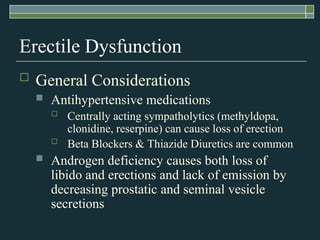
       Antihypertensive medications
           Centrally acting sympatholytics (methyldopa,
            clonidine, reserpine) can cause loss of erection
           Beta Blockers & Thiazide Diuretics are common
       Androgen deficiency causes both loss of
        libido and erections and lack of emission by
        decreasing prostatic and seminal vesicle
        secretions
Erectile Dysfunction
   General Considerations
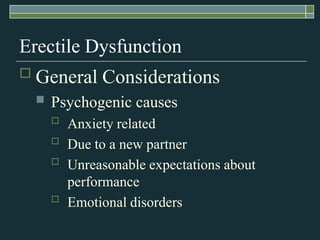
       Psychogenic causes
           Anxiety related
           Due to a new partner
           Unreasonable expectations about
            performance
           Emotional disorders
Erectile Dysfunction
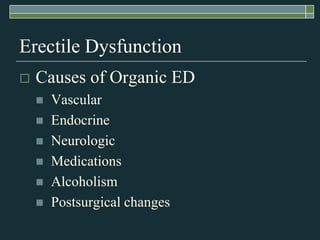
   Causes of Organic ED
       Vascular
       Endocrine
       Neurologic
       Medications
       Alcoholism
       Postsurgical changes
Erectile Dysfunction
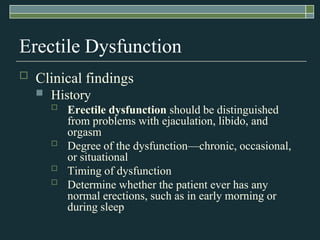
   Clinical findings
       History
           Erectile dysfunction should be distinguished
            from problems with ejaculation, libido, and
            orgasm
           Degree of the dysfunction—chronic, occasional,
            or situational
           Timing of dysfunction
           Determine whether the patient ever has any
            normal erections, such as in early morning or
            during sleep
Erectile Dysfunction
   Clinical findings
       History
           Inquire about hyperlipidemia, hypertension,
            neurologic disease, diabetes mellitus, renal
            failure, adrenal and thyroid disorders, and
            depression
           Trauma to the pelvis, pelvic surgery, or peripheral
            vascular surgery
           Use of drugs, alcohol, tobacco, and recreational
            drugs
Erectile Dysfunction
   Clinical findings
       Physical examination
           Secondary sexual characteristics
           Neurologic motor and sensory examination
           Peripheral vascular examination
           Examination of genitalia, testicles, and
            prostate
           Evaluate for penile scarring, plaque formation
            (Peyronie's disease)
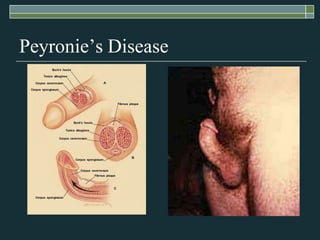
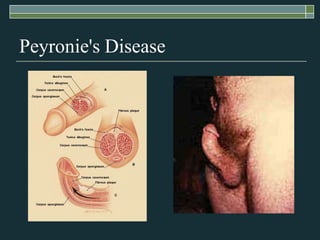
Peyronie’s Disease
   Dense fibrous plaque that forms on the tunica
    albuginea – causing a curvature of the erect
    penis
   Etiology of the plaque is unknown
       May be scar tissue resulting from microscopic
        tears of the tunica albuginea during intercourse
   Flaccid penis is usually normal on exam and
    the curvature is only noted in the erect penis
Peyronie’s Disease
Peyronie's Disease
Erectile Dysfunction
   Laboratory Tests
       Complete blood count
       Urinalysis
       Lipid profile
       Serum glucose, testosterone, LH/FSH, and
        prolactin
       Serum testosterone and gonadotropin levels may
        help localize the site of disease (CNS vs Testes)
Erectile Dysfunction
   Imaging studies
       Cavernosometry (measurement of
        flow required to maintain erection)
       Cavernosography (contrast study of
        the penis to determine site and extent
        of venous leak)
   Nocturnal penile tumescence testing
Erectile Dysfunction
   Medications
       Hormone replacement for androgen deficiency
       Alprostadil urethral suppository pellets
       PDE-5 inhibitors taken 1 hour prior to anticipated
        sexual activity
           Viagra (sildenafil) 50 mg, Levitra (vardenafil) 5 mg,
            or Cialis (tadalafil) 10 mg
           Contraindicated in patients receiving nitrates
           Some patients who do not respond to one PDE-5
            inhibitor will respond to another
Erectile Dysfunction
   Treatment Procedures
       Direct injection of vasoactive substances
        into the penis
           Prostaglandin E, papaverine, or a combination
Erectile Dysfunction
   Surgery
       Penile prosthesis: rigid, malleable, hinged,
        or inflatable
       Surgery for disorders of the arterial system
           Vascular reconstruction
           Endarterectomy and balloon dilation for
            proximal arterial occlusion
           Arterial bypass procedures for distal occlusion
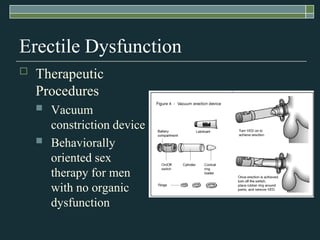
Erectile Dysfunction
   Therapeutic
    Procedures
       Vacuum
        constriction device
       Behaviorally
        oriented sex
        therapy for men
        with no organic
        dysfunction
Questions?

Testicular Disorders & Erectile Dysfunction

  • 1.
    Testicular Disorders and Erectile Dysfunction Patrick Carter MPAS, PA-C Clinical Medicine I March 4, 2011
  • 2.
    Objectives  For each of the following diseases describe the etiology, epidemiology, pathophysiology, risk factors, signs and symptoms, diagnostic work-up, and treatment:  Testicular torsion  Hypogonadism  Hypospadias  Epispadias  Cryptorchidism  Hydroceles  Varicoceles  Erectile dysfunction
  • 3.
  • 4.
    Testicular Torsion  General considerations  Ischemic Urologic Emergency  Typical sudden onset of pain  May have intermittent torsion & pain  Color flow Doppler
  • 5.
    Testicular Torsion  Epidemiology  Bimodal Peak  Neonatal Period  Age 12-18 years  Left side more common  Usually preceding physical exertion or trauma but may be spontaneous
  • 6.
    Testicular Torsion  Signs and symptoms  Sudden, severe pain  Swollen & Tender testis  Testes in affected side lies higher in scrotum & Transverse position  Absent cremasteric reflex  Nausea & vomiting  NO FEVER
  • 7.
  • 8.
  • 9.
    Testicular Torsion  Treatment  Immediate urologic consultation  Prepare patient for the OR  Doppler ultrasound if it will not delay surgery  Detorsion may be attempted if the patient is seen within a few hours of onset  ―Open book‖ method  Pain relief should be immediate  Do not delay operative intervention, since testicular infarction will occur within 6 to 12 h after torsion
  • 10.
    Testicular Torsion  Prognosis  Less than 6 hours – salvage rate is excellent  Beyond 6 hours – salvage rate becomes worse  After 48 hours – salvage rate is zero
  • 11.
    Testicular Torsion  Clinical Pearls  Patients may report similar, less severe episodes that spontaneously resolved in the recent past  Half of all torsions occur during sleep  Abdominal or inguinal pain is sometimes present without pain to the scrotum
  • 12.
  • 14.
    Hypogonadism  Etiology  Insufficient testosterone secretion by testes (MOST COMMON)  Decreased gonadotropin secretion by pituitary  EtOH, Cushing’s, chronic illnesses  Clinical features  Decreased libido, ED, fatigue, depression
  • 15.
    Hypogonadism  Signs  Diminished sexual hair growth  Decreased testicular mass  Loss of muscle mass  Diagnostic studies  Morning serum testosterone level  LH and FSH  LH and FSH is high in patients with testicular dysfunction and low in patients with pituitary disorders
  • 16.
    Hypogonadism  Management  Evaluation for prostate cancer  Testosterone replacement  Oral  IM  Transdermal
  • 17.
  • 18.
    Hypospadias Classifications A. Glandular (openingproximal to glans) B. Coronal (opening at coronal sulcus) C. Penile Shaft D. Penoscrotal F. Perineal
  • 19.
    Hypospadias  Testing  Patients with ―Penoscrotal‖ and ―Perineal‖ openings should be considered to have potential intersex problems and should be karotyping to establish genetic sex  Treatment  Surgical repair preferred before school age  Over 150 procedures
  • 20.
  • 21.
  • 22.
    Epispadias  Classification  Glandular – opens on dorsal aspect of glans  Penile – borad and gaping on dorsum of penile shaft  Penopubic – junction with groove extending through glans  Females will have bifid clitoris & separation of labia. Most are incontinent  Penile & Penopubic will usually have urinary incontinence  Surgery is required to correct incontinence
  • 23.
  • 24.
    CRYPTORCHIDISM DEFINITION: A condition inwhich one or both testes fail to descend into the scrotum. FACTS & FIGURES • Most common congenital condition involving the testes • 3% of all full-term males at birth • 20% of all premature males at birth • Less than 1% of males by 3 months of age
  • 26.
    CRYPTORCHIDISM CLINICAL: No testis detectedwith palpation of scrotum. CONCERNS: • Impaired fertility • Risk of testicular cancer 35-50% higher than in men who have descended testes DX: • CT scan • Ultrasound
  • 27.
    CRYPTORCHIDISM TREATMENT: Administration of HCG(given IM biweekly), which may initiate descent. Referral to urologist by 6 months, surgery by age 1 or 2 at the latest Orchiopexy DOES NOT reduce risk of cancer, but does facilitate examination and early detection
  • 28.
  • 29.
  • 30.
    HYDROCELE DEFINITION: A collection offluid within the tunica vaginalis Most common cause of Scrotal Swelling! •Common in infancy •Associated with 10% of testicular tumors
  • 31.
    HYDROCELE CLINICAL: •Painless swelling •Readily transilluminated •Feelslike “weight in testes” CAN OCCUR WITH: •Epididymitis •Trauma •Hernia •Tumor
  • 32.
    HYDROCELE REMEMBER: • No scrotal erythema • No pain • Transilluminates • Any Age • No Infertility • No Dysuria • No Systemic Symptoms
  • 33.
  • 34.
    VARICOCELE DEFINITION: Dilation of veinswithin the Spermatic cord (Pampiniform plexus)
  • 35.
    VARICOCELE CLINICAL: Soft, irregular painless massposterior and anterior to testes. Swelling can collapse with lying down, can refill with standing upright.
  • 36.
    VARICOCELE CLINICAL: May feel likea “weight in the testes” or “bag of worms” FACTS & FIGURES: > 15 years old More common on left side (95%)
  • 37.
    VARICOCELE REMEMBER: • No scrotalerythema • No pain (usually) • DOES NOT transilluminate • Most common after puberty • No dysuria • No systemic symptoms • In older men = think bladder/renal tumor • CAN CAUSE INFERTILITY
  • 38.
  • 39.
    Erectile Dysfunction  Essentials of Diagnosis  Most causes are organic and not psychogenic  Increasing incidence with older age  Variety of treatment available, with multiple oral agents
  • 40.
    Erectile Dysfunction  General Considerations  Inability to maintain an erect penis with sufficient rigidity to allow sexual intercourse  Loss of erections occurs from arterial, venous, neurogenic, or psychogenic causes  Associated with concurrent medical problems (hypertension, diabetes mellitus), or radical pelvic or retroperitoneal surgery  Look for concomitant cardiovascular disease
  • 41.
    Erectile Dysfunction  General Considerations  Antihypertensive medications  Centrally acting sympatholytics (methyldopa, clonidine, reserpine) can cause loss of erection  Beta Blockers & Thiazide Diuretics are common  Androgen deficiency causes both loss of libido and erections and lack of emission by decreasing prostatic and seminal vesicle secretions
  • 42.
    Erectile Dysfunction  General Considerations  Psychogenic causes  Anxiety related  Due to a new partner  Unreasonable expectations about performance  Emotional disorders
  • 43.
    Erectile Dysfunction  Causes of Organic ED  Vascular  Endocrine  Neurologic  Medications  Alcoholism  Postsurgical changes
  • 44.
    Erectile Dysfunction  Clinical findings  History  Erectile dysfunction should be distinguished from problems with ejaculation, libido, and orgasm  Degree of the dysfunction—chronic, occasional, or situational  Timing of dysfunction  Determine whether the patient ever has any normal erections, such as in early morning or during sleep
  • 45.
    Erectile Dysfunction  Clinical findings  History  Inquire about hyperlipidemia, hypertension, neurologic disease, diabetes mellitus, renal failure, adrenal and thyroid disorders, and depression  Trauma to the pelvis, pelvic surgery, or peripheral vascular surgery  Use of drugs, alcohol, tobacco, and recreational drugs
  • 46.
    Erectile Dysfunction  Clinical findings  Physical examination  Secondary sexual characteristics  Neurologic motor and sensory examination  Peripheral vascular examination  Examination of genitalia, testicles, and prostate  Evaluate for penile scarring, plaque formation (Peyronie's disease)
  • 47.
    Peyronie’s Disease  Dense fibrous plaque that forms on the tunica albuginea – causing a curvature of the erect penis  Etiology of the plaque is unknown  May be scar tissue resulting from microscopic tears of the tunica albuginea during intercourse  Flaccid penis is usually normal on exam and the curvature is only noted in the erect penis
  • 48.
  • 49.
  • 50.
    Erectile Dysfunction  Laboratory Tests  Complete blood count  Urinalysis  Lipid profile  Serum glucose, testosterone, LH/FSH, and prolactin  Serum testosterone and gonadotropin levels may help localize the site of disease (CNS vs Testes)
  • 51.
    Erectile Dysfunction  Imaging studies  Cavernosometry (measurement of flow required to maintain erection)  Cavernosography (contrast study of the penis to determine site and extent of venous leak)  Nocturnal penile tumescence testing
  • 52.
    Erectile Dysfunction  Medications  Hormone replacement for androgen deficiency  Alprostadil urethral suppository pellets  PDE-5 inhibitors taken 1 hour prior to anticipated sexual activity  Viagra (sildenafil) 50 mg, Levitra (vardenafil) 5 mg, or Cialis (tadalafil) 10 mg  Contraindicated in patients receiving nitrates  Some patients who do not respond to one PDE-5 inhibitor will respond to another
  • 53.
    Erectile Dysfunction  Treatment Procedures  Direct injection of vasoactive substances into the penis  Prostaglandin E, papaverine, or a combination
  • 54.
    Erectile Dysfunction  Surgery  Penile prosthesis: rigid, malleable, hinged, or inflatable  Surgery for disorders of the arterial system  Vascular reconstruction  Endarterectomy and balloon dilation for proximal arterial occlusion  Arterial bypass procedures for distal occlusion
  • 55.
    Erectile Dysfunction  Therapeutic Procedures  Vacuum constriction device  Behaviorally oriented sex therapy for men with no organic dysfunction
  • 56.