Dr Sujoy Dasgupta
MBBS (Gold Medalist, Hons)
MS (OBGY- Gold Medalist)
DNB (New Delhi)
MRCOG (London)
Advanced ART Course for Clinicians (NUHS, Singapore)
Consultant: Reproductive Medicine, Genome Fertility Centre, Kolkata
Visiting Consultant, RSV Hospital, Kolkata
Bhagirathi Neotia Women and Child Care centre
Woodlands Multispeciality Hospital, Kolkata
Managing Committee Member, Bengal Obstetric & Gynaecological Society (BOGS)
Secretary, Subfertility and Reproductive Endocrinology Committee, BOGS
Executive Committee Member, Indian Fertility Society (IFS)- West Bengal Chapter
Executive Committee Member, Indian Society for Assisted Reproduction (ISAR)- Bengal
Winner, Prof Geoffrey Chamberlain Award, RCOG World Congress, London, 2019
Erectile Dysfunction (ED)
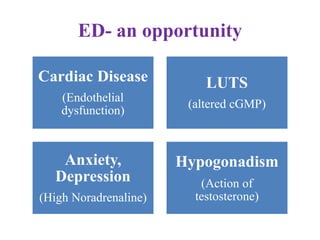
ED- an opportunity
Cardiac Disease
(Endothelial
dysfunction)
LUTS
(altered cGMP)
Anxiety,
Depression
(High Noradrenaline)
Hypogonadism
(Action of
testosterone)
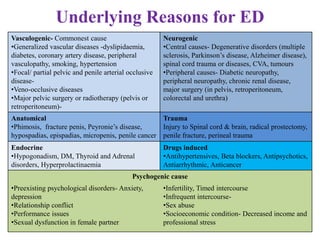
Underlying Reasons for ED
Vasculogenic- Commonest cause
•Generalized vascular diseases -dyslipidaemia,
diabetes, coronary artery disease, peripheral
vasculopathy, smoking, hypertension
•Focal/ partial pelvic and penile arterial occlusive
disease-
•Veno-occlusive diseases
•Major pelvic surgery or radiotherapy (pelvis or
retroperitoneum)-
Neurogenic
•Central causes- Degenerative disorders (multiple
sclerosis, Parkinson’s disease, Alzheimer disease),
spinal cord trauma or diseases, CVA, tumours
•Peripheral causes- Diabetic neuropathy,
peripheral neuropathy, chronic renal disease,
major surgery (in pelvis, retroperitoneum,
colorectal and urethra)
Anatomical
•Phimosis, fracture penis, Peyronie’s disease,
hypospadias, epispadias, micropenis, penile cancer
Trauma
Injury to Spinal cord & brain, radical prostectomy,
penile fracture, perineal trauma
Endocrine
•Hypogonadism, DM, Thyroid and Adrenal
disorders, Hyperprolactinaemia
Drugs induced
•Antihypertensives, Beta blockers, Antipsychotics,
Antiarrhythmic, Anticancer
Psychogenic cause
•Preexisting psychological disorders- Anxiety,
depression
•Relationship conflict
•Performance issues
•Sexual dysfunction in female partner
•Infertility, Timed intercourse
•Infrequent intercourse-
•Sex abuse
•Socioeconomic condition- Decreased income and
professional stress
Physical or Psychological ED?
Physical Psychological
Gradual Onset Sudden onset
Progressive Off and on
In all situations/ partners In some particular situations
Inadequate response to PDE5-i Good response to PDE5-i
Better erection in standing position than in
lying down
Precipitating/ psyological factors
Morning erection low Morning erection suggests but cannot
always confirm psychological eitiology
Definition of ED (DSM-V)
• the recurrent inability to
achieve an erection, the
inability to maintain an
adequate erection, and/or
a noticeable decrease in
erectile rigidity during
partnered sexual activity.
• symptoms must have
persisted for at least 6
months and must have
occurred on at least 75%
of occasions.
Evaluation
• Medical history
• Sexual history
• Addiction
• Drug history
• Lifestyle- Smoking, alcohol, anabolic steroid,
Bicycle riding >3 hours in young men
• Hypogonadism- fatigue, loss of energy, cognitive
defects, bone pain
• LUTS- frequency, urgency, hesitancy
• Psychological screening
– “During the past month have you often been
bothered by feeling down, depressed or
hopeless”
– “During the past month have you often been
bothered by little interest or pleasure, doing
things?”
• Cardiac risks
Princeton III Consensus
1. Age
2. Hypertension
3. Type 1 and
type 2 DM
4. Smoking
5. Dyslipidaemia
6. Sedentary
lifestyle
7. Family history
of premature
cardiovascular
disease
All men with ED are “Cardiac Patients”
International Index of Erectile
Function (IIEF) Questionnaire
International Index of Erectile Function (IIEF-5)
Question 1 2 3 4 5
1. How would you rate your
confidence that you could
get and keep an erection?
Very Low Low Moderate High Very
High
2. When you had erections
with sexual stimulation, how
often were your erections
hard enough for
penetration?
Almost
never
or never
A few times
(much less
than half the
time)
Sometimes
(about half
the time)
Most times
(much more
than half the
time)
Always
or
Almost
always
3. During sexual intercourse,
how often were you able to
maintain your erection after
you had penetrated your
partner?
Almost
never
or never
A few times
(much less
than half the
time)
Sometimes
(about half
the time)
Most times
(much more
than half the
time)
Always
or
Almost
always
4. During sexual intercourse,
how difficult was it to
maintain your erection to
completion of intercourse?
Extremely
difficult
Very difficult Difficult Slightly
difficult
Not
difficult
5. When you attempted sexual
intercourse, how often was it
satisfactory for you?
Almost
never
or never
A few times
(much less
than half the
time)
Sometimes
(about half
the time)
Most times
(much more
than half the
time)
Always
or
Almost
always
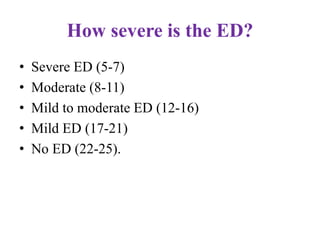
How severe is the ED?
• Severe ED (5-7)
• Moderate (8-11)
• Mild to moderate ED (12-16)
• Mild ED (17-21)
• No ED (22-25).
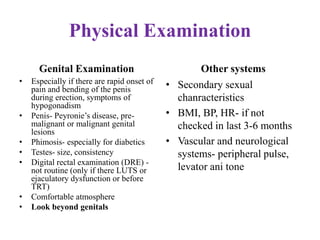
Physical Examination
Genital Examination
• Especially if there are rapid onset of
pain and bending of the penis
during erection, symptoms of
hypogonadism
• Penis- Peyronie’s disease, pre-
malignant or malignant genital
lesions
• Phimosis- especially for diabetics
• Testes- size, consistency
• Digital rectal examination (DRE) -
not routine (only if there LUTS or
ejaculatory dysfunction or before
TRT)
• Comfortable atmosphere
• Look beyond genitals
Other systems
• Secondary sexual
chanracteristics
• BMI, BP, HR- if not
checked in last 3-6 months
• Vascular and neurological
systems- peripheral pulse,
levator ani tone
Investigations
Routine/ Minimal
• HbA1c
• Lipid profile- if not assessed
in the last 12 months
• Total testosterone 8-11 AM
in the fasting condition- an
abnormal test must be
repeated after 2-3 weeks
Further
• LH- In suspected hypogonadism
• Prolactin- If low testosterone and
low or low to normal LH- In case of
unexplained elevation of prolactin,
evaluation for other endocrine
disorders (including pituitary MRI)
• Serum estradiol- If gynaecomastia
or breast symptoms- if this man
wishes to father the baby, for whom
testosterone supplementation should
not be used,
• Semen analysis- Not routine
(before TRT, if future fertility is
considered)
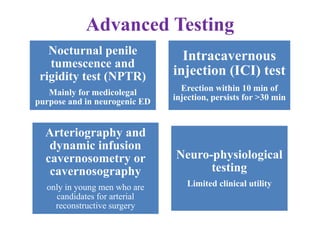
Advanced Testing
Nocturnal penile
tumescence and
rigidity test (NPTR)
Mainly for medicolegal
purpose and in neurogenic ED
Intracavernous
injection (ICI) test
Erection within 10 min of
injection, persists for >30 min
Arteriography and
dynamic infusion
cavernosometry or
cavernosography
only in young men who are
candidates for arterial
reconstructive surgery
Neuro-physiological
testing
Limited clinical utility
Duplex ultrasound of the penis
Interpretation of Doppler
Before starting treatment
Explanation
• Rationale of
investigations
• Stepwise management
• Risk of cardiac disease
• Role of partner
Phosphodiesterase-V inhibitors
Before starting PDE5i
• Exclude possible reversible causes- Hypogonadism, DM, Psychiatric illness
• Cardiac evaluation
• Non-pharmacological therapy, Pelvic floor exercise and lifestyle changes
• Explanation about the drug
1. Act ONLY after adequate sexual stimulation
2. Wait for some time (according to the medicine he is taking)- at least 15-30
minutes
3. Fatty meal impairs the absorption of sildenafil and vardenafil, but not
tadalafil. And avanafil
4. Absolute contraindications- Concomitant use of nitrate
5. Dose adjustment- In men with hepatic and renal impairment, age >65 years
and taking drugs which inhibit cytochromoe enzyme (ritonavir,
eryhthromycine etc)
6. For men with BHP- If taking alpha-blockers, the PDE-5i should be taken
after/ before alpha-blockers with a gap of at least 4-6 hours. Consider Tadalafil.
Choice of drugs
If PDE-5-I fails
Lack of efficacy
• Response rate 63-75%
• “Non-responder”- if he
fails to respond to the drug
taken on at least 6-8
occasions with maximum
dose and after adequate
sexual stimulation
Incorrect use
• Taking unlicensed drug- The
active components may vary
considerably in between the
preparations
• Lack of adequate sexual
stimulation
• Failure to wait after taking the
medicines-
• Fatty food- -sildenafil and
vardenafil
• Undiagnosed reversible cause-
Psychogenic disorder, DM,
hypogonadism, hypothyroid,
hyperprolactinaemia
Next step
• Frequent dosing regime- Regular use of PDE-5i can
salvage 50% of non-responders (Tadalafil 5 mg per day)
• Combining different PDE-5i- regular medication with
long acting drug (tadalafil) along with on-demand intake of
short acting medicines (sildenafil)- without increasing the
side effects
• Changing to different PDE-5i- Can sometimes help
• Further investigations- duplex Doppler ultrasound,
arteriography and dynamic infusion cavernosometry
• Lifestyle changes- weight, smoking, alcohol, sedentary
lifestyle
• Exclude reversible causes
Hypogonadism and ED
Low testosterone is often the reason for failure to respond to PDE-5i
Correcting low or borderline testosterone level may help to prevent
men who apparently “failure to respond” to PDE-5i from proceeding to
second and third line therapy for ED,
Testosterone supplementation can reduce the risk of CV events
Testosterone Replacement therapy (TRT)
When to start
Hypogonadism- total testosterone <12.1 nmol/L
(<300 ng/dl) or free testosterone <243 pmol/L
TRT- if total testosterone <8 nmol/L (<230
ng/dl)
Pretreatment Evaluation
Confirm diagnosis- LH, PRL, E2
BMD
Hb, HCt
Prostate check- PSA, DRE
Cardiac evaluation
Exclude contraindications
Men seeking fertility
Major CV event in last 3-6 months
Prostate disease- malignant, severe BPH
Male breast ca
HCt >50%
Monitoring
Serum Testosterone 3, 6, 12 months and then
annually (should be in the mid-tertile of the
level)
BMD-if abnormal initially- 6 and 12 months
and then annually
HCt - 3, 6, 12 months and then annually
PSA- 3, 6, 12 months and then annually
Vacuum Erection Device (VED)
VED
Advantages
• Effective in all types of ED,
particularly where PDE-5i-s
have failed or are
contraindicated
• For men who want drug-free
or infrequent intercourse
• Satisfaction rate 35-84%
• The long term compliance is
better than ICI
Disadvantages
• Penis may look bluish and may
feel cold to touch because of
obstructed venous outflow
• Pain, bruising, numbness
• Ejaculation failure, unless ring
is released
• Rarely serious risk of skin
necrosis, which can be avoided
by removing the ring within 30
minutes after intercourse
• Contraindications- bleeding
disorders or taking
anticoagulants
2nd line of treatment
Intracavernosal
Injections (ICI)
PG-E1
(Alprostadil)
Increases cAMP
FDA approved
More painful
Papaverine
Nonspecific
PDE inhibitor
Increased risk
of priapism
Phenolamine
α1-adrenergic
receptor blocker
Less side effects
Double
combination-
PGE1+
Papaverine
Triple
combination-
PGE1 +
Papaverine +
Phentolamine
Combination
of Aviptadil
(VIP) +
Phentolamine
Urethral
Suppository
ICI- pros and cons
• Initial satisfaction rate
as high as 94%.
• Efficacy 70-80%
• Requires in office
training
• Insertion site pain
(PGE1)
• Priapism- report if
erection >4 hrs
• Contraindications-
Hypersensitivity to PG,
risk of priapism,
bleeding disorder
Medical urethral System for
Erection (MUSE)
• PG-E1 pellet (0.5-1 mg) is
placed within the urethra
followed by massaging
that area
• The response-rate 56-65%
• Compliance is low
• Burning and painful
sensation in the urethra
• Rarely priapism and
fibrosis are rare
• UTI- for faulty technique
• Transfer to female partner
3rd Line of Treatment
• Penile Implants/ Prostheses
• Penile Revascularization surgery
Penile Implants
Mechanical
Easy to handle,
Low mechanical failure rates
Ideal for patients having low
manual dexterity
Can cause social
embarrassment
Two-piece Inflatable penile prostheses
(IPP))
Useful in men for whom the
placement of the abdominal
reservoir is not possible
Better flaccidity than
malleable device
Three-piece IPP
“Gold standard”
Best rigidity, girth, flaccidity
Penile Prosthesis
• Suitable mainly for men
with organic ED, caused
by diabetes, pelvic
surgery and post-priapism
• Particularly suitable for
Peyronie’s disease
• Satisfaction rate up to 92-
100%, (better than oral
PDE-5i, ICI and MUSE)
• Return to “normal” sex
life without repeated drug
therapy
• “Irreversible” and
invasive nature
• Must be medically fit with
BMI <30
• Needs expertise
• Complications-infection,
cylinder erosion, auto-
inflation, pump, reservoir
migration
• Contraindications-
Systemic, cutaneous and
urinary tract infections
Penile revascularization
Suitable candidates
• Young men (<55 years)
• Non-diabetic
• Non-smokers
• Not having concomitant
venous leak (very
important)
• Post-traumatic ED- best
prognosis
Contraindications
• Multifocal arterial disease
• Veno-occlusive diseases
• Inferior epigastric artery is anastomosed with dorsal artery of
penis
• Success rate up to 80%
• Overall satisfaction rate is much lower than IPP
• Complications- inguinal hernia, glans hyperaemia and shunt
thrombosis
Newer Therapies
• Oral agents- ROCK inhibitors and soluble guanylyl
cyclase activators- for men resistant to the oral PDE-5i
therapies (under investigation)
• Topical therapy- PG-E1 gel 300 µg (phase III trial)
• Low-Intensity Extracorporal Shock Wave
Therapy- can induce neovascularization in men
resistant to PDE-5i treatment- needs further research
• Regenerative medicine - growth factors, gene
therapy, stem cells and tissue engineering
• Penile PRP (platelet-rich-plasma)- Some clinics are
claiming high success rate
References
Take home
• ED is curable but
often undertreated
• Thorough evaluation
is needed
• Most men do well
with oral PDE5-I
• Few men require
advanced
investigations and
treatment
Erectile Dysfunction (ED)

Erectile Dysfunction (ED)

  • 1.
    Dr Sujoy Dasgupta MBBS(Gold Medalist, Hons) MS (OBGY- Gold Medalist) DNB (New Delhi) MRCOG (London) Advanced ART Course for Clinicians (NUHS, Singapore) Consultant: Reproductive Medicine, Genome Fertility Centre, Kolkata Visiting Consultant, RSV Hospital, Kolkata Bhagirathi Neotia Women and Child Care centre Woodlands Multispeciality Hospital, Kolkata Managing Committee Member, Bengal Obstetric & Gynaecological Society (BOGS) Secretary, Subfertility and Reproductive Endocrinology Committee, BOGS Executive Committee Member, Indian Fertility Society (IFS)- West Bengal Chapter Executive Committee Member, Indian Society for Assisted Reproduction (ISAR)- Bengal Winner, Prof Geoffrey Chamberlain Award, RCOG World Congress, London, 2019 Erectile Dysfunction (ED)
  • 3.
    ED- an opportunity CardiacDisease (Endothelial dysfunction) LUTS (altered cGMP) Anxiety, Depression (High Noradrenaline) Hypogonadism (Action of testosterone)
  • 4.
    Underlying Reasons forED Vasculogenic- Commonest cause •Generalized vascular diseases -dyslipidaemia, diabetes, coronary artery disease, peripheral vasculopathy, smoking, hypertension •Focal/ partial pelvic and penile arterial occlusive disease- •Veno-occlusive diseases •Major pelvic surgery or radiotherapy (pelvis or retroperitoneum)- Neurogenic •Central causes- Degenerative disorders (multiple sclerosis, Parkinson’s disease, Alzheimer disease), spinal cord trauma or diseases, CVA, tumours •Peripheral causes- Diabetic neuropathy, peripheral neuropathy, chronic renal disease, major surgery (in pelvis, retroperitoneum, colorectal and urethra) Anatomical •Phimosis, fracture penis, Peyronie’s disease, hypospadias, epispadias, micropenis, penile cancer Trauma Injury to Spinal cord & brain, radical prostectomy, penile fracture, perineal trauma Endocrine •Hypogonadism, DM, Thyroid and Adrenal disorders, Hyperprolactinaemia Drugs induced •Antihypertensives, Beta blockers, Antipsychotics, Antiarrhythmic, Anticancer Psychogenic cause •Preexisting psychological disorders- Anxiety, depression •Relationship conflict •Performance issues •Sexual dysfunction in female partner •Infertility, Timed intercourse •Infrequent intercourse- •Sex abuse •Socioeconomic condition- Decreased income and professional stress
  • 5.
    Physical or PsychologicalED? Physical Psychological Gradual Onset Sudden onset Progressive Off and on In all situations/ partners In some particular situations Inadequate response to PDE5-i Good response to PDE5-i Better erection in standing position than in lying down Precipitating/ psyological factors Morning erection low Morning erection suggests but cannot always confirm psychological eitiology
  • 6.
    Definition of ED(DSM-V) • the recurrent inability to achieve an erection, the inability to maintain an adequate erection, and/or a noticeable decrease in erectile rigidity during partnered sexual activity. • symptoms must have persisted for at least 6 months and must have occurred on at least 75% of occasions.
  • 7.
    Evaluation • Medical history •Sexual history • Addiction • Drug history • Lifestyle- Smoking, alcohol, anabolic steroid, Bicycle riding >3 hours in young men • Hypogonadism- fatigue, loss of energy, cognitive defects, bone pain • LUTS- frequency, urgency, hesitancy • Psychological screening – “During the past month have you often been bothered by feeling down, depressed or hopeless” – “During the past month have you often been bothered by little interest or pleasure, doing things?” • Cardiac risks
  • 8.
    Princeton III Consensus 1.Age 2. Hypertension 3. Type 1 and type 2 DM 4. Smoking 5. Dyslipidaemia 6. Sedentary lifestyle 7. Family history of premature cardiovascular disease
  • 9.
    All men withED are “Cardiac Patients”
  • 10.
    International Index ofErectile Function (IIEF) Questionnaire
  • 11.
    International Index ofErectile Function (IIEF-5) Question 1 2 3 4 5 1. How would you rate your confidence that you could get and keep an erection? Very Low Low Moderate High Very High 2. When you had erections with sexual stimulation, how often were your erections hard enough for penetration? Almost never or never A few times (much less than half the time) Sometimes (about half the time) Most times (much more than half the time) Always or Almost always 3. During sexual intercourse, how often were you able to maintain your erection after you had penetrated your partner? Almost never or never A few times (much less than half the time) Sometimes (about half the time) Most times (much more than half the time) Always or Almost always 4. During sexual intercourse, how difficult was it to maintain your erection to completion of intercourse? Extremely difficult Very difficult Difficult Slightly difficult Not difficult 5. When you attempted sexual intercourse, how often was it satisfactory for you? Almost never or never A few times (much less than half the time) Sometimes (about half the time) Most times (much more than half the time) Always or Almost always
  • 12.
    How severe isthe ED? • Severe ED (5-7) • Moderate (8-11) • Mild to moderate ED (12-16) • Mild ED (17-21) • No ED (22-25).
  • 13.
    Physical Examination Genital Examination •Especially if there are rapid onset of pain and bending of the penis during erection, symptoms of hypogonadism • Penis- Peyronie’s disease, pre- malignant or malignant genital lesions • Phimosis- especially for diabetics • Testes- size, consistency • Digital rectal examination (DRE) - not routine (only if there LUTS or ejaculatory dysfunction or before TRT) • Comfortable atmosphere • Look beyond genitals Other systems • Secondary sexual chanracteristics • BMI, BP, HR- if not checked in last 3-6 months • Vascular and neurological systems- peripheral pulse, levator ani tone
  • 14.
    Investigations Routine/ Minimal • HbA1c •Lipid profile- if not assessed in the last 12 months • Total testosterone 8-11 AM in the fasting condition- an abnormal test must be repeated after 2-3 weeks Further • LH- In suspected hypogonadism • Prolactin- If low testosterone and low or low to normal LH- In case of unexplained elevation of prolactin, evaluation for other endocrine disorders (including pituitary MRI) • Serum estradiol- If gynaecomastia or breast symptoms- if this man wishes to father the baby, for whom testosterone supplementation should not be used, • Semen analysis- Not routine (before TRT, if future fertility is considered)
  • 15.
    Advanced Testing Nocturnal penile tumescenceand rigidity test (NPTR) Mainly for medicolegal purpose and in neurogenic ED Intracavernous injection (ICI) test Erection within 10 min of injection, persists for >30 min Arteriography and dynamic infusion cavernosometry or cavernosography only in young men who are candidates for arterial reconstructive surgery Neuro-physiological testing Limited clinical utility
  • 16.
  • 17.
  • 18.
    Before starting treatment Explanation •Rationale of investigations • Stepwise management • Risk of cardiac disease • Role of partner
  • 19.
  • 20.
    Before starting PDE5i •Exclude possible reversible causes- Hypogonadism, DM, Psychiatric illness • Cardiac evaluation • Non-pharmacological therapy, Pelvic floor exercise and lifestyle changes • Explanation about the drug 1. Act ONLY after adequate sexual stimulation 2. Wait for some time (according to the medicine he is taking)- at least 15-30 minutes 3. Fatty meal impairs the absorption of sildenafil and vardenafil, but not tadalafil. And avanafil 4. Absolute contraindications- Concomitant use of nitrate 5. Dose adjustment- In men with hepatic and renal impairment, age >65 years and taking drugs which inhibit cytochromoe enzyme (ritonavir, eryhthromycine etc) 6. For men with BHP- If taking alpha-blockers, the PDE-5i should be taken after/ before alpha-blockers with a gap of at least 4-6 hours. Consider Tadalafil.
  • 21.
  • 22.
    If PDE-5-I fails Lackof efficacy • Response rate 63-75% • “Non-responder”- if he fails to respond to the drug taken on at least 6-8 occasions with maximum dose and after adequate sexual stimulation Incorrect use • Taking unlicensed drug- The active components may vary considerably in between the preparations • Lack of adequate sexual stimulation • Failure to wait after taking the medicines- • Fatty food- -sildenafil and vardenafil • Undiagnosed reversible cause- Psychogenic disorder, DM, hypogonadism, hypothyroid, hyperprolactinaemia
  • 23.
    Next step • Frequentdosing regime- Regular use of PDE-5i can salvage 50% of non-responders (Tadalafil 5 mg per day) • Combining different PDE-5i- regular medication with long acting drug (tadalafil) along with on-demand intake of short acting medicines (sildenafil)- without increasing the side effects • Changing to different PDE-5i- Can sometimes help • Further investigations- duplex Doppler ultrasound, arteriography and dynamic infusion cavernosometry • Lifestyle changes- weight, smoking, alcohol, sedentary lifestyle • Exclude reversible causes
  • 24.
    Hypogonadism and ED Lowtestosterone is often the reason for failure to respond to PDE-5i Correcting low or borderline testosterone level may help to prevent men who apparently “failure to respond” to PDE-5i from proceeding to second and third line therapy for ED, Testosterone supplementation can reduce the risk of CV events
  • 25.
    Testosterone Replacement therapy(TRT) When to start Hypogonadism- total testosterone <12.1 nmol/L (<300 ng/dl) or free testosterone <243 pmol/L TRT- if total testosterone <8 nmol/L (<230 ng/dl) Pretreatment Evaluation Confirm diagnosis- LH, PRL, E2 BMD Hb, HCt Prostate check- PSA, DRE Cardiac evaluation Exclude contraindications Men seeking fertility Major CV event in last 3-6 months Prostate disease- malignant, severe BPH Male breast ca HCt >50% Monitoring Serum Testosterone 3, 6, 12 months and then annually (should be in the mid-tertile of the level) BMD-if abnormal initially- 6 and 12 months and then annually HCt - 3, 6, 12 months and then annually PSA- 3, 6, 12 months and then annually
  • 26.
  • 27.
    VED Advantages • Effective inall types of ED, particularly where PDE-5i-s have failed or are contraindicated • For men who want drug-free or infrequent intercourse • Satisfaction rate 35-84% • The long term compliance is better than ICI Disadvantages • Penis may look bluish and may feel cold to touch because of obstructed venous outflow • Pain, bruising, numbness • Ejaculation failure, unless ring is released • Rarely serious risk of skin necrosis, which can be avoided by removing the ring within 30 minutes after intercourse • Contraindications- bleeding disorders or taking anticoagulants
  • 28.
    2nd line oftreatment Intracavernosal Injections (ICI) PG-E1 (Alprostadil) Increases cAMP FDA approved More painful Papaverine Nonspecific PDE inhibitor Increased risk of priapism Phenolamine α1-adrenergic receptor blocker Less side effects Double combination- PGE1+ Papaverine Triple combination- PGE1 + Papaverine + Phentolamine Combination of Aviptadil (VIP) + Phentolamine Urethral Suppository
  • 29.
    ICI- pros andcons • Initial satisfaction rate as high as 94%. • Efficacy 70-80% • Requires in office training • Insertion site pain (PGE1) • Priapism- report if erection >4 hrs • Contraindications- Hypersensitivity to PG, risk of priapism, bleeding disorder
  • 30.
    Medical urethral Systemfor Erection (MUSE) • PG-E1 pellet (0.5-1 mg) is placed within the urethra followed by massaging that area • The response-rate 56-65% • Compliance is low • Burning and painful sensation in the urethra • Rarely priapism and fibrosis are rare • UTI- for faulty technique • Transfer to female partner
  • 31.
    3rd Line ofTreatment • Penile Implants/ Prostheses • Penile Revascularization surgery
  • 32.
    Penile Implants Mechanical Easy tohandle, Low mechanical failure rates Ideal for patients having low manual dexterity Can cause social embarrassment Two-piece Inflatable penile prostheses (IPP)) Useful in men for whom the placement of the abdominal reservoir is not possible Better flaccidity than malleable device Three-piece IPP “Gold standard” Best rigidity, girth, flaccidity
  • 33.
    Penile Prosthesis • Suitablemainly for men with organic ED, caused by diabetes, pelvic surgery and post-priapism • Particularly suitable for Peyronie’s disease • Satisfaction rate up to 92- 100%, (better than oral PDE-5i, ICI and MUSE) • Return to “normal” sex life without repeated drug therapy • “Irreversible” and invasive nature • Must be medically fit with BMI <30 • Needs expertise • Complications-infection, cylinder erosion, auto- inflation, pump, reservoir migration • Contraindications- Systemic, cutaneous and urinary tract infections
  • 34.
    Penile revascularization Suitable candidates •Young men (<55 years) • Non-diabetic • Non-smokers • Not having concomitant venous leak (very important) • Post-traumatic ED- best prognosis Contraindications • Multifocal arterial disease • Veno-occlusive diseases
  • 35.
    • Inferior epigastricartery is anastomosed with dorsal artery of penis • Success rate up to 80% • Overall satisfaction rate is much lower than IPP • Complications- inguinal hernia, glans hyperaemia and shunt thrombosis
  • 36.
    Newer Therapies • Oralagents- ROCK inhibitors and soluble guanylyl cyclase activators- for men resistant to the oral PDE-5i therapies (under investigation) • Topical therapy- PG-E1 gel 300 µg (phase III trial) • Low-Intensity Extracorporal Shock Wave Therapy- can induce neovascularization in men resistant to PDE-5i treatment- needs further research • Regenerative medicine - growth factors, gene therapy, stem cells and tissue engineering • Penile PRP (platelet-rich-plasma)- Some clinics are claiming high success rate
  • 37.
  • 38.
    Take home • EDis curable but often undertreated • Thorough evaluation is needed • Most men do well with oral PDE5-I • Few men require advanced investigations and treatment