
Erectile Dysfunction
Dr. DOHA RASHEEDY ALY
Lecturer of Geriatric Medicine
Department of Geriatric and Gerontology
Ain Shams University
Physiologic changes in sexual
function with aging in men
• Testosterone levels gradually decline.
• More time is required for penile stimulation to
obtain and maintain a sufficient erection
• Prolongation of the plateau phase
• Orgasm becomes weaker with shorter intervals
• Reduction of semen volume.
• In the resolution stage, penile detumescence
occurs rapidly.
• Prolongation in the refractory period in the
interval between erections.
• ED is the persistent inability to attain or maintain a penile
erection sufficient for satisfactory sexual performance.
• There is no consensus on how often, or for what length
of time, the problem has to occur to meet this definition.
A duration of greater than 3 months or more than 25% of
attempts has been suggested as a reasonable clinical
guideline.
Physiology of Erection
• The male sexual cycle can be considered to have 4 phases:
sexual desire (libido), arousal (erection), ejaculation
(orgasm), and detumescence (penile flaccidity).
• Psychogenic and reflexogenic mechanisms play a role in this
chain of events.
• Psychogenic erections are triggered centrally in response to
visual, auditory, olfactory, or imaginary stimuli.
Reflexogenic erections are brought on peripherally by
stimulation of sensory receptors on the penis, involving
somatic and parasympathetic efferent actions via spinal
pathways.
• On a biochemical level, the parasympathetic activity
sets off the release of nitric oxide (NO), eventually
resulting in increased levels of the intracellular
mediator cyclic guanosine monophosphate (cGMP),
which in turn causes penile vascular and trabecular
smooth muscle relaxation.
• In the flaccid state, the penis maintains a balance
between the blood flowing into the corpora cavernosa
and the corpus spongiosum and the blood flowing out
via postcavernous venules that eventually drain into
the deep dorsal vein.
• During an erection, the blood flowing into the erectile
tissue increases considerably, compressing the venules
and restricting venous outflow, and eventually resulting
in full penile rigidity.
Pathophysiology of Erectile
Dysfunction
• The cause of erectile dysfunction is primarily
organic; however, psychogenic causes cannot be
ruled out as part of a differential diagnosis.
• vascular diseases.
• Neurologic diseases.
• Psychological disorders.
• Endocrine disorders.
• Structural abnormalities.
• Drugs.
vascular diseases
• vascular disease is the commonest cause of erectile dysfunction.
• There are two primary mechanisms by which vascular disease causes
erectile dysfunction: arterial insufficiency and venous leakage.
• Atherosclerotic arterial occlusive disease decreases perfusion
pressure and arterial flow to the lacunar spaces necessary to achieve
a rigid erection. ED may be the initial sign of serious vascular
disease, preceding MI or stroke.
• Ischemia also results in replacement of smooth muscle by connective
tissue, which results in impaired cavernosal expandability.
• Venous leakage, excessive outflow through the subtunical
venules, prevents the development of high pressure within the
corpora cavernosa necessary for a rigid erection. It is caused by an
increased number of venous outflow channels, decreased compliance
of trabeculae with inability to compress the subtunical venules, and
insufficient relaxation of trabecular smooth muscle.
Neurologic Disease
• Neurologic disease accounts for the second most
common cause of ED in older men.
• It results from disorders of the parasympathetic
sacral spinal cord or peripheral efferent
autonomic fibers to the penis, which impair penile
smooth muscle relaxation and prevent the
vasodilation needed for erection.
• Common neurologic causes of ED in older men
include autonomic dysfunction from diabetes
mellitus, stroke, or Parkinson’s disease, and injury
to autonomic nerves from radical prostatectomy
or proctocolectomy.
Medications
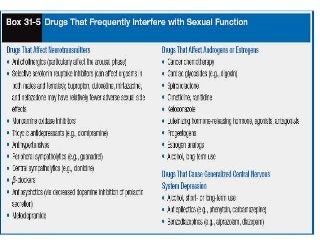
• antihypertensives, antidepressants, antipsychotics,
and anticholinergic medications, may predispose
an individual to erectile dysfunction.
• Abusive drugs, such as alcohol, heroin, cocaine,
and tobacco,have been associated with male
sexual dysfunction
Psychosocial disorders
• psychogenic causes should not be neglected if testing for
organic causes is not fruitful.
• In addition to physical changes, psychosocial changes affect the
sexual lives of older persons. The loss of a sex partner through
divorce, mental or physical illness, or death can affect sexual
functioning.
• Role changes imposed by retirement or job loss can lead to
boredom, low self-esteem, and lack of confidence.
• Specific types of psychogenic erectile dysfunction include
performance anxiety and fear of sexually transmitted diseases.
Widower’s syndrome is a defense mechanism whereby the
widower develops erectile dysfunction secondary to guilt
feelings relating to his dead spouse, which prevents erection.
• Depression is frequently correlated with decreases in sexual
desire or function, while some antidepressants can increase
sexual dysfunction.
Endocrine disorders
• Hypogonadism
• Hyperprolactinemia decreases serum testosterone
concentration due to inhibition of gonadotropin-
releasing hormone secretion.
• Hypothyroidism may also cause ED via elevated
prolactin and low testosterone levels.
• Hyperthyroidism is more associated with a decline in
libido than with ED.
• Chronic alcoholism can cause ED via toxicity at the
hypothalamic-pituitary-gonadal levels, or peripheral
and autonomic neuropathy.
• Severe chronic obstructive lung disease with hypoxia
suppresses the hypothalamic-pituitary-gonadal axis
Structural abnormalities
• Peyronie disease
• Epispadias
• Priapism
Diagnostic Evaluation
• Initial evaluation should include:
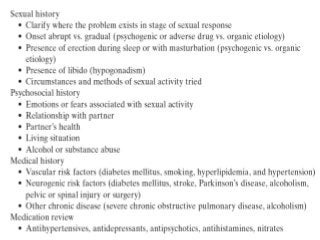
• A sexual, psychosocial, and medical history,
medication review.
• Focused physical exam.
• Diagnostic tests.
The physical exam
• should search for signs of vascular disease (absent
peripheral pulses, femoral bruits).
• neurologic disease (penile or peripheral
neuropathy).
• penile plaques.
• hypogonadism (testicular atrophy, gynecomastia),
• evidence of undiagnosed thyroid disease
Laboratory tests
• Blood glucose, cholesterol
• Testosterone, prolactin, luteinizing hormone
• Thyroid-stimulating hormone
• A variety of additional testing modalities to
assess erectile function are available (e.g.,
nocturnal penile tumescence, intracavernous
injection, penile brachial blood pressure index
measurements, duplex ultrasonography,
penile cavernosography).
Treatment
• Therapy for ED includes risk factor modification, followed by
counseling and, when necessary, medication. Lifestyle
interventions such as healthy eating, weight loss, smoking
cessation, moderation of alcohol intake, and increased physical
activity have been shown to benefit men with ED by reducing the
markers of inflammation and improving endothelial function.
• Regardless of the primary cause of ED, there is often a coexisting
psychological element. Education, support, and reassurance may
be all that is needed to restore sexual function.
• Therapeutic options for ED include (1) external
vacuum tumescence devices, (2) oral
pharmacotherapy, (3) intracorporeal or
intraurethral pharmacotherapy, (4) penile
prostheses, or (5) for hypogonadal
men, testosterone.
Constriction rings
• which are made of rubber, slow venous
outflow at the base of the penis and may be
useful for men who can obtain erections but
cannot sustain them.
• Constriction rings can produce local
discomfort and, if too tight, difficulty with
ejaculation.
VACUUM THERAPY
• This involves placing a cylinder over an
unerect penis, sucking out air to produce an
erection, and applying a wide rubber band at
the base to maintain the erection. One third
of individuals who try vacuum devices find
them helpful. They should not be used by men
taking anticoagulants or those who have low
platelet counts.
oral pharmacotherapy
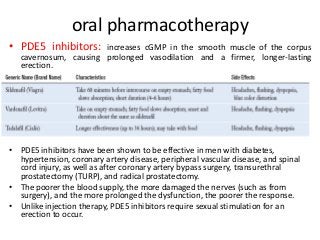
• PDE5 inhibitors: increases cGMP in the smooth muscle of the corpus
cavernosum, causing prolonged vasodilation and a firmer, longer-lasting
erection.
• PDE5 inhibitors have been shown to be effective in men with diabetes,
hypertension, coronary artery disease, peripheral vascular disease, and spinal
cord injury, as well as after coronary artery bypass surgery, transurethral
prostatectomy (TURP), and radical prostatectomy.
• The poorer the blood supply, the more damaged the nerves (such as from
surgery), and the more prolonged the dysfunction, the poorer the response.
• Unlike injection therapy, PDE5 inhibitors require sexual stimulation for an
erection to occur.
• concomitant use of nitrates is an absolute contraindication PDE5
inhibition potentiates the hypotensive effects of nitrates.
• The use of alpha adrenergic blockers also increases the risk for
hypotension and generally should be avoided.
• Relative contraindications include MI, stroke, or dysrhythmia
within the past 6 months; poorly controlled hypertension or
hypotension; uncompensated cardiac failure; unstable angina; a
predisposition to priapism; and retinitis pigmentosa.
• The most common side effects reported include headache,
flushing, dyspepsia, and nasal congestion. The inhibition of
phosphodiesterase 6 in the retina by sildenafil may cause altered
color vision–usually a blue tinge—or increased sensitivity to light
in some men.
• Yohimbine is an oral alpha-2 adrenergic-receptor
blocker that may improve erectile function better
than placebo, particularly in psychogenic
impotence.
• Studies remain ongoing for the use of
phentolamine, apomorphine, dopaminergic, and
many other agents.
INTRACORPOREAL OR INTRAURETHRAL
PHARMACOTHERAPY
• injection into the corpora cavernosa of
prostaglandin E1, papaverine, phentolamine, or
some combination of the three.
• Complications: prolonged erection (priapism) or
penile fibrosis,brusing.
• Prostaglandin E1 (alprostadil) can also be
administered intraurethrally as a small pellet. This
method relies on absorption from the
submucosal veins of the urethra that
communicate between the corpus spongiosum
and the corpora cavernosa.
IMPLANT
• A permanent penile prosthesis may help a patient
with an otherwise untreatable potency problem.
Such a prosthesis is irreversible and therefore should
be used only as a last resort.
• Penile implants can be noninflatable (positionable or
semirigid rod prosthesis) and inflatable.
• Contraindications to this treatment include
psychiatric problems such as psychosis and
untreated depression.
• Complications include infection, mechanical failure,
and penile fibrosis.
• Testosterone supplementation should be reserved
for men diagnosed with hypogonadism.
Penile revascularization surgery
• (especially arterial) is relatively experimental
and has not been found to have high success
rates.
• With venous disease, ligation surgery may
afford benefit in the short run.
Herbal remedies and alternative
medicine
• Although many herbal therapies are used for ED,
their efficacy and safety have yet to be properly
validated, and they are not clinically approved.
• Korean red ginseng, Korean black raspberry.
• acupuncture is an alternative treatment of ED,
but found insufficient evidence to suggest it as an
effective intervention and recommended further
research on its potential benefits.
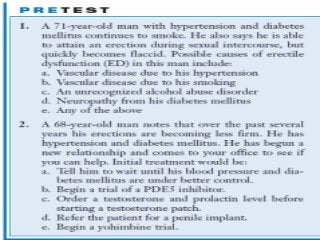
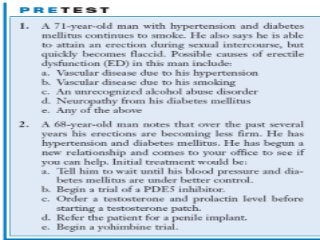
Answers
• 1-e
• 2-b
Thank you

Impotence

  • 1.
    Erectile Dysfunction Dr. DOHARASHEEDY ALY Lecturer of Geriatric Medicine Department of Geriatric and Gerontology Ain Shams University
  • 3.
    Physiologic changes insexual function with aging in men • Testosterone levels gradually decline. • More time is required for penile stimulation to obtain and maintain a sufficient erection • Prolongation of the plateau phase • Orgasm becomes weaker with shorter intervals • Reduction of semen volume. • In the resolution stage, penile detumescence occurs rapidly. • Prolongation in the refractory period in the interval between erections.
  • 4.
    • ED isthe persistent inability to attain or maintain a penile erection sufficient for satisfactory sexual performance. • There is no consensus on how often, or for what length of time, the problem has to occur to meet this definition. A duration of greater than 3 months or more than 25% of attempts has been suggested as a reasonable clinical guideline.
  • 5.
    Physiology of Erection •The male sexual cycle can be considered to have 4 phases: sexual desire (libido), arousal (erection), ejaculation (orgasm), and detumescence (penile flaccidity). • Psychogenic and reflexogenic mechanisms play a role in this chain of events. • Psychogenic erections are triggered centrally in response to visual, auditory, olfactory, or imaginary stimuli. Reflexogenic erections are brought on peripherally by stimulation of sensory receptors on the penis, involving somatic and parasympathetic efferent actions via spinal pathways.
  • 6.
    • On abiochemical level, the parasympathetic activity sets off the release of nitric oxide (NO), eventually resulting in increased levels of the intracellular mediator cyclic guanosine monophosphate (cGMP), which in turn causes penile vascular and trabecular smooth muscle relaxation. • In the flaccid state, the penis maintains a balance between the blood flowing into the corpora cavernosa and the corpus spongiosum and the blood flowing out via postcavernous venules that eventually drain into the deep dorsal vein. • During an erection, the blood flowing into the erectile tissue increases considerably, compressing the venules and restricting venous outflow, and eventually resulting in full penile rigidity.
  • 7.
    Pathophysiology of Erectile Dysfunction •The cause of erectile dysfunction is primarily organic; however, psychogenic causes cannot be ruled out as part of a differential diagnosis. • vascular diseases. • Neurologic diseases. • Psychological disorders. • Endocrine disorders. • Structural abnormalities. • Drugs.
  • 8.
    vascular diseases • vasculardisease is the commonest cause of erectile dysfunction. • There are two primary mechanisms by which vascular disease causes erectile dysfunction: arterial insufficiency and venous leakage. • Atherosclerotic arterial occlusive disease decreases perfusion pressure and arterial flow to the lacunar spaces necessary to achieve a rigid erection. ED may be the initial sign of serious vascular disease, preceding MI or stroke. • Ischemia also results in replacement of smooth muscle by connective tissue, which results in impaired cavernosal expandability. • Venous leakage, excessive outflow through the subtunical venules, prevents the development of high pressure within the corpora cavernosa necessary for a rigid erection. It is caused by an increased number of venous outflow channels, decreased compliance of trabeculae with inability to compress the subtunical venules, and insufficient relaxation of trabecular smooth muscle.
  • 9.
    Neurologic Disease • Neurologicdisease accounts for the second most common cause of ED in older men. • It results from disorders of the parasympathetic sacral spinal cord or peripheral efferent autonomic fibers to the penis, which impair penile smooth muscle relaxation and prevent the vasodilation needed for erection. • Common neurologic causes of ED in older men include autonomic dysfunction from diabetes mellitus, stroke, or Parkinson’s disease, and injury to autonomic nerves from radical prostatectomy or proctocolectomy.
  • 10.
    Medications • antihypertensives, antidepressants,antipsychotics, and anticholinergic medications, may predispose an individual to erectile dysfunction. • Abusive drugs, such as alcohol, heroin, cocaine, and tobacco,have been associated with male sexual dysfunction
  • 12.
    Psychosocial disorders • psychogeniccauses should not be neglected if testing for organic causes is not fruitful. • In addition to physical changes, psychosocial changes affect the sexual lives of older persons. The loss of a sex partner through divorce, mental or physical illness, or death can affect sexual functioning. • Role changes imposed by retirement or job loss can lead to boredom, low self-esteem, and lack of confidence. • Specific types of psychogenic erectile dysfunction include performance anxiety and fear of sexually transmitted diseases. Widower’s syndrome is a defense mechanism whereby the widower develops erectile dysfunction secondary to guilt feelings relating to his dead spouse, which prevents erection. • Depression is frequently correlated with decreases in sexual desire or function, while some antidepressants can increase sexual dysfunction.
  • 13.
    Endocrine disorders • Hypogonadism •Hyperprolactinemia decreases serum testosterone concentration due to inhibition of gonadotropin- releasing hormone secretion. • Hypothyroidism may also cause ED via elevated prolactin and low testosterone levels. • Hyperthyroidism is more associated with a decline in libido than with ED. • Chronic alcoholism can cause ED via toxicity at the hypothalamic-pituitary-gonadal levels, or peripheral and autonomic neuropathy. • Severe chronic obstructive lung disease with hypoxia suppresses the hypothalamic-pituitary-gonadal axis
  • 14.
    Structural abnormalities • Peyroniedisease • Epispadias • Priapism
  • 15.
    Diagnostic Evaluation • Initialevaluation should include: • A sexual, psychosocial, and medical history, medication review. • Focused physical exam. • Diagnostic tests.
  • 17.
    The physical exam •should search for signs of vascular disease (absent peripheral pulses, femoral bruits). • neurologic disease (penile or peripheral neuropathy). • penile plaques. • hypogonadism (testicular atrophy, gynecomastia), • evidence of undiagnosed thyroid disease
  • 18.
    Laboratory tests • Bloodglucose, cholesterol • Testosterone, prolactin, luteinizing hormone • Thyroid-stimulating hormone
  • 19.
    • A varietyof additional testing modalities to assess erectile function are available (e.g., nocturnal penile tumescence, intracavernous injection, penile brachial blood pressure index measurements, duplex ultrasonography, penile cavernosography).
  • 20.
    Treatment • Therapy forED includes risk factor modification, followed by counseling and, when necessary, medication. Lifestyle interventions such as healthy eating, weight loss, smoking cessation, moderation of alcohol intake, and increased physical activity have been shown to benefit men with ED by reducing the markers of inflammation and improving endothelial function. • Regardless of the primary cause of ED, there is often a coexisting psychological element. Education, support, and reassurance may be all that is needed to restore sexual function.
  • 21.
    • Therapeutic optionsfor ED include (1) external vacuum tumescence devices, (2) oral pharmacotherapy, (3) intracorporeal or intraurethral pharmacotherapy, (4) penile prostheses, or (5) for hypogonadal men, testosterone.
  • 22.
    Constriction rings • whichare made of rubber, slow venous outflow at the base of the penis and may be useful for men who can obtain erections but cannot sustain them. • Constriction rings can produce local discomfort and, if too tight, difficulty with ejaculation.
  • 23.
    VACUUM THERAPY • Thisinvolves placing a cylinder over an unerect penis, sucking out air to produce an erection, and applying a wide rubber band at the base to maintain the erection. One third of individuals who try vacuum devices find them helpful. They should not be used by men taking anticoagulants or those who have low platelet counts.
  • 24.
    oral pharmacotherapy • PDE5inhibitors: increases cGMP in the smooth muscle of the corpus cavernosum, causing prolonged vasodilation and a firmer, longer-lasting erection. • PDE5 inhibitors have been shown to be effective in men with diabetes, hypertension, coronary artery disease, peripheral vascular disease, and spinal cord injury, as well as after coronary artery bypass surgery, transurethral prostatectomy (TURP), and radical prostatectomy. • The poorer the blood supply, the more damaged the nerves (such as from surgery), and the more prolonged the dysfunction, the poorer the response. • Unlike injection therapy, PDE5 inhibitors require sexual stimulation for an erection to occur.
  • 25.
    • concomitant useof nitrates is an absolute contraindication PDE5 inhibition potentiates the hypotensive effects of nitrates. • The use of alpha adrenergic blockers also increases the risk for hypotension and generally should be avoided. • Relative contraindications include MI, stroke, or dysrhythmia within the past 6 months; poorly controlled hypertension or hypotension; uncompensated cardiac failure; unstable angina; a predisposition to priapism; and retinitis pigmentosa. • The most common side effects reported include headache, flushing, dyspepsia, and nasal congestion. The inhibition of phosphodiesterase 6 in the retina by sildenafil may cause altered color vision–usually a blue tinge—or increased sensitivity to light in some men.
  • 26.
    • Yohimbine isan oral alpha-2 adrenergic-receptor blocker that may improve erectile function better than placebo, particularly in psychogenic impotence. • Studies remain ongoing for the use of phentolamine, apomorphine, dopaminergic, and many other agents.
  • 27.
    INTRACORPOREAL OR INTRAURETHRAL PHARMACOTHERAPY •injection into the corpora cavernosa of prostaglandin E1, papaverine, phentolamine, or some combination of the three. • Complications: prolonged erection (priapism) or penile fibrosis,brusing. • Prostaglandin E1 (alprostadil) can also be administered intraurethrally as a small pellet. This method relies on absorption from the submucosal veins of the urethra that communicate between the corpus spongiosum and the corpora cavernosa.
  • 28.
    IMPLANT • A permanentpenile prosthesis may help a patient with an otherwise untreatable potency problem. Such a prosthesis is irreversible and therefore should be used only as a last resort. • Penile implants can be noninflatable (positionable or semirigid rod prosthesis) and inflatable. • Contraindications to this treatment include psychiatric problems such as psychosis and untreated depression. • Complications include infection, mechanical failure, and penile fibrosis.
  • 29.
    • Testosterone supplementationshould be reserved for men diagnosed with hypogonadism.
  • 30.
    Penile revascularization surgery •(especially arterial) is relatively experimental and has not been found to have high success rates. • With venous disease, ligation surgery may afford benefit in the short run.
  • 31.
    Herbal remedies andalternative medicine • Although many herbal therapies are used for ED, their efficacy and safety have yet to be properly validated, and they are not clinically approved. • Korean red ginseng, Korean black raspberry. • acupuncture is an alternative treatment of ED, but found insufficient evidence to suggest it as an effective intervention and recommended further research on its potential benefits.
  • 33.
  • 34.