
Priapism
           Dr Atef M Solimann
               Urosurgeon
                  MBH

04/10/12                        1
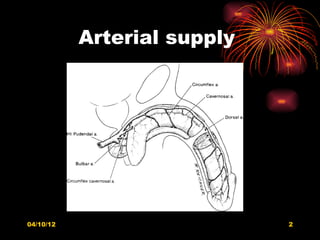
Arterial supply


04/10/12                     2
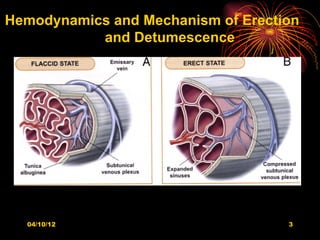
Hemodynamics and Mechanism of Erection
           and Detumescence


  04/10/12                          3
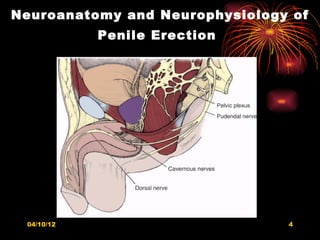
Neuroanatomy and Neurophysiology of
            Penile Erection


 04/10/12                       4
Neuroanatomy and Neurophysiology of Penile Erection
                      cont.

  Most researchers now agree
 that NO released from
 nonadrenergic,
 noncholinergic
 neurotransmission and from
 the endothelium is the
 principal neurotransmitter
 mediating penile erection. NO
 increases the production of
 cGMP, which in turn relaxes
 the cavernous smooth muscle
  (Trigo-Rocha et al, 1993a, 1993b).
04/10/12                                        5
•    DEFINITION   
•    EPIDEMIOLOGY   
•    ETIOLOGY   
•    NATURAL HISTORY   
•    PATHOLOGY   
•    PATHOPHYSIOLOGY   
•    CLASSIFICATION   
•    DIAGNOSIS   
•    TREATMENT   
•    SUMMARY
    04/10/12              6
DEFINITION
• Is a pathologic condition of penile erection
  characterized as prolonged and devoid of
  sexual stimulation or excitement ( Berger et al,
   2001 and Montague et al, 2003 ).
• Priapism of the clitoris has also been
  described in the medical literature ( Monllor et
   al, 1996 ).
• Pain is a common descriptor, perceived to
  be a consequence of genital tissue
  ischemia and increased pressure
  generated within the corporal bodies,
  although this feature is not a requirement
  for the designation of priapism.

04/10/12                                         7
EPIDEMIOLOGY

    Cohort studies involving
   populations with sickle
   disease demonstrate
   lifetime probabilities for
   development of priapism to
   be between 29% and 42%
           (Adeyoju et al, 2002 ).


04/10/12                             8
ETIOLOGY


1- Hematologic
 Dyscrasias
   Sickle cell disease 23% of adult,
   63% of pediatric cases, Leukemia
   50% of patients with this disease,
   Asplenism, Erythropoietin,
   hypercoagulable states, total
   parenteral nutrition containing 20%
04/10/12 emulsion
   fat                                   9
ETIOLOGY cont.
2- Neurologic Conditions

  Neurologic infections such as syphilis, brain tumors,
 epilepsy, intoxication, and brain and spinal cord injury
 ( Hinman, 1914 and Munro et al, 1948 ).


 Anesthesia, either general or regional (spinal or epidural)
 administration, with genital manipulation as part of the
 surgical procedure
 (Shantha et al, 1989 and Dittrich et al, 1991 ).

   04/10/12                                                 10
ETIOLOGY cont.


3- Nonhematologic Malignant
  Neoplasms
  Local primary or metastatic neoplastic processes are also
 known to carry priapism risks. Organs of cancer origin
 include penis, urethra, prostate, bladder, kidney, and
 rectosigmoid colon

    (Morga Egea et al, 2000 and Hettiarachchi et al, 2001 ).


   04/10/12                                           11
ETIOLOGY cont.


4-Trauma

   Priapism has been associated with direct
   penile and perineal trauma (straddle injury
   or direct scrotal trauma) ( Burt et al, 1960 ;
   Hinman, 1960 ) as well as traumatic needle
   insertion with intracavernosal
   pharmacotherapy      ( Witt et al, 1990 ).


04/10/12                                            12
ETIOLOGY cont.


5- Erectile Dysfunction
 Pharmacotherapy
 Lomas and Jarow (1992) defined the risk profile of priapism
 in this setting, finding that younger men with better baseline
 erectile function, patients with overt neurologic disease, and
 patients without significant cardiovascular disease were
 most susceptible.


   04/10/12                                              13
ETIOLOGY cont.
6- Pharmacologic Exposures

A- Antihypertensive agents:
Hydralazine and guanethidine ( Rubin, 1968 ) and α-adrenergic antagonists
 (Vaidyanathan et al, 1998 ).


B- Psychotropic and antidepressant medications:
Phenothiazines, sedative-hypnotics, SSRI, and trazodone (Compton and Miller,
  2001 ).


C- Other medications:
 Heavy alcohol intake (Kulmala et al, 1995b), Topical and intranasal cocaine
 administration (Altman et al, 1999 ), Immunosuppressant agent FK506
 (tacrolimus) ( Harmon et al, 1999 ), androgen supplements (Zargooshi, 2000 ),
 and scorpion toxin ( Teixeira et al, 2004 ).


    04/10/12                                                         14
ETIOLOGY cont.


7- Idiopathic
   Some investigators have estimated that this
   disorder accounts for as many as half of all
   documented cases ( Larocque and Cosgrove, 1974 ;
   Pohl et al, 1986 ; Winter and McDowell, 1988 ).


04/10/12                                         15
NATURAL HISTORY
• Outcome: is either its permanent resolution
  or its progression to recurrent episodes with
  or without some degree of erectile
  impairment.

• In the absence of effective treatment, it has
  long been recognized that even major
  episodes of ischemic priapism will
  eventually resolve in time, although
  permanent damage of the penis may be
  expected.

• It is perceived that individuals with
  nonischemic priapism generally preserve
  erectile ability.
   04/10/12                               16
PATHOLOGY
• Penile tissue necrosis and progressive
  fibrosis are the end-stage
  manifestations of ischemic priapism, (
  Hinman, 1960 ).


• The irreversible effects resulted
  most consistently from the
  combination of hypoxia, acidosis,
  and glucopenia at a time interval
  of 4 hours (Muneer and
  associates, 2005) .
   04/10/12                      17
PATHOPHYSIOLOGY
• Vascular stasis in the penis and decreased
  venous outflow from the organ were the
  primary circumstances that mechanically or
  physically interfered with detumescence
  ( Hinman,1960).

• Fistula formation (cavernous artery and lacunar
  spaces of the cavernous tissue), which allows
  blood to bypass the normal cavernous
  arteriolar bed, then accounts for
  traumatically induced priapism (Hakim et
  al, 1996).
   04/10/12                                 18
CLASSIFICATION
• Ischemic (low flow) Priapism

• Nonischemic (high flow) Priapism


  04/10/12                       19
CLASSIFICATION cont.


           Priapism Variants
1-   Recurrent (Stuttering) Priapism
2-   Refractory Priapism
3-   Neurogenic Priapism
4-   Idiopathic Priapism
5- Drug-Induced Priapism


04/10/12                               20
DIAGNOSIS
                             History
Pain, duration of priapism (< or >4hrs), prior priapism, use and
  success of relieving maneuvers or prior clinical treatments,
  existence of etiologic conditions, and erectile function
  status before the priapism episode.


                 Physical Examination
Inspection and palpation of the penis:
   extent of tumescence or rigidity, corporal body involvement
  (i.e., whether rigidity involves only the corpora cavernosa
  with a soft glans penis and corpus spongiosum or all three
  corporal bodies).


Abdominal, perineal, and DRE may reveal signs of trauma or malignant
  disease.
     04/10/12                                                 21
DIAGNOSIS cont.
               Laboratory Testing

 CBC, white blood cell differential, and platelet count
(acute infections or hematologic abnormalities).

 Reticulocyte count and hemoglobin electrophoresis
(sickle cell disease or trait and hemoglobinopathies)

Screening for psychoactive drugs and urine
toxicology to identify overdoses of legal and illegal
drugs may also be performed.
             Berger et al, 2001 ; Montague et al, 2003

  04/10/12                                               22
DIAGNOSIS cont.
            Penile Diagnostics

1- Aspirates should be visually inspected

Patients with ischemic priapism, the blood is
hypoxic and therefore dark, whereas that of
patients with nonischemic priapism is oxygenated
and therefore bright red.


 04/10/12                                   23
DIAGNOSIS cont.
                Penile Diagnostics cont.
          2- Cavernous blood gas testing


• Normal flaccid penis cavernous blood gas levels:
  normal mixed venous blood at room air (Po2 of 40 mm
  Hg, Pco2 of 50 mm Hg, and pH of 7.35) ( Montague et al,
  2003 ).

• Cavernous blood gas in patients with ischemic
  priapism: Po2 <30 mm Hg, Pco2 >60 mm Hg, and pH
  below 7.25


• Cavernous blood gas in patients with nonischemic
  priapism (normal arterial blood at room air ): Po2 > 90
  mm Hg, Pco2 < 40 mm Hg, and pH of 7.40 (Montague et
    04/10/12                                       24
  al, 2003 ).
DIAGNOSIS cont.
                 Radiologic Evaluation

1- Color duplex ultrasonography
(lithotomy or frogleg position, scanning the perineum first and then the entire
   penile shaft).

Ischemic priapism have minimal or absent blood flow in
  the cavernosal arteries and the corpora cavernosa.
Nonischemic priapism have normal to high blood flow
  velocities in the cavernosal arteries and the corpora
  cavernosa.

Anatomic abnormalities: cavernous arterial fistula or
  pseudoaneurysm, to confirm the diagnosis of nonischemic
  priapism.
(Hakim et al, 1996 ).

      04/10/12                                                           25
DIAGNOSIS cont.
             Radiologic Evaluation cont

2- Arteriography:
  Not routinely used for diagnosis
 and is otherwise usually
 performed as part of an
 embolization procedure.


  04/10/12                                26
TREATMENT


               I- Ischemic Priapism

In general, since ischemic priapism of more than 4
  hours in duration irrespective of etiology implies a
  compartment syndrome, decompression of the
  corpora cavernosa is recommended for
  counteracting the ischemic effects including pain
  sensations (Montague et al, 2003 ).

    04/10/12                                    27
TREATMENT cont.
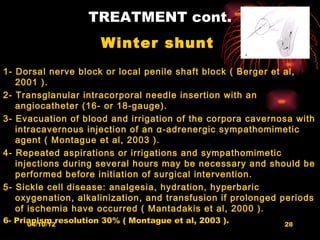
                      Winter shunt
1- Dorsal nerve block or local penile shaft block ( Berger et al,
   2001 ).
2- Transglanular intracorporal needle insertion with an
   angiocatheter (16- or 18-gauge).
3- Evacuation of blood and irrigation of the corpora cavernosa with
   intracavernous injection of an α-adrenergic sympathomimetic
   agent ( Montague et al, 2003 ).
4- Repeated aspirations or irrigations and sympathomimetic
   injections during several hours may be necessary and should be
   performed before initiation of surgical intervention.
5- Sickle cell disease: analgesia, hydration, hyperbaric
   oxygenation, alkalinization, and transfusion if prolonged periods
   of ischemia have occurred ( Mantadakis et al, 2000 ).
6- Priapism resolution 30% ( Montague et al, 2003 ).
      04/10/12                                               28
TREATMENT cont.
1- Sympathomimetics (α-adrenergic agents)
  contractile effects on the cavernous tissue

  (Blood pressure and ECG monitoring in patients with
  high cardiovascular risk) (Montague et al, 2003 ).

A- Phenylephrine:
α1-selective adrenergic agonist < the risk of
  cardiovascular side effects, 100-200 mg
  every 5-10 min until detumescence
  (maximum 1000 μg)


B- Epinephrine α, β agonist 10-20 μg every 5-10 min
  until detumescence

    04/10/12                                    29
TREATMENT cont.

2- Antiandrogens (Hormonal)
A-Gonadotropin-releasing hormone agonist,
Leuprolide 7.5 mg once a month IM


B- Androgen receptor antagonist, Oral tablets
Bicalutamide 50 mg once a day

Flutamide 250 mg every 8 hours


    04/10/12                                    30
TREATMENT cont.
3- Miscellaneous


Oral tablets
 Baclofen γ-Aminobutyric acid agonist, 20-40 mg once a day
  (bedtime)


 Digoxin       Cardiac glycoside, 0.5 mg every day


    04/10/12                                          31
TREATMENT cont.


                Surgical shunt
                 Indications


1- Intracavernous treatment has failed.
2- Extended durations (48 to 72
  hours).
( Montague et al, 2003 )
   04/10/12                         32
TREATMENT cont.
                    Surgical shunt cont.
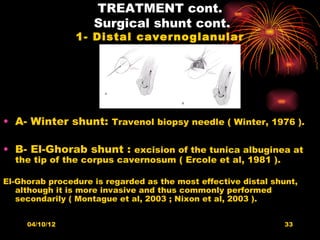
                1- Distal cavernoglanular


• A- Winter shunt: Travenol biopsy needle ( Winter, 1976 ).

• B- El-Ghorab shunt : excision of the tunica albuginea at
  the tip of the corpus cavernosum ( Ercole et al, 1981 ).

El-Ghorab procedure is regarded as the most effective distal shunt,
   although it is more invasive and thus commonly performed
   secondarily ( Montague et al, 2003 ; Nixon et al, 2003 ).


     04/10/12                                                   33
TREATMENT cont.
                        Surgical shunt cont.
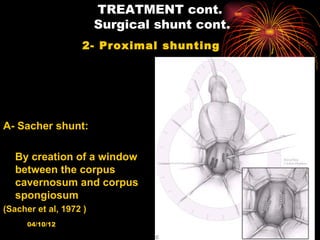
                   2- Proximal shunting


A- Sacher shunt:

   By creation of a window
   between the corpus
   cavernosum and corpus
   spongiosum
(Sacher et al, 1972 )
      04/10/12                                 34
TREATMENT cont.
                  Surgical shunt cont.
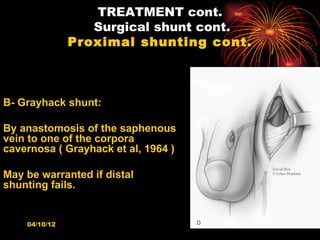
               Proximal shunting cont.


B- Grayhack shunt:

By anastomosis of the saphenous
vein to one of the corpora
cavernosa ( Grayhack et al, 1964 )

May be warranted if distal
shunting fails.


    04/10/12                             35
TREATMENT cont.
                  Complications


Urethral fistulas
Purulent cavernositis
Pulmonary embolism

( Kandel et al, 1968 ).


    04/10/12                       36
TREATMENT cont.


        II- Nonischemic Priapism

The initial management of
 nonischemic priapism should be
 observation (Montague et al, 2003 ).

Selective arterial embolization offers
 the next step for the patient desirous
 of an immediate resolution.
   04/10/12                         37
TREATMENT cont.
               Nonischemic Priapism cont.

               Embolization materials
• Nonpermanent (autologous clot, absorbable gels).
• Permanent (coils, ethanol, polyvinyl alcohol particles,
  and acrylic glue)
                  (75% resolution rate)

Nonpermanent materials are preferred as
 producing a lesser ED rate (5% versus 39%
 with permanent substances) ( Montague et al,
 2003 ).

    04/10/12                                          38
TREATMENT cont.


III-Recurrent (Stuttering) Priapism


All episodes of recurrent priapism should be
treated like ischemic priapism ( Montague et
al, 2003 ).


Systemic therapies (hormonal agents , baclofen,
digoxin) or intracavernous self-injection of
sympathomimetic agents, and penile prosthesis
surgery.

  04/10/12                                   39
TREATMENT cont.


Miscellaneous Medical Therapies

• hydroxyurea in the treatment of sickle cell-
  associated priapism
• Thrombolytics such as streptokinase ( Gibel
  et al, 1985 ) and tissue plasminogen
  activator ( Rutchik et al, 2001 ) for ischemic
  priapism
• Methylene blue for high-flow priapism
  ( Steers and Selby, 1991
   04/10/12                                40
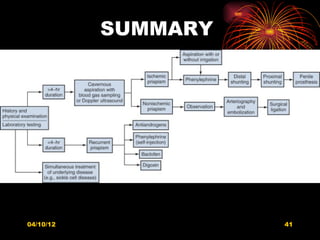
SUMMARY


04/10/12             41
Thank u
04/10/12             42

Priapism

  • 1.
    Priapism Dr Atef M Solimann Urosurgeon MBH 04/10/12 1
  • 2.
  • 3.
    Hemodynamics and Mechanismof Erection and Detumescence 04/10/12 3
  • 4.
    Neuroanatomy and Neurophysiologyof Penile Erection 04/10/12 4
  • 5.
    Neuroanatomy and Neurophysiologyof Penile Erection cont. Most researchers now agree that NO released from nonadrenergic, noncholinergic neurotransmission and from the endothelium is the principal neurotransmitter mediating penile erection. NO increases the production of cGMP, which in turn relaxes the cavernous smooth muscle (Trigo-Rocha et al, 1993a, 1993b). 04/10/12 5
  • 6.
    DEFINITION    • EPIDEMIOLOGY    • ETIOLOGY    • NATURAL HISTORY    • PATHOLOGY    • PATHOPHYSIOLOGY    • CLASSIFICATION    • DIAGNOSIS    • TREATMENT    • SUMMARY 04/10/12 6
  • 7.
    DEFINITION • Is apathologic condition of penile erection characterized as prolonged and devoid of sexual stimulation or excitement ( Berger et al, 2001 and Montague et al, 2003 ). • Priapism of the clitoris has also been described in the medical literature ( Monllor et al, 1996 ). • Pain is a common descriptor, perceived to be a consequence of genital tissue ischemia and increased pressure generated within the corporal bodies, although this feature is not a requirement for the designation of priapism. 04/10/12 7
  • 8.
    EPIDEMIOLOGY Cohort studies involving populations with sickle disease demonstrate lifetime probabilities for development of priapism to be between 29% and 42% (Adeyoju et al, 2002 ). 04/10/12 8
  • 9.
    ETIOLOGY 1- Hematologic Dyscrasias Sickle cell disease 23% of adult, 63% of pediatric cases, Leukemia 50% of patients with this disease, Asplenism, Erythropoietin, hypercoagulable states, total parenteral nutrition containing 20% 04/10/12 emulsion fat 9
  • 10.
    ETIOLOGY cont. 2- NeurologicConditions Neurologic infections such as syphilis, brain tumors, epilepsy, intoxication, and brain and spinal cord injury ( Hinman, 1914 and Munro et al, 1948 ). Anesthesia, either general or regional (spinal or epidural) administration, with genital manipulation as part of the surgical procedure (Shantha et al, 1989 and Dittrich et al, 1991 ). 04/10/12 10
  • 11.
    ETIOLOGY cont. 3- NonhematologicMalignant Neoplasms Local primary or metastatic neoplastic processes are also known to carry priapism risks. Organs of cancer origin include penis, urethra, prostate, bladder, kidney, and rectosigmoid colon (Morga Egea et al, 2000 and Hettiarachchi et al, 2001 ). 04/10/12 11
  • 12.
    ETIOLOGY cont. 4-Trauma Priapism has been associated with direct penile and perineal trauma (straddle injury or direct scrotal trauma) ( Burt et al, 1960 ; Hinman, 1960 ) as well as traumatic needle insertion with intracavernosal pharmacotherapy ( Witt et al, 1990 ). 04/10/12 12
  • 13.
    ETIOLOGY cont. 5- ErectileDysfunction Pharmacotherapy Lomas and Jarow (1992) defined the risk profile of priapism in this setting, finding that younger men with better baseline erectile function, patients with overt neurologic disease, and patients without significant cardiovascular disease were most susceptible. 04/10/12 13
  • 14.
    ETIOLOGY cont. 6- PharmacologicExposures A- Antihypertensive agents: Hydralazine and guanethidine ( Rubin, 1968 ) and α-adrenergic antagonists (Vaidyanathan et al, 1998 ). B- Psychotropic and antidepressant medications: Phenothiazines, sedative-hypnotics, SSRI, and trazodone (Compton and Miller, 2001 ). C- Other medications: Heavy alcohol intake (Kulmala et al, 1995b), Topical and intranasal cocaine administration (Altman et al, 1999 ), Immunosuppressant agent FK506 (tacrolimus) ( Harmon et al, 1999 ), androgen supplements (Zargooshi, 2000 ), and scorpion toxin ( Teixeira et al, 2004 ). 04/10/12 14
  • 15.
    ETIOLOGY cont. 7- Idiopathic Some investigators have estimated that this disorder accounts for as many as half of all documented cases ( Larocque and Cosgrove, 1974 ; Pohl et al, 1986 ; Winter and McDowell, 1988 ). 04/10/12 15
  • 16.
    NATURAL HISTORY • Outcome:is either its permanent resolution or its progression to recurrent episodes with or without some degree of erectile impairment. • In the absence of effective treatment, it has long been recognized that even major episodes of ischemic priapism will eventually resolve in time, although permanent damage of the penis may be expected. • It is perceived that individuals with nonischemic priapism generally preserve erectile ability. 04/10/12 16
  • 17.
    PATHOLOGY • Penile tissuenecrosis and progressive fibrosis are the end-stage manifestations of ischemic priapism, ( Hinman, 1960 ). • The irreversible effects resulted most consistently from the combination of hypoxia, acidosis, and glucopenia at a time interval of 4 hours (Muneer and associates, 2005) . 04/10/12 17
  • 18.
    PATHOPHYSIOLOGY • Vascular stasisin the penis and decreased venous outflow from the organ were the primary circumstances that mechanically or physically interfered with detumescence ( Hinman,1960). • Fistula formation (cavernous artery and lacunar spaces of the cavernous tissue), which allows blood to bypass the normal cavernous arteriolar bed, then accounts for traumatically induced priapism (Hakim et al, 1996). 04/10/12 18
  • 19.
    CLASSIFICATION • Ischemic (lowflow) Priapism • Nonischemic (high flow) Priapism 04/10/12 19
  • 20.
    CLASSIFICATION cont. Priapism Variants 1- Recurrent (Stuttering) Priapism 2- Refractory Priapism 3- Neurogenic Priapism 4- Idiopathic Priapism 5- Drug-Induced Priapism 04/10/12 20
  • 21.
    DIAGNOSIS History Pain, duration of priapism (< or >4hrs), prior priapism, use and success of relieving maneuvers or prior clinical treatments, existence of etiologic conditions, and erectile function status before the priapism episode. Physical Examination Inspection and palpation of the penis: extent of tumescence or rigidity, corporal body involvement (i.e., whether rigidity involves only the corpora cavernosa with a soft glans penis and corpus spongiosum or all three corporal bodies). Abdominal, perineal, and DRE may reveal signs of trauma or malignant disease. 04/10/12 21
  • 22.
    DIAGNOSIS cont. Laboratory Testing CBC, white blood cell differential, and platelet count (acute infections or hematologic abnormalities). Reticulocyte count and hemoglobin electrophoresis (sickle cell disease or trait and hemoglobinopathies) Screening for psychoactive drugs and urine toxicology to identify overdoses of legal and illegal drugs may also be performed. Berger et al, 2001 ; Montague et al, 2003 04/10/12 22
  • 23.
    DIAGNOSIS cont. Penile Diagnostics 1- Aspirates should be visually inspected Patients with ischemic priapism, the blood is hypoxic and therefore dark, whereas that of patients with nonischemic priapism is oxygenated and therefore bright red. 04/10/12 23
  • 24.
    DIAGNOSIS cont. Penile Diagnostics cont. 2- Cavernous blood gas testing • Normal flaccid penis cavernous blood gas levels: normal mixed venous blood at room air (Po2 of 40 mm Hg, Pco2 of 50 mm Hg, and pH of 7.35) ( Montague et al, 2003 ). • Cavernous blood gas in patients with ischemic priapism: Po2 <30 mm Hg, Pco2 >60 mm Hg, and pH below 7.25 • Cavernous blood gas in patients with nonischemic priapism (normal arterial blood at room air ): Po2 > 90 mm Hg, Pco2 < 40 mm Hg, and pH of 7.40 (Montague et 04/10/12 24 al, 2003 ).
  • 25.
    DIAGNOSIS cont. Radiologic Evaluation 1- Color duplex ultrasonography (lithotomy or frogleg position, scanning the perineum first and then the entire penile shaft). Ischemic priapism have minimal or absent blood flow in the cavernosal arteries and the corpora cavernosa. Nonischemic priapism have normal to high blood flow velocities in the cavernosal arteries and the corpora cavernosa. Anatomic abnormalities: cavernous arterial fistula or pseudoaneurysm, to confirm the diagnosis of nonischemic priapism. (Hakim et al, 1996 ). 04/10/12 25
  • 26.
    DIAGNOSIS cont. Radiologic Evaluation cont 2- Arteriography: Not routinely used for diagnosis and is otherwise usually performed as part of an embolization procedure. 04/10/12 26
  • 27.
    TREATMENT I- Ischemic Priapism In general, since ischemic priapism of more than 4 hours in duration irrespective of etiology implies a compartment syndrome, decompression of the corpora cavernosa is recommended for counteracting the ischemic effects including pain sensations (Montague et al, 2003 ). 04/10/12 27
  • 28.
    TREATMENT cont. Winter shunt 1- Dorsal nerve block or local penile shaft block ( Berger et al, 2001 ). 2- Transglanular intracorporal needle insertion with an angiocatheter (16- or 18-gauge). 3- Evacuation of blood and irrigation of the corpora cavernosa with intracavernous injection of an α-adrenergic sympathomimetic agent ( Montague et al, 2003 ). 4- Repeated aspirations or irrigations and sympathomimetic injections during several hours may be necessary and should be performed before initiation of surgical intervention. 5- Sickle cell disease: analgesia, hydration, hyperbaric oxygenation, alkalinization, and transfusion if prolonged periods of ischemia have occurred ( Mantadakis et al, 2000 ). 6- Priapism resolution 30% ( Montague et al, 2003 ). 04/10/12 28
  • 29.
    TREATMENT cont. 1- Sympathomimetics(α-adrenergic agents) contractile effects on the cavernous tissue (Blood pressure and ECG monitoring in patients with high cardiovascular risk) (Montague et al, 2003 ). A- Phenylephrine: α1-selective adrenergic agonist < the risk of cardiovascular side effects, 100-200 mg every 5-10 min until detumescence (maximum 1000 μg) B- Epinephrine α, β agonist 10-20 μg every 5-10 min until detumescence 04/10/12 29
  • 30.
    TREATMENT cont. 2- Antiandrogens(Hormonal) A-Gonadotropin-releasing hormone agonist, Leuprolide 7.5 mg once a month IM B- Androgen receptor antagonist, Oral tablets Bicalutamide 50 mg once a day Flutamide 250 mg every 8 hours 04/10/12 30
  • 31.
    TREATMENT cont. 3- Miscellaneous Oraltablets Baclofen γ-Aminobutyric acid agonist, 20-40 mg once a day (bedtime) Digoxin Cardiac glycoside, 0.5 mg every day 04/10/12 31
  • 32.
    TREATMENT cont. Surgical shunt Indications 1- Intracavernous treatment has failed. 2- Extended durations (48 to 72 hours). ( Montague et al, 2003 ) 04/10/12 32
  • 33.
    TREATMENT cont. Surgical shunt cont. 1- Distal cavernoglanular • A- Winter shunt: Travenol biopsy needle ( Winter, 1976 ). • B- El-Ghorab shunt : excision of the tunica albuginea at the tip of the corpus cavernosum ( Ercole et al, 1981 ). El-Ghorab procedure is regarded as the most effective distal shunt, although it is more invasive and thus commonly performed secondarily ( Montague et al, 2003 ; Nixon et al, 2003 ). 04/10/12 33
  • 34.
    TREATMENT cont. Surgical shunt cont. 2- Proximal shunting A- Sacher shunt: By creation of a window between the corpus cavernosum and corpus spongiosum (Sacher et al, 1972 ) 04/10/12 34
  • 35.
    TREATMENT cont. Surgical shunt cont. Proximal shunting cont. B- Grayhack shunt: By anastomosis of the saphenous vein to one of the corpora cavernosa ( Grayhack et al, 1964 ) May be warranted if distal shunting fails. 04/10/12 35
  • 36.
    TREATMENT cont. Complications Urethral fistulas Purulent cavernositis Pulmonary embolism ( Kandel et al, 1968 ). 04/10/12 36
  • 37.
    TREATMENT cont. II- Nonischemic Priapism The initial management of nonischemic priapism should be observation (Montague et al, 2003 ). Selective arterial embolization offers the next step for the patient desirous of an immediate resolution. 04/10/12 37
  • 38.
    TREATMENT cont. Nonischemic Priapism cont. Embolization materials • Nonpermanent (autologous clot, absorbable gels). • Permanent (coils, ethanol, polyvinyl alcohol particles, and acrylic glue) (75% resolution rate) Nonpermanent materials are preferred as producing a lesser ED rate (5% versus 39% with permanent substances) ( Montague et al, 2003 ). 04/10/12 38
  • 39.
    TREATMENT cont. III-Recurrent (Stuttering)Priapism All episodes of recurrent priapism should be treated like ischemic priapism ( Montague et al, 2003 ). Systemic therapies (hormonal agents , baclofen, digoxin) or intracavernous self-injection of sympathomimetic agents, and penile prosthesis surgery. 04/10/12 39
  • 40.
    TREATMENT cont. Miscellaneous MedicalTherapies • hydroxyurea in the treatment of sickle cell- associated priapism • Thrombolytics such as streptokinase ( Gibel et al, 1985 ) and tissue plasminogen activator ( Rutchik et al, 2001 ) for ischemic priapism • Methylene blue for high-flow priapism ( Steers and Selby, 1991 04/10/12 40
  • 41.
  • 42.