



Kulsoom pirjan
biosynthetic pathway of
terpenes
And enymes with multiple
fuctions
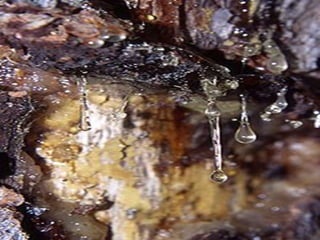
• Terpenes are a large and diverse class of organic
compounds, produced by a variety of plants, particularly
conifers.
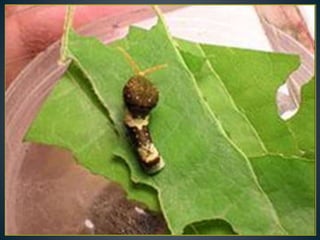
• some insects such as termites or swallowtail butterflies,
which emit terpenes from their osmeteria. They are often
strong-smelling.
• They may protect the plants that produce them by
deterring herbivores and by attracting predators and
parasites of herbivores.
• Many terpenes are aromatic hydrocarbons and thus may
have had a protective function.
• The name "terpene" is derived from the word
"turpentine".
• In addition to their roles as end-products in many
organisms, terpenes are major biosynthetic building
blocks within nearly every living creature.
• Steroids, for example, are derivatives of the triterpene
squalene.
• When terpenes are modified chemically, such as by
oxidation or rearrangement of the carbon skeleton, the
resulting compounds are generally referred to as
terpenoids.
• Some authors will use the term terpene to include all
terpenoids. Terpenoids are also known as isoprenoids.
• The difference between terpenes and terpenoids is that
terpenes are hydrocarbons, whereas terpenoids contain
additional functional groups.
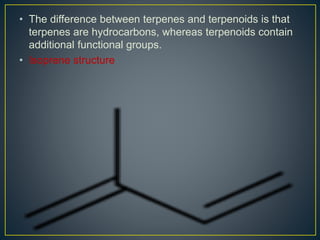
• Isoprene structure
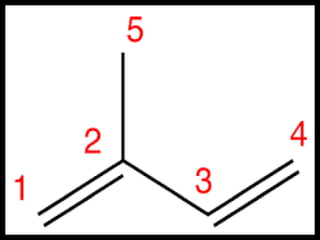
• Terpenes are derived biosynthetically from units of isoprene,
which has the molecular formula C5H8. The basic molecular
formulae of terpenes are multiples of that, (C5H8)n where n is
the number of linked isoprenes units.
• The isoprene units may be linked together "head to tail" to form
linear chains or they may be arranged to form rings. One can
consider the isoprene unit as one of nature's common building
blocks.
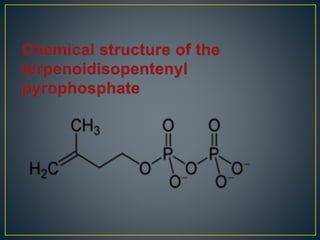
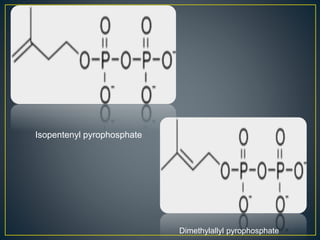
• Active forms of terpenes, isopentenyl pyrophosphate
(IPP or also isopentenyl activated fordiphosphate) and
dimethylallyl pyrophosphate (DMAPP or also
dimethylallyl diphosphate), are the components in the
biosynthetic pathway. IPP is formed from acetyl-CoA
• Through differnts biosynthetic pathways such as
mevalonic acid in the HMG-CoA reductase pathway.
Isopentenyl pyrophosphate
Dimethylallyl pyrophosphate
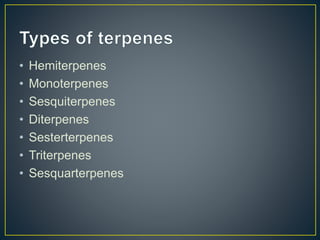
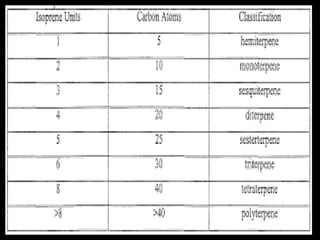
• Hemiterpenes
• Monoterpenes
• Sesquiterpenes
• Diterpenes
• Sesterterpenes
• Triterpenes
• Sesquarterpenes
• Tetraterpenes
• Polyterpenes
• consist of a single isoprene unit.
Isoprene itself is considered the only
hemiterpene, but oxygen-containing
derivatives such as prenol and
isovaleric acid are hemiterpenoids.
• consist of two isoprene units and have the
molecular formula C10H16. Examples of
monoterpenes and monoterpenoids
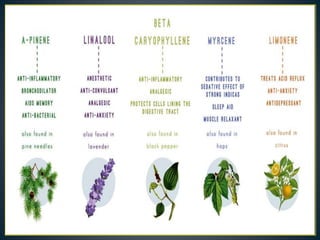
include geraniol, limonene, terpineol and
myrcene.
• consist of three isoprene units and have
the molecular formula C15H24. Examples
of sesquiterpenes and sesquiterpenoids
include humulene, farnesenes, farnesol.
• are composed of four isoprene units and
have the molecular formula C20H32. They
derive from geranyl pyrophosphate.
Examples of diterpenes and diterpenoids
are cafestol
• Diterpenes also form the basis for
biologically important compounds such as
retinol.
• Sesterterpenoids, 5 isoprene units (25C)
• Triterpenoids, 6 isoprene units (30C)
(e.g. sterols)
• Tetraterpenoids, 8 isoprene units (40C)
(e.g. carotenoids)
• Polyterpenoid with a larger number of isoprene
units.
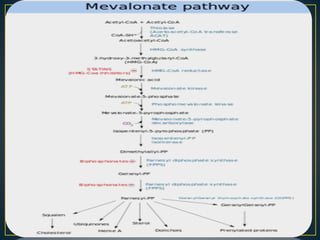
• is an important cellular metabolic pathway
present in all higher eukaryotes and many
bacteria.
• It is important for the production of
dimethylallyl pyrophosphate (DMAPP) and
isopentenyl pyrophosphate(IPP)
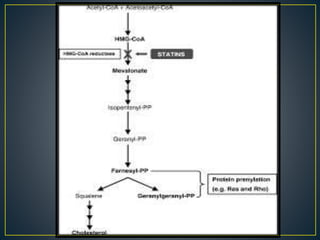
• Many organisms manufacture terpenoids through
the HMG-CoA reductase pathway, which also
produces cholesterol. The reactions take place in
the cytosol. The pathway was discovered in the
1950s.
• The mevalonate pathway or HMG-CoA
reductase pathway or mevalonate-dependent
(MAD) route or isoprenoid pathway , MVA having
formula C6H12O4
• which serve as the basis for the biosynthesis of
molecules used in processes as diverse as
terpenoid synthesis
• cell membrane maintenance, hormones, protein
anchoring
and It is also a part of steroid biosynthesis.
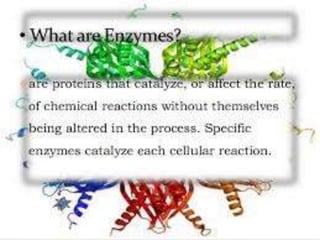
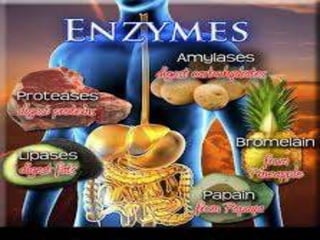
• Enzymes are biological molecules (proteins) that
act as catalysts and help complex reactions
occur everywhere in life. Let's say you ate a
piece of meat. Proteases would go to work and
help break down the peptide bonds between the
amino acids.
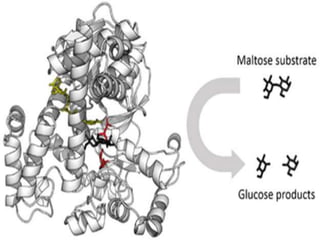
• Enzymes are macromolecular biological
catalysts ,Enzymes accelerate, or catalyze,
chemical reactions.
• The molecules at the beginning of the process
are called substrates and the enzyme converts
these into different molecules, called products
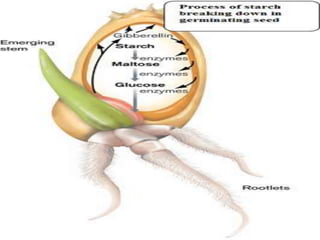
• A seed contains an embryo plant and a stored
food supply provided for the embryo to develop.
• Germination of the seeds starts with the uptake
of water. As the cotyledons take in the water,
they swell and burst the seed coat (testa). Once
the seeds have enough water, enzymes in the
cotyledons become active
• Amylase begins to break down stored starch
molecules to maltose.
• Proteases break down protein molecules into
amino acids.
• Lipase breaks down oil into fatty acids and
glycerol. Maltose, amino acids, glycerol and fatty
acids are soluble, they dissolve in the absorbed
water, and diffuse to the embryo plant, to be
used for food for growth and development.
terpenes and enzymes

terpenes and enzymes

  • 2.
  • 3.
    biosynthetic pathway of terpenes Andenymes with multiple fuctions
  • 5.
    • Terpenes area large and diverse class of organic compounds, produced by a variety of plants, particularly conifers. • some insects such as termites or swallowtail butterflies, which emit terpenes from their osmeteria. They are often strong-smelling.
  • 8.
    • They mayprotect the plants that produce them by deterring herbivores and by attracting predators and parasites of herbivores. • Many terpenes are aromatic hydrocarbons and thus may have had a protective function.
  • 9.
    • The name"terpene" is derived from the word "turpentine". • In addition to their roles as end-products in many organisms, terpenes are major biosynthetic building blocks within nearly every living creature. • Steroids, for example, are derivatives of the triterpene squalene.
  • 10.
    • When terpenesare modified chemically, such as by oxidation or rearrangement of the carbon skeleton, the resulting compounds are generally referred to as terpenoids. • Some authors will use the term terpene to include all terpenoids. Terpenoids are also known as isoprenoids.
  • 11.
    • The differencebetween terpenes and terpenoids is that terpenes are hydrocarbons, whereas terpenoids contain additional functional groups. • Isoprene structure
  • 13.
    • Terpenes arederived biosynthetically from units of isoprene, which has the molecular formula C5H8. The basic molecular formulae of terpenes are multiples of that, (C5H8)n where n is the number of linked isoprenes units. • The isoprene units may be linked together "head to tail" to form linear chains or they may be arranged to form rings. One can consider the isoprene unit as one of nature's common building blocks.
  • 15.
    • Active formsof terpenes, isopentenyl pyrophosphate (IPP or also isopentenyl activated fordiphosphate) and dimethylallyl pyrophosphate (DMAPP or also dimethylallyl diphosphate), are the components in the biosynthetic pathway. IPP is formed from acetyl-CoA • Through differnts biosynthetic pathways such as mevalonic acid in the HMG-CoA reductase pathway.
  • 16.
  • 17.
    • Hemiterpenes • Monoterpenes •Sesquiterpenes • Diterpenes • Sesterterpenes • Triterpenes • Sesquarterpenes
  • 18.
  • 19.
    • consist ofa single isoprene unit. Isoprene itself is considered the only hemiterpene, but oxygen-containing derivatives such as prenol and isovaleric acid are hemiterpenoids.
  • 20.
    • consist oftwo isoprene units and have the molecular formula C10H16. Examples of monoterpenes and monoterpenoids include geraniol, limonene, terpineol and myrcene.
  • 21.
    • consist ofthree isoprene units and have the molecular formula C15H24. Examples of sesquiterpenes and sesquiterpenoids include humulene, farnesenes, farnesol.
  • 22.
    • are composedof four isoprene units and have the molecular formula C20H32. They derive from geranyl pyrophosphate. Examples of diterpenes and diterpenoids are cafestol • Diterpenes also form the basis for biologically important compounds such as retinol.
  • 23.
    • Sesterterpenoids, 5isoprene units (25C) • Triterpenoids, 6 isoprene units (30C) (e.g. sterols) • Tetraterpenoids, 8 isoprene units (40C) (e.g. carotenoids) • Polyterpenoid with a larger number of isoprene units.
  • 26.
    • is animportant cellular metabolic pathway present in all higher eukaryotes and many bacteria. • It is important for the production of dimethylallyl pyrophosphate (DMAPP) and isopentenyl pyrophosphate(IPP)
  • 27.
    • Many organismsmanufacture terpenoids through the HMG-CoA reductase pathway, which also produces cholesterol. The reactions take place in the cytosol. The pathway was discovered in the 1950s. • The mevalonate pathway or HMG-CoA reductase pathway or mevalonate-dependent (MAD) route or isoprenoid pathway , MVA having formula C6H12O4
  • 28.
    • which serveas the basis for the biosynthesis of molecules used in processes as diverse as terpenoid synthesis • cell membrane maintenance, hormones, protein anchoring and It is also a part of steroid biosynthesis.
  • 32.
    • Enzymes arebiological molecules (proteins) that act as catalysts and help complex reactions occur everywhere in life. Let's say you ate a piece of meat. Proteases would go to work and help break down the peptide bonds between the amino acids.
  • 34.
    • Enzymes aremacromolecular biological catalysts ,Enzymes accelerate, or catalyze, chemical reactions. • The molecules at the beginning of the process are called substrates and the enzyme converts these into different molecules, called products
  • 36.
    • A seedcontains an embryo plant and a stored food supply provided for the embryo to develop. • Germination of the seeds starts with the uptake of water. As the cotyledons take in the water, they swell and burst the seed coat (testa). Once the seeds have enough water, enzymes in the cotyledons become active
  • 38.
    • Amylase beginsto break down stored starch molecules to maltose. • Proteases break down protein molecules into amino acids. • Lipase breaks down oil into fatty acids and glycerol. Maltose, amino acids, glycerol and fatty acids are soluble, they dissolve in the absorbed water, and diffuse to the embryo plant, to be used for food for growth and development.