Bangabandhu Sheikh Mujibur Rahman Science & Technology University
A presentation on terpenoids
Presented by group A
Student’s ID: 16PHR001, 16PHR002, 16PHR003, 16PHR004, 16PHR005, 16PHR006, 16PHR007,
16PHR008, 16PHR009, 16PHR010, 16PHR012, 16PHR014, 16PHR015, 16PHR016
16PHR017, 16PHR018
Course Code: PHR253
Course title: Medicinal Chemistry-I
What is terpenoids
Any of a large class of organic compounds including terpenes, diterpenes, and sesquiterpenes. They
have unsaturated molecules composed of linked isoprene units, generally having the formula
(C5H8) n.
Isoprene unit are 5 carbon unit
For having isoprene unit they are also called isoprenoids
Physical properties of terpenoids
Odorous
Volatile at room temperature
They represents essence or active constituents of plants hence called essential oil
Lighter than water
Have high refractive index
Are optically active
Chemical Properties of teprenoids
Terpenoids are the hydrocarbones of plant origin of the general formula (C5H8)n as well as their oxygenated, hydrogenated &
dehydrogenated derivatives.
Terpenoids are regarded as derivatives of polymers of isoprene, CH3H2C=C-CH=CH2 (i.e.C5H80)
They consist of a complex mixture of terpenes or sesquiterpenes, alcohols, aldehydes, ketone, acid & esters.
They are unsaturated compounds.
They undergo addition reaction with hydrogen, halogen, halogen acids to form addition products
They undergo polymerization and dehydrogenation in the ring.
On thermal decomposition, terpenoid gives isoprene as one of the product.
Chemical Properties of teprenoids
Terpinoids are modified terpenes, where in methyl groups have been moved or removed, or
oxygen atoms added.
 Sometimes terpinoids are added to proteins, e.g., to enhance their attachment to the cell
membrane.
The steroids and sterols in animals are biologically produced from terpinoid precursors.
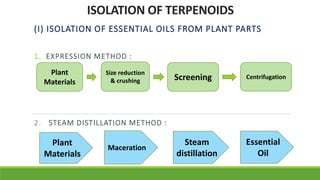
ISOLATION OF TERPENOIDS
(I) ISOLATION OF ESSENTIAL OILS FROM PLANT PARTS
1. EXPRESSION METHOD :
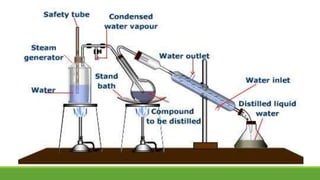
2. STEAM DISTILLATION METHOD :
Plant
Materials
Size reduction
& crushing Screening Centrifugation
Plant
Materials
Maceration
Steam
distillation
Essential
Oil
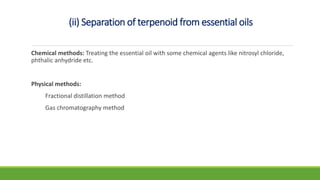
(ii) Separation of terpenoid from essential oils
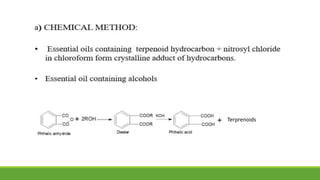
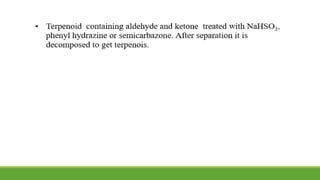
Chemical methods: Treating the essential oil with some chemical agents like nitrosyl chloride,
phthalic anhydride etc.
Physical methods:
Fractional distillation method
Gas chromatography method
Terprenoids
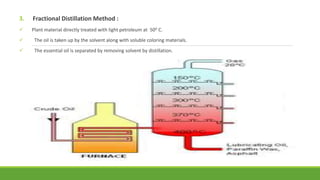
3. Fractional Distillation Method :
 Plant material directly treated with light petroleum at 500 C.
 The oil is taken up by the solvent along with soluble coloring materials.
 The essential oil is separated by removing solvent by distillation.
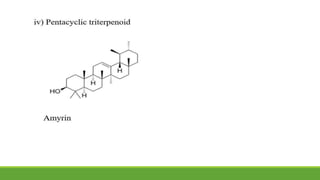
Amyrin
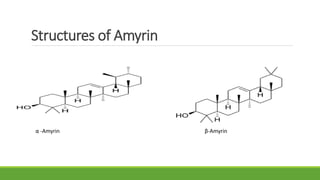
The amyrins are three closely related natural chemical compounds
of the triterpene class. They are designated α-amyrin (ursane
skeleton), β-amyrin (oleanane skeleton) and δ-amyrin. Each is a
pentacyclic triterpenol with the chemical formula C30H50O. They are
widely distributed in nature and have been isolated from a variety of
plant sources such as epicuticular wax. In plant biosynthesis, α-
amyrin is the precursor of ursolic acid and β-amyrin is the precursor
of oleanolic acid. All three amyrins occur in the surface wax of
tomato fruit. α-Amyrin is found in dandelion coffee.
Structures of Amyrin
α -Amyrin β-Amyrin
Importance of Amyrin
They act as hepatoprotective agens.
They decrease the activity of serum alanine aminotransferase and aspartate aminotransferase.
Amyrin could potentiate the pentobarbital (50 mg/kg, i.p.) sleeping time.
They give protection against toxic liver.
Geraniol
▪Geraniol is a monoterpenoid and an alcohol.
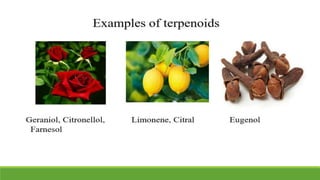
▪It is the primary component of rose oil, palmarosa oil, citronella oil (Java type).
▪It is a colorless oil, although commercial samples can appear yellow.
▪It has low solubility in water, but it is soluble in common organic solvent.
▪Functional group derived from geraniol (In essence, geraniol lacking the terminal- OH) is called
Geranyl.
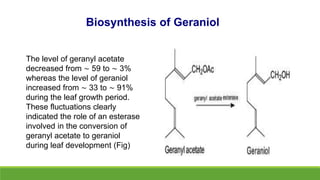
The level of geranyl acetate
decreased from ∼ 59 to ∼ 3%
whereas the level of geraniol
increased from ∼ 33 to ∼ 91%
during the leaf growth period.
These fluctuations clearly
indicated the role of an esterase
involved in the conversion of
geranyl acetate to geraniol
during leaf development (Fig)
Biosynthesis of Geraniol
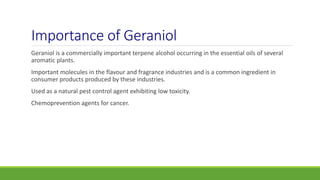
Importance of Geraniol
Geraniol is a commercially important terpene alcohol occurring in the essential oils of several
aromatic plants.
Important molecules in the flavour and fragrance industries and is a common ingredient in
consumer products produced by these industries.
Used as a natural pest control agent exhibiting low toxicity.
Chemoprevention agents for cancer.
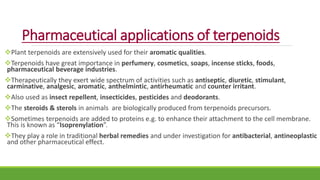
Pharmaceutical applications of terpenoids
Plant terpenoids are extensively used for their aromatic qualities.
Terpenoids have great importance in perfumery, cosmetics, soaps, incense sticks, foods,
pharmaceutical beverage industries.
Therapeutically they exert wide spectrum of activities such as antiseptic, diuretic, stimulant,
carminative, analgesic, aromatic, anthelmintic, antirheumatic and counter irritant.
Also used as insect repellent, insecticides, pesticides and deodorants.
The steroids & sterols in animals are biologically produced from terpenoids precursors.
Sometimes terpenoids are added to proteins e.g. to enhance their attachment to the cell membrane.
This is known as “Isoprenylation”.
They play a role in traditional herbal remedies and under investigation for antibacterial, antineoplastic
and other pharmaceutical effect.
Terpenoids

Terpenoids

  • 1.
    Bangabandhu Sheikh MujiburRahman Science & Technology University A presentation on terpenoids Presented by group A Student’s ID: 16PHR001, 16PHR002, 16PHR003, 16PHR004, 16PHR005, 16PHR006, 16PHR007, 16PHR008, 16PHR009, 16PHR010, 16PHR012, 16PHR014, 16PHR015, 16PHR016 16PHR017, 16PHR018 Course Code: PHR253 Course title: Medicinal Chemistry-I
  • 2.
    What is terpenoids Anyof a large class of organic compounds including terpenes, diterpenes, and sesquiterpenes. They have unsaturated molecules composed of linked isoprene units, generally having the formula (C5H8) n. Isoprene unit are 5 carbon unit For having isoprene unit they are also called isoprenoids
  • 4.
    Physical properties ofterpenoids Odorous Volatile at room temperature They represents essence or active constituents of plants hence called essential oil Lighter than water Have high refractive index Are optically active
  • 5.
    Chemical Properties ofteprenoids Terpenoids are the hydrocarbones of plant origin of the general formula (C5H8)n as well as their oxygenated, hydrogenated & dehydrogenated derivatives. Terpenoids are regarded as derivatives of polymers of isoprene, CH3H2C=C-CH=CH2 (i.e.C5H80) They consist of a complex mixture of terpenes or sesquiterpenes, alcohols, aldehydes, ketone, acid & esters. They are unsaturated compounds. They undergo addition reaction with hydrogen, halogen, halogen acids to form addition products They undergo polymerization and dehydrogenation in the ring. On thermal decomposition, terpenoid gives isoprene as one of the product.
  • 6.
    Chemical Properties ofteprenoids Terpinoids are modified terpenes, where in methyl groups have been moved or removed, or oxygen atoms added.  Sometimes terpinoids are added to proteins, e.g., to enhance their attachment to the cell membrane. The steroids and sterols in animals are biologically produced from terpinoid precursors.
  • 20.
    ISOLATION OF TERPENOIDS (I)ISOLATION OF ESSENTIAL OILS FROM PLANT PARTS 1. EXPRESSION METHOD : 2. STEAM DISTILLATION METHOD : Plant Materials Size reduction & crushing Screening Centrifugation Plant Materials Maceration Steam distillation Essential Oil
  • 22.
    (ii) Separation ofterpenoid from essential oils Chemical methods: Treating the essential oil with some chemical agents like nitrosyl chloride, phthalic anhydride etc. Physical methods: Fractional distillation method Gas chromatography method
  • 23.
  • 25.
    3. Fractional DistillationMethod :  Plant material directly treated with light petroleum at 500 C.  The oil is taken up by the solvent along with soluble coloring materials.  The essential oil is separated by removing solvent by distillation.
  • 26.
    Amyrin The amyrins arethree closely related natural chemical compounds of the triterpene class. They are designated α-amyrin (ursane skeleton), β-amyrin (oleanane skeleton) and δ-amyrin. Each is a pentacyclic triterpenol with the chemical formula C30H50O. They are widely distributed in nature and have been isolated from a variety of plant sources such as epicuticular wax. In plant biosynthesis, α- amyrin is the precursor of ursolic acid and β-amyrin is the precursor of oleanolic acid. All three amyrins occur in the surface wax of tomato fruit. α-Amyrin is found in dandelion coffee.
  • 27.
    Structures of Amyrin α-Amyrin β-Amyrin
  • 28.
    Importance of Amyrin Theyact as hepatoprotective agens. They decrease the activity of serum alanine aminotransferase and aspartate aminotransferase. Amyrin could potentiate the pentobarbital (50 mg/kg, i.p.) sleeping time. They give protection against toxic liver.
  • 29.
    Geraniol ▪Geraniol is amonoterpenoid and an alcohol. ▪It is the primary component of rose oil, palmarosa oil, citronella oil (Java type). ▪It is a colorless oil, although commercial samples can appear yellow. ▪It has low solubility in water, but it is soluble in common organic solvent. ▪Functional group derived from geraniol (In essence, geraniol lacking the terminal- OH) is called Geranyl.
  • 30.
    The level ofgeranyl acetate decreased from ∼ 59 to ∼ 3% whereas the level of geraniol increased from ∼ 33 to ∼ 91% during the leaf growth period. These fluctuations clearly indicated the role of an esterase involved in the conversion of geranyl acetate to geraniol during leaf development (Fig) Biosynthesis of Geraniol
  • 31.
    Importance of Geraniol Geraniolis a commercially important terpene alcohol occurring in the essential oils of several aromatic plants. Important molecules in the flavour and fragrance industries and is a common ingredient in consumer products produced by these industries. Used as a natural pest control agent exhibiting low toxicity. Chemoprevention agents for cancer.
  • 32.
    Pharmaceutical applications ofterpenoids Plant terpenoids are extensively used for their aromatic qualities. Terpenoids have great importance in perfumery, cosmetics, soaps, incense sticks, foods, pharmaceutical beverage industries. Therapeutically they exert wide spectrum of activities such as antiseptic, diuretic, stimulant, carminative, analgesic, aromatic, anthelmintic, antirheumatic and counter irritant. Also used as insect repellent, insecticides, pesticides and deodorants. The steroids & sterols in animals are biologically produced from terpenoids precursors. Sometimes terpenoids are added to proteins e.g. to enhance their attachment to the cell membrane. This is known as “Isoprenylation”. They play a role in traditional herbal remedies and under investigation for antibacterial, antineoplastic and other pharmaceutical effect.