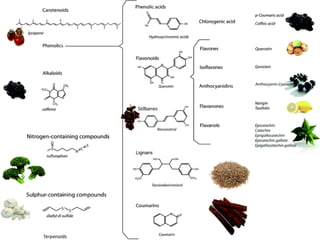
 Introduction
 Classification
 Occurrence
 Synthesis
 Defense
 In organic chemistry
A class of chemical compounds which consist of
a hydroxyl group (OH) directly bonded to an
aromatic hydrocarbon group
 Phenolic compounds are the substances
containing benzoic molecules with one or several
hydroxylic groups and their derivatives. If
molecule contains two or more hydroxylic groups
there is polyphenols.
PHENOL POLYPHENOLE
 Biologically
 These are secondary natural metabolites
produced in plants biogenetically from either
the shikimate/phenylpropanoid pathway
which directly provide phenylpropanoids and
which fulfill a very broad physiological role in
plants
 Thousands of Phenolic structures known
 Account for 40% of organic carbon circulating
in the biosphere
 Evolution of vascular plants: in cell wall
structures, plant defense, features of woods
and barks, flower color, flavors
Phenolics are widely distributed secondary
metabolite
 Vascular plants
 Bryophytes
 Fungi, Algae, Bacteria
 Vitamin-E
Vitamin-E is a fat soluble vitamin which generally found in nuts,
vegetables and fish oils. It is not a single molecule but a family if
molecule in which four are called as tocopherols and rest of four are
known as tocotrienols


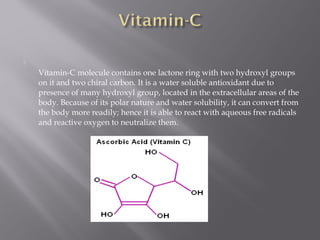
Vitamin-C molecule contains one lactone ring with two hydroxyl groups
on it and two chiral carbon. It is a water soluble antioxidant due to
presence of many hydroxyl group, located in the extracellular areas of the
body. Because of its polar nature and water solubility, it can convert from
the body more readily; hence it is able to react with aqueous free radicals
and reactive oxygen to neutralize them.
 The name “tannin” is derived from the French
“tanin” (tanning substance) and is used for a
range of natural polyphenols. Probably the
most acceptable definition of vegetable tannins
is still that of Bate-Smith and Swain,
formulated in 1962
 The plant tannins are a unique group of
phenolic compounds of relatively high
molecular weight which have the ability to
complex strongly with carbohydrates and
proteins.
Antioxidant Properties of Phenolic Compounds
Back to Top
Antioxidant action of phenolic compounds is because of their high tendency to
chelate metals with heavy metals like iron and copper. In human body as well
as in plant system, free radicals are main component which can easily damage
cell due to the presence of free electrons.
Proteins, green vegetables have releases some compounds which can
neutralize free radicals and help to repair the damage occur in cell due to free
radicals. Generally antioxidants can rapidly lose electron to a free radical and
get paired. The pairing of electron with free radical makes it less harmful.
Plant-microorganism communication
Flavonoid compounds have roles as signal molecules, phytoalexins,
detoxifying agents and stimulants for germination of spores.
Stimulant or protection
Flavonoids may have a stimulant or protective role depending on the roles of
the microorganisms in the plant.
Pigments
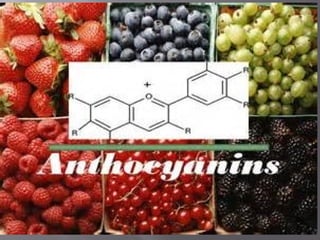
The colours of flowers, fruits, and leaves of plants are related to anthocyanins.
Flavouring
Flavonoids are amongst of the chemicals that give the plant a rich taste
(Harbone, 1976). The flavour may act as an attractant or repellent to
pollinators or pests.
 Rippling
 Inhibitor
 Natural animal toxicants
Examples , simple pehnolic , complex tannins ,
resins in the plant surface , deter birds .
UV radiation ranges 290-400nm
280-351nm damages nucleic acid, protein
Flavones and flavanole protect from excessive UV
radiation
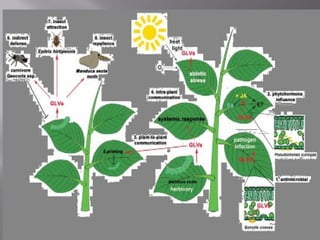
 One of the tomato's common pests is the beet armyworm, a greenish 1-inch-long caterpillar
that feeds on tomato leaves and fruit.
 the beet armyworm's natural enemy, a tiny parasitic wasp.
 The chemical resistance response in a plant is"octadecanoid pathway," triggered
 A wound from the insect signals the plant to produce a chemical known as "jasmonic acid,"
which in turn causes increased production of chemicals responsible for the leafy green odors of
plants.
 Wasps can smell those compounds through their antennae and can more easily find the
caterpillars when the caterpillars are less than 1 centimeter long," Thaler said. "The plants are
essentially sending up a chemical 'smoke-signal' to attract the wasps."
 With its ovipositor, the wasp pierces the caterpillar's flesh and places a single egg inside. A
wasp larva hatches from the egg and feeds on the caterpillar's internal organs, efficiently
saving the brain for the very last. The wasp larva then emerges from the caterpillar's decimated
body and builds a cocoon. A week later, the adult wasp emerges from the cocoon and the cycle
begins again.  
 A good example of this is the lima bean. when a
caterpillar starts feeding on a leaf, many things
happen. The physical damage itself releases a
cloud of fragrances. This fragrance warns the
whole plant of the impending danger, and all the
leaves begin producing chemicals for defence.
The fragrance mixture is like an “express
highway” of information, enabling immediate
dissemination of information. Neighbouring
plants also understand the message and start
defensive measures.
 Role in allelopathic interactions[edit]
 Natural phenols can be involved in allelopathic interactions, for example
in soil[107]
 or in water. Juglone is an example of such a molecule inhibiting
the growth of other plant species around walnut trees.[citationneeded]
 The aquatic
vascular plant Myriophyllum spicatum produces ellagic, gallic and 
pyrogallic acids and (+)-catechin, allelopathic phenolic compounds
inhibiting the growth of blue-green alga Microcystis aeruginosa.[72]
 Phenolics, and in particular flavonoids and isoflavonoids, may be
involved in endomycorrhizae formation.[108]
 Acetosyringone has been best known for its involvement in plant-
pathogen recognition,[109]
 especially its role as a signal attracting and
transforming unique, oncogenic bacteria in genus Agrobacterium.[citationneeded]
 The
virA gene on the Ti plasmid in the genome of Agrobacterium tumefaciens
 and Agrobacterium rhizogenes is used by these soil bacteria to infect plants,
via its encoding for a receptor for acetosyringone and other phenolic
phytochemicals exuded by plant wounds.[110]
 This compound also allows
higher transformation efficiency in plants, in A. tumefaciens mediated
transformation procedures, and so is of importance in plant
biotechnology
 Role in soils
 In soils, it is assumed that larger amounts of phenols are released
from decomposing plant litter rather than from throughfall in any
natural plant community.[citationneeded]
Decomposition of dead plant
material causes complex organic compounds to be slowly
oxidized lignin-like humus or to break down into simpler forms
(sugars and amino sugars, aliphatic and phenolic organic acids),
which are further transformed into microbial biomass (microbial
humus) or are reorganized, and further oxidized, into humic
assemblages (fulvic and humic acids), which bind to clay
minerals and metal hydroxides.[citationneeded]
 There has been a long debate
about the ability of plants to uptake humic substances from their
root systems and to metabolize them.[citationneeded]
 There is now a
consensus about how humus plays a hormonal role rather than
simply a nutritional role in plant physiology.[
Plant phenolic compounds

Plant phenolic compounds

  • 2.
     Introduction  Classification Occurrence  Synthesis  Defense
  • 3.
     In organicchemistry A class of chemical compounds which consist of a hydroxyl group (OH) directly bonded to an aromatic hydrocarbon group  Phenolic compounds are the substances containing benzoic molecules with one or several hydroxylic groups and their derivatives. If molecule contains two or more hydroxylic groups there is polyphenols.
  • 4.
  • 5.
     Biologically  Theseare secondary natural metabolites produced in plants biogenetically from either the shikimate/phenylpropanoid pathway which directly provide phenylpropanoids and which fulfill a very broad physiological role in plants
  • 7.
     Thousands ofPhenolic structures known  Account for 40% of organic carbon circulating in the biosphere  Evolution of vascular plants: in cell wall structures, plant defense, features of woods and barks, flower color, flavors
  • 8.
    Phenolics are widelydistributed secondary metabolite  Vascular plants  Bryophytes  Fungi, Algae, Bacteria
  • 12.
     Vitamin-E Vitamin-E isa fat soluble vitamin which generally found in nuts, vegetables and fish oils. It is not a single molecule but a family if molecule in which four are called as tocopherols and rest of four are known as tocotrienols 
  • 13.
     Vitamin-C molecule contains onelactone ring with two hydroxyl groups on it and two chiral carbon. It is a water soluble antioxidant due to presence of many hydroxyl group, located in the extracellular areas of the body. Because of its polar nature and water solubility, it can convert from the body more readily; hence it is able to react with aqueous free radicals and reactive oxygen to neutralize them.
  • 14.
     The name“tannin” is derived from the French “tanin” (tanning substance) and is used for a range of natural polyphenols. Probably the most acceptable definition of vegetable tannins is still that of Bate-Smith and Swain, formulated in 1962  The plant tannins are a unique group of phenolic compounds of relatively high molecular weight which have the ability to complex strongly with carbohydrates and proteins.
  • 19.
    Antioxidant Properties ofPhenolic Compounds Back to Top Antioxidant action of phenolic compounds is because of their high tendency to chelate metals with heavy metals like iron and copper. In human body as well as in plant system, free radicals are main component which can easily damage cell due to the presence of free electrons. Proteins, green vegetables have releases some compounds which can neutralize free radicals and help to repair the damage occur in cell due to free radicals. Generally antioxidants can rapidly lose electron to a free radical and get paired. The pairing of electron with free radical makes it less harmful.
  • 20.
    Plant-microorganism communication Flavonoid compoundshave roles as signal molecules, phytoalexins, detoxifying agents and stimulants for germination of spores. Stimulant or protection Flavonoids may have a stimulant or protective role depending on the roles of the microorganisms in the plant. Pigments The colours of flowers, fruits, and leaves of plants are related to anthocyanins. Flavouring Flavonoids are amongst of the chemicals that give the plant a rich taste (Harbone, 1976). The flavour may act as an attractant or repellent to pollinators or pests.
  • 21.
     Rippling  Inhibitor Natural animal toxicants Examples , simple pehnolic , complex tannins , resins in the plant surface , deter birds .
  • 23.
    UV radiation ranges290-400nm 280-351nm damages nucleic acid, protein Flavones and flavanole protect from excessive UV radiation
  • 28.
     One ofthe tomato's common pests is the beet armyworm, a greenish 1-inch-long caterpillar that feeds on tomato leaves and fruit.  the beet armyworm's natural enemy, a tiny parasitic wasp.  The chemical resistance response in a plant is"octadecanoid pathway," triggered  A wound from the insect signals the plant to produce a chemical known as "jasmonic acid," which in turn causes increased production of chemicals responsible for the leafy green odors of plants.  Wasps can smell those compounds through their antennae and can more easily find the caterpillars when the caterpillars are less than 1 centimeter long," Thaler said. "The plants are essentially sending up a chemical 'smoke-signal' to attract the wasps."  With its ovipositor, the wasp pierces the caterpillar's flesh and places a single egg inside. A wasp larva hatches from the egg and feeds on the caterpillar's internal organs, efficiently saving the brain for the very last. The wasp larva then emerges from the caterpillar's decimated body and builds a cocoon. A week later, the adult wasp emerges from the cocoon and the cycle begins again.  
  • 30.
     A goodexample of this is the lima bean. when a caterpillar starts feeding on a leaf, many things happen. The physical damage itself releases a cloud of fragrances. This fragrance warns the whole plant of the impending danger, and all the leaves begin producing chemicals for defence. The fragrance mixture is like an “express highway” of information, enabling immediate dissemination of information. Neighbouring plants also understand the message and start defensive measures.
  • 31.
     Role inallelopathic interactions[edit]  Natural phenols can be involved in allelopathic interactions, for example in soil[107]  or in water. Juglone is an example of such a molecule inhibiting the growth of other plant species around walnut trees.[citationneeded]  The aquatic vascular plant Myriophyllum spicatum produces ellagic, gallic and  pyrogallic acids and (+)-catechin, allelopathic phenolic compounds inhibiting the growth of blue-green alga Microcystis aeruginosa.[72]  Phenolics, and in particular flavonoids and isoflavonoids, may be involved in endomycorrhizae formation.[108]  Acetosyringone has been best known for its involvement in plant- pathogen recognition,[109]  especially its role as a signal attracting and transforming unique, oncogenic bacteria in genus Agrobacterium.[citationneeded]  The virA gene on the Ti plasmid in the genome of Agrobacterium tumefaciens  and Agrobacterium rhizogenes is used by these soil bacteria to infect plants, via its encoding for a receptor for acetosyringone and other phenolic phytochemicals exuded by plant wounds.[110]  This compound also allows higher transformation efficiency in plants, in A. tumefaciens mediated transformation procedures, and so is of importance in plant biotechnology
  • 32.
     Role insoils  In soils, it is assumed that larger amounts of phenols are released from decomposing plant litter rather than from throughfall in any natural plant community.[citationneeded] Decomposition of dead plant material causes complex organic compounds to be slowly oxidized lignin-like humus or to break down into simpler forms (sugars and amino sugars, aliphatic and phenolic organic acids), which are further transformed into microbial biomass (microbial humus) or are reorganized, and further oxidized, into humic assemblages (fulvic and humic acids), which bind to clay minerals and metal hydroxides.[citationneeded]  There has been a long debate about the ability of plants to uptake humic substances from their root systems and to metabolize them.[citationneeded]  There is now a consensus about how humus plays a hormonal role rather than simply a nutritional role in plant physiology.[