Pharmacognosy & Phytochemistry-II
Unit–I Metabolicpathwaysinhigherplantsandtheirdetermination
Presented by :- Miss. M A Joshi
Asst. Professor, IVM’s IIPER
Plant biosynthesis
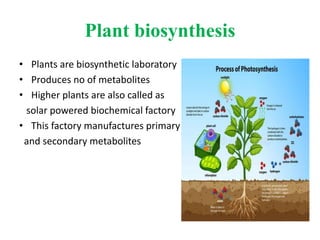
• Plants are biosynthetic laboratory
• Produces no of metabolites
• Higher plants are also called as
solar powered biochemical factory
• This factory manufactures primary
and secondary metabolites
What are primary and secondary
metabolites???
• Primary metabolites- fulfill primary need of plants.
• Growth of plant
• Physiological development of plant
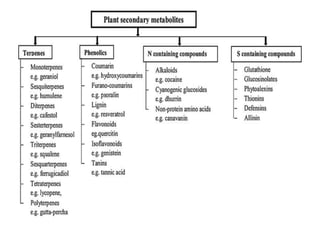
Secondary metabolites
• Biosynthetically derived from primary
metabolites
• Present only in higher plant or taxonomic group.
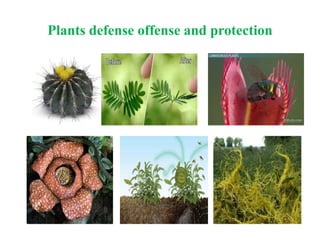
• They are chemical adaptation of plant to
environmental stress.
• They serves as defensive, protective or offensive
chemicals.
• Sometimes waste products of plant which
interrupt normal metabolism in plant are also
converted into secondary metabolites.
Plants defense offense and protection
Importance of secondary metabolites
• As medicines – as laxative, cardio tonic,
antihypertensive, sedatives, hypnotics,
Immuno-modulators etc.
• Flavors
• Perfumes
• For industrial purpose such as lubricant
protection etc
• Insecticides and pesticides eg. tobacco
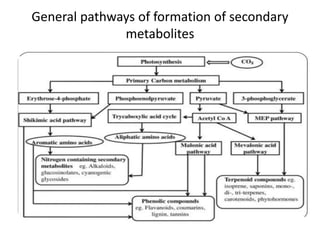
General pathways of formation of secondary
metabolites
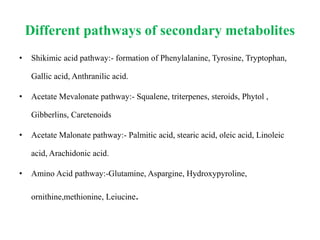
Different pathways of secondary metabolites
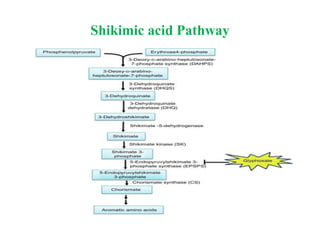
• Shikimic acid pathway:- formation of Phenylalanine, Tyrosine, Tryptophan,
Gallic acid, Anthranilic acid.
• Acetate Mevalonate pathway:- Squalene, triterpenes, steroids, Phytol ,
Gibberlins, Caretenoids
• Acetate Malonate pathway:- Palmitic acid, stearic acid, oleic acid, Linoleic
acid, Arachidonic acid.
• Amino Acid pathway:-Glutamine, Aspargine, Hydroxypyroline,
ornithine,methionine, Leiucine.
Shikimic acid Pathway
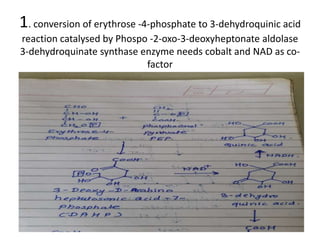
1. conversion of erythrose -4-phosphate to 3-dehydroquinic acid
reaction catalysed by Phospo -2-oxo-3-deoxyheptonate aldolase
3-dehydroquinate synthase enzyme needs cobalt and NAD as co-
factor
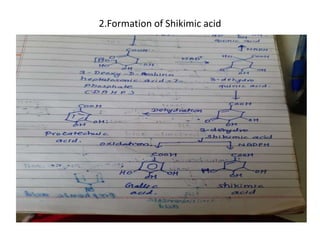
2.Formation of Shikimic acid
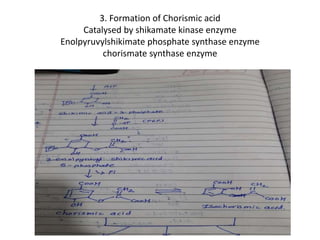
3. Formation of Chorismic acid
Catalysed by shikamate kinase enzyme
Enolpyruvylshikimate phosphate synthase enzyme
chorismate synthase enzyme
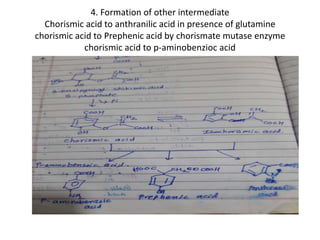
4. Formation of other intermediate
Chorismic acid to anthranilic acid in presence of glutamine
chorismic acid to Prephenic acid by chorismate mutase enzyme
chorismic acid to p-aminobenzioc acid
5. Formation of Aromatic amino acid
Anthranilic acid to Phosphoribosyl anthranilic acid- anthranilate phosphoribosyl
transferase
Carboxyphenylaminodeoxyribulose-5-Phosphate-Phosphoribosyl anthranilate
isomarase
conversion to Indolyl-3-glycero phosphate – Indolyl-3-glycerol phosphate synthase
condensation of indol with serine to form tryptophan
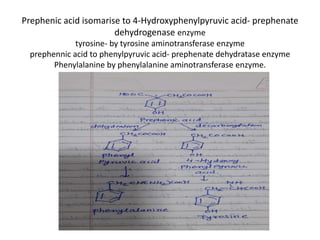
Prephenic acid isomarise to 4-Hydroxyphenylpyruvic acid- prephenate
dehydrogenase enzyme
tyrosine- by tyrosine aminotransferase enzyme
prephennic acid to phenylpyruvic acid- prephenate dehydratase enzyme
Phenylalanine by phenylalanine aminotransferase enzyme.
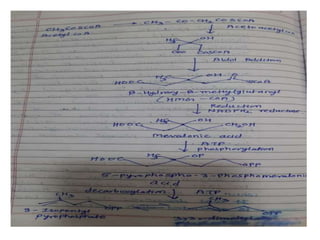
Acetate Mevalonate Pathway
Role of acetic acid in biogenetic was discovered in 1950 after the discovery of
acetyl co-enzyme A (Active acetate).
Mevalonic acid is associated with acetate.
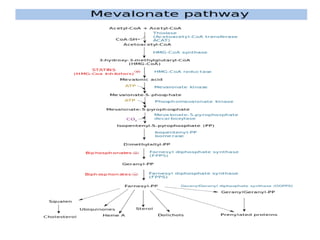
IPP and DMAPP are two chief isoprene unit as the basic building block of
isoprenoid compounds.
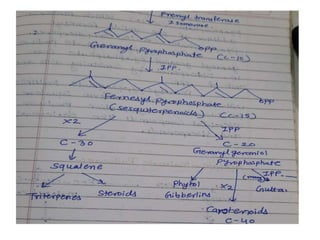
They produce geranyl pyrophosphate (C10 monoterpenes), which assciates with
IPP to produce Farnesyl pyrophosphate (C-15 sequiterpenes)
Farnesyl pyrophosphate multiply to form C30 compound and then after further
addition of IPP it forms Squalene , Triterpenes and Steroids.
Farnesyl pyrophosphate and IPP forms C-20 Geranyl geraniol pyrophosphate.
Geranyl Geraniol pyrophosphate and further additions of IPP forms Guttas, Phytol
and Gibberlins.
Two molecultes of Geranyl Geraniol pyrophosphate forms C-40 carotenoids.
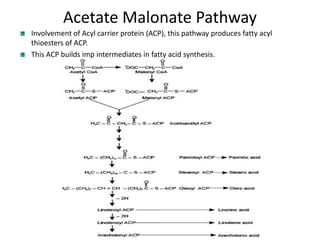
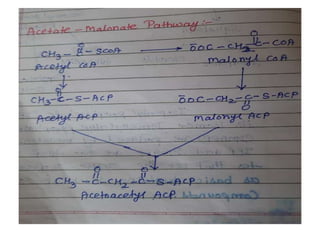
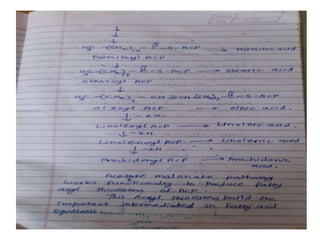
Acetate Malonate Pathway
Involvement of Acyl carrier protein (ACP), this pathway produces fatty acyl
thioesters of ACP.
This ACP builds imp intermediates in fatty acid synthesis.
Amino acid pathway
Amino acid found in free state and they are basic unit of proteins
They are precursors for secondary metabolites eg. Alkaloids
Most of the amino acid found in nature in the form of alpha amino
acid.( functional group attached to alpha carbon both functional
groups carboxylic acid and amino group)
Amino acid pathway starts from Glycolysis and Krebs cycle
Plant synthesize all 20 amino acids by using different routes of
biosynthesis.
Nitrogen enter in reaction through reductive amination of alpha keto
acid.
The aliphatic and heterocyclic amino acid have different routes of
biogenesis.
We have to learn amino acid biogenesis by 5 different pathways.
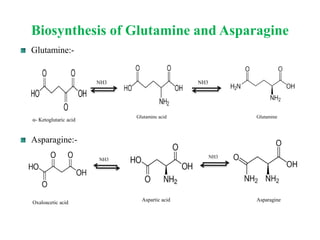
Biosynthesis of Glutamine and Asparagine
Glutamine:-
Asparagine:-
NH3 NH3
α- Ketoglutaric acid
GlutamineGlutaminc acid
NH3
NH3
Oxaloacetic acid
Aspartic acid Asparagine
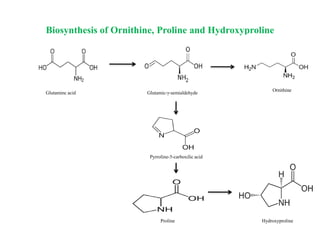
Biosynthesis of Ornithine, Proline and Hydroxyproline
Glutaminc acid Glutamic-γ-semialdehyde
Ornithine
Pyrroline-5-carboxilic acid
Proline Hydroxyproline
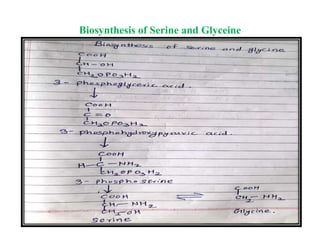
Biosynthesis of Serine and Glyceine
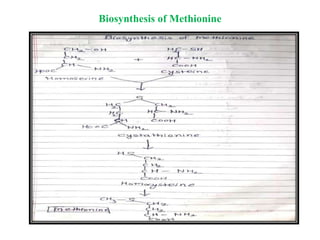
Biosynthesis of Methionine
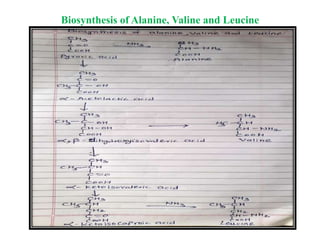
Biosynthesis of Alanine, Valine and Leucine
Biogenetic studies
• Various intermediated steps involved in biogenetic pathways of
plant are investigated by following different techniques.
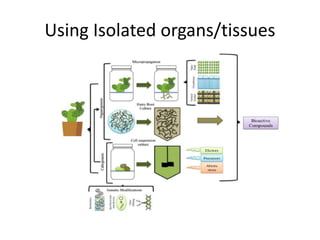
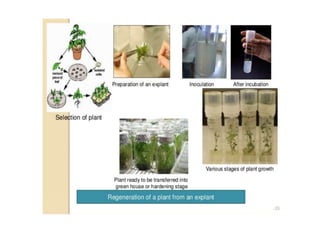
1. Using Isolated organs/tissues
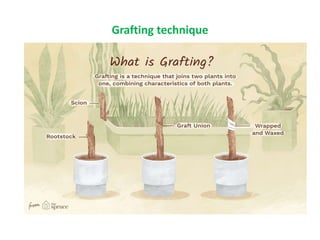
2. Grafting method
3. Use of Mutant strains
4. Tracer Technique
Using Isolated organs/tissues
Grafting technique
Used for study of alkaloids
Tomato and Dhatura are grafted to locate the position of secondary
metabolite.
When tomato scion grafted of Dhatura root stock it shows accumulation of
alkaloids.
But when Dharura scion grafted on tomato root stock it do not show very
small amount of alkaloid.
It is conclude that main synthesis site for formation of Dhatura alkaloids is
root.
Use of Mutant strain technique
• Gibberela is used for synthesis of isopronoid compounds
• Lactobacillus acidophilus is used in mevalonic acid
pathway for synthesis of isoprenoid units.
• In this technique normal metabolism is blocked on any
stage to synthesise required compound.
Utilization of radioactive isotopes
Radio labeled compound is used to investigate biosynthetic
pathways.
To investigate different techniques
C14, H3, S35,P32 are mainly used compounds for the investigation
of biosynthetic pathways.
Highly effective technique
Can be used in living system.
Provides accurate results.
Steps involved in utilization of
Radiolabel compound
1.Criteria for Tracer/ Isotope selection :-
Concentration should be sufficient
Physical and chemical properties should be well known.
It should not interfere in reaction system.
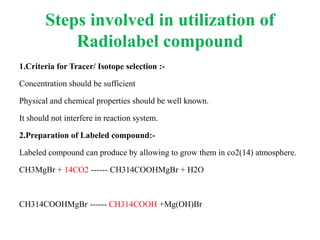
2.Preparation of Labeled compound:-
Labeled compound can produce by allowing to grow them in co2(14) atmosphere.
CH3MgBr + 14CO2 ------ CH314COOHMgBr + H2O
CH314COOHMgBr ------ CH314COOH +Mg(OH)Br
Introduction of Labeled compound
into biological system
• Root feeding method
• Step feeding
• Direct injection
• Infiltration or wick feeding
• Floating method
• Spray technique
4. Separation and detection technique
• Soft and fresh tissue :- Infusion and maceration
• Hard tissue:- Decoction and Hot percolation
• Unorganized tissue:- maceration with adjustment
• Fat and oil :- non-polar solvents
• Akaloids, Glycosides, and Flavonoids:- Slightly polar solvent
• Plants and Phenols:- Polar solvents
• GM counter
• Liquid scintillation Chember
• Gas ionisation chember
• Mass spectroscopy
• NMR spectroscopy
• Auto-radiography
Methods for Tracer Technique
• 1. Precursor Product Sequence:
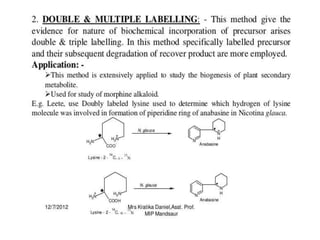
• 2. Double and Multiple Labeling
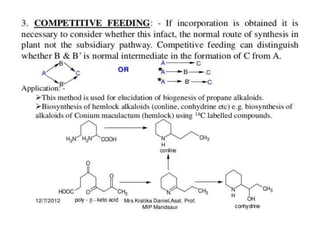
• 3. Competitive Feeding
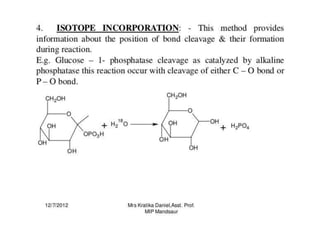
• 4. Isotope Incorporation
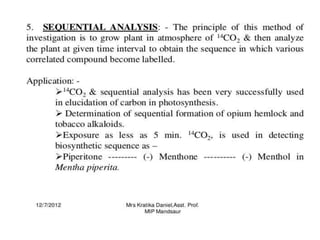
• 5. Sequential Analysis
Plants defense offense and protection

Biosynthetic pathways of secondary metabolites

  • 1.
    Pharmacognosy & Phytochemistry-II Unit–IMetabolicpathwaysinhigherplantsandtheirdetermination Presented by :- Miss. M A Joshi Asst. Professor, IVM’s IIPER
  • 2.
    Plant biosynthesis • Plantsare biosynthetic laboratory • Produces no of metabolites • Higher plants are also called as solar powered biochemical factory • This factory manufactures primary and secondary metabolites
  • 3.
    What are primaryand secondary metabolites??? • Primary metabolites- fulfill primary need of plants. • Growth of plant • Physiological development of plant
  • 5.
    Secondary metabolites • Biosyntheticallyderived from primary metabolites • Present only in higher plant or taxonomic group. • They are chemical adaptation of plant to environmental stress. • They serves as defensive, protective or offensive chemicals. • Sometimes waste products of plant which interrupt normal metabolism in plant are also converted into secondary metabolites.
  • 6.
    Plants defense offenseand protection
  • 7.
    Importance of secondarymetabolites • As medicines – as laxative, cardio tonic, antihypertensive, sedatives, hypnotics, Immuno-modulators etc. • Flavors • Perfumes • For industrial purpose such as lubricant protection etc • Insecticides and pesticides eg. tobacco
  • 8.
    General pathways offormation of secondary metabolites
  • 9.
    Different pathways ofsecondary metabolites • Shikimic acid pathway:- formation of Phenylalanine, Tyrosine, Tryptophan, Gallic acid, Anthranilic acid. • Acetate Mevalonate pathway:- Squalene, triterpenes, steroids, Phytol , Gibberlins, Caretenoids • Acetate Malonate pathway:- Palmitic acid, stearic acid, oleic acid, Linoleic acid, Arachidonic acid. • Amino Acid pathway:-Glutamine, Aspargine, Hydroxypyroline, ornithine,methionine, Leiucine.
  • 10.
  • 11.
    1. conversion oferythrose -4-phosphate to 3-dehydroquinic acid reaction catalysed by Phospo -2-oxo-3-deoxyheptonate aldolase 3-dehydroquinate synthase enzyme needs cobalt and NAD as co- factor
  • 12.
  • 13.
    3. Formation ofChorismic acid Catalysed by shikamate kinase enzyme Enolpyruvylshikimate phosphate synthase enzyme chorismate synthase enzyme
  • 14.
    4. Formation ofother intermediate Chorismic acid to anthranilic acid in presence of glutamine chorismic acid to Prephenic acid by chorismate mutase enzyme chorismic acid to p-aminobenzioc acid
  • 15.
    5. Formation ofAromatic amino acid Anthranilic acid to Phosphoribosyl anthranilic acid- anthranilate phosphoribosyl transferase Carboxyphenylaminodeoxyribulose-5-Phosphate-Phosphoribosyl anthranilate isomarase conversion to Indolyl-3-glycero phosphate – Indolyl-3-glycerol phosphate synthase condensation of indol with serine to form tryptophan
  • 16.
    Prephenic acid isomariseto 4-Hydroxyphenylpyruvic acid- prephenate dehydrogenase enzyme tyrosine- by tyrosine aminotransferase enzyme prephennic acid to phenylpyruvic acid- prephenate dehydratase enzyme Phenylalanine by phenylalanine aminotransferase enzyme.
  • 17.
    Acetate Mevalonate Pathway Roleof acetic acid in biogenetic was discovered in 1950 after the discovery of acetyl co-enzyme A (Active acetate). Mevalonic acid is associated with acetate. IPP and DMAPP are two chief isoprene unit as the basic building block of isoprenoid compounds. They produce geranyl pyrophosphate (C10 monoterpenes), which assciates with IPP to produce Farnesyl pyrophosphate (C-15 sequiterpenes) Farnesyl pyrophosphate multiply to form C30 compound and then after further addition of IPP it forms Squalene , Triterpenes and Steroids. Farnesyl pyrophosphate and IPP forms C-20 Geranyl geraniol pyrophosphate. Geranyl Geraniol pyrophosphate and further additions of IPP forms Guttas, Phytol and Gibberlins. Two molecultes of Geranyl Geraniol pyrophosphate forms C-40 carotenoids.
  • 21.
    Acetate Malonate Pathway Involvementof Acyl carrier protein (ACP), this pathway produces fatty acyl thioesters of ACP. This ACP builds imp intermediates in fatty acid synthesis.
  • 24.
    Amino acid pathway Aminoacid found in free state and they are basic unit of proteins They are precursors for secondary metabolites eg. Alkaloids Most of the amino acid found in nature in the form of alpha amino acid.( functional group attached to alpha carbon both functional groups carboxylic acid and amino group) Amino acid pathway starts from Glycolysis and Krebs cycle Plant synthesize all 20 amino acids by using different routes of biosynthesis. Nitrogen enter in reaction through reductive amination of alpha keto acid. The aliphatic and heterocyclic amino acid have different routes of biogenesis. We have to learn amino acid biogenesis by 5 different pathways.
  • 25.
    Biosynthesis of Glutamineand Asparagine Glutamine:- Asparagine:- NH3 NH3 α- Ketoglutaric acid GlutamineGlutaminc acid NH3 NH3 Oxaloacetic acid Aspartic acid Asparagine
  • 26.
    Biosynthesis of Ornithine,Proline and Hydroxyproline Glutaminc acid Glutamic-γ-semialdehyde Ornithine Pyrroline-5-carboxilic acid Proline Hydroxyproline
  • 27.
  • 28.
  • 29.
    Biosynthesis of Alanine,Valine and Leucine
  • 30.
    Biogenetic studies • Variousintermediated steps involved in biogenetic pathways of plant are investigated by following different techniques. 1. Using Isolated organs/tissues 2. Grafting method 3. Use of Mutant strains 4. Tracer Technique
  • 31.
  • 33.
  • 35.
    Used for studyof alkaloids Tomato and Dhatura are grafted to locate the position of secondary metabolite. When tomato scion grafted of Dhatura root stock it shows accumulation of alkaloids. But when Dharura scion grafted on tomato root stock it do not show very small amount of alkaloid. It is conclude that main synthesis site for formation of Dhatura alkaloids is root.
  • 36.
    Use of Mutantstrain technique • Gibberela is used for synthesis of isopronoid compounds • Lactobacillus acidophilus is used in mevalonic acid pathway for synthesis of isoprenoid units. • In this technique normal metabolism is blocked on any stage to synthesise required compound.
  • 37.
    Utilization of radioactiveisotopes Radio labeled compound is used to investigate biosynthetic pathways. To investigate different techniques C14, H3, S35,P32 are mainly used compounds for the investigation of biosynthetic pathways. Highly effective technique Can be used in living system. Provides accurate results.
  • 38.
    Steps involved inutilization of Radiolabel compound 1.Criteria for Tracer/ Isotope selection :- Concentration should be sufficient Physical and chemical properties should be well known. It should not interfere in reaction system. 2.Preparation of Labeled compound:- Labeled compound can produce by allowing to grow them in co2(14) atmosphere. CH3MgBr + 14CO2 ------ CH314COOHMgBr + H2O CH314COOHMgBr ------ CH314COOH +Mg(OH)Br
  • 39.
    Introduction of Labeledcompound into biological system • Root feeding method • Step feeding • Direct injection • Infiltration or wick feeding • Floating method • Spray technique
  • 40.
    4. Separation anddetection technique • Soft and fresh tissue :- Infusion and maceration • Hard tissue:- Decoction and Hot percolation • Unorganized tissue:- maceration with adjustment • Fat and oil :- non-polar solvents • Akaloids, Glycosides, and Flavonoids:- Slightly polar solvent • Plants and Phenols:- Polar solvents • GM counter • Liquid scintillation Chember • Gas ionisation chember • Mass spectroscopy • NMR spectroscopy • Auto-radiography
  • 41.
    Methods for TracerTechnique • 1. Precursor Product Sequence: • 2. Double and Multiple Labeling • 3. Competitive Feeding • 4. Isotope Incorporation • 5. Sequential Analysis
  • 46.
    Plants defense offenseand protection