Terpenes
1
ACETATE MEVALONATE PATHWAY AND TERPENES
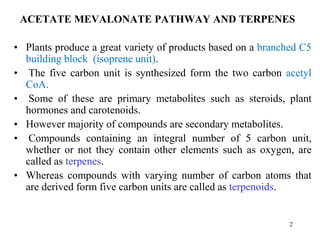
• Plants produce a great variety of products based on a branched C5
building block (isoprene unit).
• The five carbon unit is synthesized form the two carbon acetyl
CoA.
• Some of these are primary metabolites such as steroids, plant
hormones and carotenoids.
• However majority of compounds are secondary metabolites.
• Compounds containing an integral number of 5 carbon unit,
whether or not they contain other elements such as oxygen, are
called as terpenes.
• Whereas compounds with varying number of carbon atoms that
are derived form five carbon units are called as terpenoids.
2
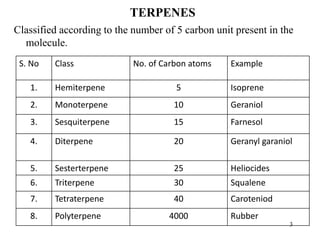
TERPENES
Classified according to the number of 5 carbon unit present in the
molecule.
S. No Class No. of Carbon atoms Example
1. Hemiterpene 5 Isoprene
2. Monoterpene 10 Geraniol
3. Sesquiterpene 15 Farnesol
4. Diterpene 20 Geranyl garaniol
5. Sesterterpene 25 Heliocides
6. Triterpene 30 Squalene
7. Tetraterpene 40 Caroteniod
8. Polyterpene 4000 Rubber
3
Biosynthesis
• The basic five carbon unit – isopenetenyl pyrophosphate is first
synthesized from acetyl CoA.
• In order to start the polymerization reactions which produce the
higher terpenes, isopentenyl pyrophosphate (IPP) is converted into
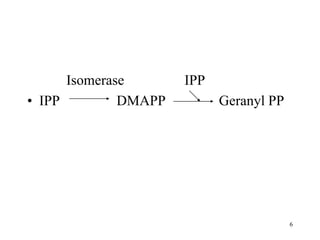
dimethylallyl pyrophosphate in the presence of an isomerase.
• Dimethyl allyl pyrophosphate (DMAPP) then acts as a starter for
polymerization.
• Similar subsequent addition of IPP molecules lead to farnesyl
pyrophosphate and geranyl pyrophosphate and other terpenes.
4
HMG CoA synthase
HMG CoA reductase
Mevalonate kinase
PhosphoMevalonate kinase
5
Isomerase IPP
• IPP DMAPP Geranyl PP
6
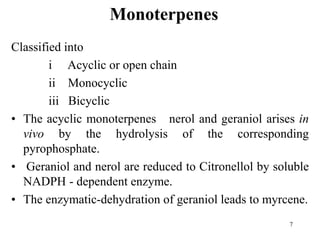
Monoterpenes
Classified into
i Acyclic or open chain
ii Monocyclic
iii Bicyclic
• The acyclic monoterpenes nerol and geraniol arises in
vivo by the hydrolysis of the corresponding
pyrophosphate.
• Geraniol and nerol are reduced to Citronellol by soluble
NADPH - dependent enzyme.
• The enzymatic-dehydration of geraniol leads to myrcene.
7
Essential oils
Mixtures of volatile organic compounds which produce the odours of
the vegetable substances form which they are derived.
• Function in plants: Chemical compounds such as alkaloids
flavones, rubber latex and essential oils appear to contribute no
useful function to the chemistry of the living plant and the reason
for their presence is unknown.
• Essential oils may have an ecological importance.
• For example, some oil – bearing plants are attractive to certain
animals and insects which contribute towards more effective
pollination;
• others are repellents and afford protection of the plant from
animals and parasites.
• It is notable that plants possessing strong odours tend to be less
colourful than non–odorous plants.
8
The majority of compounds found in essential oils
may be classified into four main groups:
• Terpenes
• Strainght chain compounds
• Benzene derivatives
• Miscellaneous Compounds
9
Terpenes
• Several oxygenated acyclic monoterpenes are
extremely important in perfume industry
• present in many essential oils as major components.
• Geraniol, linalool, citronellal, citral are some examples
10
Patchouli oil
• The patchouli plant P. patchouli is used for extraction of
the essential oil.
• It is rich in various sesquiterpene compounds particularly
patchouli alcohol which comprises 60% of the oil.
• It is the most important ingredient in perfumery.
11
Rose oil (absolute)
• It is widely used in high – class perfumes
• Also employed to give interesting flavour effects
in fruit flavours.
• They are rich in phenylethyl alcohol, geraniol,
nerol and l – citronellol
12
Sesquiterpenes
• Several sesquiterpenes play well defined and
essential roles in higher and lower plants including the
hormone abscisic acid, furaniod phytoalexins, lactone
antifeedants and numerous antibiotics.
• Several thousand individual sesquiterpenes have been
identified.
• Most sesquiterpenes are constructed by the typical head
to tail fusion of IPP.
13
Diterpenes
• They are derived from geranyl geranyl PP.
• Important diterpenes include gymnosperm resin acids
and the plant hormone gibberellins.
• Most of them are cyclic compounds.
• The open chain alcohol, phytol, is found as a side chain
on the cholorophyll molecule.
14
Some terpenes
15
Triterpenes
Two molecules of farnesyl PP condense tail to tail to form cyclic
triterpene, squalene.
This is the precurssor of all other triterpenes as well as steroids.
A majority of natural triterpenes are pentacyclic compounds and are
mostly alcohols (sterols).
They occur free and as glycosides.
The important compounds include
Sapogenins
Cardiac glycosides
Ecdysones
Steriod alkaloids
16
Sterol synthesis
17
Triterpenoid compounds from neem
• Neem plants synthesize azadirachtin, a triterpeniod, by a well
known route from acetate pathway through mevalonate and squalene.
• The parents terpene is apotirucallol or apoeuphol.
• Azadirachtin was very different from the parent structure and
contained a surprising 16 oxygen atoms.
• It has insecticidal properties
18
Tetraterpenes
• Tetraterpenes consist of one group of compounds ,the caroteniod
pigments.
• About 500 structures are known but only a limited number are
present in green leaves.
• They are localized in the chloroplasts.
• Their protective presence is essential for the survival of
chloroplasts under light / aerobic conditions.
• They also contribute to light harvesting in photosynthesis.
• The colour of carotenionds is due to the presence of a long series
of conjugated double bonds present in the molecule.
• The hydrocarbon tetraterpenes are called as carotenes and those
containing oxygen functions are known as xanthophylls.
19
Functions of carotenoids
• Carotenoids have one another important function. They prevent
photodynamic damage.
• This damage is caused by first excited singlet oxygen.
• This singlet oxygen is very reactive and is capable of oxidizing as
whole range of organic compounds thereby rendering them unfit
for their normal physiological function.
• Singlet oxygen is reactive because it is in excited state and is
therefore more energetic than the ground state.
• It is formed form atmospheric oxygen, when energy is supplied.
• This energy is usually supplied in the form of light in the presence
of chlorophyll.
20
• Carotenoids are able to prevent photodynamic damage occurring
with in the photosynthetic apparatus in three different ways.
• 1. Carotenoids quench (90%) the first excited triplet state of
chlorophyll.
• 2. The carotenoid ground state singlet (Carso) reacts with ChlT1
in a reaction to yield a chlorophyll ground – state singlet(ChlSo)
and a carotenoid first - excited state triplet (CarT1).
• The latter then subsides to CarSo by intersystem crossing and the
vibrational cascade.
21
3.Caroteniod quench singlet oxygen directly
• Caroteniods act as a preferred substrate for oxidation by
any singlet oxygen.
• Only carotenoids with 9 or more conjugated double
bonds are capable of quenching in this way because only
on such molecules is the triplet energy level near or
below that of singlet oxygen.
22
Biosynthesis
• Caroteniods are synthesised form two molecules of
geranyl – geranyl PP and the first compound formed is
phytoene.
• This is not the C40 analogue of squalene because it
contains a central double bond that is missing form
squalene.
• From phytoene other terpenes such as lycopene, γ–
carotene, β-carotene, α–carotene and xanthophylls are
formed
23
Polyterpenes
• Polyterpenes include high molecular weight polymers rubber, gutta
and chicle.
• These are long chain hydrocarbons.
• Rubber is all – cis polyisoprene of mixed molecular weight from less
than 105 to about 4 x 10⁶.
• Rubber is mainly obtained form the latex of Hevea brasiliensis.
• Rubber particles accumulate in specialised cells called lactifiers.
24
Gutta
• Trans – polyisoprene of lower MW.
• The trans double bonds of gutta results in a material
whose molecules readily align themselves into
crystalline form.
• Thus the material is thermoplastic hard at ordinary
temperature but soften on heating.
• The important source is Palaquium gutta and
guayule plant.
• Latex does not flow as readily as rubber.
• Harvesting of gutta results in destruction of trees.
25
Chicle
• mixture of low MW cis–and trans –
polyisoprenes together with acetone soluble
resins.
• The source is Achras sapota.
26
BIOSYNTHESIS OF TERPENS AND TERPENOIDS
Acetyl COA Malonyl COA
Acetylenes
Polyketides
Phytoalexins
Mevalonic acid
Hemiterpenes
IPP DMAPP
Geranyl PP Monoterpenes
Essential oil components
Sesquilerpenes
Farnesyl PP Abscisic acid
Steroids
Triterpenes Sapogenins
Ecdysone
Steroid alkaloids
Diterpenes Gibberellins
Gernygeranyl PP
Tetraterpenes Carotenoids
Gernanyl farnesyl PP Sesterterpenes Heliocides
Polyprenols
Polyprenyl PP Rubber
Polyterpenes Gutta
Chicle
27
28
Brassinosteroids
• In 1979, a novel plant growth regulating steroidal
substance called brassinolide
• isolated from rape (Brassica napus) pollen .
• More than 24 compounds are known (designated as BR1,
BR2).
• Pollen is the richest source.
• Brassinosterols are active at concentration much lower
(nM to pM range) than those of other types of hormones.
• Brassinosterols elicit a pronounced stem elongation
response in dwarf pea epicotyls, mung bean epicotyls that
are sensitive also to gibberellic acids but not auxins.
• Brassinosteroids are thought by some to be a new class of
plant hormones.
29
The evidences are
• i. They are widely distributed in the plant
kingdom.
• ii. They have an effect at extremely low
concentration.
• iii. They have a range of effects which are
different from the other classes of plant hormones.
• iv. They can be applied to one part of the plant
and transported to another where in very low
amounts elicit a biological response.
30
• They are widely distributed including dicots,
monocots, gymnosperms and algae, and in various
plant parts such as pollen, leaves, flowers, seeds,
shoots and stems.
• Among the naturally occurring brassinosteroids,
brassinolide and castasterone are considered to
be the most important because of their wide
distribution as well as their potent physiological
activity.
31
32
Physiological effects of brassinosteroids
• Promotion of ethylene biosynthesis by stimulating ACC
synthase activity.
• Promote elongation of vegetative tissue in a wide
variety of plants at very low concentration.
• They are powerful inhibitors of root growth and
development (via ethylene).
• They have been shown to interfere with ecdysteroids at
their site of action, and are thus the first true
antiecdysteroids.
• They enhance resistance to chilling, disease, herbicides
and salt stress, promote germination and decrease fruit
abortion and drop
33
Practical application of BR
• Large scale field trials in China and Japan over a six year
period have shown that 24- epibrassinolide, an alternative to
brassinolide, increased the production of agronomic and
horticultural crops (wheat, corn, tobacco, watermelon and
cucumber). Environmental stresses were also seemed to be
allievated by treatment with brassinolide.
34

Terpenes.pptx

  • 1.
  • 2.
    ACETATE MEVALONATE PATHWAYAND TERPENES • Plants produce a great variety of products based on a branched C5 building block (isoprene unit). • The five carbon unit is synthesized form the two carbon acetyl CoA. • Some of these are primary metabolites such as steroids, plant hormones and carotenoids. • However majority of compounds are secondary metabolites. • Compounds containing an integral number of 5 carbon unit, whether or not they contain other elements such as oxygen, are called as terpenes. • Whereas compounds with varying number of carbon atoms that are derived form five carbon units are called as terpenoids. 2
  • 3.
    TERPENES Classified according tothe number of 5 carbon unit present in the molecule. S. No Class No. of Carbon atoms Example 1. Hemiterpene 5 Isoprene 2. Monoterpene 10 Geraniol 3. Sesquiterpene 15 Farnesol 4. Diterpene 20 Geranyl garaniol 5. Sesterterpene 25 Heliocides 6. Triterpene 30 Squalene 7. Tetraterpene 40 Caroteniod 8. Polyterpene 4000 Rubber 3
  • 4.
    Biosynthesis • The basicfive carbon unit – isopenetenyl pyrophosphate is first synthesized from acetyl CoA. • In order to start the polymerization reactions which produce the higher terpenes, isopentenyl pyrophosphate (IPP) is converted into dimethylallyl pyrophosphate in the presence of an isomerase. • Dimethyl allyl pyrophosphate (DMAPP) then acts as a starter for polymerization. • Similar subsequent addition of IPP molecules lead to farnesyl pyrophosphate and geranyl pyrophosphate and other terpenes. 4
  • 5.
    HMG CoA synthase HMGCoA reductase Mevalonate kinase PhosphoMevalonate kinase 5
  • 6.
    Isomerase IPP • IPPDMAPP Geranyl PP 6
  • 7.
    Monoterpenes Classified into i Acyclicor open chain ii Monocyclic iii Bicyclic • The acyclic monoterpenes nerol and geraniol arises in vivo by the hydrolysis of the corresponding pyrophosphate. • Geraniol and nerol are reduced to Citronellol by soluble NADPH - dependent enzyme. • The enzymatic-dehydration of geraniol leads to myrcene. 7
  • 8.
    Essential oils Mixtures ofvolatile organic compounds which produce the odours of the vegetable substances form which they are derived. • Function in plants: Chemical compounds such as alkaloids flavones, rubber latex and essential oils appear to contribute no useful function to the chemistry of the living plant and the reason for their presence is unknown. • Essential oils may have an ecological importance. • For example, some oil – bearing plants are attractive to certain animals and insects which contribute towards more effective pollination; • others are repellents and afford protection of the plant from animals and parasites. • It is notable that plants possessing strong odours tend to be less colourful than non–odorous plants. 8
  • 9.
    The majority ofcompounds found in essential oils may be classified into four main groups: • Terpenes • Strainght chain compounds • Benzene derivatives • Miscellaneous Compounds 9
  • 10.
    Terpenes • Several oxygenatedacyclic monoterpenes are extremely important in perfume industry • present in many essential oils as major components. • Geraniol, linalool, citronellal, citral are some examples 10
  • 11.
    Patchouli oil • Thepatchouli plant P. patchouli is used for extraction of the essential oil. • It is rich in various sesquiterpene compounds particularly patchouli alcohol which comprises 60% of the oil. • It is the most important ingredient in perfumery. 11
  • 12.
    Rose oil (absolute) •It is widely used in high – class perfumes • Also employed to give interesting flavour effects in fruit flavours. • They are rich in phenylethyl alcohol, geraniol, nerol and l – citronellol 12
  • 13.
    Sesquiterpenes • Several sesquiterpenesplay well defined and essential roles in higher and lower plants including the hormone abscisic acid, furaniod phytoalexins, lactone antifeedants and numerous antibiotics. • Several thousand individual sesquiterpenes have been identified. • Most sesquiterpenes are constructed by the typical head to tail fusion of IPP. 13
  • 14.
    Diterpenes • They arederived from geranyl geranyl PP. • Important diterpenes include gymnosperm resin acids and the plant hormone gibberellins. • Most of them are cyclic compounds. • The open chain alcohol, phytol, is found as a side chain on the cholorophyll molecule. 14
  • 15.
  • 16.
    Triterpenes Two molecules offarnesyl PP condense tail to tail to form cyclic triterpene, squalene. This is the precurssor of all other triterpenes as well as steroids. A majority of natural triterpenes are pentacyclic compounds and are mostly alcohols (sterols). They occur free and as glycosides. The important compounds include Sapogenins Cardiac glycosides Ecdysones Steriod alkaloids 16
  • 17.
  • 18.
    Triterpenoid compounds fromneem • Neem plants synthesize azadirachtin, a triterpeniod, by a well known route from acetate pathway through mevalonate and squalene. • The parents terpene is apotirucallol or apoeuphol. • Azadirachtin was very different from the parent structure and contained a surprising 16 oxygen atoms. • It has insecticidal properties 18
  • 19.
    Tetraterpenes • Tetraterpenes consistof one group of compounds ,the caroteniod pigments. • About 500 structures are known but only a limited number are present in green leaves. • They are localized in the chloroplasts. • Their protective presence is essential for the survival of chloroplasts under light / aerobic conditions. • They also contribute to light harvesting in photosynthesis. • The colour of carotenionds is due to the presence of a long series of conjugated double bonds present in the molecule. • The hydrocarbon tetraterpenes are called as carotenes and those containing oxygen functions are known as xanthophylls. 19
  • 20.
    Functions of carotenoids •Carotenoids have one another important function. They prevent photodynamic damage. • This damage is caused by first excited singlet oxygen. • This singlet oxygen is very reactive and is capable of oxidizing as whole range of organic compounds thereby rendering them unfit for their normal physiological function. • Singlet oxygen is reactive because it is in excited state and is therefore more energetic than the ground state. • It is formed form atmospheric oxygen, when energy is supplied. • This energy is usually supplied in the form of light in the presence of chlorophyll. 20
  • 21.
    • Carotenoids areable to prevent photodynamic damage occurring with in the photosynthetic apparatus in three different ways. • 1. Carotenoids quench (90%) the first excited triplet state of chlorophyll. • 2. The carotenoid ground state singlet (Carso) reacts with ChlT1 in a reaction to yield a chlorophyll ground – state singlet(ChlSo) and a carotenoid first - excited state triplet (CarT1). • The latter then subsides to CarSo by intersystem crossing and the vibrational cascade. 21
  • 22.
    3.Caroteniod quench singletoxygen directly • Caroteniods act as a preferred substrate for oxidation by any singlet oxygen. • Only carotenoids with 9 or more conjugated double bonds are capable of quenching in this way because only on such molecules is the triplet energy level near or below that of singlet oxygen. 22
  • 23.
    Biosynthesis • Caroteniods aresynthesised form two molecules of geranyl – geranyl PP and the first compound formed is phytoene. • This is not the C40 analogue of squalene because it contains a central double bond that is missing form squalene. • From phytoene other terpenes such as lycopene, γ– carotene, β-carotene, α–carotene and xanthophylls are formed 23
  • 24.
    Polyterpenes • Polyterpenes includehigh molecular weight polymers rubber, gutta and chicle. • These are long chain hydrocarbons. • Rubber is all – cis polyisoprene of mixed molecular weight from less than 105 to about 4 x 10⁶. • Rubber is mainly obtained form the latex of Hevea brasiliensis. • Rubber particles accumulate in specialised cells called lactifiers. 24
  • 25.
    Gutta • Trans –polyisoprene of lower MW. • The trans double bonds of gutta results in a material whose molecules readily align themselves into crystalline form. • Thus the material is thermoplastic hard at ordinary temperature but soften on heating. • The important source is Palaquium gutta and guayule plant. • Latex does not flow as readily as rubber. • Harvesting of gutta results in destruction of trees. 25
  • 26.
    Chicle • mixture oflow MW cis–and trans – polyisoprenes together with acetone soluble resins. • The source is Achras sapota. 26
  • 27.
    BIOSYNTHESIS OF TERPENSAND TERPENOIDS Acetyl COA Malonyl COA Acetylenes Polyketides Phytoalexins Mevalonic acid Hemiterpenes IPP DMAPP Geranyl PP Monoterpenes Essential oil components Sesquilerpenes Farnesyl PP Abscisic acid Steroids Triterpenes Sapogenins Ecdysone Steroid alkaloids Diterpenes Gibberellins Gernygeranyl PP Tetraterpenes Carotenoids Gernanyl farnesyl PP Sesterterpenes Heliocides Polyprenols Polyprenyl PP Rubber Polyterpenes Gutta Chicle 27
  • 28.
  • 29.
    Brassinosteroids • In 1979,a novel plant growth regulating steroidal substance called brassinolide • isolated from rape (Brassica napus) pollen . • More than 24 compounds are known (designated as BR1, BR2). • Pollen is the richest source. • Brassinosterols are active at concentration much lower (nM to pM range) than those of other types of hormones. • Brassinosterols elicit a pronounced stem elongation response in dwarf pea epicotyls, mung bean epicotyls that are sensitive also to gibberellic acids but not auxins. • Brassinosteroids are thought by some to be a new class of plant hormones. 29
  • 30.
    The evidences are •i. They are widely distributed in the plant kingdom. • ii. They have an effect at extremely low concentration. • iii. They have a range of effects which are different from the other classes of plant hormones. • iv. They can be applied to one part of the plant and transported to another where in very low amounts elicit a biological response. 30
  • 31.
    • They arewidely distributed including dicots, monocots, gymnosperms and algae, and in various plant parts such as pollen, leaves, flowers, seeds, shoots and stems. • Among the naturally occurring brassinosteroids, brassinolide and castasterone are considered to be the most important because of their wide distribution as well as their potent physiological activity. 31
  • 32.
  • 33.
    Physiological effects ofbrassinosteroids • Promotion of ethylene biosynthesis by stimulating ACC synthase activity. • Promote elongation of vegetative tissue in a wide variety of plants at very low concentration. • They are powerful inhibitors of root growth and development (via ethylene). • They have been shown to interfere with ecdysteroids at their site of action, and are thus the first true antiecdysteroids. • They enhance resistance to chilling, disease, herbicides and salt stress, promote germination and decrease fruit abortion and drop 33
  • 34.
    Practical application ofBR • Large scale field trials in China and Japan over a six year period have shown that 24- epibrassinolide, an alternative to brassinolide, increased the production of agronomic and horticultural crops (wheat, corn, tobacco, watermelon and cucumber). Environmental stresses were also seemed to be allievated by treatment with brassinolide. 34