TELE4653 Digital Modulation &
          Coding
                  Digital Modulation
                          Wei Zhang
                     w.zhang@unsw.edu.au


    School of Electrical Engineering and Telecommunications
              The University of New South Wales
Outline

 CPFSK
 CPM
 MSK
 Offset QPSK


               TELE4653 - Digital Modulation & Coding - Lecture 2. March 15, 2010. – p.1/2
Modulation with Memory
 Modulation is the mapping between the digital sequence
 and the signal sequence to be transmitted over the channel.
 Modulation with memory: the mapping depends on the
 current and the past bits.
 Example: differential encoding.

                       bk = ak ⊕ bk−1


                                    TELE4653 - Digital Modulation & Coding - Lecture 2. March 15, 2010. – p.2/2
from Digital Communications (5th Ed.) – John G. Proakis and Masoud Salehi
CPFSK

Why do we need Continuous-Phase FSK (CPFSK)?
   A conventional FSK signal is generated by shifting the
   carrier by m∆f , 1 ≤ m ≤ M . It can be accomplished by
   having M separate oscillators tuned to the desired
   frequencies.
   The abrupt switching from one oscillator output to another
   results in large spectral side lobes of the signal.
   To address spectral side lobes, the frequency is changed
   continuously. CPFSK.


                                       TELE4653 - Digital Modulation & Coding - Lecture 2. March 15, 2010. – p.6/2
CPFSK

The signal waveform of CPFSK is given by

                       2E
            s(t) =        cos [2πfc t + φ(t; I) + φ0 ]                                                (1)
                       T
where φ(t; I) represents the time-varying phase of the carrier, as
                                       t
                 φ(t; I) = 4πT fd          d(τ )dτ                                                    (2)
                                      −∞

with a PAM signal
                     d(t) =       In g(t − nT ).                                                      (3)
                              n

In denotes the sequence of amplitudes and g(t) is the
                                   1
rectangular pulse of amplitude of 2T and duration of T .
                                               TELE4653 - Digital Modulation & Coding - Lecture 2. March 15, 2010. – p.7/2
CPFSK

 Although d(t) contains discontinuities, φ(t; I) is continuous.
 The phase φ(t; I) in the interval nT ≤ t ≤ (n + 1)T is
                            n−1
        φ(t; I) = 2πfd T          Ik + 4πfd T q(t − nT )In                                    (4)
                           k=−∞
                = θn + 2πhIn q(t − nT )                                                       (5)

                                                                              n−1
 where h = 2fd T is the modulation index, θn = πh                             k=−∞ Ik
 represents the accumulation of all symbols, and
                       
                        0
                                t<0
                       
                       
                q(t) =    t
                              0≤t≤T                                                           (6)
                        2T
                       
                        1
                       
                            2    t>T
                                       TELE4653 - Digital Modulation & Coding - Lecture 2. March 15, 2010. – p.8/2
CPM

For continuous-phase modulation (CPM) signals,
                    n
    φ(t; I) = 2π          Ik hk q(t − kT ), nT ≤ t ≤ (n + 1)T                                               (7)
                   k=−∞

where {Ik } is the sequence of M -ary symbols selected from
{±1, ±3, · · · , ±(M − 1)}, {hk } is a sequence of modulation
indices, and q(t) is some normalized waveform shape as
                                       t
                          q(t) =           g(τ )dτ                                                          (8)
                                   0

Full-response CPM if g(t) = 0 for t > T , and Partial-response
CPM if g(t) = 0 for t > T .

                                                     TELE4653 - Digital Modulation & Coding - Lecture 2. March 15, 2010. – p.9/2
from Digital Communications (5th Ed.) – John G. Proakis and Masoud Salehi
MSK

Minimum-shift keying (MSK) is a special case of binary CPFSK
(and CPM) in which h = 1 and g(t) is a rectangular pulse of
                         2
duration T . The phase of the carrier in the interval
nT ≤ t ≤ (n + 1)T is [obtained from Eq. (5)]

                           t − nT
      φ(t; I) = θn + πIn            , nT ≤ t ≤ (n + 1)T                                       (9)
                             2T

and the MSK signal is
       s(t) = A cos [2πfc t + φ(t; I)]                                                      (10)
                                 1        1
            = A cos 2π fc +         In t − nπIn + θn ,                                      (11)
                                4T        2

for nT ≤ t ≤ (n + 1)T .
                                      TELE4653 - Digital Modulation & Coding - Lecture 2. March 15, 2010. – p.12/2
MSK

For binary CPFSK, i.e., In = {±1}, the signal may be written as

                                 1
     si (t) = A cos 2πfi t + θn + nπ(−1)i−1 , i = 1, 2                                         (12)
                                 2

where                                1
                        f1   = fc −                                                            (13)
                                    4T
                                     1
                        f2   = fc +                                                            (14)
                                    4T
Note ∆f = f2 − f1 = 1/2T , i.e., the minimum frequency
separation that is necessary to ensure the orthogonality of
signals s1 (t) and s2 (t). This explains why binary CPFSK with
h = 1 is called the MSK.
    2

                                         TELE4653 - Digital Modulation & Coding - Lecture 2. March 15, 2010. – p.13/2
from Digital Communications (5th Ed.) – John G. Proakis and Masoud Salehi
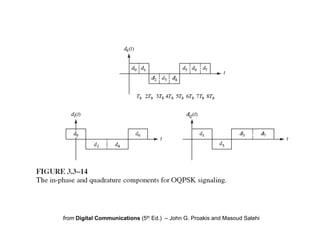
Offset QPSK

 For conventional QPSK signals, the possible 180◦ phase
 change can occur when both I and Q components change
 simultaneously.
 To prevent 180◦ phase changes that cause abrupt changes
 in the signal, resulting in large spectral side lobes, offset
 QPSK (OQPSK) is introduced, by misalignment of the I and
 Q components. The OQPSK signal can be written as
                        ∞
      s(t) = A              I2n g(t − 2nT ) cos 2πfc t
                     n=−∞
                    ∞
            +            I2n+1 g(t − 2nT − T ) sin 2πfc t                                   (15)
                  n=−∞
                                      TELE4653 - Digital Modulation & Coding - Lecture 2. March 15, 2010. – p.16/2
from Digital Communications (5th Ed.) – John G. Proakis and Masoud Salehi
OQPSK vs. MSK

 Conventional QPSK contains phase jumps of ±180◦ or
 ±90◦ .
 Offset QPSK contains phase jumps of ±90◦ . It has constant
 frequency, but there exist jumps in its waveform.
 MSK may be represented as a form of OQPSK.
 MSK has continuous phase, so there exist no jumps in the
 waveform. But there are jumps in its instantaneous
 frequency.
 GMSK can smooth the frequency jumps of MSK by shaping
 the lowpass signal before being applied to the MSK
 modulator.
                                   TELE4653 - Digital Modulation & Coding - Lecture 2. March 15, 2010. – p.19/2
from Digital Communications (5th Ed.) – John G. Proakis and Masoud Salehi

Tele4653 l3

  • 1.
    TELE4653 Digital Modulation& Coding Digital Modulation Wei Zhang w.zhang@unsw.edu.au School of Electrical Engineering and Telecommunications The University of New South Wales
  • 2.
    Outline CPFSK CPM MSK Offset QPSK TELE4653 - Digital Modulation & Coding - Lecture 2. March 15, 2010. – p.1/2
  • 3.
    Modulation with Memory Modulation is the mapping between the digital sequence and the signal sequence to be transmitted over the channel. Modulation with memory: the mapping depends on the current and the past bits. Example: differential encoding. bk = ak ⊕ bk−1 TELE4653 - Digital Modulation & Coding - Lecture 2. March 15, 2010. – p.2/2
  • 4.
    from Digital Communications(5th Ed.) – John G. Proakis and Masoud Salehi
  • 5.
    from Digital Communications(5th Ed.) – John G. Proakis and Masoud Salehi
  • 6.
    from Digital Communications(5th Ed.) – John G. Proakis and Masoud Salehi
  • 7.
    CPFSK Why do weneed Continuous-Phase FSK (CPFSK)? A conventional FSK signal is generated by shifting the carrier by m∆f , 1 ≤ m ≤ M . It can be accomplished by having M separate oscillators tuned to the desired frequencies. The abrupt switching from one oscillator output to another results in large spectral side lobes of the signal. To address spectral side lobes, the frequency is changed continuously. CPFSK. TELE4653 - Digital Modulation & Coding - Lecture 2. March 15, 2010. – p.6/2
  • 8.
    CPFSK The signal waveformof CPFSK is given by 2E s(t) = cos [2πfc t + φ(t; I) + φ0 ] (1) T where φ(t; I) represents the time-varying phase of the carrier, as t φ(t; I) = 4πT fd d(τ )dτ (2) −∞ with a PAM signal d(t) = In g(t − nT ). (3) n In denotes the sequence of amplitudes and g(t) is the 1 rectangular pulse of amplitude of 2T and duration of T . TELE4653 - Digital Modulation & Coding - Lecture 2. March 15, 2010. – p.7/2
  • 9.
    CPFSK Although d(t)contains discontinuities, φ(t; I) is continuous. The phase φ(t; I) in the interval nT ≤ t ≤ (n + 1)T is n−1 φ(t; I) = 2πfd T Ik + 4πfd T q(t − nT )In (4) k=−∞ = θn + 2πhIn q(t − nT ) (5) n−1 where h = 2fd T is the modulation index, θn = πh k=−∞ Ik represents the accumulation of all symbols, and   0  t<0   q(t) = t 0≤t≤T (6)  2T   1  2 t>T TELE4653 - Digital Modulation & Coding - Lecture 2. March 15, 2010. – p.8/2
  • 10.
    CPM For continuous-phase modulation(CPM) signals, n φ(t; I) = 2π Ik hk q(t − kT ), nT ≤ t ≤ (n + 1)T (7) k=−∞ where {Ik } is the sequence of M -ary symbols selected from {±1, ±3, · · · , ±(M − 1)}, {hk } is a sequence of modulation indices, and q(t) is some normalized waveform shape as t q(t) = g(τ )dτ (8) 0 Full-response CPM if g(t) = 0 for t > T , and Partial-response CPM if g(t) = 0 for t > T . TELE4653 - Digital Modulation & Coding - Lecture 2. March 15, 2010. – p.9/2
  • 11.
    from Digital Communications(5th Ed.) – John G. Proakis and Masoud Salehi
  • 12.
    from Digital Communications(5th Ed.) – John G. Proakis and Masoud Salehi
  • 13.
    MSK Minimum-shift keying (MSK)is a special case of binary CPFSK (and CPM) in which h = 1 and g(t) is a rectangular pulse of 2 duration T . The phase of the carrier in the interval nT ≤ t ≤ (n + 1)T is [obtained from Eq. (5)] t − nT φ(t; I) = θn + πIn , nT ≤ t ≤ (n + 1)T (9) 2T and the MSK signal is s(t) = A cos [2πfc t + φ(t; I)] (10) 1 1 = A cos 2π fc + In t − nπIn + θn , (11) 4T 2 for nT ≤ t ≤ (n + 1)T . TELE4653 - Digital Modulation & Coding - Lecture 2. March 15, 2010. – p.12/2
  • 14.
    MSK For binary CPFSK,i.e., In = {±1}, the signal may be written as 1 si (t) = A cos 2πfi t + θn + nπ(−1)i−1 , i = 1, 2 (12) 2 where 1 f1 = fc − (13) 4T 1 f2 = fc + (14) 4T Note ∆f = f2 − f1 = 1/2T , i.e., the minimum frequency separation that is necessary to ensure the orthogonality of signals s1 (t) and s2 (t). This explains why binary CPFSK with h = 1 is called the MSK. 2 TELE4653 - Digital Modulation & Coding - Lecture 2. March 15, 2010. – p.13/2
  • 15.
    from Digital Communications(5th Ed.) – John G. Proakis and Masoud Salehi
  • 16.
    from Digital Communications(5th Ed.) – John G. Proakis and Masoud Salehi
  • 17.
    Offset QPSK Forconventional QPSK signals, the possible 180◦ phase change can occur when both I and Q components change simultaneously. To prevent 180◦ phase changes that cause abrupt changes in the signal, resulting in large spectral side lobes, offset QPSK (OQPSK) is introduced, by misalignment of the I and Q components. The OQPSK signal can be written as ∞ s(t) = A I2n g(t − 2nT ) cos 2πfc t n=−∞ ∞ + I2n+1 g(t − 2nT − T ) sin 2πfc t (15) n=−∞ TELE4653 - Digital Modulation & Coding - Lecture 2. March 15, 2010. – p.16/2
  • 18.
    from Digital Communications(5th Ed.) – John G. Proakis and Masoud Salehi
  • 19.
    from Digital Communications(5th Ed.) – John G. Proakis and Masoud Salehi
  • 20.
    OQPSK vs. MSK Conventional QPSK contains phase jumps of ±180◦ or ±90◦ . Offset QPSK contains phase jumps of ±90◦ . It has constant frequency, but there exist jumps in its waveform. MSK may be represented as a form of OQPSK. MSK has continuous phase, so there exist no jumps in the waveform. But there are jumps in its instantaneous frequency. GMSK can smooth the frequency jumps of MSK by shaping the lowpass signal before being applied to the MSK modulator. TELE4653 - Digital Modulation & Coding - Lecture 2. March 15, 2010. – p.19/2
  • 21.
    from Digital Communications(5th Ed.) – John G. Proakis and Masoud Salehi