
Dipanjon Halder
1230630
MP3
Player
WHAT IS
MP3 ??
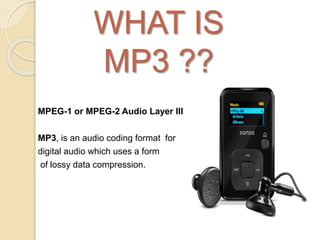
MPEG-1 or MPEG-2 Audio Layer III
MP3, is an audio coding format for
digital audio which uses a form
of lossy data compression.
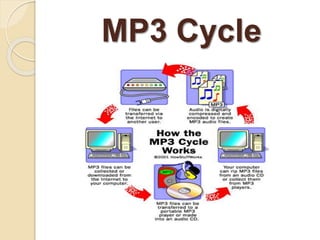
MP3 Cycle
Audio as Physical
Phenomenon
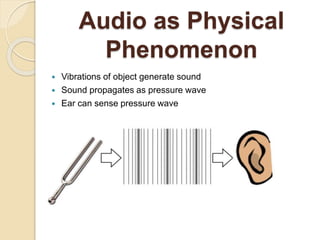
 Vibrations of object generate sound
 Sound propagates as pressure wave
 Ear can sense pressure wave
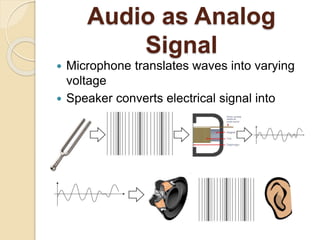
Audio as Analog
Signal
 Microphone translates waves into varying
voltage
 Speaker converts electrical signal into
pressure wave
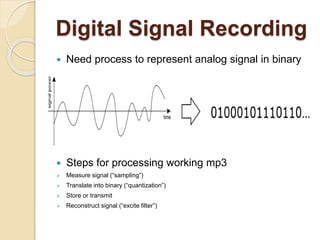
Digital Signal Recording
 Need process to represent analog signal in binary
 Steps for processing working mp3
 Measure signal (“sampling”)
 Translate into binary (“quantization”)
 Store or transmit
 Reconstruct signal (“excite filter”)
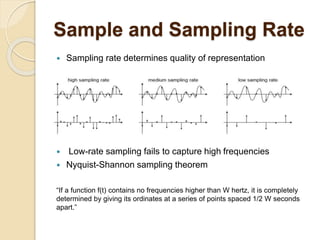
Sample and Sampling Rate
 Sampling rate determines quality of representation
 Low-rate sampling fails to capture high frequencies
 Nyquist-Shannon sampling theorem
“If a function f(t) contains no frequencies higher than W hertz, it is completely
determined by giving its ordinates at a series of points spaced 1/2 W seconds
apart.”
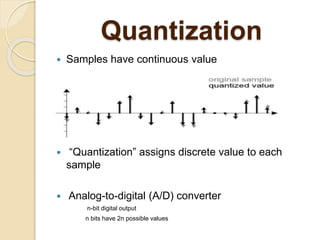
Quantization
 Samples have continuous value
 “Quantization” assigns discrete value to each
sample
 Analog-to-digital (A/D) converter
n-bit digital output
n bits have 2n possible values
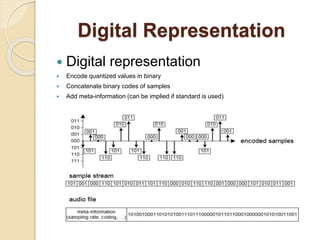
Digital Representation
 Digital representation
 Encode quantized values in binary
 Concatenate binary codes of samples
 Add meta-information (can be implied if standard is used)
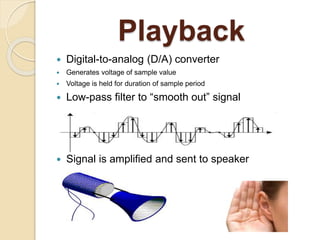
Playback
 Digital-to-analog (D/A) converter
 Generates voltage of sample value
 Voltage is held for duration of sample period
 Low-pass filter to “smooth out” signal
 Signal is amplified and sent to speaker
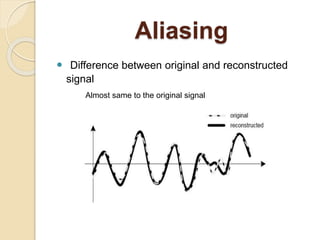
Aliasing
 Difference between original and reconstructed
signal
Almost same to the original signal
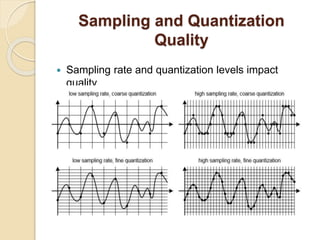
Sampling and Quantization
Quality
 Sampling rate and quantization levels impact
quality
Parameters
 Telephony: pulse code modulation (PCM)
 ITU-T standard G.711 (sample 8000, quantazation-8 bit)
 µ-law in U.S. (14-bit samples)
 A-law in Europe (13-bit samples)
 Encoded signal: 64 kb/s
 CD-quality audio: (PCM)
 Sampling: 44,100 samples per second
 Quantization: 16-bit samples
 Encoded signal (stereo): (176.4kB/s)
How Can Reduced the Mp3 size???
Compression
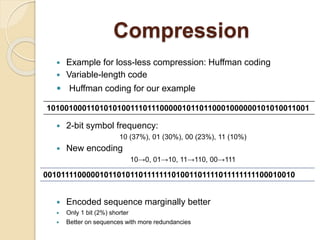
 Example for loss-less compression: Huffman coding
 Variable-length code
 Huffman coding for our example
 2-bit symbol frequency:
10 (37%), 01 (30%), 00 (23%), 11 (10%)
 New encoding
10→0, 01→10, 11→110, 00→111
 Encoded sequence marginally better
 Only 1 bit (2%) shorter
 Better on sequences with more redundancies
101001000110101010011101110000010110110001000000101010011001
00101111000001011010110111111101001101111011111111100010010
Conti……
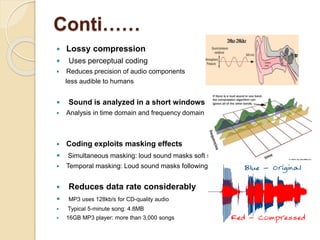
 Lossy compression
 Uses perceptual coding
 Reduces precision of audio components
less audible to humans
 Sound is analyzed in a short windows
 Analysis in time domain and frequency domain
 Coding exploits masking effects
 Simultaneous masking: loud sound masks soft sound
 Temporal masking: Loud sound masks following soft sound
 Reduces data rate considerably
 MP3 uses 128kb/s for CD-quality audio
 Typical 5-minute song: 4.8MB
 16GB MP3 player: more than 3,000 songs
Mp3 player working by digital signal processing

Mp3 player working by digital signal processing

  • 1.
  • 2.
    WHAT IS MP3 ?? MPEG-1or MPEG-2 Audio Layer III MP3, is an audio coding format for digital audio which uses a form of lossy data compression.
  • 3.
  • 4.
    Audio as Physical Phenomenon Vibrations of object generate sound  Sound propagates as pressure wave  Ear can sense pressure wave
  • 5.
    Audio as Analog Signal Microphone translates waves into varying voltage  Speaker converts electrical signal into pressure wave
  • 6.
    Digital Signal Recording Need process to represent analog signal in binary  Steps for processing working mp3  Measure signal (“sampling”)  Translate into binary (“quantization”)  Store or transmit  Reconstruct signal (“excite filter”)
  • 7.
    Sample and SamplingRate  Sampling rate determines quality of representation  Low-rate sampling fails to capture high frequencies  Nyquist-Shannon sampling theorem “If a function f(t) contains no frequencies higher than W hertz, it is completely determined by giving its ordinates at a series of points spaced 1/2 W seconds apart.”
  • 8.
    Quantization  Samples havecontinuous value  “Quantization” assigns discrete value to each sample  Analog-to-digital (A/D) converter n-bit digital output n bits have 2n possible values
  • 9.
    Digital Representation  Digitalrepresentation  Encode quantized values in binary  Concatenate binary codes of samples  Add meta-information (can be implied if standard is used)
  • 10.
    Playback  Digital-to-analog (D/A)converter  Generates voltage of sample value  Voltage is held for duration of sample period  Low-pass filter to “smooth out” signal  Signal is amplified and sent to speaker
  • 11.
    Aliasing  Difference betweenoriginal and reconstructed signal Almost same to the original signal
  • 12.
    Sampling and Quantization Quality Sampling rate and quantization levels impact quality
  • 13.
    Parameters  Telephony: pulsecode modulation (PCM)  ITU-T standard G.711 (sample 8000, quantazation-8 bit)  µ-law in U.S. (14-bit samples)  A-law in Europe (13-bit samples)  Encoded signal: 64 kb/s  CD-quality audio: (PCM)  Sampling: 44,100 samples per second  Quantization: 16-bit samples  Encoded signal (stereo): (176.4kB/s) How Can Reduced the Mp3 size???
  • 14.
    Compression  Example forloss-less compression: Huffman coding  Variable-length code  Huffman coding for our example  2-bit symbol frequency: 10 (37%), 01 (30%), 00 (23%), 11 (10%)  New encoding 10→0, 01→10, 11→110, 00→111  Encoded sequence marginally better  Only 1 bit (2%) shorter  Better on sequences with more redundancies 101001000110101010011101110000010110110001000000101010011001 00101111000001011010110111111101001101111011111111100010010
  • 15.
    Conti……  Lossy compression Uses perceptual coding  Reduces precision of audio components less audible to humans  Sound is analyzed in a short windows  Analysis in time domain and frequency domain  Coding exploits masking effects  Simultaneous masking: loud sound masks soft sound  Temporal masking: Loud sound masks following soft sound  Reduces data rate considerably  MP3 uses 128kb/s for CD-quality audio  Typical 5-minute song: 4.8MB  16GB MP3 player: more than 3,000 songs