Bahir Dar University
Ethiopian Institute of Textile and
Fashion Technology
Structural Mechanics of Textile Structures
Seminar on
Technology of Draw Frame Autoleveller
January 2015
Contents
1. Introduction
2. Monitoring Devices
3. Principles of Measurement
4. Important Parameters for Quality Leveling
5. Significance of Draw Frame Autoleveller
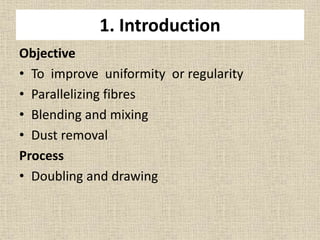
1. Introduction
Objective
• To improve uniformity or regularity
• Parallelizing fibres
• Blending and mixing
• Dust removal
Process
• Doubling and drawing
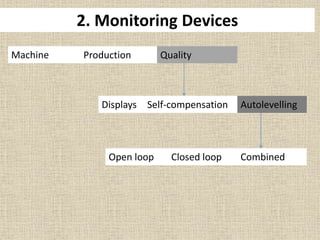
2. Monitoring Devices
AutolevellingSelf-compensationDisplays
Machine Production Quality
Open loop Closed loop Combined
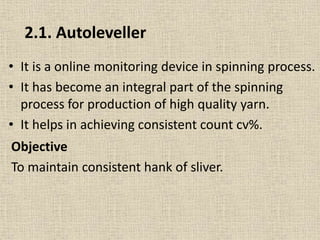
2.1. Autoleveller
• It is a online monitoring device in spinning process.
• It has become an integral part of the spinning
process for production of high quality yarn.
• It helps in achieving consistent count cv%.
Objective
To maintain consistent hank of sliver.
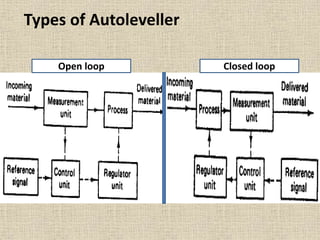
Types of Autoleveller
Open loop Closed loop
Open Loop Closed Loop
This system is effective for short,
medium and to some extent long
term variations
This system is effective for long
term variations
Lack of self monitoring (i.e. no
check on the delivered material by
the control unit)
Self monitering
More popularly used Rarely used
It requires very exact values of the
adjustment at all times
Simpler than open-loop control in
operation as no store is required
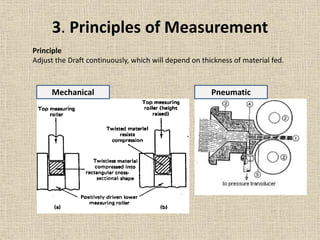
3. Principles of Measurement
Principle
Adjust the Draft continuously, which will depend on thickness of material fed.
Mechanical Pneumatic
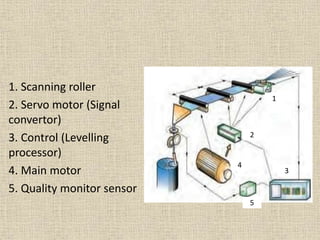
1. Scanning roller
2. Servo motor (Signal
convertor)
3. Control (Levelling
processor)
4. Main motor
5. Quality monitor sensor
1
2
4
3
5
Servo Drives
4. Important Parameters for Quality Leveling
• Leveling intensity
• Leveling action point
Leveling Intensity
• It indicates the amount of correction to be
done.
• It is to decide the amount of draft change
required to correct feed variation.
• The correlation between mass and volume for
different fibres is not same.
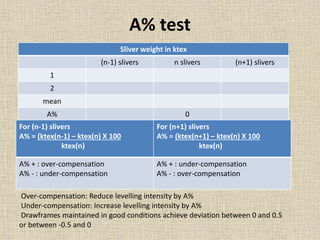
A% test
Sliver weight in ktex
(n-1) slivers n slivers (n+1) slivers
1
2
mean
A% 0
For (n-1) slivers
A% = (ktex(n-1) – ktex(n) X 100
ktex(n)
For (n+1) slivers
A% = (ktex(n+1) – ktex(n) X 100
ktex(n)
A% + : over-compensation
A% - : under-compensation
A% + : under-compensation
A% - : over-compensation
Over-compensation: Reduce levelling intensity by A%
Under-compensation: Increase levelling intensity by A%
Drawframes maintained in good conditions achieve deviation between 0 and 0.5
or between -0.5 and 0
Leveling action point
• The calculated correction should be done on the
corresponding defective place.
• The time required for the defective material to
reach the correction point should be known.
• Levelling action point depends on break draft,
main draft, roller setting and delivery speed.
• Helps to produce cotton yarns with count C.V. of 1.2 to
1.4%
• The Lea strength C.V. improves by 1.2 to 1.6% in different
counts
• The single yarn strength also improves by about 4% in
different counts.
• End breaks in spinning get reduced by 9 to 12 breaks per
100 spindle hours in different counts.
5. Significance of Draw Frame Autoleveller
References
[1] TRUTZSCHLER auto leveller Draw Frame TD 03 –
Manual
[2] RIETER auto leveller Draw Frame RSB D – 40 – Manual
[3] GALILEO auto leveller Draw Frame DFR1 - Manual
[4] Sanjay R. Patel, Some Considerations in Designing
Autolevelling System for Conventional Draw frames
(Textile Machinery), Central Instrumentation (Mech.)
Faculity of Technology and Engineering, M.S.U. of Baroda
[5] Draw Frame Teaching Materials

Technology of draw frame autolevellers

  • 1.
    Bahir Dar University EthiopianInstitute of Textile and Fashion Technology Structural Mechanics of Textile Structures Seminar on Technology of Draw Frame Autoleveller January 2015
  • 2.
    Contents 1. Introduction 2. MonitoringDevices 3. Principles of Measurement 4. Important Parameters for Quality Leveling 5. Significance of Draw Frame Autoleveller
  • 3.
    1. Introduction Objective • Toimprove uniformity or regularity • Parallelizing fibres • Blending and mixing • Dust removal Process • Doubling and drawing
  • 4.
    2. Monitoring Devices AutolevellingSelf-compensationDisplays MachineProduction Quality Open loop Closed loop Combined
  • 5.
    2.1. Autoleveller • Itis a online monitoring device in spinning process. • It has become an integral part of the spinning process for production of high quality yarn. • It helps in achieving consistent count cv%. Objective To maintain consistent hank of sliver.
  • 6.
  • 7.
    Open Loop ClosedLoop This system is effective for short, medium and to some extent long term variations This system is effective for long term variations Lack of self monitoring (i.e. no check on the delivered material by the control unit) Self monitering More popularly used Rarely used It requires very exact values of the adjustment at all times Simpler than open-loop control in operation as no store is required
  • 8.
    3. Principles ofMeasurement Principle Adjust the Draft continuously, which will depend on thickness of material fed. Mechanical Pneumatic
  • 9.
    1. Scanning roller 2.Servo motor (Signal convertor) 3. Control (Levelling processor) 4. Main motor 5. Quality monitor sensor 1 2 4 3 5
  • 10.
  • 11.
    4. Important Parametersfor Quality Leveling • Leveling intensity • Leveling action point
  • 12.
    Leveling Intensity • Itindicates the amount of correction to be done. • It is to decide the amount of draft change required to correct feed variation. • The correlation between mass and volume for different fibres is not same.
  • 13.
    A% test Sliver weightin ktex (n-1) slivers n slivers (n+1) slivers 1 2 mean A% 0 For (n-1) slivers A% = (ktex(n-1) – ktex(n) X 100 ktex(n) For (n+1) slivers A% = (ktex(n+1) – ktex(n) X 100 ktex(n) A% + : over-compensation A% - : under-compensation A% + : under-compensation A% - : over-compensation Over-compensation: Reduce levelling intensity by A% Under-compensation: Increase levelling intensity by A% Drawframes maintained in good conditions achieve deviation between 0 and 0.5 or between -0.5 and 0
  • 14.
    Leveling action point •The calculated correction should be done on the corresponding defective place. • The time required for the defective material to reach the correction point should be known. • Levelling action point depends on break draft, main draft, roller setting and delivery speed.
  • 15.
    • Helps toproduce cotton yarns with count C.V. of 1.2 to 1.4% • The Lea strength C.V. improves by 1.2 to 1.6% in different counts • The single yarn strength also improves by about 4% in different counts. • End breaks in spinning get reduced by 9 to 12 breaks per 100 spindle hours in different counts. 5. Significance of Draw Frame Autoleveller
  • 16.
    References [1] TRUTZSCHLER autoleveller Draw Frame TD 03 – Manual [2] RIETER auto leveller Draw Frame RSB D – 40 – Manual [3] GALILEO auto leveller Draw Frame DFR1 - Manual [4] Sanjay R. Patel, Some Considerations in Designing Autolevelling System for Conventional Draw frames (Textile Machinery), Central Instrumentation (Mech.) Faculity of Technology and Engineering, M.S.U. of Baroda [5] Draw Frame Teaching Materials