Ibrahim Tareq
Business Development Engineer,
email: ibrahimctec@gmail.com
LAKSHMI Global FZE, DHAKA,BANGLADESH
Web: www.lmwtmd.com
BASIC TRAINIG ON DRAW FRAME
What is Draw Frame?
Draw Frame is the machine where the slivers are doubled or combined, blended & mixed, leveled and
attenuated transiently through a series of pairs of rollers. In the drafting arrangement each pair of rollers
move faster than the prior one.
The key purpose of implementing draw frames to spinning procedure is to develop the yarn quality,
particularly yarn evenness through increasing sliver quality. Draw frame is the definitive compensation
point for eliminating errors.
Terms and definition :
Doubling: The practice of merging two or more slivers, roving or yarns into one. This stint is
not limited to the arrangement of two units only.
Drafting: The process of decreasing the thickness or linear density of the input material by
attenuation is known as drafting. The feed supplies may be lap, sliver and roving etc.
Drawing: The process of combining and attenuating the slivers simultaneously is denoted as
drawing. A drafting without doubling is not a good practice for the slivers and vice versa.
Drawing= Drafting + Doubling
Objectives of Draw Frame:
 Equalizing
One of the main tasks of the draw frame is improving evenness over the short, medium and especially-
long term. To obtain an optimal value for strength in the yarn characteristics, the fibers must be
 Parallelizing
arranged parallel in the fiber strand. It is mainly the draw frame's task to create this parallel arrangement.
It fulfills this task by means of the draft, since every drafting step leads to straightening of the fibers.
 Blending
In addition to the equalizing effect, doubling also provides a degree of compensation of raw material
variations by blending, which occurs simultaneously.
 Dust removal
Dust is steadily becoming a greater problem both in processing and for the personnel involved. It is
therefore important to remove dust to the greatest practical extent at every possible point within the
overall process.
 To straighten the fibres in the slivers.
 To make them lie in a manner parallel to their neighbors and to the sliver axis.
 To improve the uniformity or evenness of the slivers.
Waste of Draw Frame:
01. Filter waste
02. Clearer waste
03. Sliver cut
Importance/ Necessity of Draw Frame:
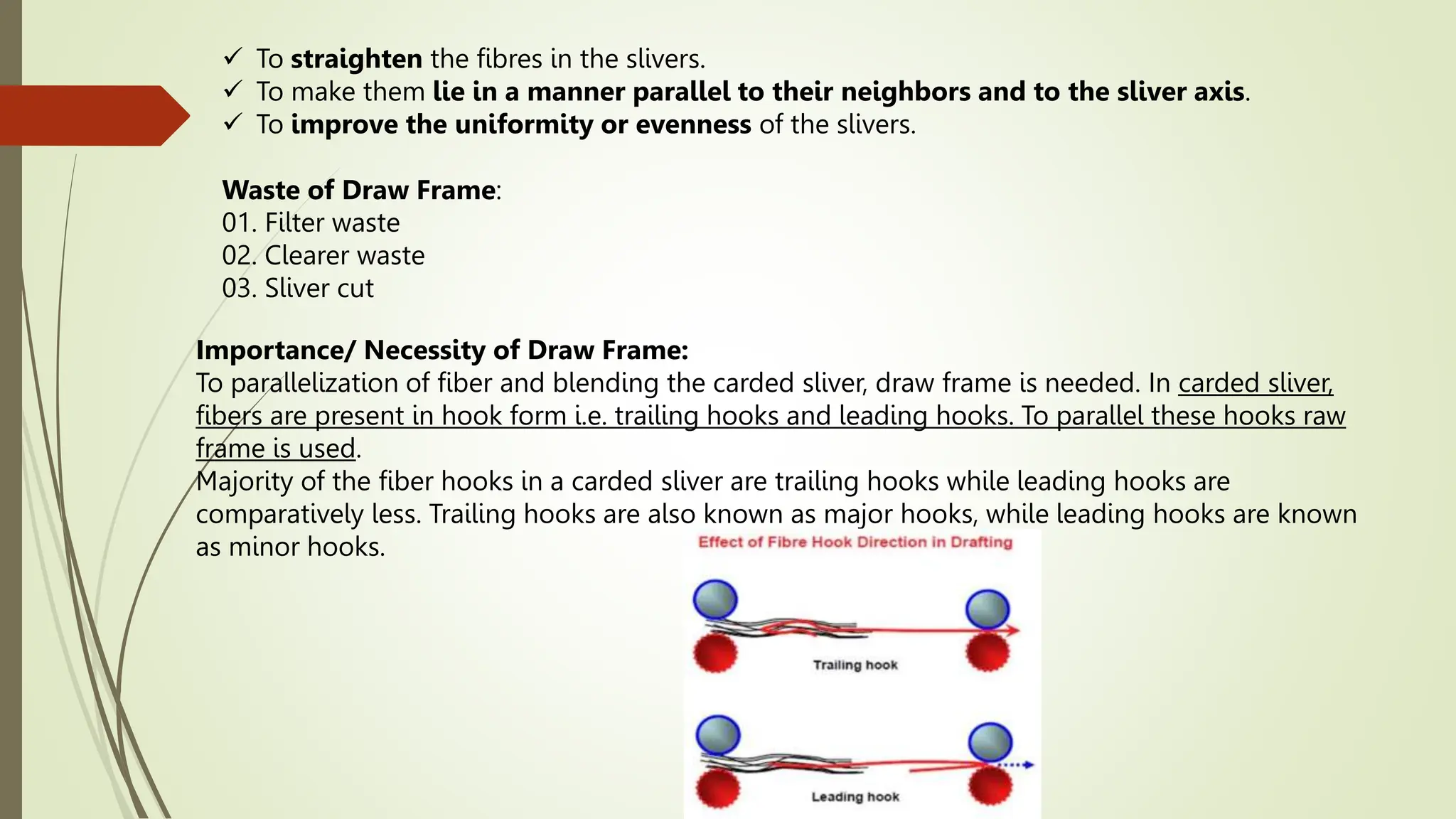
To parallelization of fiber and blending the carded sliver, draw frame is needed. In carded sliver,
fibers are present in hook form i.e. trailing hooks and leading hooks. To parallel these hooks raw
frame is used.
Majority of the fiber hooks in a carded sliver are trailing hooks while leading hooks are
comparatively less. Trailing hooks are also known as major hooks, while leading hooks are known
as minor hooks.
Operating principle:
Four to eight card or draw frame slivers are fed to the drafting arrangement (3). A feed roller pair (2) is
located above each can (1) to enable the feeding step to be performed in a controlled manner without
false drafts. The feed roller pairs are mounted in a creel frame or table and each is positively driven.
The slivers running into the drafting arrangement leave it, after a draft of 4 to 8,as a web lacking
significant cohesion. In order to avoid disintegration of the web , which would otherwise be unavoidable
at the high operating speeds currently in use, it is condensed into a sliver immediately after the drafting
arrangement.
This sliver is then guided through a tube (4) via a passage (6) of the tube gear into a can (7), in which it
must be laid in clean coils with optimal utilization of the space in the can.
To enable the can to take up as much material as possible, the sliver is compressed by passing it through
calendaring rollers (5).
Autoleveller
Autoleveller to Minimize Count Variation of Yarn
Purpose: The motive for the application of Autolevellers at carding machine and draw frames is to
uphold the complete sliver fineness that eventually decreases count variation in the yarn.
Function: An Autoleveller processes the sliver width variations and then constantly adjusts the draft
by servo-controlled drafting system so that additional draft is exerted to the thick places, and a
reduced amount of draft to thin places with the end result that the delivered sliver becomes more even.
Classification: Autoleveller can be categorized into three main sets in line with the basic principle of
operation:
1. Open loop Autoleveller,
2. Closed loop Autoleveller and
3. Combined loop Autoleveller.
Open-loop system: In this system, there is no measuring on final sliver. In other words the
alterations in draft are uniquely established on the mass deviation in the feed material. Almost
all of the Autoleveller draw frames are functioning on the principle of OPEN LOOP control system.
Closed-loop system: In this system, the checking is completed on the product of the progression i.e. on
delivered sliver. In other words, the closed loop Autoleveller measures the consequence of its specific
accomplishment
Frequently Asked Questions
1. Why Autoleveller is used only in breaker draw frame but not in finisher draw frame?
Since Autoleveller is a costly device and the finisher draw frame or post-comb draw frame is the last machine to
improve the sliver quality hence yarn qaulity, that is why Autoleveller is used only in finisher draw frame.
2.Why doubling and drafting is done altogether?
It has been observed that due to doubling the irregularities in sliver are reduced and mass variation is
average out due to multiple number of slivers. On the other hand, drafting increases the irregularities in
lengthwise throughout the end product. That is why to compensate these irregularities due to attenuating, drafting
and doubling are done altogether.
Roller gauge setting:
Wheel change:
Roller Gauge:
Insert and condenser
Coiler gauge setting:

Autoleveller Draw frame presentation.pptx

  • 1.
    Ibrahim Tareq Business DevelopmentEngineer, email: ibrahimctec@gmail.com LAKSHMI Global FZE, DHAKA,BANGLADESH Web: www.lmwtmd.com BASIC TRAINIG ON DRAW FRAME
  • 2.
    What is DrawFrame? Draw Frame is the machine where the slivers are doubled or combined, blended & mixed, leveled and attenuated transiently through a series of pairs of rollers. In the drafting arrangement each pair of rollers move faster than the prior one. The key purpose of implementing draw frames to spinning procedure is to develop the yarn quality, particularly yarn evenness through increasing sliver quality. Draw frame is the definitive compensation point for eliminating errors. Terms and definition : Doubling: The practice of merging two or more slivers, roving or yarns into one. This stint is not limited to the arrangement of two units only. Drafting: The process of decreasing the thickness or linear density of the input material by attenuation is known as drafting. The feed supplies may be lap, sliver and roving etc. Drawing: The process of combining and attenuating the slivers simultaneously is denoted as drawing. A drafting without doubling is not a good practice for the slivers and vice versa. Drawing= Drafting + Doubling
  • 3.
    Objectives of DrawFrame:  Equalizing One of the main tasks of the draw frame is improving evenness over the short, medium and especially- long term. To obtain an optimal value for strength in the yarn characteristics, the fibers must be  Parallelizing arranged parallel in the fiber strand. It is mainly the draw frame's task to create this parallel arrangement. It fulfills this task by means of the draft, since every drafting step leads to straightening of the fibers.  Blending In addition to the equalizing effect, doubling also provides a degree of compensation of raw material variations by blending, which occurs simultaneously.  Dust removal Dust is steadily becoming a greater problem both in processing and for the personnel involved. It is therefore important to remove dust to the greatest practical extent at every possible point within the overall process.
  • 4.
     To straightenthe fibres in the slivers.  To make them lie in a manner parallel to their neighbors and to the sliver axis.  To improve the uniformity or evenness of the slivers. Waste of Draw Frame: 01. Filter waste 02. Clearer waste 03. Sliver cut Importance/ Necessity of Draw Frame: To parallelization of fiber and blending the carded sliver, draw frame is needed. In carded sliver, fibers are present in hook form i.e. trailing hooks and leading hooks. To parallel these hooks raw frame is used. Majority of the fiber hooks in a carded sliver are trailing hooks while leading hooks are comparatively less. Trailing hooks are also known as major hooks, while leading hooks are known as minor hooks.
  • 5.
    Operating principle: Four toeight card or draw frame slivers are fed to the drafting arrangement (3). A feed roller pair (2) is located above each can (1) to enable the feeding step to be performed in a controlled manner without false drafts. The feed roller pairs are mounted in a creel frame or table and each is positively driven. The slivers running into the drafting arrangement leave it, after a draft of 4 to 8,as a web lacking significant cohesion. In order to avoid disintegration of the web , which would otherwise be unavoidable at the high operating speeds currently in use, it is condensed into a sliver immediately after the drafting arrangement. This sliver is then guided through a tube (4) via a passage (6) of the tube gear into a can (7), in which it must be laid in clean coils with optimal utilization of the space in the can. To enable the can to take up as much material as possible, the sliver is compressed by passing it through calendaring rollers (5).
  • 7.
    Autoleveller Autoleveller to MinimizeCount Variation of Yarn Purpose: The motive for the application of Autolevellers at carding machine and draw frames is to uphold the complete sliver fineness that eventually decreases count variation in the yarn. Function: An Autoleveller processes the sliver width variations and then constantly adjusts the draft by servo-controlled drafting system so that additional draft is exerted to the thick places, and a reduced amount of draft to thin places with the end result that the delivered sliver becomes more even. Classification: Autoleveller can be categorized into three main sets in line with the basic principle of operation: 1. Open loop Autoleveller, 2. Closed loop Autoleveller and 3. Combined loop Autoleveller. Open-loop system: In this system, there is no measuring on final sliver. In other words the alterations in draft are uniquely established on the mass deviation in the feed material. Almost all of the Autoleveller draw frames are functioning on the principle of OPEN LOOP control system.
  • 8.
    Closed-loop system: Inthis system, the checking is completed on the product of the progression i.e. on delivered sliver. In other words, the closed loop Autoleveller measures the consequence of its specific accomplishment
  • 9.
    Frequently Asked Questions 1.Why Autoleveller is used only in breaker draw frame but not in finisher draw frame? Since Autoleveller is a costly device and the finisher draw frame or post-comb draw frame is the last machine to improve the sliver quality hence yarn qaulity, that is why Autoleveller is used only in finisher draw frame. 2.Why doubling and drafting is done altogether? It has been observed that due to doubling the irregularities in sliver are reduced and mass variation is average out due to multiple number of slivers. On the other hand, drafting increases the irregularities in lengthwise throughout the end product. That is why to compensate these irregularities due to attenuating, drafting and doubling are done altogether.
  • 10.
  • 11.
  • 12.
  • 13.
  • 14.