TACHOMETER , LUX METER,
YARN TENSION METER AND
PACKAGE HARDNESS TESTER
IN APPAREL INDUSTRY.
Tachometer
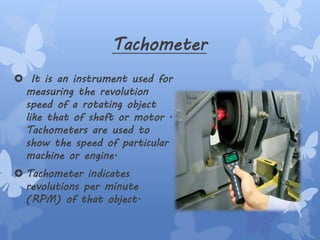
 It is an instrument used for
measuring the revolution
speed of a rotating object
like that of shaft or motor .
Tachometers are used to
show the speed of particular
machine or engine.
 Tachometer indicates
revolutions per minute
(RPM) of that object.
Uses of Tachometer /Practical
Application Of Tachometer
 The key application areas of Tachometer include its
usage in Automobiles, airplanes, trucks, trains ,
light rail vehicles and tractors
 It is used in many Laser instruments
Tachometer in apparel
industry
 A laser tachometer
generally uses infrared light
to measure the speed of
rotation of a shaft or
wheel or any other
rotating object.
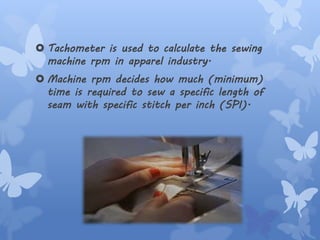
 Tachometer is used to calculate the sewing
machine rpm in apparel industry.
 Machine rpm decides how much (minimum)
time is required to sew a specific length of
seam with specific stitch per inch (SPI).
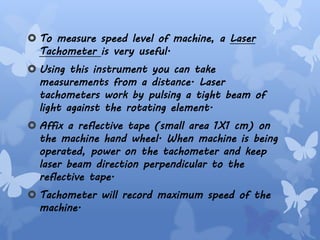
 To measure speed level of machine, a Laser
Tachometer is very useful.
 Using this instrument you can take
measurements from a distance. Laser
tachometers work by pulsing a tight beam of
light against the rotating element.
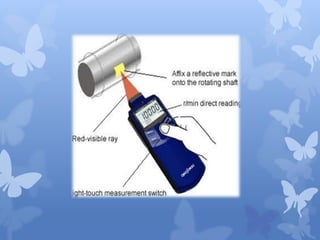
 Affix a reflective tape (small area 1X1 cm) on
the machine hand wheel. When machine is being
operated, power on the tachometer and keep
laser beam direction perpendicular to the
reflective tape.
 Tachometer will record maximum speed of the
machine.
LUXMETER IN APPAREL
INDUSTRY
 Environmental parameters in
a garment manufacturing
industry such as illumination
were measured using lux
meter .
 Lux meter is used to check
the illumination of an
industry.
 Absence of environmental factors as per the
regulatory standards can lead to eye strain,
headache, dizziness, heat stress, heat cramps,
heat burns, heat exhaustion, heat stroke and
other such illness for the workers.
 This can result in employee absenteeism,
increased employee turn -over and decrease in
performance levels.
 Cutting section:
The illumination levels ranged
from 230 lux to 270 lux with a mean of
245.5 lux. According to Energy efficiency guide
for industry in Asia, the illumination between
500 lux to 1000 lux gives satisfaction to the
workers.
 Sewing section:
The illumination levels ranged
from 558 lux to 1186 lux with a mean of 598
lux. According to Energy efficiency guide for
industry in Asia, the illumination between 500
lux to 1000 lux gives satisfaction to the
workers
 Finishing section:
For an industry in Asia, the
illumination between 250 lux to 500 lux gives
satisfaction to the workers.
PACKAGE HARDNESS TESTER
IN APPAREL INDUSTRY
HARDNESS
 Hardness is not a intrinsic material property
dictated by precise definitions in terms of
fundamental units of mass, length and time.
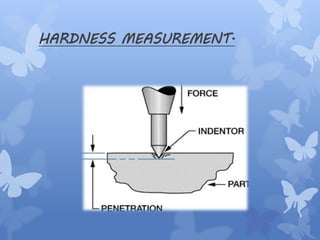
 The usual method to achieve a hardness value is
to measure the depth or area of an indentation
left by an indenter of a specific shape, with a
specific force applied for a specific time.
HARDNESS MEASUREMENT.
INTRODUCTION
 PACKAGE HARDNESS
TESTER is used to
evaluate the hardness of
yarn packages, cones, top
rollers of Draw Frame,
Roving Frame & Ring
Frame etc.
 It is very useful in
textile mills, College &
Universities.
EQUIPMENT
 Paramount Package Hardness Tester is
completely made of special grade aluminum
casting for lightweight & resilience.
 The Equipment is fitted with a specially
designed calibrated analog dial to show the
hardness of material being tested in degree
shore.
 The capacity of the equipment is 0 to 100°
shore.
FEATURES
 Specially designed equipment to determine the
hardness of any cylindrical material in Degree
Shore. (Like yarn packages)
 Very useful for spinning mills to measure the
hardness of rollers used in Ring Frame, Draw
Frame, Roving Frame etc.
 Handy, easy to operate.
 Duly packed in a wooden case for safety. With
calibrated precision dial for direct reading of
hardness in Degree Shore.
 Supplied with inspection & calibration
certificates
YARN TENSION METER IN
APPAREL INDUSTRY
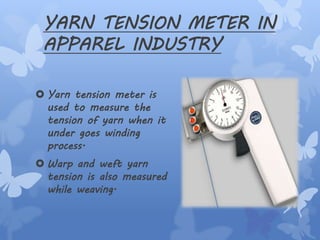
 Yarn tension meter is
used to measure the
tension of yarn when it
under goes winding
process.
 Warp and weft yarn
tension is also measured
while weaving.
INTRODUCTION
 As the yarn tension is very important factor in
several textile processes and needs to be checked
regularly for the processes like winding, warping
and sizing, require a high speed control of yarn
tension.
 Variation in yarn tension brings radial changes, as
it affects the physical properties.
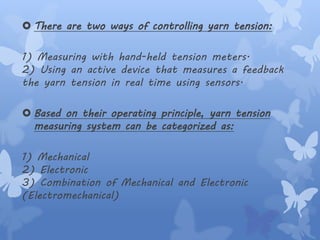
 There are two ways of controlling yarn tension:
1) Measuring with hand-held tension meters.
2) Using an active device that measures a feedback
the yarn tension in real time using sensors.
 Based on their operating principle, yarn tension
measuring system can be categorized as:
1) Mechanical
2) Electronic
3) Combination of Mechanical and Electronic
(Electromechanical)
MECHANICAL:
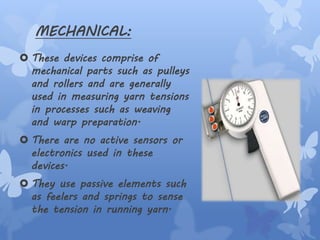
 These devices comprise of
mechanical parts such as pulleys
and rollers and are generally
used in measuring yarn tensions
in processes such as weaving
and warp preparation.
 There are no active sensors or
electronics used in these
devices.
 They use passive elements such
as feelers and springs to sense
the tension in running yarn.
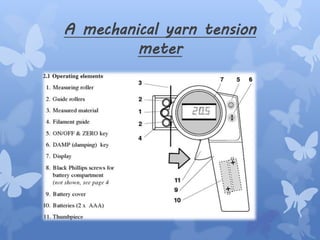
A mechanical yarn tension
meter
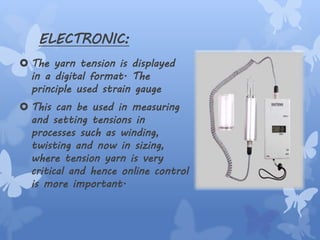
ELECTRONIC:
 The yarn tension is displayed
in a digital format. The
principle used strain gauge
 This can be used in measuring
and setting tensions in
processes such as winding,
twisting and now in sizing,
where tension yarn is very
critical and hence online control
is more important.
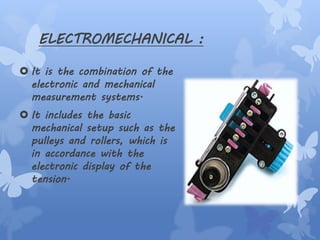
ELECTROMECHANICAL :
 It is the combination of the
electronic and mechanical
measurement systems.
 It includes the basic
mechanical setup such as the
pulleys and rollers, which is
in accordance with the
electronic display of the
tension.
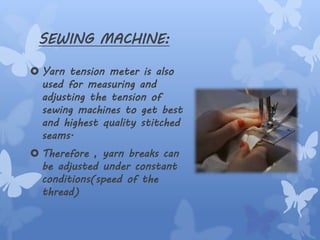
SEWING MACHINE:
 Yarn tension meter is also
used for measuring and
adjusting the tension of
sewing machines to get best
and highest quality stitched
seams.
 Therefore , yarn breaks can
be adjusted under constant
conditions(speed of the
thread)
THANKYOU !

ELEMENTS OF TECHNOLOGY

  • 2.
    TACHOMETER , LUXMETER, YARN TENSION METER AND PACKAGE HARDNESS TESTER IN APPAREL INDUSTRY.
  • 3.
    Tachometer  It isan instrument used for measuring the revolution speed of a rotating object like that of shaft or motor . Tachometers are used to show the speed of particular machine or engine.  Tachometer indicates revolutions per minute (RPM) of that object.
  • 4.
    Uses of Tachometer/Practical Application Of Tachometer  The key application areas of Tachometer include its usage in Automobiles, airplanes, trucks, trains , light rail vehicles and tractors  It is used in many Laser instruments
  • 5.
    Tachometer in apparel industry A laser tachometer generally uses infrared light to measure the speed of rotation of a shaft or wheel or any other rotating object.
  • 6.
     Tachometer isused to calculate the sewing machine rpm in apparel industry.  Machine rpm decides how much (minimum) time is required to sew a specific length of seam with specific stitch per inch (SPI).
  • 7.
     To measurespeed level of machine, a Laser Tachometer is very useful.  Using this instrument you can take measurements from a distance. Laser tachometers work by pulsing a tight beam of light against the rotating element.  Affix a reflective tape (small area 1X1 cm) on the machine hand wheel. When machine is being operated, power on the tachometer and keep laser beam direction perpendicular to the reflective tape.  Tachometer will record maximum speed of the machine.
  • 9.
    LUXMETER IN APPAREL INDUSTRY Environmental parameters in a garment manufacturing industry such as illumination were measured using lux meter .  Lux meter is used to check the illumination of an industry.
  • 10.
     Absence ofenvironmental factors as per the regulatory standards can lead to eye strain, headache, dizziness, heat stress, heat cramps, heat burns, heat exhaustion, heat stroke and other such illness for the workers.  This can result in employee absenteeism, increased employee turn -over and decrease in performance levels.
  • 11.
     Cutting section: Theillumination levels ranged from 230 lux to 270 lux with a mean of 245.5 lux. According to Energy efficiency guide for industry in Asia, the illumination between 500 lux to 1000 lux gives satisfaction to the workers.  Sewing section: The illumination levels ranged from 558 lux to 1186 lux with a mean of 598 lux. According to Energy efficiency guide for industry in Asia, the illumination between 500 lux to 1000 lux gives satisfaction to the workers
  • 12.
     Finishing section: Foran industry in Asia, the illumination between 250 lux to 500 lux gives satisfaction to the workers.
  • 13.
  • 14.
    HARDNESS  Hardness isnot a intrinsic material property dictated by precise definitions in terms of fundamental units of mass, length and time.  The usual method to achieve a hardness value is to measure the depth or area of an indentation left by an indenter of a specific shape, with a specific force applied for a specific time.
  • 15.
  • 16.
    INTRODUCTION  PACKAGE HARDNESS TESTERis used to evaluate the hardness of yarn packages, cones, top rollers of Draw Frame, Roving Frame & Ring Frame etc.  It is very useful in textile mills, College & Universities.
  • 17.
    EQUIPMENT  Paramount PackageHardness Tester is completely made of special grade aluminum casting for lightweight & resilience.  The Equipment is fitted with a specially designed calibrated analog dial to show the hardness of material being tested in degree shore.  The capacity of the equipment is 0 to 100° shore.
  • 18.
    FEATURES  Specially designedequipment to determine the hardness of any cylindrical material in Degree Shore. (Like yarn packages)  Very useful for spinning mills to measure the hardness of rollers used in Ring Frame, Draw Frame, Roving Frame etc.  Handy, easy to operate.
  • 19.
     Duly packedin a wooden case for safety. With calibrated precision dial for direct reading of hardness in Degree Shore.  Supplied with inspection & calibration certificates
  • 20.
    YARN TENSION METERIN APPAREL INDUSTRY  Yarn tension meter is used to measure the tension of yarn when it under goes winding process.  Warp and weft yarn tension is also measured while weaving.
  • 21.
    INTRODUCTION  As theyarn tension is very important factor in several textile processes and needs to be checked regularly for the processes like winding, warping and sizing, require a high speed control of yarn tension.  Variation in yarn tension brings radial changes, as it affects the physical properties.
  • 22.
     There aretwo ways of controlling yarn tension: 1) Measuring with hand-held tension meters. 2) Using an active device that measures a feedback the yarn tension in real time using sensors.  Based on their operating principle, yarn tension measuring system can be categorized as: 1) Mechanical 2) Electronic 3) Combination of Mechanical and Electronic (Electromechanical)
  • 23.
    MECHANICAL:  These devicescomprise of mechanical parts such as pulleys and rollers and are generally used in measuring yarn tensions in processes such as weaving and warp preparation.  There are no active sensors or electronics used in these devices.  They use passive elements such as feelers and springs to sense the tension in running yarn.
  • 24.
    A mechanical yarntension meter
  • 25.
    ELECTRONIC:  The yarntension is displayed in a digital format. The principle used strain gauge  This can be used in measuring and setting tensions in processes such as winding, twisting and now in sizing, where tension yarn is very critical and hence online control is more important.
  • 26.
    ELECTROMECHANICAL :  Itis the combination of the electronic and mechanical measurement systems.  It includes the basic mechanical setup such as the pulleys and rollers, which is in accordance with the electronic display of the tension.
  • 27.
    SEWING MACHINE:  Yarntension meter is also used for measuring and adjusting the tension of sewing machines to get best and highest quality stitched seams.  Therefore , yarn breaks can be adjusted under constant conditions(speed of the thread)
  • 28.