Carding
• Objectives                  • Clearance setting for
• The machinery in use          various parts
• Various components of       • Wire point specification
  carding machine             • Stop motion for LC1/3
• Technical parameter of LC
  1/3
• Speeds(rpm) of different
  rollers
Objectives

   •      individualization and partial parallelization of fibers.
   •      fiber to fiber separation.
   •      removal of remaining trash B/R process.
   •      conversion of lap or opened fiber into sliver.
   •       to affect through mixing of the fiber.


Sunday, October 23, 2011   TEXTILE INTERNSHIP- DILIP SINGH, KUMAR SARVESH, PRASHANT
                           GAURAV & RAJEEV SHARAN/ DFT-05/ NIFT BANGALORE
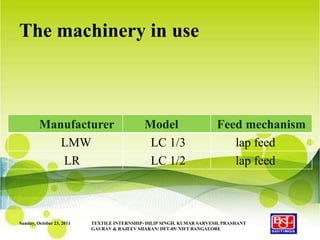
The machinery in use


         Manufacturer                         Model                     Feed mechanism
            LMW                                LC 1/3                      lap feed
            LR                                 LC 1/2                      lap feed


Sunday, October 23, 2011   TEXTILE INTERNSHIP- DILIP SINGH, KUMAR SARVESH, PRASHANT
                           GAURAV & RAJEEV SHARAN/ DFT-05/ NIFT BANGALORE
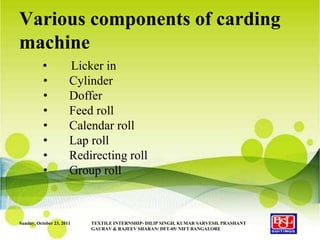
Various components of carding
machine
           •           Licker in
           •           Cylinder
           •           Doffer
           •           Feed roll
           •           Calendar roll
           •           Lap roll
           •           Redirecting roll
           •           Group roll


Sunday, October 23, 2011   TEXTILE INTERNSHIP- DILIP SINGH, KUMAR SARVESH, PRASHANT
                           GAURAV & RAJEEV SHARAN/ DFT-05/ NIFT BANGALORE
Technical parameter of LC 1/3

             •Diameter of lap roll – 162 mm
             •Diameter of feed roll – 80 mm
             •Diameter of licker in – 253 mm
             •Diameter of cylinder – 1290 mm
             •Diameter of doffer – 680 mm
             •Diameter of calendar roll – 80 mm


Sunday, October 23, 2011   TEXTILE INTERNSHIP- DILIP SINGH, KUMAR SARVESH, PRASHANT
                           GAURAV & RAJEEV SHARAN/ DFT-05/ NIFT BANGALORE
Speeds(rpm) of different rollers


                 •Lap roller – 1.725
                 •Feed roller – 2.875
                 •Licker in cylinder – 840
                 •Main cylinder – 360
                 •Doffer – 30


Sunday, October 23, 2011   TEXTILE INTERNSHIP- DILIP SINGH, KUMAR SARVESH, PRASHANT
                           GAURAV & RAJEEV SHARAN/ DFT-05/ NIFT BANGALORE
Clearance setting for various parts
          •Licker in to feed plate – 18 TH
          •Licker in to cylinder – 7 TH
          •Cylinder to doffer – 4 TH
          •Doffer to crush roll – 6 TH
          •Licker in to combing segment – 16 TH

  •Draft for the machine = 102 (approx).
  •Production in kg/hr at 85% efficiency = 19.4 kg/hour


Sunday, October 23, 2011   TEXTILE INTERNSHIP- DILIP SINGH, KUMAR SARVESH, PRASHANT
                           GAURAV & RAJEEV SHARAN/ DFT-05/ NIFT BANGALORE
Stop motion for LC1/3
•Limit switch for lap tool – it stops the card in case of
shortage of lap.
•Limit switch over feed roll – it stops the card if the feeding
of double lap takes place.
•Limit switch at front panel – it stops the cylinder if the front
panel is opened.
•Limit switch over crush tool – it senses the lapping of the
crush tool.
•Full can change motion – when the can is full of slivers the
machine stops and the can is changed either by tenter or
automatically.

 Sunday, October 23, 2011   TEXTILE INTERNSHIP- DILIP SINGH, KUMAR SARVESH, PRASHANT
                            GAURAV & RAJEEV SHARAN/ DFT-05/ NIFT BANGALORE

Carding

  • 1.
    Carding • Objectives • Clearance setting for • The machinery in use various parts • Various components of • Wire point specification carding machine • Stop motion for LC1/3 • Technical parameter of LC 1/3 • Speeds(rpm) of different rollers
  • 2.
    Objectives • individualization and partial parallelization of fibers. • fiber to fiber separation. • removal of remaining trash B/R process. • conversion of lap or opened fiber into sliver. • to affect through mixing of the fiber. Sunday, October 23, 2011 TEXTILE INTERNSHIP- DILIP SINGH, KUMAR SARVESH, PRASHANT GAURAV & RAJEEV SHARAN/ DFT-05/ NIFT BANGALORE
  • 3.
    The machinery inuse Manufacturer Model Feed mechanism LMW LC 1/3 lap feed LR LC 1/2 lap feed Sunday, October 23, 2011 TEXTILE INTERNSHIP- DILIP SINGH, KUMAR SARVESH, PRASHANT GAURAV & RAJEEV SHARAN/ DFT-05/ NIFT BANGALORE
  • 4.
    Various components ofcarding machine • Licker in • Cylinder • Doffer • Feed roll • Calendar roll • Lap roll • Redirecting roll • Group roll Sunday, October 23, 2011 TEXTILE INTERNSHIP- DILIP SINGH, KUMAR SARVESH, PRASHANT GAURAV & RAJEEV SHARAN/ DFT-05/ NIFT BANGALORE
  • 5.
    Technical parameter ofLC 1/3 •Diameter of lap roll – 162 mm •Diameter of feed roll – 80 mm •Diameter of licker in – 253 mm •Diameter of cylinder – 1290 mm •Diameter of doffer – 680 mm •Diameter of calendar roll – 80 mm Sunday, October 23, 2011 TEXTILE INTERNSHIP- DILIP SINGH, KUMAR SARVESH, PRASHANT GAURAV & RAJEEV SHARAN/ DFT-05/ NIFT BANGALORE
  • 6.
    Speeds(rpm) of differentrollers •Lap roller – 1.725 •Feed roller – 2.875 •Licker in cylinder – 840 •Main cylinder – 360 •Doffer – 30 Sunday, October 23, 2011 TEXTILE INTERNSHIP- DILIP SINGH, KUMAR SARVESH, PRASHANT GAURAV & RAJEEV SHARAN/ DFT-05/ NIFT BANGALORE
  • 7.
    Clearance setting forvarious parts •Licker in to feed plate – 18 TH •Licker in to cylinder – 7 TH •Cylinder to doffer – 4 TH •Doffer to crush roll – 6 TH •Licker in to combing segment – 16 TH •Draft for the machine = 102 (approx). •Production in kg/hr at 85% efficiency = 19.4 kg/hour Sunday, October 23, 2011 TEXTILE INTERNSHIP- DILIP SINGH, KUMAR SARVESH, PRASHANT GAURAV & RAJEEV SHARAN/ DFT-05/ NIFT BANGALORE
  • 8.
    Stop motion forLC1/3 •Limit switch for lap tool – it stops the card in case of shortage of lap. •Limit switch over feed roll – it stops the card if the feeding of double lap takes place. •Limit switch at front panel – it stops the cylinder if the front panel is opened. •Limit switch over crush tool – it senses the lapping of the crush tool. •Full can change motion – when the can is full of slivers the machine stops and the can is changed either by tenter or automatically. Sunday, October 23, 2011 TEXTILE INTERNSHIP- DILIP SINGH, KUMAR SARVESH, PRASHANT GAURAV & RAJEEV SHARAN/ DFT-05/ NIFT BANGALORE