MD.KHAIRUL BASHARMD.KHAIRUL BASHAR
B.Sc. in Textile Engineering
Concentration:Concentration: Apparel Manufacturing
Technology
Introduction to Textile EngineeringIntroduction to Textile Engineering
Bangladesh University of Business andBangladesh University of Business and
Technology(BUBT)Technology(BUBT)
PRESENTATIONPRESENTATION
Introduction to TextileIntroduction to Textile
EngineeringEngineering
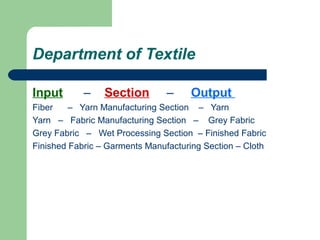
Department of Textile
Input – Section – Output
Fiber – Yarn Manufacturing Section – Yarn
Yarn – Fabric Manufacturing Section – Grey Fabric
Grey Fabric – Wet Processing Section – Finished Fabric
Finished Fabric – Garments Manufacturing Section – Cloth
Spinning
The process of producing yarn or filament
from fibers or monomer respectively is
called spinning.
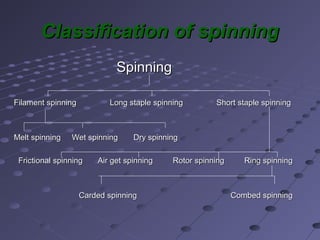
Classification of spinningClassification of spinning
SpinningSpinning
Filament spinning Long staple spinning Short staple spinningFilament spinning Long staple spinning Short staple spinning
Melt spinning Wet spinning Dry spinningMelt spinning Wet spinning Dry spinning
Frictional spinning Air get spinning Rotor spinning Ring spinningFrictional spinning Air get spinning Rotor spinning Ring spinning
Carded spinning Combed spinningCarded spinning Combed spinning
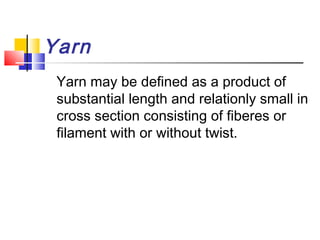
Yarn
Yarn may be defined as a product of
substantial length and relationly small in
cross section consisting of fiberes or
filament with or without twist.
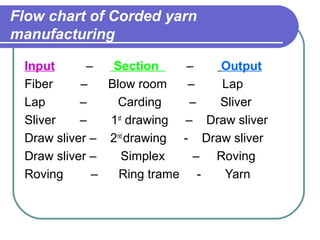
Flow chart of Corded yarn
manufacturing
Input – Section – Output
Fiber – Blow room – Lap
Lap – Carding – Sliver
Sliver – 1st
drawing – Draw sliver
Draw sliver – 2nd
drawing - Draw sliver
Draw sliver – Simplex – Roving
Roving – Ring trame - Yarn
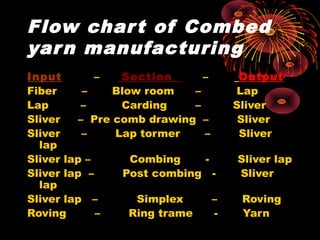
Flow chart of Combed
yarn manufacturing
Input – Section – Output
Fiber – Blow room – Lap
Lap – Carding – Sliver
Sliver – Pre comb drawing – Sliver
Sliver – Lap tormer – Sliver
lap
Sliver lap – Combing - Sliver lap
Sliver lap – Post combing - Sliver
lap
Sliver lap – Simplex – Roving
Roving – Ring trame - Yarn
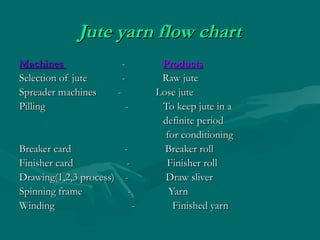
Jute yarn flow chartJute yarn flow chart
MachinesMachines -- ProductsProducts
Selection of jute - Raw juteSelection of jute - Raw jute
Spreader machines - Lose juteSpreader machines - Lose jute
Pilling - To keep jute in aPilling - To keep jute in a
definite perioddefinite period
for conditioningfor conditioning
Breaker card - Breaker rollBreaker card - Breaker roll
Finisher card - Finisher rollFinisher card - Finisher roll
Drawing(1,2,3 process) - Draw sliverDrawing(1,2,3 process) - Draw sliver
Spinning frame - YarnSpinning frame - Yarn
Winding - Finished yarnWinding - Finished yarn
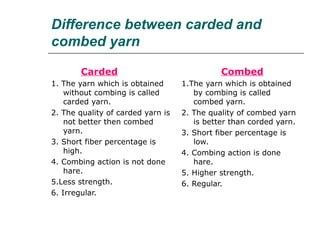
Difference between carded and
combed yarn
Carded
1. The yarn which is obtained
without combing is called
carded yarn.
2. The quality of carded yarn is
not better then combed
yarn.
3. Short fiber percentage is
high.
4. Combing action is not done
hare.
5.Less strength.
6. Irregular.
Combed
1.The yarn which is obtained
by combing is called
combed yarn.
2. The quality of combed yarn
is better than corded yarn.
3. Short fiber percentage is
low.
4. Combing action is done
hare.
5. Higher strength.
6. Regular.
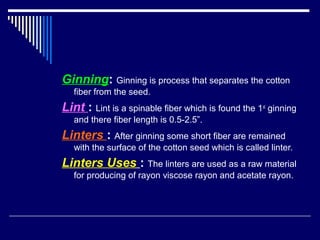
Ginning: Ginning is process that separates the cotton
fiber from the seed.
Lint : Lint is a spinable fiber which is found the 1st
ginning
and there fiber length is 0.5-2.5”.
Linters : After ginning some short fiber are remained
with the surface of the cotton seed which is called linter.
Linters Uses : The linters are used as a raw material
for producing of rayon viscose rayon and acetate rayon.
Thank You!Thank You!

Introduction to Textile Engineering

  • 1.
    MD.KHAIRUL BASHARMD.KHAIRUL BASHAR B.Sc.in Textile Engineering Concentration:Concentration: Apparel Manufacturing Technology Introduction to Textile EngineeringIntroduction to Textile Engineering Bangladesh University of Business andBangladesh University of Business and Technology(BUBT)Technology(BUBT)
  • 2.
  • 3.
    Department of Textile Input– Section – Output Fiber – Yarn Manufacturing Section – Yarn Yarn – Fabric Manufacturing Section – Grey Fabric Grey Fabric – Wet Processing Section – Finished Fabric Finished Fabric – Garments Manufacturing Section – Cloth
  • 4.
    Spinning The process ofproducing yarn or filament from fibers or monomer respectively is called spinning.
  • 5.
    Classification of spinningClassificationof spinning SpinningSpinning Filament spinning Long staple spinning Short staple spinningFilament spinning Long staple spinning Short staple spinning Melt spinning Wet spinning Dry spinningMelt spinning Wet spinning Dry spinning Frictional spinning Air get spinning Rotor spinning Ring spinningFrictional spinning Air get spinning Rotor spinning Ring spinning Carded spinning Combed spinningCarded spinning Combed spinning
  • 6.
    Yarn Yarn may bedefined as a product of substantial length and relationly small in cross section consisting of fiberes or filament with or without twist.
  • 7.
    Flow chart ofCorded yarn manufacturing Input – Section – Output Fiber – Blow room – Lap Lap – Carding – Sliver Sliver – 1st drawing – Draw sliver Draw sliver – 2nd drawing - Draw sliver Draw sliver – Simplex – Roving Roving – Ring trame - Yarn
  • 8.
    Flow chart ofCombed yarn manufacturing Input – Section – Output Fiber – Blow room – Lap Lap – Carding – Sliver Sliver – Pre comb drawing – Sliver Sliver – Lap tormer – Sliver lap Sliver lap – Combing - Sliver lap Sliver lap – Post combing - Sliver lap Sliver lap – Simplex – Roving Roving – Ring trame - Yarn
  • 9.
    Jute yarn flowchartJute yarn flow chart MachinesMachines -- ProductsProducts Selection of jute - Raw juteSelection of jute - Raw jute Spreader machines - Lose juteSpreader machines - Lose jute Pilling - To keep jute in aPilling - To keep jute in a definite perioddefinite period for conditioningfor conditioning Breaker card - Breaker rollBreaker card - Breaker roll Finisher card - Finisher rollFinisher card - Finisher roll Drawing(1,2,3 process) - Draw sliverDrawing(1,2,3 process) - Draw sliver Spinning frame - YarnSpinning frame - Yarn Winding - Finished yarnWinding - Finished yarn
  • 10.
    Difference between cardedand combed yarn Carded 1. The yarn which is obtained without combing is called carded yarn. 2. The quality of carded yarn is not better then combed yarn. 3. Short fiber percentage is high. 4. Combing action is not done hare. 5.Less strength. 6. Irregular. Combed 1.The yarn which is obtained by combing is called combed yarn. 2. The quality of combed yarn is better than corded yarn. 3. Short fiber percentage is low. 4. Combing action is done hare. 5. Higher strength. 6. Regular.
  • 11.
    Ginning: Ginning isprocess that separates the cotton fiber from the seed. Lint : Lint is a spinable fiber which is found the 1st ginning and there fiber length is 0.5-2.5”. Linters : After ginning some short fiber are remained with the surface of the cotton seed which is called linter. Linters Uses : The linters are used as a raw material for producing of rayon viscose rayon and acetate rayon.
  • 12.