PSG POLYTECHNIC COLLEGE
Presentation on
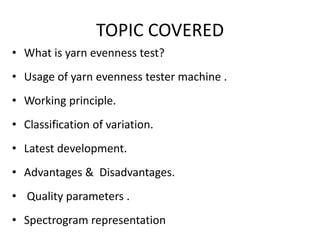
LATEST DEVELOPMENT IN YARN EVENNESS TESTING MACHINE
presented by
T.S.R. praveen (14T025)
k. rubini (15TH05)
TOPIC COVERED
• What is yarn evenness test?
• Usage of yarn evenness tester machine .
• Working principle.
• Classification of variation.
• Latest development.
• Advantages & Disadvantages.
• Quality parameters .
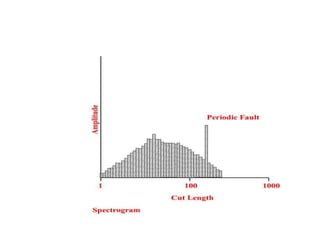
• Spectrogram representation
What is yarn evenness test?
• The instrument by which the evenness (u%),co-efficient of
variation mass (CVm%) yarn hairiness , imperfection index
(IPI)and thick and thin place neps of yarn ,roving , sliver can
be measured or calculated is called evenness test.
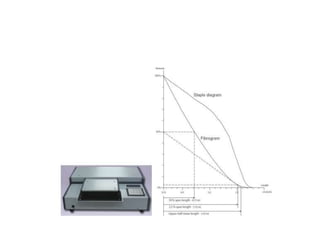
• The mass variations or weight per unit length variations are
recorded and printed as diagram .
• It provides the wavelength spectrum, u%value and the
imperfection .
Usage of yarn evenness testing
machine
• Evenness measurement of yarn , roving and sliver
• Measurement of imperfection (thick,thin
places,neps)
• Yarn hairiness measurement .
• Variation of trend analysis
• Mass analysis
• Spectrogram analysis/frequency analysis
• Fabric simulation i.e before making fabric .
CLASSIFICATION OF VARIATION
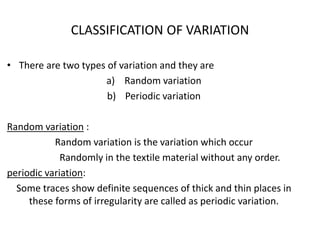
• There are two types of variation and they are
a) Random variation
b) Periodic variation
Random variation :
Random variation is the variation which occur
Randomly in the textile material without any order.
periodic variation:
Some traces show definite sequences of thick and thin places in
these forms of irregularity are called as periodic variation.
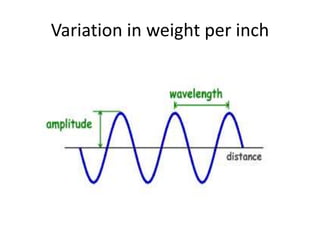
Variation in weight per inch
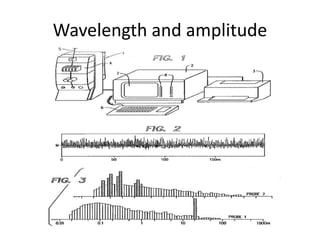
Wavelength and amplitude
Short ,medium and long term variations
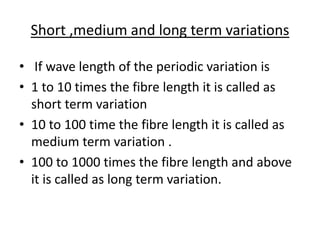
• If wave length of the periodic variation is
• 1 to 10 times the fibre length it is called as
short term variation
• 10 to 100 time the fibre length it is called as
medium term variation .
• 100 to 1000 times the fibre length and above
it is called as long term variation.
Methods of measuring yarn evenness.
• In fact to measuring irregularity ,many methods are
available involving from no equipment to electronic
instruments . Of all these are to see,
1. Visual examination methods:
Using black boards ,drums ,photographic device ,
lap meter
2.Cutting and weighing methods:
Lap scale lapmeter , sliver , roving, and yarn wrapping
3.Electronic capacitance testers:
Uster evenness tester
Photoelectric testers:
WIRA Photoelectric testers ,LINRA tester
Latest development in yarn evenness
tester machine
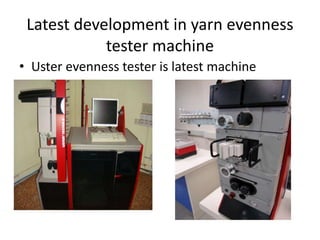
• Uster evenness tester is latest machine
•
About uster tester machine
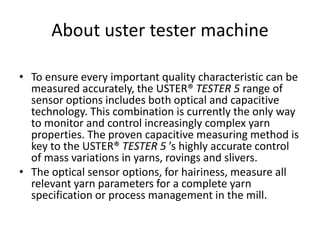
• To ensure every important quality characteristic can be
measured accurately, the USTER® TESTER 5 range of
sensor options includes both optical and capacitive
technology. This combination is currently the only way
to monitor and control increasingly complex yarn
properties. The proven capacitive measuring method is
key to the USTER® TESTER 5 ’s highly accurate control
of mass variations in yarns, rovings and slivers.
• The optical sensor options, for hairiness, measure all
relevant yarn parameters for a complete yarn
specification or process management in the mill.
Working principle of uster machine
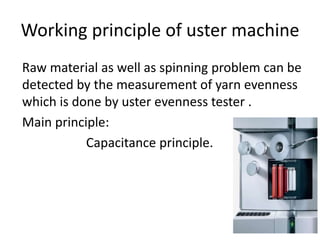
Raw material as well as spinning problem can be
detected by the measurement of yarn evenness
which is done by uster evenness tester .
Main principle:
Capacitance principle.
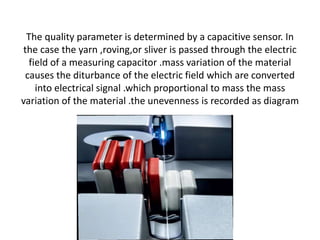
The quality parameter is determined by a capacitive sensor. In
the case the yarn ,roving,or sliver is passed through the electric
field of a measuring capacitor .mass variation of the material
causes the diturbance of the electric field which are converted
into electrical signal .which proportional to mass the mass
variation of the material .the unevenness is recorded as diagram
The characteristic features of uster evenness
tester
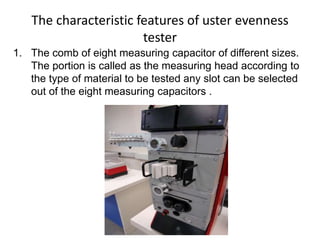
1. The comb of eight measuring capacitor of different sizes.
The portion is called as the measuring head according to
the type of material to be tested any slot can be selected
out of the eight measuring capacitors .
2. Creel and guides: These are to hold the package of
material and to guide them into the correct position into the
slot.
3.Traverse rollers : these roller can control the speed of the
material passing over a range from 2 to 400 meters/min set with a
switch
4. Control switches for direct evaluation
5. Momentary variation indicating meter on the main unit
6. The integrator which indicates the pmd or cv%
Uster statistics
• The uster statistics as quality reference figures which
permit a classification of fibre , sliver, roving and yarn
with regard to world production .
• -50 thick places
• +50 thin places
• 200 neps
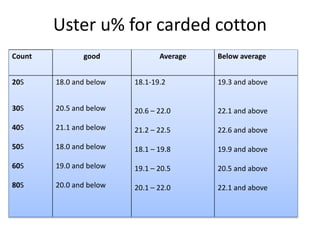
Uster u% for carded cotton
Count good Average Below average
20S
30S
40S
50S
60S
80S
18.0 and below
20.5 and below
21.1 and below
18.0 and below
19.0 and below
20.0 and below
18.1-19.2
20.6 – 22.0
21.2 – 22.5
18.1 – 19.8
19.1 – 20.5
20.1 – 22.0
19.3 and above
22.1 and above
22.6 and above
19.9 and above
20.5 and above
22.1 and above
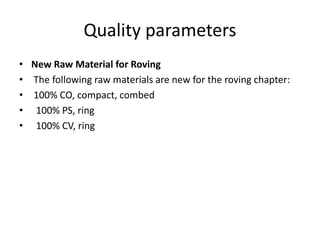
Quality parameters
• New Raw Material for Roving
• The following raw materials are new for the roving chapter:
• 100% CO, compact, combed
• 100% PS, ring
• 100% CV, ring
Advantages
• The CV% measured by Uster give a measure of
variation of weight per unit length.
• This instrument measure the irregularity of material
at high speed (2-100ft/min)
• It can show both % of M.D & C.V. of material.
• The recorder of pen can work at a high speed of
100yds/min
Disadvantage of uster evenness tester
• The result obtained by this M/C is affected by
moisture content of material .
• In this instrument material up to a certain thickness
can be tested .
• Expensive more compare to other evenness m/c
Reference:
• Uster tester brochure
• Application and report hand book of uster
tester
• www.encylopediya .(uster5 tester )
• Textile testing books.
THANK YOU

LATEST DEVELOPMENT IN YARN EVENNESS TESTING MACHINE

  • 1.
    PSG POLYTECHNIC COLLEGE Presentationon LATEST DEVELOPMENT IN YARN EVENNESS TESTING MACHINE presented by T.S.R. praveen (14T025) k. rubini (15TH05)
  • 2.
    TOPIC COVERED • Whatis yarn evenness test? • Usage of yarn evenness tester machine . • Working principle. • Classification of variation. • Latest development. • Advantages & Disadvantages. • Quality parameters . • Spectrogram representation
  • 3.
    What is yarnevenness test? • The instrument by which the evenness (u%),co-efficient of variation mass (CVm%) yarn hairiness , imperfection index (IPI)and thick and thin place neps of yarn ,roving , sliver can be measured or calculated is called evenness test. • The mass variations or weight per unit length variations are recorded and printed as diagram . • It provides the wavelength spectrum, u%value and the imperfection .
  • 4.
    Usage of yarnevenness testing machine • Evenness measurement of yarn , roving and sliver • Measurement of imperfection (thick,thin places,neps) • Yarn hairiness measurement . • Variation of trend analysis • Mass analysis • Spectrogram analysis/frequency analysis • Fabric simulation i.e before making fabric .
  • 5.
    CLASSIFICATION OF VARIATION •There are two types of variation and they are a) Random variation b) Periodic variation Random variation : Random variation is the variation which occur Randomly in the textile material without any order. periodic variation: Some traces show definite sequences of thick and thin places in these forms of irregularity are called as periodic variation.
  • 6.
  • 7.
  • 8.
    Short ,medium andlong term variations • If wave length of the periodic variation is • 1 to 10 times the fibre length it is called as short term variation • 10 to 100 time the fibre length it is called as medium term variation . • 100 to 1000 times the fibre length and above it is called as long term variation.
  • 9.
    Methods of measuringyarn evenness. • In fact to measuring irregularity ,many methods are available involving from no equipment to electronic instruments . Of all these are to see, 1. Visual examination methods: Using black boards ,drums ,photographic device , lap meter 2.Cutting and weighing methods: Lap scale lapmeter , sliver , roving, and yarn wrapping 3.Electronic capacitance testers: Uster evenness tester Photoelectric testers: WIRA Photoelectric testers ,LINRA tester
  • 10.
    Latest development inyarn evenness tester machine • Uster evenness tester is latest machine •
  • 11.
    About uster testermachine • To ensure every important quality characteristic can be measured accurately, the USTER® TESTER 5 range of sensor options includes both optical and capacitive technology. This combination is currently the only way to monitor and control increasingly complex yarn properties. The proven capacitive measuring method is key to the USTER® TESTER 5 ’s highly accurate control of mass variations in yarns, rovings and slivers. • The optical sensor options, for hairiness, measure all relevant yarn parameters for a complete yarn specification or process management in the mill.
  • 12.
    Working principle ofuster machine Raw material as well as spinning problem can be detected by the measurement of yarn evenness which is done by uster evenness tester . Main principle: Capacitance principle.
  • 13.
    The quality parameteris determined by a capacitive sensor. In the case the yarn ,roving,or sliver is passed through the electric field of a measuring capacitor .mass variation of the material causes the diturbance of the electric field which are converted into electrical signal .which proportional to mass the mass variation of the material .the unevenness is recorded as diagram
  • 14.
    The characteristic featuresof uster evenness tester 1. The comb of eight measuring capacitor of different sizes. The portion is called as the measuring head according to the type of material to be tested any slot can be selected out of the eight measuring capacitors .
  • 15.
    2. Creel andguides: These are to hold the package of material and to guide them into the correct position into the slot. 3.Traverse rollers : these roller can control the speed of the material passing over a range from 2 to 400 meters/min set with a switch 4. Control switches for direct evaluation 5. Momentary variation indicating meter on the main unit 6. The integrator which indicates the pmd or cv%
  • 16.
    Uster statistics • Theuster statistics as quality reference figures which permit a classification of fibre , sliver, roving and yarn with regard to world production . • -50 thick places • +50 thin places • 200 neps
  • 19.
    Uster u% forcarded cotton Count good Average Below average 20S 30S 40S 50S 60S 80S 18.0 and below 20.5 and below 21.1 and below 18.0 and below 19.0 and below 20.0 and below 18.1-19.2 20.6 – 22.0 21.2 – 22.5 18.1 – 19.8 19.1 – 20.5 20.1 – 22.0 19.3 and above 22.1 and above 22.6 and above 19.9 and above 20.5 and above 22.1 and above
  • 20.
    Quality parameters • NewRaw Material for Roving • The following raw materials are new for the roving chapter: • 100% CO, compact, combed • 100% PS, ring • 100% CV, ring
  • 21.
    Advantages • The CV%measured by Uster give a measure of variation of weight per unit length. • This instrument measure the irregularity of material at high speed (2-100ft/min) • It can show both % of M.D & C.V. of material. • The recorder of pen can work at a high speed of 100yds/min
  • 22.
    Disadvantage of usterevenness tester • The result obtained by this M/C is affected by moisture content of material . • In this instrument material up to a certain thickness can be tested . • Expensive more compare to other evenness m/c
  • 23.
    Reference: • Uster testerbrochure • Application and report hand book of uster tester • www.encylopediya .(uster5 tester ) • Textile testing books.
  • 24.