Technological innovations
in Neurology – 2
Dr Sanjoy Sanyal sanyal.sanjoy8@gmail.com
Professor – Neuroscience
An outline of techno-gadgets used / tried / tested / in Neurological disorders
Med 3 Neuroscience students from Summer 2009 to Summer 2010 semesters of
Medical University of Americas (MUA), Nevis, St. Kitts-Nevis, W.I., contributed partly to
the material for this presentation
September 2010
• Magnetoencephalography (MEG) in Epilepsy
(Slides 3 – 16)
• Brain computer interface (BCI) (Slides 17 – 27)
• Neuroswitch in Locked-in (Slides 28 – 29)
• Speech synthesizer – Neuralynx (Slide 30)
• Lokomat orthosis in Cerebral palsy (31 – 38)
• Virtual reality in paralysis (Slide 39)
• Brainport in bilateral vestibular damage and
blindness (Slides 40 – 52)
• Bionic eye – Argus II in Retinitis pigmentosa
(Slides 53 – 56)
• Bionic arm – SmartHand (Slides 57 – 61)
• Neuro-feedback sensors and Neuro-headset
detection suites in video gaming (Slides 62 – 66)
• Helmet force sensors in CTE (Slides 67 – 69)
Contents
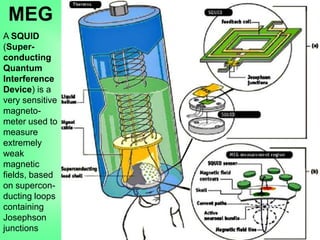
MEG
A SQUID
(Super-
conducting
Quantum
Interference
Device) is a
very sensitive
magneto-
meter used to
measure
extremely
weak
magnetic
fields, based
on supercon-
ducting loops
containing
Josephson
junctions
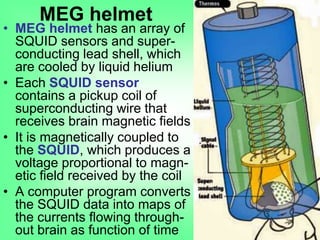
• MEG helmet has an array of
SQUID sensors and super-
conducting lead shell, which
are cooled by liquid helium
• Each SQUID sensor
contains a pickup coil of
superconducting wire that
receives brain magnetic fields
• It is magnetically coupled to
the SQUID, which produces a
voltage proportional to magn-
etic field received by the coil
• A computer program converts
the SQUID data into maps of
the currents flowing through-
out brain as function of time
MEG helmet
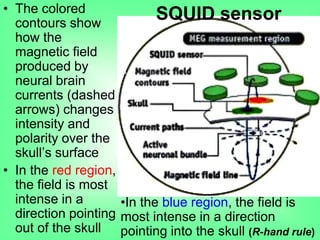
• The colored
contours show
how the
magnetic field
produced by
neural brain
currents (dashed
arrows) changes
intensity and
polarity over the
skull‟s surface
• In the red region,
the field is most
intense in a
direction pointing
out of the skull
•In the blue region, the field is
most intense in a direction
pointing into the skull (R-hand rule)
SQUID sensor
SQUID
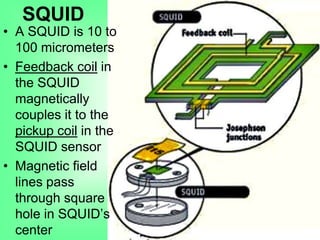
• A SQUID is 10 to
100 micrometers
• Feedback coil in
the SQUID
magnetically
couples it to the
pickup coil in the
SQUID sensor
• Magnetic field
lines pass
through square
hole in SQUID‟s
center
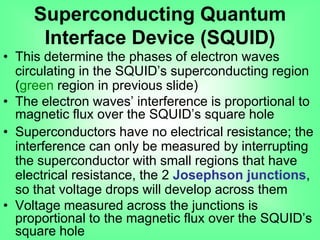
• This determine the phases of electron waves
circulating in the SQUID‟s superconducting region
(green region in previous slide)
• The electron waves‟ interference is proportional to
magnetic flux over the SQUID‟s square hole
• Superconductors have no electrical resistance; the
interference can only be measured by interrupting
the superconductor with small regions that have
electrical resistance, the 2 Josephson junctions,
so that voltage drops will develop across them
• Voltage measured across the junctions is
proportional to the magnetic flux over the SQUID‟s
square hole
Superconducting Quantum
Interface Device (SQUID)
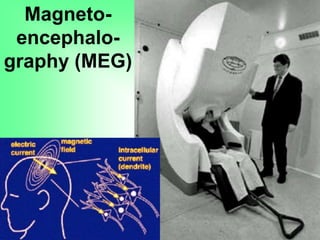
Magneto-
encephalo-
graphy (MEG)
• MEG is used for identifying and analyzing brain
activity based on magnetic fields produced by it
• Principle: MEG is sensitive to the magnetic fields
generated by intra-neuronal currents generated in
the brain (Slide 8); Resultant magnetic field
contours in brain are captured by SQUID sensors
(Slide 6) in MEG helmet (Slides 4,8), which are
rendered in the form of computer-generated image
• Applications:
– Demonstrate functional activity of brain regions
(next slide)
– Localize seizure focus (Slide 14)
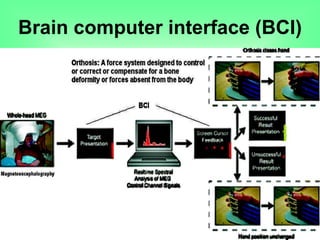
– Demonstrate functioning of Orthosis system
through Brain-computer interface (Slide 19)
Magnetoencephalography (MEG)
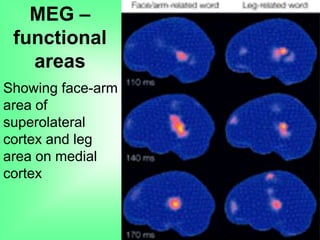
MEG –
functional
areas
Showing face-arm
area of
superolateral
cortex and leg
area on medial
cortex
• MEG is used for localizing the epileptic focus
during pre-surgical evaluation of patients with
medically intractable epilepsy
• MEG is non-invasive and is complementary to
EEG
• The following case study demonstrates the role of
MEG in a 22-year old female with refractory
epilepsy that did not respond to drugs
• She had undergone a number of investigations to
try to delineate the epileptic focus; MRI; interictal
and ictal scalp EEGs; FDG-PET; MEG; Wada Test
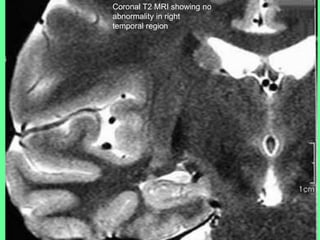
• MRI showed no anatomical abnormality (Slide 13)
MEG in epilepsy
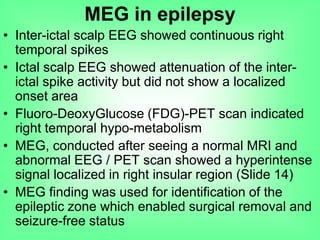
• Inter-ictal scalp EEG showed continuous right
temporal spikes
• Ictal scalp EEG showed attenuation of the inter-
ictal spike activity but did not show a localized
onset area
• Fluoro-DeoxyGlucose (FDG)-PET scan indicated
right temporal hypo-metabolism
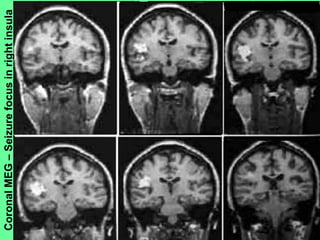
• MEG, conducted after seeing a normal MRI and
abnormal EEG / PET scan showed a hyperintense
signal localized in right insular region (Slide 14)
• MEG finding was used for identification of the
epileptic zone which enabled surgical removal and
seizure-free status
MEG in epilepsy
Coronal T2 MRI showing no
abnormality in right
temporal region
CoronalMEG–Seizurefocusinrightinsula
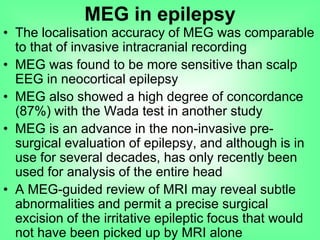
• The localisation accuracy of MEG was comparable
to that of invasive intracranial recording
• MEG was found to be more sensitive than scalp
EEG in neocortical epilepsy
• MEG also showed a high degree of concordance
(87%) with the Wada test in another study
• MEG is an advance in the non-invasive pre-
surgical evaluation of epilepsy, and although is in
use for several decades, has only recently been
used for analysis of the entire head
• A MEG-guided review of MRI may reveal subtle
abnormalities and permit a precise surgical
excision of the irritative epileptic focus that would
not have been picked up by MRI alone
MEG in epilepsy
• Application of MEG in MRI-negative non-lesional
cases provides additional information needed for
decision-making before surgery can be attempted
• The rate of +ve findings after MEG-guided review
of previously MRI-negative films is ~ 17.5%
• Because MEG is primarily sensitive to magnetic
fields generated by intracellular currents, it limits
inaccurate readings from outside sources
• Drawbacks: Major costs associated with operating
it as well as its limited availability
Poon TL, Cheung FC and Lui CH. Magnetoencephalography and its role in evaluation
for epilepsy surgery. HKMJ. 2010 February [cited 2010 March 29]; 16(1):44-47[4
pages]. Available from: http://www.hkmj.org/article_pdfs/hkm1002p44.pdf
MEG in epilepsy
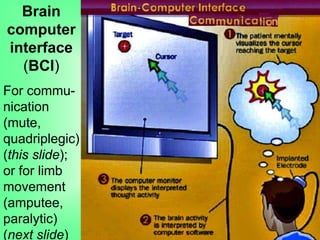
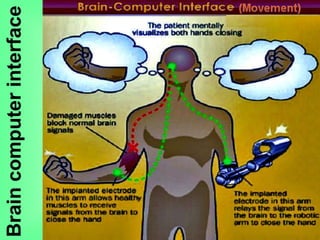
Brain
computer
interface
(BCI)
For commu-
nication
(mute,
quadriplegic)
(this slide);
or for limb
movement
(amputee,
paralytic)
(next slide)
Braincomputerinterface
Brain computer interface (BCI)
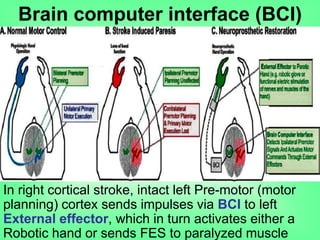
In right cortical stroke, intact left Pre-motor (motor
planning) cortex sends impulses via BCI to left
External effector, which in turn activates either a
Robotic hand or sends FES to paralyzed muscle
• BCI is gateway between brain and external device
• Brain signals can be translated to commands to
control this device (External effector), reflecting
the intentions of the user (Slide 20)
• Previous primate studies demonstrated that motor
cortex neurons can predict the direction and speed
of arm movements
• Recent human studies translated these findings to
increased levels of brain-derived control
• Because there is a lesion in the brain, BCI cannot
use normal cortical pathways to interact with
environment; it creates a completely new output
pathway for the brain; e.g., quadriplegic controlling
cursor on screen with signals derived from Pre-
motor cortex (Slides 17, 19)
Brain computer interface (BCI)
There are 4 functional components of BCI:
1. Signal acquisition: Information input from Pre-
motor cortex is recorded into the BCI
• Measurement of brain activity is usually via
electrodes, either invasive or non invasive
• Signal acquisition can be EEG-based, ECoG-
based, „Single unit‟ microelectrode-based
2. Signal processing: Conversion of raw informa-
tion into useful device command; Requires
complex array of analyses (Slide 19);
• Assessment of frequency power spectra
• Event-related potentials
• Cross correlation coefficients for EEG analysis
• These are to determine the relationship between an electro-
physiological event and a given cognitive or motor task
BCI
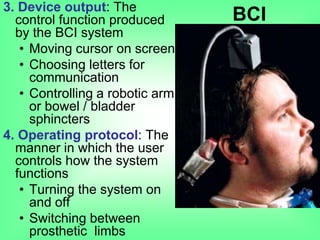
3. Device output: The
control function produced
by the BCI system
• Moving cursor on screen
• Choosing letters for
communication
• Controlling a robotic arm
or bowel / bladder
sphincters
4. Operating protocol: The
manner in which the user
controls how the system
functions
• Turning the system on
and off
• Switching between
prosthetic limbs
BCI
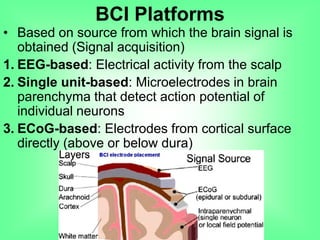
• Based on source from which the brain signal is
obtained (Signal acquisition)
1. EEG-based: Electrical activity from the scalp
2. Single unit-based: Microelectrodes in brain
parenchyma that detect action potential of
individual neurons
3. ECoG-based: Electrodes from cortical surface
directly (above or below dura)
BCI Platforms
• EEG-based: Most common technique
– Detects only Mu (8-12 Hz), Beta (18-25 Hz)
wave-forms (rhythms), which are produced by
sensorimotor cortex and thalamo-cortical circuits
– Pros: Convenient, safe, and inexpensive
– Cons: Poor spatial resolution; No specific
information about details such as position or
velocity of hand movements
• Single unit-based: Micro-electrodes penetrate
into brain parenchyma
– Very successful in recording electrical activity for
limited time periods
– Pros: High spatial / temporal resolution
– Cons: Highly invasive, can cause neural and
vascular damage, chances of infections
BCI platforms
• ECoG-based: More practical and robust platform
for clinical applications
– Signal is 5 times larger than EEG signal
– Higher spatial resolution, and detects higher
frequency waveforms (rhythms)
– Lower frequencies, known as Mu (8-12 Hz) and
Beta (18-25 Hz), detectable by EEG, are
produced by thalamo-cortical circuits
– Higher frequencies appreciable only with ECoG,
a.k.a. Gamma band activity, show close
correlation with action potential of neurons of
Primary motor cortex; Also associated with
numerous aspects of speech
BCI platforms
• BCI is really helpful in motor-disabled
patients
– Spinal cord injuries
– Peripheral neuromuscular dysfunction
• However, BCI is limited in patients suffering
from hemiparesis from hemispheric stroke or
traumatic brain injury
• The field of neuroprosthetics is growing
rapidly
• It can be further expanded to language
function and plasticity
BCI future
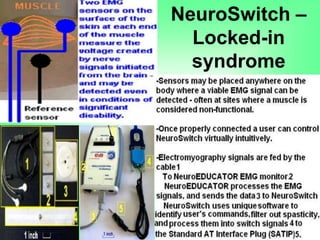
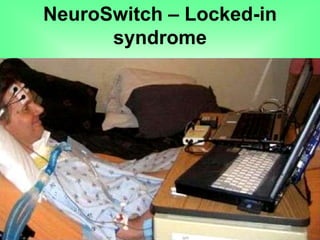
NeuroSwitch –
Locked-in
syndrome
NeuroSwitch – Locked-in
syndrome
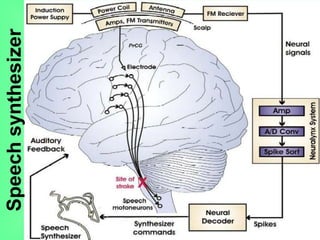
Speechsynthesizer
• Cerebral palsy: Damage to Precentral gyrus
(PrCG) of the developing brain up to 3 years of
age; Results in motor palsy in developing children
• Motor disorders are often accompanied by
secondary musculoskeletal problems, and
disturbances of sensation, perception, cognition,
communication, behavior, and epilepsy
• Lokomat gait orthosis: Developed by Swiss
scientists at University Hospital of Zurich in
January 2006
• It is a virtual gate training therapy for children with
neurological gate impairments like CP, which
incorporates sensory and external motor stimuli
Cerebral palsy (CP)
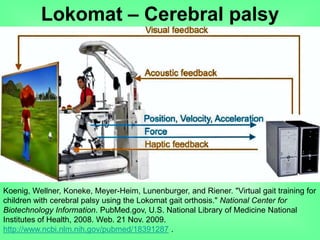
Lokomat – Cerebral palsy
Koenig, Wellner, Koneke, Meyer-Heim, Lunenburger, and Riener. "Virtual gait training for
children with cerebral palsy using the Lokomat gait orthosis." National Center for
Biotechnology Information. PubMed.gov, U.S. National Library of Medicine National
Institutes of Health, 2008. Web. 21 Nov. 2009.
http://www.ncbi.nlm.nih.gov/pubmed/18391287 .
Lokomat – Cerebral palsy
Meyer-Heim, Andreas. "Robotic-assisted locomotor training in gait rehabilitation of
children." Research Portal. Stud Health Technol Inform, Jan. 2006. Web. 21 Nov. 2009.
http://www.researchportal.ch/unizh/p9021.htm .
"Robot-Assisted Walking Therapy Using the Lokomat." Rehabilitation Institute of
Chicago. 25 Sept. 2009. Web. 21 Nov. 2009. http://www.ric.org/conditions/pcs-
specialized/lokomat/index.aspx
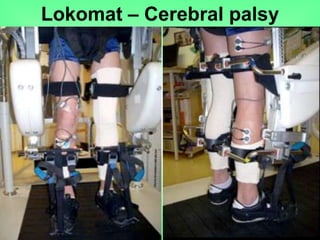
• Patient is placed in harnesses over the treadmill
part of the machine and connected to all the
sensory receptors (1st 2 Lokomat slides)
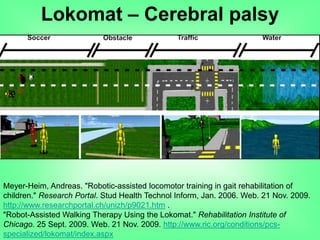
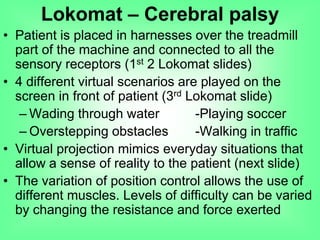
• 4 different virtual scenarios are played on the
screen in front of patient (3rd Lokomat slide)
– Wading through water -Playing soccer
– Overstepping obstacles -Walking in traffic
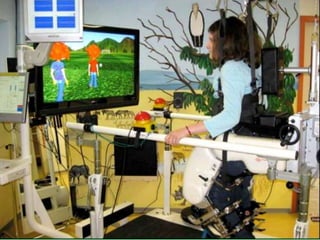
• Virtual projection mimics everyday situations that
allow a sense of reality to the patient (next slide)
• The variation of position control allows the use of
different muscles. Levels of difficulty can be varied
by changing the resistance and force exerted
Lokomat – Cerebral palsy
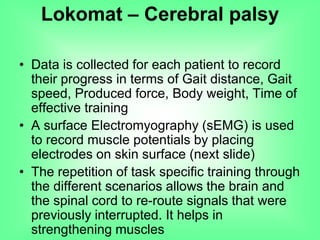
• Data is collected for each patient to record
their progress in terms of Gait distance, Gait
speed, Produced force, Body weight, Time of
effective training
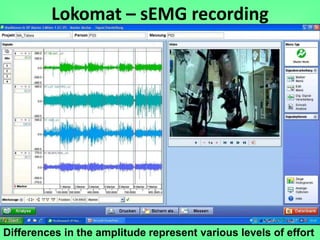
• A surface Electromyography (sEMG) is used
to record muscle potentials by placing
electrodes on skin surface (next slide)
• The repetition of task specific training through
the different scenarios allows the brain and
the spinal cord to re-route signals that were
previously interrupted. It helps in
strengthening muscles
Lokomat – Cerebral palsy
Lokomat – sEMG recording
Differences in the amplitude represent various levels of effort
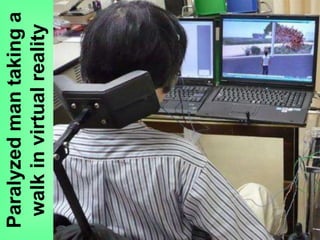
Paralyzedmantakinga
walkinvirtualreality
• Brainport system provides electrotactile
stimulation for sensory augmentation which uses
encoded electric current to represent actual
sensory information that is deficient
• By sending this current to the skin, the brain
adapts to interpret the sensory information as if it
were coming from the original organ
• This is because sensory information is carried by
nerve fibers in the form of impulse patterns that are
then interpreted by their respective brain centers
• Brainport works via an Electrode array that
receives input from a non-tactile source, which
then applies controlled currents to the skin in a
precise pattern at a precise location
Brainport
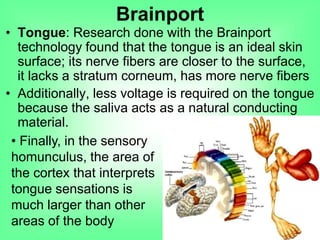
• Tongue: Research done with the Brainport
technology found that the tongue is an ideal skin
surface; its nerve fibers are closer to the surface,
it lacks a stratum corneum, has more nerve fibers
• Additionally, less voltage is required on the tongue
because the saliva acts as a natural conducting
material.
Brainport
• Finally, in the sensory
homunculus, the area of
the cortex that interprets
tongue sensations is
much larger than other
areas of the body
• The initial application of the Brainport device was
in the field of balance correction
• Trial patients had damage to their inner ears, due
to Bilateral vestibular disorders (BVD), Acoustic
neuromas, or Meniere‟s disease, and had resultant
loss of balance
• In the absence of a functional vestibular system,
the brain has difficulty correctly integrating visual
and proprioceptive cues, leading to problems with
posture control and movement
• They have difficulty in engaging in daily activities;
walking in low-light or busy environments, walking
on uneven surfaces, bending forward to pick
something up, driving a car, or reading a book
Vestibular dysfunction
Brainport–vestibular
• These patients adopted correctional mechanisms
on their own; gripping sides of the wall, guarded
stance, slow, shuffling steps, which offer minimal
compensation
• Brainport aided them to interpret their balance
information (proproceptive cues) as coming from
their tongue instead of inner ear.
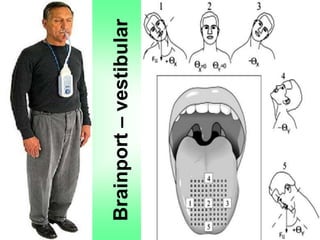
• Brainport integrates an Accelerometer with output
device, which provides input to the Facial and
Lingual nerves via the anterior 2/3rd of tongue
• The Accelerometer measures tilt with respect to
pull of gravity. It is on underside of 10 x 10
Electrode array, and transmits data about head
position to CPU through communication circuitry
Brainport – vestibular use
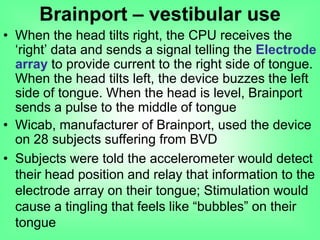
• When the head tilts right, the CPU receives the
„right‟ data and sends a signal telling the Electrode
array to provide current to the right side of tongue.
When the head tilts left, the device buzzes the left
side of tongue. When the head is level, Brainport
sends a pulse to the middle of tongue
• Wicab, manufacturer of Brainport, used the device
on 28 subjects suffering from BVD
• Subjects were told the accelerometer would detect
their head position and relay that information to the
electrode array on their tongue; Stimulation would
cause a tingling that feels like “bubbles” on their
tongue
Brainport – vestibular use
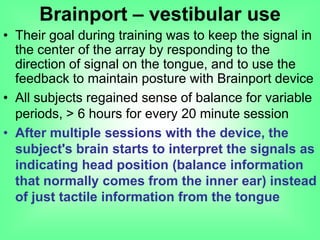
• Their goal during training was to keep the signal in
the center of the array by responding to the
direction of signal on the tongue, and to use the
feedback to maintain posture with Brainport device
• All subjects regained sense of balance for variable
periods, > 6 hours for every 20 minute session
• After multiple sessions with the device, the
subject's brain starts to interpret the signals as
indicating head position (balance information
that normally comes from the inner ear) instead
of just tactile information from the tongue
Brainport – vestibular use
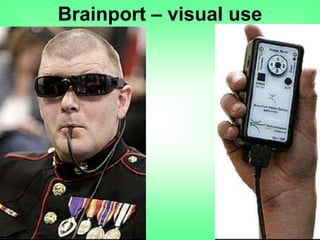
Brainport – visual use
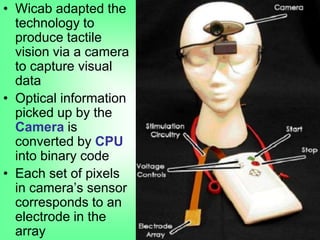
• Wicab adapted the
technology to
produce tactile
vision via a camera
to capture visual
data
• Optical information
picked up by the
Camera is
converted by CPU
into binary code
• Each set of pixels
in camera‟s sensor
corresponds to an
electrode in the
array
• These signals represent differences in pixel data
such as frequency, amplitude and duration. When
fully converted, the image takes the form of
variations in pulse current, voltage, duration, and
intervals between each pulse
• Electrode array receives the resulting signal via
the stimulation circuitry and applies it to the tongue
• Wicab trained 15 subjects; Training sessions
included several brief trials of 1-5 minutes each,
followed by one 20-minute trial involving the
patient in progressively challenging positions while
using the device
• Scientists evaluated the subjects before training
began and after the last training session; In all
improvement occurred in at least one area
Brainport – visual use
• Users described it as pictures drawn on their
tongue with champagne bubbles. With
training users may perceive shape, size,
location and motion of objects in their
environment
• The brain eventually learns to interpret
and use the information coming from the
tongue as if it were coming from the eyes
• Results were confirmed with an independent
study that conducted PET scans of
congenitally blind people while they were
using the Brainport device
Brainport – visual use
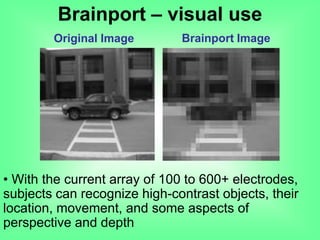
Original Image Brainport Image
Brainport – visual use
• With the current array of 100 to 600+ electrodes,
subjects can recognize high-contrast objects, their
location, movement, and some aspects of
perspective and depth
• Blind subjects can perceive looming, depth,
perspective, size and shape. They could still
feel the pulses on their tongue, but they
could also perceive images generated from
those pulses by their brain
• Subjects perceived the objects as "out there"
in front of them, separate from their own
bodies. They perceived and identified letters
of alphabet
• Currently, the Brainport is intended to
augment rather than replace the white cane
Brainport – visual use
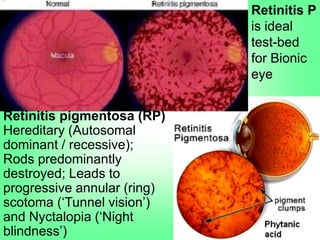
Retinitis pigmentosa (RP)
Hereditary (Autosomal
dominant / recessive);
Rods predominantly
destroyed; Leads to
progressive annular (ring)
scotoma („Tunnel vision‟)
and Nyctalopia („Night
blindness‟)
Retinitis P
is ideal
test-bed
for Bionic
eye
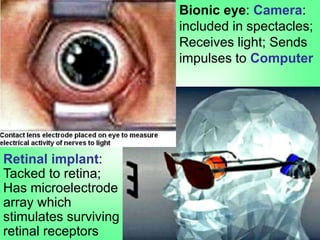
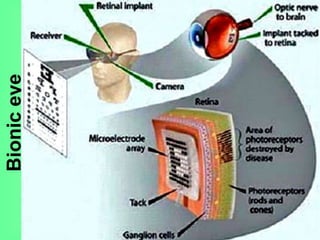
Bionic eye: Camera:
included in spectacles;
Receives light; Sends
impulses to Computer
Retinal implant:
Tacked to retina;
Has microelectrode
array which
stimulates surviving
retinal receptors
Bioniceye
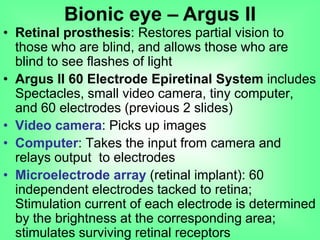
• Retinal prosthesis: Restores partial vision to
those who are blind, and allows those who are
blind to see flashes of light
• Argus II 60 Electrode Epiretinal System includes
Spectacles, small video camera, tiny computer,
and 60 electrodes (previous 2 slides)
• Video camera: Picks up images
• Computer: Takes the input from camera and
relays output to electrodes
• Microelectrode array (retinal implant): 60
independent electrodes tacked to retina;
Stimulation current of each electrode is determined
by the brightness at the corresponding area;
stimulates surviving retinal receptors
Bionic eye – Argus II
Bionic arm – TMR
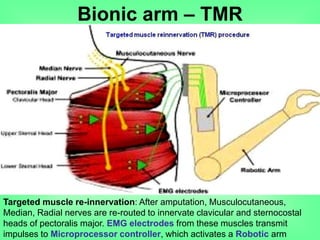
Targeted muscle re-innervation: After amputation, Musculocutaneous,
Median, Radial nerves are re-routed to innervate clavicular and sternocostal
heads of pectoralis major. EMG electrodes from these muscles transmit
impulses to Microprocessor controller, which activates a Robotic arm
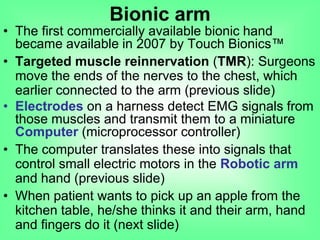
• The first commercially available bionic hand
became available in 2007 by Touch Bionics™
• Targeted muscle reinnervation (TMR): Surgeons
move the ends of the nerves to the chest, which
earlier connected to the arm (previous slide)
• Electrodes on a harness detect EMG signals from
those muscles and transmit them to a miniature
Computer (microprocessor controller)
• The computer translates these into signals that
control small electric motors in the Robotic arm
and hand (previous slide)
• When patient wants to pick up an apple from the
kitchen table, he/she thinks it and their arm, hand
and fingers do it (next slide)
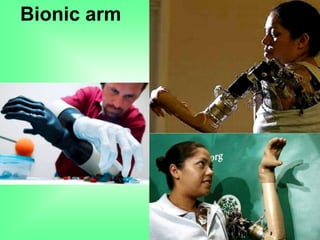
Bionic arm
Bionic arm
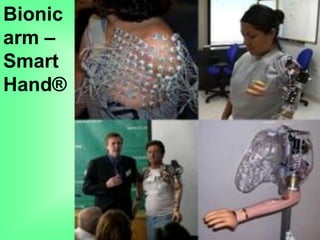
Bionic
arm –
Smart
Hand®
• The main limitation of previous models was the
deficit in sensory function
• New models now convey sensation from the
device to neural receptors in the chest (and to the
brain) to allow sensation of Feeling, Touch,
Pressure, Vibration
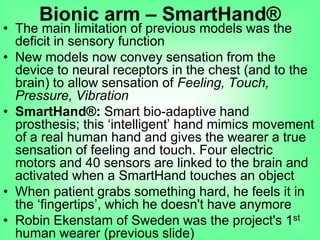
• SmartHand®: Smart bio-adaptive hand
prosthesis; this „intelligent‟ hand mimics movement
of a real human hand and gives the wearer a true
sensation of feeling and touch. Four electric
motors and 40 sensors are linked to the brain and
activated when a SmartHand touches an object
• When patient grabs something hard, he feels it in
the „fingertips‟, which he doesn't have anymore
• Robin Ekenstam of Sweden was the project's 1st
human wearer (previous slide)
Bionic arm – SmartHand®
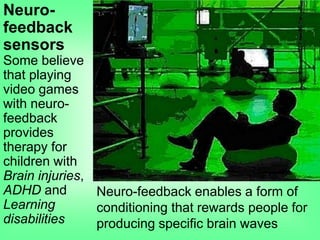
Neuro-
feedback
sensors
Some believe
that playing
video games
with neuro-
feedback
provides
therapy for
children with
Brain injuries,
ADHD and
Learning
disabilities
Neuro-feedback enables a form of
conditioning that rewards people for
producing specific brain waves
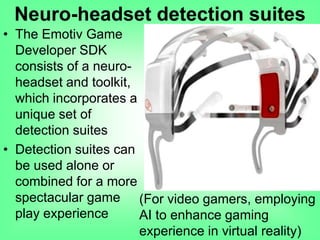
• The Emotiv Game
Developer SDK
consists of a neuro-
headset and toolkit,
which incorporates a
unique set of
detection suites
• Detection suites can
be used alone or
combined for a more
spectacular game
play experience
(For video gamers, employing
AI to enhance gaming
experience in virtual reality)
Neuro-headset detection suites
• Affectiv suite monitors player‟s emotional states
/ state of mind in real-time
• It provides extra dimension in game interaction
by allowing the game to respond to a player's
emotions
• Characters can transform in response to
player's feeling
• Music, scene lighting and effects can be
tailored to heighten the experience for the
player in real-time
• Affectiv suite can be used to adjust difficulty to
suit each situation
Affectiv™ suite
• Expressiv suite uses the signals measured by
the neuro-headset to interpret player‟s facial
expressions in real-time
• When a player smiles, their avatar can mimic
the expression even before they are aware of
their own feelings
• It provides a natural enhancement to game
interaction by allowing game characters to
come to life
• Artificial intelligence (AI) can now respond to
players naturally, in ways only humans have
been able to until now
Expressiv™ suite
• Cognitiv suite reads and interprets a player's
conscious thoughts and intent
• Gamers can manipulate virtual objects using
only the power of their thought
• The fantasy of magic and supernatural power
can be experienced
Cognitiv™ suite
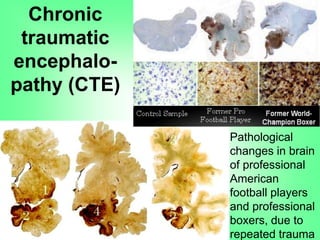
Chronic
traumatic
encephalo-
pathy (CTE)
Pathological
changes in brain
of professional
American
football players
and professional
boxers, due to
repeated trauma
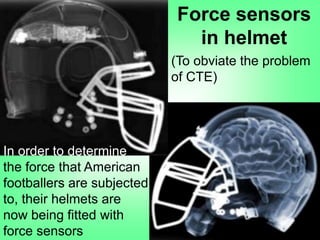
Force sensors
in helmet
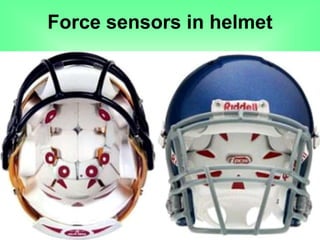
In order to determine
the force that American
footballers are subjected
to, their helmets are
now being fitted with
force sensors
(To obviate the problem
of CTE)
Force sensors in helmet

Technological Innovations in Neurology 2 - Sanjoy Sanyal

  • 1.
    Technological innovations in Neurology– 2 Dr Sanjoy Sanyal sanyal.sanjoy8@gmail.com Professor – Neuroscience An outline of techno-gadgets used / tried / tested / in Neurological disorders Med 3 Neuroscience students from Summer 2009 to Summer 2010 semesters of Medical University of Americas (MUA), Nevis, St. Kitts-Nevis, W.I., contributed partly to the material for this presentation September 2010
  • 2.
    • Magnetoencephalography (MEG)in Epilepsy (Slides 3 – 16) • Brain computer interface (BCI) (Slides 17 – 27) • Neuroswitch in Locked-in (Slides 28 – 29) • Speech synthesizer – Neuralynx (Slide 30) • Lokomat orthosis in Cerebral palsy (31 – 38) • Virtual reality in paralysis (Slide 39) • Brainport in bilateral vestibular damage and blindness (Slides 40 – 52) • Bionic eye – Argus II in Retinitis pigmentosa (Slides 53 – 56) • Bionic arm – SmartHand (Slides 57 – 61) • Neuro-feedback sensors and Neuro-headset detection suites in video gaming (Slides 62 – 66) • Helmet force sensors in CTE (Slides 67 – 69) Contents
  • 3.
    MEG A SQUID (Super- conducting Quantum Interference Device) isa very sensitive magneto- meter used to measure extremely weak magnetic fields, based on supercon- ducting loops containing Josephson junctions
  • 4.
    • MEG helmethas an array of SQUID sensors and super- conducting lead shell, which are cooled by liquid helium • Each SQUID sensor contains a pickup coil of superconducting wire that receives brain magnetic fields • It is magnetically coupled to the SQUID, which produces a voltage proportional to magn- etic field received by the coil • A computer program converts the SQUID data into maps of the currents flowing through- out brain as function of time MEG helmet
  • 5.
    • The colored contoursshow how the magnetic field produced by neural brain currents (dashed arrows) changes intensity and polarity over the skull‟s surface • In the red region, the field is most intense in a direction pointing out of the skull •In the blue region, the field is most intense in a direction pointing into the skull (R-hand rule) SQUID sensor
  • 6.
    SQUID • A SQUIDis 10 to 100 micrometers • Feedback coil in the SQUID magnetically couples it to the pickup coil in the SQUID sensor • Magnetic field lines pass through square hole in SQUID‟s center
  • 7.
    • This determinethe phases of electron waves circulating in the SQUID‟s superconducting region (green region in previous slide) • The electron waves‟ interference is proportional to magnetic flux over the SQUID‟s square hole • Superconductors have no electrical resistance; the interference can only be measured by interrupting the superconductor with small regions that have electrical resistance, the 2 Josephson junctions, so that voltage drops will develop across them • Voltage measured across the junctions is proportional to the magnetic flux over the SQUID‟s square hole Superconducting Quantum Interface Device (SQUID)
  • 8.
  • 9.
    • MEG isused for identifying and analyzing brain activity based on magnetic fields produced by it • Principle: MEG is sensitive to the magnetic fields generated by intra-neuronal currents generated in the brain (Slide 8); Resultant magnetic field contours in brain are captured by SQUID sensors (Slide 6) in MEG helmet (Slides 4,8), which are rendered in the form of computer-generated image • Applications: – Demonstrate functional activity of brain regions (next slide) – Localize seizure focus (Slide 14) – Demonstrate functioning of Orthosis system through Brain-computer interface (Slide 19) Magnetoencephalography (MEG)
  • 10.
    MEG – functional areas Showing face-arm areaof superolateral cortex and leg area on medial cortex
  • 11.
    • MEG isused for localizing the epileptic focus during pre-surgical evaluation of patients with medically intractable epilepsy • MEG is non-invasive and is complementary to EEG • The following case study demonstrates the role of MEG in a 22-year old female with refractory epilepsy that did not respond to drugs • She had undergone a number of investigations to try to delineate the epileptic focus; MRI; interictal and ictal scalp EEGs; FDG-PET; MEG; Wada Test • MRI showed no anatomical abnormality (Slide 13) MEG in epilepsy
  • 12.
    • Inter-ictal scalpEEG showed continuous right temporal spikes • Ictal scalp EEG showed attenuation of the inter- ictal spike activity but did not show a localized onset area • Fluoro-DeoxyGlucose (FDG)-PET scan indicated right temporal hypo-metabolism • MEG, conducted after seeing a normal MRI and abnormal EEG / PET scan showed a hyperintense signal localized in right insular region (Slide 14) • MEG finding was used for identification of the epileptic zone which enabled surgical removal and seizure-free status MEG in epilepsy
  • 13.
    Coronal T2 MRIshowing no abnormality in right temporal region
  • 14.
  • 15.
    • The localisationaccuracy of MEG was comparable to that of invasive intracranial recording • MEG was found to be more sensitive than scalp EEG in neocortical epilepsy • MEG also showed a high degree of concordance (87%) with the Wada test in another study • MEG is an advance in the non-invasive pre- surgical evaluation of epilepsy, and although is in use for several decades, has only recently been used for analysis of the entire head • A MEG-guided review of MRI may reveal subtle abnormalities and permit a precise surgical excision of the irritative epileptic focus that would not have been picked up by MRI alone MEG in epilepsy
  • 16.
    • Application ofMEG in MRI-negative non-lesional cases provides additional information needed for decision-making before surgery can be attempted • The rate of +ve findings after MEG-guided review of previously MRI-negative films is ~ 17.5% • Because MEG is primarily sensitive to magnetic fields generated by intracellular currents, it limits inaccurate readings from outside sources • Drawbacks: Major costs associated with operating it as well as its limited availability Poon TL, Cheung FC and Lui CH. Magnetoencephalography and its role in evaluation for epilepsy surgery. HKMJ. 2010 February [cited 2010 March 29]; 16(1):44-47[4 pages]. Available from: http://www.hkmj.org/article_pdfs/hkm1002p44.pdf MEG in epilepsy
  • 17.
  • 18.
  • 19.
  • 20.
    Brain computer interface(BCI) In right cortical stroke, intact left Pre-motor (motor planning) cortex sends impulses via BCI to left External effector, which in turn activates either a Robotic hand or sends FES to paralyzed muscle
  • 21.
    • BCI isgateway between brain and external device • Brain signals can be translated to commands to control this device (External effector), reflecting the intentions of the user (Slide 20) • Previous primate studies demonstrated that motor cortex neurons can predict the direction and speed of arm movements • Recent human studies translated these findings to increased levels of brain-derived control • Because there is a lesion in the brain, BCI cannot use normal cortical pathways to interact with environment; it creates a completely new output pathway for the brain; e.g., quadriplegic controlling cursor on screen with signals derived from Pre- motor cortex (Slides 17, 19) Brain computer interface (BCI)
  • 22.
    There are 4functional components of BCI: 1. Signal acquisition: Information input from Pre- motor cortex is recorded into the BCI • Measurement of brain activity is usually via electrodes, either invasive or non invasive • Signal acquisition can be EEG-based, ECoG- based, „Single unit‟ microelectrode-based 2. Signal processing: Conversion of raw informa- tion into useful device command; Requires complex array of analyses (Slide 19); • Assessment of frequency power spectra • Event-related potentials • Cross correlation coefficients for EEG analysis • These are to determine the relationship between an electro- physiological event and a given cognitive or motor task BCI
  • 23.
    3. Device output:The control function produced by the BCI system • Moving cursor on screen • Choosing letters for communication • Controlling a robotic arm or bowel / bladder sphincters 4. Operating protocol: The manner in which the user controls how the system functions • Turning the system on and off • Switching between prosthetic limbs BCI
  • 24.
    • Based onsource from which the brain signal is obtained (Signal acquisition) 1. EEG-based: Electrical activity from the scalp 2. Single unit-based: Microelectrodes in brain parenchyma that detect action potential of individual neurons 3. ECoG-based: Electrodes from cortical surface directly (above or below dura) BCI Platforms
  • 25.
    • EEG-based: Mostcommon technique – Detects only Mu (8-12 Hz), Beta (18-25 Hz) wave-forms (rhythms), which are produced by sensorimotor cortex and thalamo-cortical circuits – Pros: Convenient, safe, and inexpensive – Cons: Poor spatial resolution; No specific information about details such as position or velocity of hand movements • Single unit-based: Micro-electrodes penetrate into brain parenchyma – Very successful in recording electrical activity for limited time periods – Pros: High spatial / temporal resolution – Cons: Highly invasive, can cause neural and vascular damage, chances of infections BCI platforms
  • 26.
    • ECoG-based: Morepractical and robust platform for clinical applications – Signal is 5 times larger than EEG signal – Higher spatial resolution, and detects higher frequency waveforms (rhythms) – Lower frequencies, known as Mu (8-12 Hz) and Beta (18-25 Hz), detectable by EEG, are produced by thalamo-cortical circuits – Higher frequencies appreciable only with ECoG, a.k.a. Gamma band activity, show close correlation with action potential of neurons of Primary motor cortex; Also associated with numerous aspects of speech BCI platforms
  • 27.
    • BCI isreally helpful in motor-disabled patients – Spinal cord injuries – Peripheral neuromuscular dysfunction • However, BCI is limited in patients suffering from hemiparesis from hemispheric stroke or traumatic brain injury • The field of neuroprosthetics is growing rapidly • It can be further expanded to language function and plasticity BCI future
  • 28.
  • 29.
  • 30.
  • 31.
    • Cerebral palsy:Damage to Precentral gyrus (PrCG) of the developing brain up to 3 years of age; Results in motor palsy in developing children • Motor disorders are often accompanied by secondary musculoskeletal problems, and disturbances of sensation, perception, cognition, communication, behavior, and epilepsy • Lokomat gait orthosis: Developed by Swiss scientists at University Hospital of Zurich in January 2006 • It is a virtual gate training therapy for children with neurological gate impairments like CP, which incorporates sensory and external motor stimuli Cerebral palsy (CP)
  • 32.
    Lokomat – Cerebralpalsy Koenig, Wellner, Koneke, Meyer-Heim, Lunenburger, and Riener. "Virtual gait training for children with cerebral palsy using the Lokomat gait orthosis." National Center for Biotechnology Information. PubMed.gov, U.S. National Library of Medicine National Institutes of Health, 2008. Web. 21 Nov. 2009. http://www.ncbi.nlm.nih.gov/pubmed/18391287 .
  • 33.
  • 34.
    Lokomat – Cerebralpalsy Meyer-Heim, Andreas. "Robotic-assisted locomotor training in gait rehabilitation of children." Research Portal. Stud Health Technol Inform, Jan. 2006. Web. 21 Nov. 2009. http://www.researchportal.ch/unizh/p9021.htm . "Robot-Assisted Walking Therapy Using the Lokomat." Rehabilitation Institute of Chicago. 25 Sept. 2009. Web. 21 Nov. 2009. http://www.ric.org/conditions/pcs- specialized/lokomat/index.aspx
  • 35.
    • Patient isplaced in harnesses over the treadmill part of the machine and connected to all the sensory receptors (1st 2 Lokomat slides) • 4 different virtual scenarios are played on the screen in front of patient (3rd Lokomat slide) – Wading through water -Playing soccer – Overstepping obstacles -Walking in traffic • Virtual projection mimics everyday situations that allow a sense of reality to the patient (next slide) • The variation of position control allows the use of different muscles. Levels of difficulty can be varied by changing the resistance and force exerted Lokomat – Cerebral palsy
  • 37.
    • Data iscollected for each patient to record their progress in terms of Gait distance, Gait speed, Produced force, Body weight, Time of effective training • A surface Electromyography (sEMG) is used to record muscle potentials by placing electrodes on skin surface (next slide) • The repetition of task specific training through the different scenarios allows the brain and the spinal cord to re-route signals that were previously interrupted. It helps in strengthening muscles Lokomat – Cerebral palsy
  • 38.
    Lokomat – sEMGrecording Differences in the amplitude represent various levels of effort
  • 39.
  • 40.
    • Brainport systemprovides electrotactile stimulation for sensory augmentation which uses encoded electric current to represent actual sensory information that is deficient • By sending this current to the skin, the brain adapts to interpret the sensory information as if it were coming from the original organ • This is because sensory information is carried by nerve fibers in the form of impulse patterns that are then interpreted by their respective brain centers • Brainport works via an Electrode array that receives input from a non-tactile source, which then applies controlled currents to the skin in a precise pattern at a precise location Brainport
  • 41.
    • Tongue: Researchdone with the Brainport technology found that the tongue is an ideal skin surface; its nerve fibers are closer to the surface, it lacks a stratum corneum, has more nerve fibers • Additionally, less voltage is required on the tongue because the saliva acts as a natural conducting material. Brainport • Finally, in the sensory homunculus, the area of the cortex that interprets tongue sensations is much larger than other areas of the body
  • 42.
    • The initialapplication of the Brainport device was in the field of balance correction • Trial patients had damage to their inner ears, due to Bilateral vestibular disorders (BVD), Acoustic neuromas, or Meniere‟s disease, and had resultant loss of balance • In the absence of a functional vestibular system, the brain has difficulty correctly integrating visual and proprioceptive cues, leading to problems with posture control and movement • They have difficulty in engaging in daily activities; walking in low-light or busy environments, walking on uneven surfaces, bending forward to pick something up, driving a car, or reading a book Vestibular dysfunction
  • 43.
  • 44.
    • These patientsadopted correctional mechanisms on their own; gripping sides of the wall, guarded stance, slow, shuffling steps, which offer minimal compensation • Brainport aided them to interpret their balance information (proproceptive cues) as coming from their tongue instead of inner ear. • Brainport integrates an Accelerometer with output device, which provides input to the Facial and Lingual nerves via the anterior 2/3rd of tongue • The Accelerometer measures tilt with respect to pull of gravity. It is on underside of 10 x 10 Electrode array, and transmits data about head position to CPU through communication circuitry Brainport – vestibular use
  • 45.
    • When thehead tilts right, the CPU receives the „right‟ data and sends a signal telling the Electrode array to provide current to the right side of tongue. When the head tilts left, the device buzzes the left side of tongue. When the head is level, Brainport sends a pulse to the middle of tongue • Wicab, manufacturer of Brainport, used the device on 28 subjects suffering from BVD • Subjects were told the accelerometer would detect their head position and relay that information to the electrode array on their tongue; Stimulation would cause a tingling that feels like “bubbles” on their tongue Brainport – vestibular use
  • 46.
    • Their goalduring training was to keep the signal in the center of the array by responding to the direction of signal on the tongue, and to use the feedback to maintain posture with Brainport device • All subjects regained sense of balance for variable periods, > 6 hours for every 20 minute session • After multiple sessions with the device, the subject's brain starts to interpret the signals as indicating head position (balance information that normally comes from the inner ear) instead of just tactile information from the tongue Brainport – vestibular use
  • 47.
  • 48.
    • Wicab adaptedthe technology to produce tactile vision via a camera to capture visual data • Optical information picked up by the Camera is converted by CPU into binary code • Each set of pixels in camera‟s sensor corresponds to an electrode in the array
  • 49.
    • These signalsrepresent differences in pixel data such as frequency, amplitude and duration. When fully converted, the image takes the form of variations in pulse current, voltage, duration, and intervals between each pulse • Electrode array receives the resulting signal via the stimulation circuitry and applies it to the tongue • Wicab trained 15 subjects; Training sessions included several brief trials of 1-5 minutes each, followed by one 20-minute trial involving the patient in progressively challenging positions while using the device • Scientists evaluated the subjects before training began and after the last training session; In all improvement occurred in at least one area Brainport – visual use
  • 50.
    • Users describedit as pictures drawn on their tongue with champagne bubbles. With training users may perceive shape, size, location and motion of objects in their environment • The brain eventually learns to interpret and use the information coming from the tongue as if it were coming from the eyes • Results were confirmed with an independent study that conducted PET scans of congenitally blind people while they were using the Brainport device Brainport – visual use
  • 51.
    Original Image BrainportImage Brainport – visual use • With the current array of 100 to 600+ electrodes, subjects can recognize high-contrast objects, their location, movement, and some aspects of perspective and depth
  • 52.
    • Blind subjectscan perceive looming, depth, perspective, size and shape. They could still feel the pulses on their tongue, but they could also perceive images generated from those pulses by their brain • Subjects perceived the objects as "out there" in front of them, separate from their own bodies. They perceived and identified letters of alphabet • Currently, the Brainport is intended to augment rather than replace the white cane Brainport – visual use
  • 53.
    Retinitis pigmentosa (RP) Hereditary(Autosomal dominant / recessive); Rods predominantly destroyed; Leads to progressive annular (ring) scotoma („Tunnel vision‟) and Nyctalopia („Night blindness‟) Retinitis P is ideal test-bed for Bionic eye
  • 54.
    Bionic eye: Camera: includedin spectacles; Receives light; Sends impulses to Computer Retinal implant: Tacked to retina; Has microelectrode array which stimulates surviving retinal receptors
  • 55.
  • 56.
    • Retinal prosthesis:Restores partial vision to those who are blind, and allows those who are blind to see flashes of light • Argus II 60 Electrode Epiretinal System includes Spectacles, small video camera, tiny computer, and 60 electrodes (previous 2 slides) • Video camera: Picks up images • Computer: Takes the input from camera and relays output to electrodes • Microelectrode array (retinal implant): 60 independent electrodes tacked to retina; Stimulation current of each electrode is determined by the brightness at the corresponding area; stimulates surviving retinal receptors Bionic eye – Argus II
  • 57.
    Bionic arm –TMR Targeted muscle re-innervation: After amputation, Musculocutaneous, Median, Radial nerves are re-routed to innervate clavicular and sternocostal heads of pectoralis major. EMG electrodes from these muscles transmit impulses to Microprocessor controller, which activates a Robotic arm
  • 58.
    • The firstcommercially available bionic hand became available in 2007 by Touch Bionics™ • Targeted muscle reinnervation (TMR): Surgeons move the ends of the nerves to the chest, which earlier connected to the arm (previous slide) • Electrodes on a harness detect EMG signals from those muscles and transmit them to a miniature Computer (microprocessor controller) • The computer translates these into signals that control small electric motors in the Robotic arm and hand (previous slide) • When patient wants to pick up an apple from the kitchen table, he/she thinks it and their arm, hand and fingers do it (next slide) Bionic arm
  • 59.
  • 60.
  • 61.
    • The mainlimitation of previous models was the deficit in sensory function • New models now convey sensation from the device to neural receptors in the chest (and to the brain) to allow sensation of Feeling, Touch, Pressure, Vibration • SmartHand®: Smart bio-adaptive hand prosthesis; this „intelligent‟ hand mimics movement of a real human hand and gives the wearer a true sensation of feeling and touch. Four electric motors and 40 sensors are linked to the brain and activated when a SmartHand touches an object • When patient grabs something hard, he feels it in the „fingertips‟, which he doesn't have anymore • Robin Ekenstam of Sweden was the project's 1st human wearer (previous slide) Bionic arm – SmartHand®
  • 62.
    Neuro- feedback sensors Some believe that playing videogames with neuro- feedback provides therapy for children with Brain injuries, ADHD and Learning disabilities Neuro-feedback enables a form of conditioning that rewards people for producing specific brain waves
  • 63.
    • The EmotivGame Developer SDK consists of a neuro- headset and toolkit, which incorporates a unique set of detection suites • Detection suites can be used alone or combined for a more spectacular game play experience (For video gamers, employing AI to enhance gaming experience in virtual reality) Neuro-headset detection suites
  • 64.
    • Affectiv suitemonitors player‟s emotional states / state of mind in real-time • It provides extra dimension in game interaction by allowing the game to respond to a player's emotions • Characters can transform in response to player's feeling • Music, scene lighting and effects can be tailored to heighten the experience for the player in real-time • Affectiv suite can be used to adjust difficulty to suit each situation Affectiv™ suite
  • 65.
    • Expressiv suiteuses the signals measured by the neuro-headset to interpret player‟s facial expressions in real-time • When a player smiles, their avatar can mimic the expression even before they are aware of their own feelings • It provides a natural enhancement to game interaction by allowing game characters to come to life • Artificial intelligence (AI) can now respond to players naturally, in ways only humans have been able to until now Expressiv™ suite
  • 66.
    • Cognitiv suitereads and interprets a player's conscious thoughts and intent • Gamers can manipulate virtual objects using only the power of their thought • The fantasy of magic and supernatural power can be experienced Cognitiv™ suite
  • 67.
    Chronic traumatic encephalo- pathy (CTE) Pathological changes inbrain of professional American football players and professional boxers, due to repeated trauma
  • 68.
    Force sensors in helmet Inorder to determine the force that American footballers are subjected to, their helmets are now being fitted with force sensors (To obviate the problem of CTE)
  • 69.

Editor's Notes

  • #25 ECoG- electrocorticography