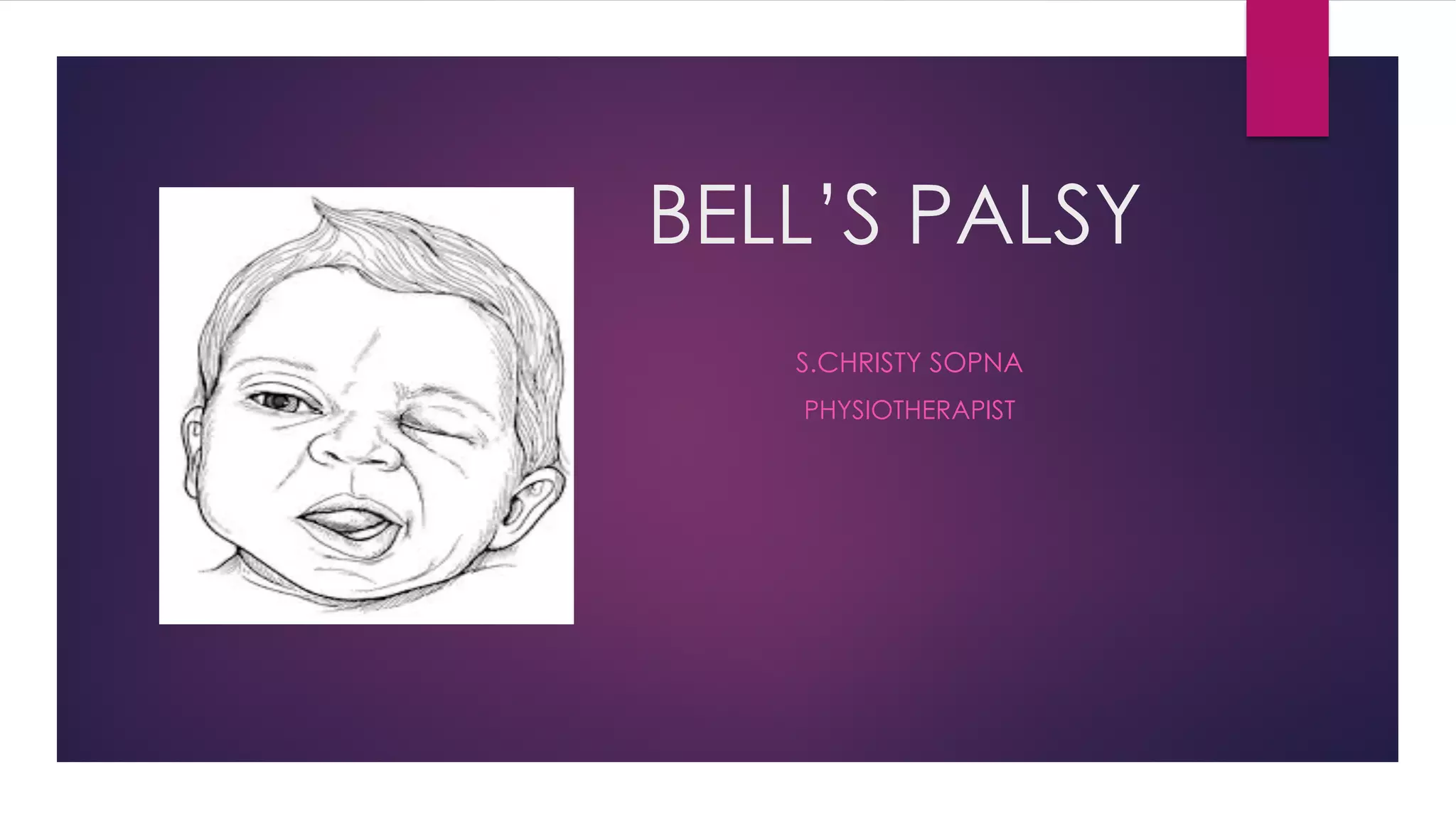
BELL’S PALSY
S.CHRISTY SOPNA
PHYSIOTHERAPIST
DEFINITION
Bell’s palsy is a facial paralysis of acute onset presumed to be due to non-
suppurative inflammation of unknown etiology of the facial nerve within its canal
above the stylomastoid foramen.
ETIOLOGY
u History of exposure of the ear to extreme cold
u Water retention in pregnancy
u Infection of the ear(otitis media )
u Upper respiratory tract infection
u Idiopathic
u VIRAL INFECTIONS – Herpex simplex
Epstein Barr
varicella-zoster
u BACTERIAL INFECTION – Borrelia burgdorferi
Bells palsy
u Damage to the 7th cranial nerve (FACIAL NERVE)
u AFFECT :
u LACRIMAL GLAND- produces tears
u MUCOUS MEMBRANE – nose, mouth and nasopharynx
u SUBMANDIBULAR, SUBLINGUAL GLAND – produces saliva
u Affect taste in anterior 2/3rd of tongue
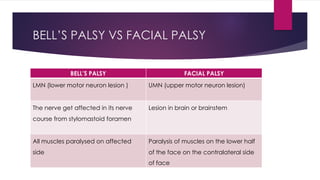
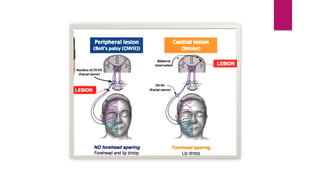
BELL’S PALSY VS FACIAL PALSY
BELL’S PALSY FACIAL PALSY
LMN (lower motor neuron lesion ) UMN (upper motor neuron lesion)
The nerve get affected in its nerve
course from stylomastoid foramen
Lesion in brain or brainstem
All muscles paralysed on affected
side
Paralysis of muscles on the lower half
of the face on the contralateral side
of face
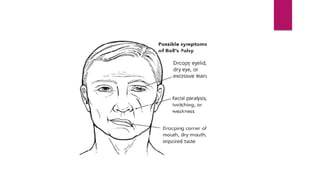
SYMPTOMS
u Drooping eyelid
u Absence of nasolabial fold
u Drooping mouth
u Dryness in affected eye or mouth
u Hypersensitivity to loud noises (HPERACUSIS)
u Loss of taste sensation on anterior 2/3rd of tongue
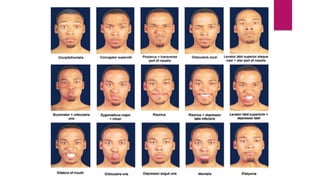
MUSCLES AFFECTED
u Frontalis
u Corrugator supercili
u Orbicularis oculi
u Nasalis
u Levator labi superioris and inferioris
u Risorius
u Buccinator
u Depressor labi orbicularis oris
u Mentalis
TYPES OF NERVE INJURY
u NEUROPRAXIA
u AXONOTOMESIS
u NEUROTOMESIS
CASE STUDY
A 50 year old man came with a Condition of weakness in right side face, Slurring of
speech, inability to close right eye, deviation of mouth to left side & reduced
sensation in the right side tongue, Thus accumulation of food in right side and
drooling of water therefore the patient complains severe pain in the nerve course.
ON OBSERVATION
u Incomplete closure of eye
u Left side deviation of mouth
u Sagging face
u Absence of nasolabial fold
ON PALPATION
u Dryness of face
u Saggy muscles
SPECIAL TESTS
u Bells phenomenon – positive
u Marin amat phenomenon – negative
EXAMINATION
u MUSCLE POWER ASSESMENT
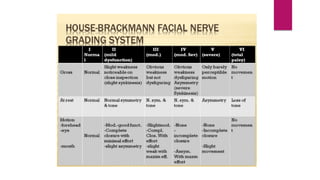
u Housebrackmann facial nerve grading system
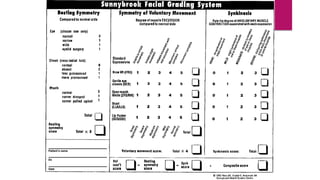
u Sunnybrook facial grading system
u Faradic galvanic test – to find out whether the nerve is innervated or
denervated
u Strength duration curve - to find out whether the nerve is innervated ,
partially innervated or denervated
PHYSIOTHERAPEUTIC TREATMENT
u Electrical stimulation – surged faradic and interrupted galvanic
u Infrared(IR) and short wave diathermy (SWD)– to increase circulation to resolve
inflammation
u facial massage – upward direction
deep friction massage and kneading
u Taping or splinting – eye and mouth
u Eye care – instruct patient to wear goggles
u Visual feedback exercise
u Strengthening exercise
u Balloon blowing
u Candle blowing
u Telling vowels a,e,I,o,u
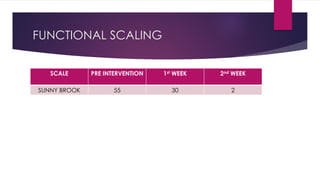
FUNCTIONAL SCALING
SCALE PRE INTERVENTION 1st WEEK 2nd WEEK
SUNNY BROOK 55 30 2
THANK YOU

Bell's Palsy

  • 1.
  • 2.
    DEFINITION Bell’s palsy isa facial paralysis of acute onset presumed to be due to non- suppurative inflammation of unknown etiology of the facial nerve within its canal above the stylomastoid foramen.
  • 3.
    ETIOLOGY u History ofexposure of the ear to extreme cold u Water retention in pregnancy u Infection of the ear(otitis media ) u Upper respiratory tract infection u Idiopathic u VIRAL INFECTIONS – Herpex simplex Epstein Barr varicella-zoster u BACTERIAL INFECTION – Borrelia burgdorferi
  • 4.
    Bells palsy u Damageto the 7th cranial nerve (FACIAL NERVE) u AFFECT : u LACRIMAL GLAND- produces tears u MUCOUS MEMBRANE – nose, mouth and nasopharynx u SUBMANDIBULAR, SUBLINGUAL GLAND – produces saliva u Affect taste in anterior 2/3rd of tongue
  • 5.
    BELL’S PALSY VSFACIAL PALSY BELL’S PALSY FACIAL PALSY LMN (lower motor neuron lesion ) UMN (upper motor neuron lesion) The nerve get affected in its nerve course from stylomastoid foramen Lesion in brain or brainstem All muscles paralysed on affected side Paralysis of muscles on the lower half of the face on the contralateral side of face
  • 7.
    SYMPTOMS u Drooping eyelid uAbsence of nasolabial fold u Drooping mouth u Dryness in affected eye or mouth u Hypersensitivity to loud noises (HPERACUSIS) u Loss of taste sensation on anterior 2/3rd of tongue
  • 9.
    MUSCLES AFFECTED u Frontalis uCorrugator supercili u Orbicularis oculi u Nasalis u Levator labi superioris and inferioris u Risorius u Buccinator u Depressor labi orbicularis oris u Mentalis
  • 10.
    TYPES OF NERVEINJURY u NEUROPRAXIA u AXONOTOMESIS u NEUROTOMESIS
  • 11.
    CASE STUDY A 50year old man came with a Condition of weakness in right side face, Slurring of speech, inability to close right eye, deviation of mouth to left side & reduced sensation in the right side tongue, Thus accumulation of food in right side and drooling of water therefore the patient complains severe pain in the nerve course.
  • 12.
    ON OBSERVATION u Incompleteclosure of eye u Left side deviation of mouth u Sagging face u Absence of nasolabial fold
  • 13.
    ON PALPATION u Drynessof face u Saggy muscles
  • 14.
    SPECIAL TESTS u Bellsphenomenon – positive u Marin amat phenomenon – negative
  • 15.
    EXAMINATION u MUSCLE POWERASSESMENT u Housebrackmann facial nerve grading system u Sunnybrook facial grading system u Faradic galvanic test – to find out whether the nerve is innervated or denervated u Strength duration curve - to find out whether the nerve is innervated , partially innervated or denervated
  • 18.
    PHYSIOTHERAPEUTIC TREATMENT u Electricalstimulation – surged faradic and interrupted galvanic u Infrared(IR) and short wave diathermy (SWD)– to increase circulation to resolve inflammation u facial massage – upward direction deep friction massage and kneading u Taping or splinting – eye and mouth u Eye care – instruct patient to wear goggles u Visual feedback exercise u Strengthening exercise u Balloon blowing u Candle blowing u Telling vowels a,e,I,o,u
  • 20.
    FUNCTIONAL SCALING SCALE PREINTERVENTION 1st WEEK 2nd WEEK SUNNY BROOK 55 30 2
  • 21.