Teaching with
Visual
Symbols
Prepared by:
Jaycris C. Agnes
2SED-SC
Lesson Objectives:
 To define what visual symbols are.
 To identify the instructional materials fall
under visual symbols.
 To enumerate and describe the types of
visual symbols.
 To identify the guidelines that must be
follow when reading chart, maps and
graphs.
Visual Symbols
Visual Symbols ―worth a
―thousand words.
Examine the content of the following slides..
Visual Symbols
Sexualization of children
AT press time the Secretary of the Department of
Education seem to have stepped back from implementing
the sex education curriculum saying ―we have decided to
hold sex education module in abeyance until a final decision
is made on the consulting process.‖
At first blush that seems to be happy development. But
this is no cause for jubilation for the parents who went out of
their way to sue the Education Department. Because, if there
is going to be any ―consultation process‖ it will merely be, as
perhaps before, a rubber stamp of an aggressive
implementation of a curriculum that will allow neither
concession nor compromise—despite media statements of
the Department to the contrary.
Visual Symbols
The reason why this curriculum is ―immutable‖ is, it is crafted or,
better still, dictated, by foreign sponsors that have bundled both
content and logistics in one well-funded program. This present sex
education curriculum that was supposed to be piloted, or in fact,
already implemented in several schools this year carries the content of
a sex-ed curriculum model issued by UNESCO in which five year olds
would be literally taught about the pleasures of masturbation. The
cover of the sex-ed manual carries the logo of both DepEd and
UNFPA, the United Nations Population Fund.
There should be an overarching agenda why this seeming
obsessive-compulsive behavior of international grand planners seems
too overt. They are the same planners that met in Cairo in September
1994 on Population and Development; in Beijing in 1995 on the 4th
World Conference on Women; in Davos Switzerland on Climate
Change and Tourism UNWTO in 2007 and elsewhere.
Visual Symbols
Whatever the grand plan is, it is troubling to finally
realize that these supposedly technocrats stand on a theory
that children’s innocence is a myth. Their psychological
premise is that children younger than five already know about
sex and are sexual ―agents‖—hence, the logic and necessity
of teaching them about sex. This, of course, is not true no
matter what modern theorists says—unless, of course, they
have already changed human nature in the same fashion
that George Soros is famed for changing a financial scenario
by mere currency speculation.
It is not therefore far-fetched to say that this sex
education proposed by the education department will
certainly disrupt the natural development of sexual awareness
of children by deliberately feeding them more advanced
knowledge which is still beyond their realm. This indeed is a
form of ―sexualizing‖ the children which in itself is already a
form of sexual abuse that may progressively prepare them for
physical abuse should any occasion arise.
Visual Symbols
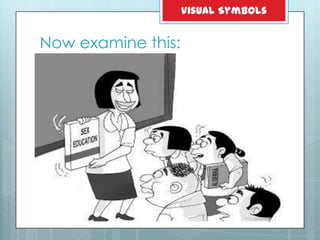
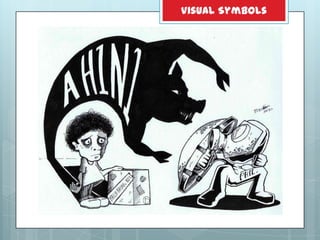
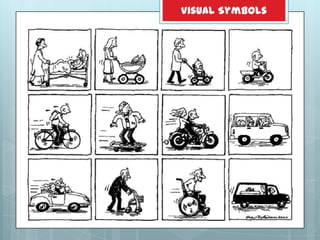
Now examine this:
Visual Symbols
Which is easier to
understand?
The Paragraphs or the
Cartoon?
Visual Symbols
What are Visual symbols?
Visual symbols are
representations of direct
reality, which comes in the
form of signs and symbols.
Visual Symbols
Kinds of Visual
Symbols.
Visual Symbols
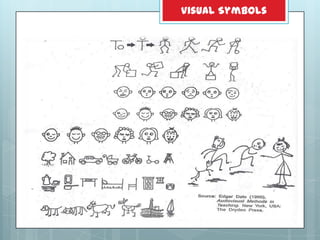
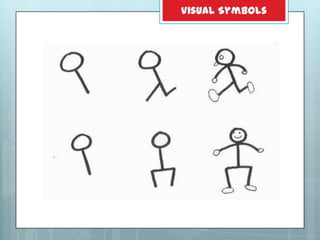
A. Drawings
The art or act of making figure,
plan, or sketch by means of lines.
(Webster,1976).
One essential skill that the teacher
should posses is drawing.
Visual Symbols
Visual Symbols
Visual Symbols
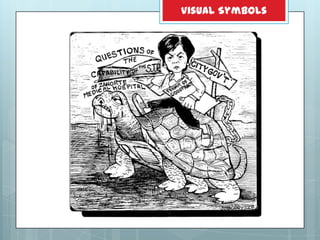
B. Cartoons
A first-rate tells its story
metaphorically. The less the artist
depends on words, the more
effective the symbolism. The
symbolism conveys the message.
Visual Symbols
Visual Symbols
Visual Symbols
Visual Symbols
Use of cartoons:
a. Appropriateness to experience level. The age
and the experience or maturity of the target
learners must be taken into consideration.
b. Simplicity – contains only the essential features.
The cartoon must not contain so many details.
c. Brevity of captions if ever but they may not be
given any. Short and direct captions are used
when necessary only.
Use of cartoons:
d. Use of clear symbols. Use symbols
that are conventional, like; the dove to
mean death; the turtle to mean slow or
sluggishness and others.
e. Adequateness of size. The cartoon
should be big enough to be seen and
appreciated.
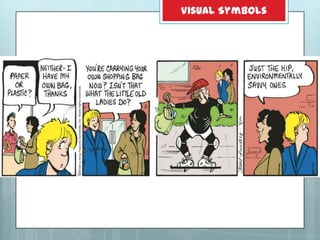
C. Strip Drawings
These are commonly called comics
or comic strip. Dale(1969) asserts
that a more accurate term is strip
drawings. Make use of strips that
are educational and entertaining
at the same time.
Visual Symbols
Visual Symbols
Visual Symbols
Values derived from strip
drawing:
1. Increases interest in the subject.
2. Individualizes and personalizes.
instruction for certain types of pupils.
3. Serves as a valuable practice in
reading.
4.Widens reading interest.
D. Diagrams
It is ―any line drawing that shows
arrangement and relations as a
part to the whole, relative values,
origins and developments,
chronological fluctuations,
distribution, etc‖.(Dale, 1969)
Visual Symbols
Types of Diagram
Affinity Diagram- used to cluster
complex apparently unrelated
data into natural and
meaningful groups.
Visual Symbols
Visual Symbols
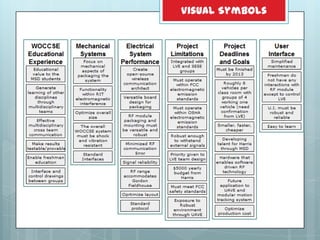
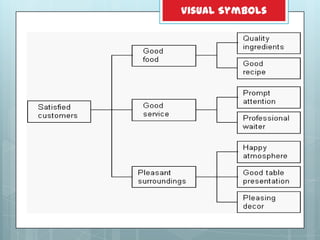
Tree Diagram- used to chart
out, in increasing details, the
various tasks that must be
accomplished to complete
a project or achieve a
specific objective.
Visual Symbols
Visual Symbols
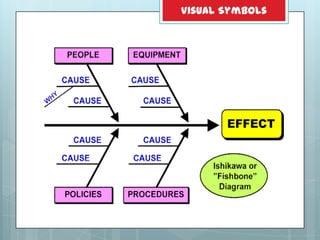
Fishbone diagram- it is also
called the cause-and-effect
diagram. It is most commonly
used to analyze work-related
problems.
Visual Symbols
Visual Symbols
E. Charts
It is diagrammatic representation
of relationships among
individuals within an
organization.
Visual Symbols
Kinds of Charts
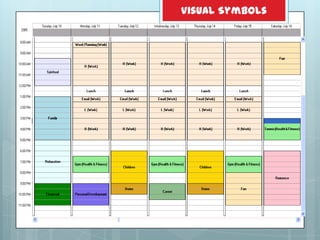
Time Chart- Is a tabular
time chart that presents
data in ordinal sequence.
Visual Symbols
Visual Symbols
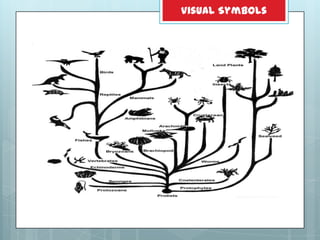
Tree or stream Chart- depicts
development, growth and change
by beginning with a single course
(the trunk) which spread out into
many branches; or by beginning
with the many tributaries which then
converge into a single channel.
Visual Symbols
Visual Symbols
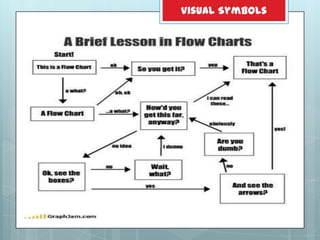
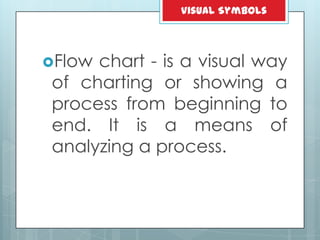
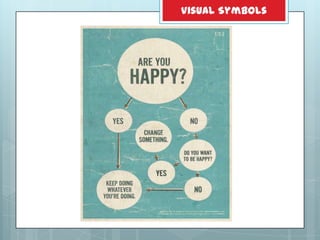
Flow chart - is a visual way
of charting or showing a
process from beginning to
end. It is a means of
analyzing a process.
Visual Symbols
Visual Symbols
Visual Symbols
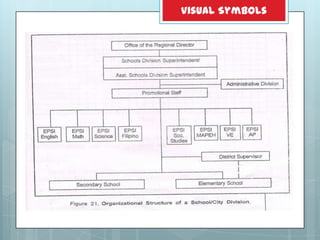
Organizational chart - shows
how one part of the
organization relates to other
parts of the organization.
Visual Symbols
Visual Symbols
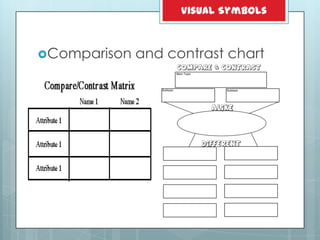
Comparison and contrast chart
Visual Symbols
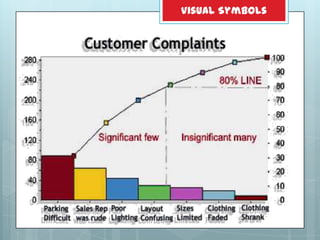
 Pareto chart - is a type of bar
chart, prioritized in descending
order of magnitude or importance
from left to right. It shows at a
glance which factors are occurring
most.
Visual Symbols
Visual Symbols
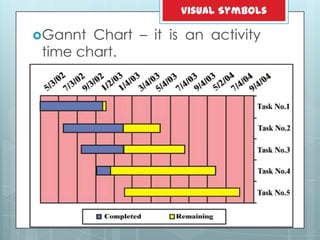
Gannt Chart – it is an activity
time chart.
Visual Symbols
F. Graphs
Based diagrams: these take a
collection of items and relationships
between them, and express them
by giving each item a 2D position,
while the relationships are expressed
as connections between the items
or overlaps between the items.
(Wikipedia)
Visual Symbols
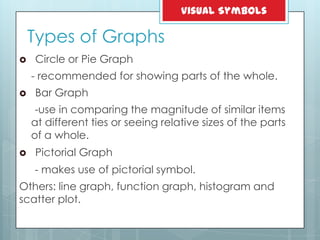
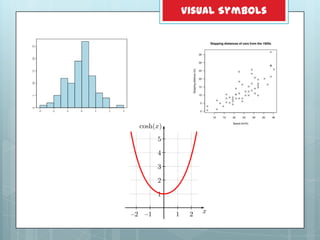
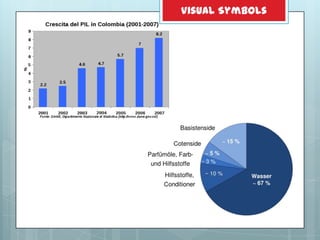
Types of Graphs
 Circle or Pie Graph
- recommended for showing parts of the whole.
 Bar Graph
-use in comparing the magnitude of similar items
at different ties or seeing relative sizes of the parts
of a whole.
 Pictorial Graph
- makes use of pictorial symbol.
Others: line graph, function graph, histogram and
scatter plot.
Visual Symbols
Visual Symbols
Visual Symbols
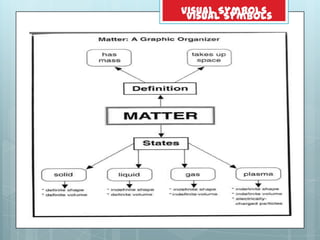
Graphic Organizers
- Visual representations of
knowledge, concepts,
thoughts, or ideas. Graphic
Organizers historically have
been organized bits of data in
easy-to-understand formats,
such as charts, tables, and
graphs.
Visual Symbols
Visual SymbolsVisual Symbols
G. Maps
A map is a representation of
the surface of the earth or
some part of it.
Visual Symbols
Kinds of Map
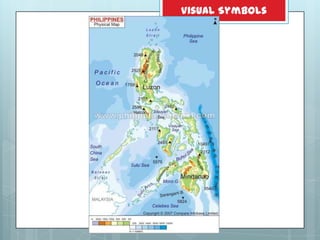
Physical Map- combines in a
single projection data like
altitude, temperature, rainfall,
precipitation, vegetation, and
soil.
Visual Symbols
Visual Symbols
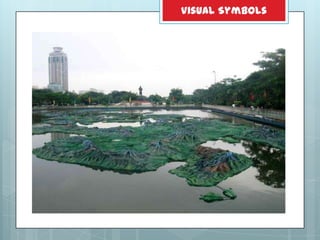
Relief Map- - has three
dimensional representations
and show contours the
physical data of the earth or
part of the earth
Visual Symbols
Visual Symbols
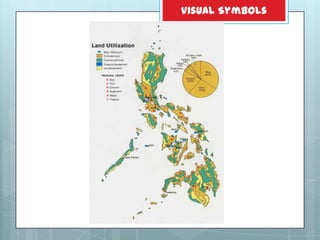
Commercial or economic
map - also called product or
industrial map since they
show land areas in relation to
the economy.
Visual Symbols
Visual Symbols
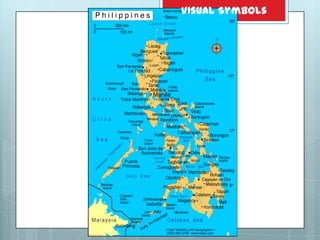
Political map - gives detailed
information about country,
provinces, cities and towns,
roads and highways. Oceans,
rivers and lakes are the main
features of most political maps.
Visual Symbols
Visual Symbols
Understanding Maps, Graphs
and Charts.
 Read the titles and the subtitles
 Read the key, and/or the legend
 Read the information shown along
the side and the bottom of the
graphs and charts and tables, if
any.
 Determine your purpose of
reading the map.
Visual Symbols
1. Visuals must be directly relevant to
the audio content.
2. Redundancy between visuals and
audio must be avoided. If words are
displayed, viewers must be given
time to read it.
Rules in using visuals:
Visual Symbols
3. Visual displays should be big
enough to be seen by the farthest
pupil.
4. Visual displays must be attractive.
5. Visual displays must be
aesthetically presented to maintain
good taste.
Visual Symbols
Summary:
 Like a picture, a graph and all other visual
symbols, are worth a thousand words. The proper
use of the visual symbols will contribute to the
optimum learning.
 Visual symbol come in many forms. For these
visual symbols to be at your finger tips, you ought
to be skilled in making them.
 The collection, preparation and use of these
various visual symbols depend on the great
extent on your own resourcefulness and
creativity. If you used them skilfully, your
classroom may turn into a beehive of busy
students.
Visual Symbols
―Visual Symbols will be
made meaningful if we can
use them as summaries of our
direct experiences or our rich
indirect experiences… A little
can stand for a lot!‖
End.
Visual Symbols

Teaching with visual symbols report

  • 1.
  • 2.
    Lesson Objectives:  Todefine what visual symbols are.  To identify the instructional materials fall under visual symbols.  To enumerate and describe the types of visual symbols.  To identify the guidelines that must be follow when reading chart, maps and graphs. Visual Symbols
  • 4.
    Visual Symbols ―wortha ―thousand words. Examine the content of the following slides.. Visual Symbols
  • 5.
    Sexualization of children ATpress time the Secretary of the Department of Education seem to have stepped back from implementing the sex education curriculum saying ―we have decided to hold sex education module in abeyance until a final decision is made on the consulting process.‖ At first blush that seems to be happy development. But this is no cause for jubilation for the parents who went out of their way to sue the Education Department. Because, if there is going to be any ―consultation process‖ it will merely be, as perhaps before, a rubber stamp of an aggressive implementation of a curriculum that will allow neither concession nor compromise—despite media statements of the Department to the contrary. Visual Symbols
  • 6.
    The reason whythis curriculum is ―immutable‖ is, it is crafted or, better still, dictated, by foreign sponsors that have bundled both content and logistics in one well-funded program. This present sex education curriculum that was supposed to be piloted, or in fact, already implemented in several schools this year carries the content of a sex-ed curriculum model issued by UNESCO in which five year olds would be literally taught about the pleasures of masturbation. The cover of the sex-ed manual carries the logo of both DepEd and UNFPA, the United Nations Population Fund. There should be an overarching agenda why this seeming obsessive-compulsive behavior of international grand planners seems too overt. They are the same planners that met in Cairo in September 1994 on Population and Development; in Beijing in 1995 on the 4th World Conference on Women; in Davos Switzerland on Climate Change and Tourism UNWTO in 2007 and elsewhere. Visual Symbols
  • 7.
    Whatever the grandplan is, it is troubling to finally realize that these supposedly technocrats stand on a theory that children’s innocence is a myth. Their psychological premise is that children younger than five already know about sex and are sexual ―agents‖—hence, the logic and necessity of teaching them about sex. This, of course, is not true no matter what modern theorists says—unless, of course, they have already changed human nature in the same fashion that George Soros is famed for changing a financial scenario by mere currency speculation. It is not therefore far-fetched to say that this sex education proposed by the education department will certainly disrupt the natural development of sexual awareness of children by deliberately feeding them more advanced knowledge which is still beyond their realm. This indeed is a form of ―sexualizing‖ the children which in itself is already a form of sexual abuse that may progressively prepare them for physical abuse should any occasion arise. Visual Symbols
  • 8.
  • 9.
    Which is easierto understand? The Paragraphs or the Cartoon? Visual Symbols
  • 10.
    What are Visualsymbols? Visual symbols are representations of direct reality, which comes in the form of signs and symbols. Visual Symbols
  • 11.
  • 12.
    A. Drawings The artor act of making figure, plan, or sketch by means of lines. (Webster,1976). One essential skill that the teacher should posses is drawing. Visual Symbols
  • 13.
  • 14.
  • 15.
    B. Cartoons A first-ratetells its story metaphorically. The less the artist depends on words, the more effective the symbolism. The symbolism conveys the message. Visual Symbols
  • 16.
  • 17.
  • 18.
  • 19.
    Use of cartoons: a.Appropriateness to experience level. The age and the experience or maturity of the target learners must be taken into consideration. b. Simplicity – contains only the essential features. The cartoon must not contain so many details. c. Brevity of captions if ever but they may not be given any. Short and direct captions are used when necessary only.
  • 20.
    Use of cartoons: d.Use of clear symbols. Use symbols that are conventional, like; the dove to mean death; the turtle to mean slow or sluggishness and others. e. Adequateness of size. The cartoon should be big enough to be seen and appreciated.
  • 21.
    C. Strip Drawings Theseare commonly called comics or comic strip. Dale(1969) asserts that a more accurate term is strip drawings. Make use of strips that are educational and entertaining at the same time. Visual Symbols
  • 22.
  • 23.
  • 24.
    Values derived fromstrip drawing: 1. Increases interest in the subject. 2. Individualizes and personalizes. instruction for certain types of pupils. 3. Serves as a valuable practice in reading. 4.Widens reading interest.
  • 25.
    D. Diagrams It is―any line drawing that shows arrangement and relations as a part to the whole, relative values, origins and developments, chronological fluctuations, distribution, etc‖.(Dale, 1969) Visual Symbols
  • 26.
    Types of Diagram AffinityDiagram- used to cluster complex apparently unrelated data into natural and meaningful groups. Visual Symbols
  • 27.
  • 28.
    Tree Diagram- usedto chart out, in increasing details, the various tasks that must be accomplished to complete a project or achieve a specific objective. Visual Symbols
  • 29.
  • 30.
    Fishbone diagram- itis also called the cause-and-effect diagram. It is most commonly used to analyze work-related problems. Visual Symbols
  • 31.
  • 32.
    E. Charts It isdiagrammatic representation of relationships among individuals within an organization. Visual Symbols
  • 33.
    Kinds of Charts TimeChart- Is a tabular time chart that presents data in ordinal sequence. Visual Symbols
  • 34.
  • 35.
    Tree or streamChart- depicts development, growth and change by beginning with a single course (the trunk) which spread out into many branches; or by beginning with the many tributaries which then converge into a single channel. Visual Symbols
  • 36.
  • 37.
    Flow chart -is a visual way of charting or showing a process from beginning to end. It is a means of analyzing a process. Visual Symbols
  • 38.
  • 39.
  • 40.
    Organizational chart -shows how one part of the organization relates to other parts of the organization. Visual Symbols
  • 41.
  • 42.
    Comparison and contrastchart Visual Symbols
  • 43.
     Pareto chart- is a type of bar chart, prioritized in descending order of magnitude or importance from left to right. It shows at a glance which factors are occurring most. Visual Symbols
  • 44.
  • 45.
    Gannt Chart –it is an activity time chart. Visual Symbols
  • 46.
    F. Graphs Based diagrams:these take a collection of items and relationships between them, and express them by giving each item a 2D position, while the relationships are expressed as connections between the items or overlaps between the items. (Wikipedia) Visual Symbols
  • 47.
    Types of Graphs Circle or Pie Graph - recommended for showing parts of the whole.  Bar Graph -use in comparing the magnitude of similar items at different ties or seeing relative sizes of the parts of a whole.  Pictorial Graph - makes use of pictorial symbol. Others: line graph, function graph, histogram and scatter plot. Visual Symbols
  • 48.
  • 49.
  • 50.
    Graphic Organizers - Visualrepresentations of knowledge, concepts, thoughts, or ideas. Graphic Organizers historically have been organized bits of data in easy-to-understand formats, such as charts, tables, and graphs. Visual Symbols
  • 51.
  • 52.
    G. Maps A mapis a representation of the surface of the earth or some part of it. Visual Symbols
  • 53.
    Kinds of Map PhysicalMap- combines in a single projection data like altitude, temperature, rainfall, precipitation, vegetation, and soil. Visual Symbols
  • 54.
  • 55.
    Relief Map- -has three dimensional representations and show contours the physical data of the earth or part of the earth Visual Symbols
  • 56.
  • 57.
    Commercial or economic map- also called product or industrial map since they show land areas in relation to the economy. Visual Symbols
  • 58.
  • 59.
    Political map -gives detailed information about country, provinces, cities and towns, roads and highways. Oceans, rivers and lakes are the main features of most political maps. Visual Symbols
  • 60.
  • 61.
    Understanding Maps, Graphs andCharts.  Read the titles and the subtitles  Read the key, and/or the legend  Read the information shown along the side and the bottom of the graphs and charts and tables, if any.  Determine your purpose of reading the map. Visual Symbols
  • 62.
    1. Visuals mustbe directly relevant to the audio content. 2. Redundancy between visuals and audio must be avoided. If words are displayed, viewers must be given time to read it. Rules in using visuals: Visual Symbols
  • 63.
    3. Visual displaysshould be big enough to be seen by the farthest pupil. 4. Visual displays must be attractive. 5. Visual displays must be aesthetically presented to maintain good taste. Visual Symbols
  • 64.
    Summary:  Like apicture, a graph and all other visual symbols, are worth a thousand words. The proper use of the visual symbols will contribute to the optimum learning.  Visual symbol come in many forms. For these visual symbols to be at your finger tips, you ought to be skilled in making them.  The collection, preparation and use of these various visual symbols depend on the great extent on your own resourcefulness and creativity. If you used them skilfully, your classroom may turn into a beehive of busy students. Visual Symbols
  • 65.
    ―Visual Symbols willbe made meaningful if we can use them as summaries of our direct experiences or our rich indirect experiences… A little can stand for a lot!‖
  • 66.

Editor's Notes

  • #11 Compare it to Contrived experiences.
  • #19 Sources of cartoon
  • #22 Where to use drawing as an instruction? These can serve as a motivation and starter of your lesson. It can also be given as an activity for students to express insights gained at the conclusion of a lesson.
  • #30 Always answered the question “why?”
  • #32 Created by Kaoru Ishikawa
  • #61 Map language