JEDALYN R. BRIONES MA in Education-Educational Management Dr. Christopher Chua Professor
Roles of Visuals  Visual Literacy  Decoding: Interpret visuals  Encoding: Creating Visuals (Basic Goals)  Process of Visual Design  Visual Design Elements Visual Design Pattern Visual Design Arrangement
Slightly superior than text display only depends on many factors provide concrete reference for ideas attract and hold attention, generate emotional responses simplify information that is difficult to understand redundant channel for information
Input strategies to decode, or read visuals proficiently Output strategies to encode, or write, visuals  to express themselves and communicate with others.
Developmental Effects: before 12 -- section;  after 12 -- whole. Relationships should clearly spelt out. Avoid highly realistic visuals which may distract children. Cultural Effects Visual Preferences color preferred photographs preferred preferred versus effective
Ensure legibility (giving examples) Reduce the effort required to interpret the message (proximity, consistency,..) Increase the viewer’s active engagement with the message (motivation) Focus attention on the most important parts of the message
Elements  – selecting the verbal/visual elements to be incorporated into display Pattern  – choosing an underlying pattern for the elements of the display Arrangement  – arranging the individual element within the underlying pattern
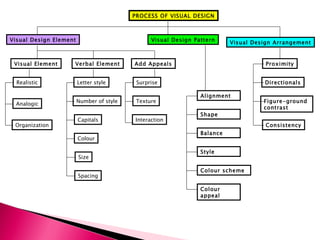
PROCESS OF VISUAL DESIGN Visual Design Element Visual Design Pattern Visual Design Arrangement Visual Element Verbal Element Realistic Analogic Organization Letter style Colour Capitals Number of style Size Spacing Add Appeals Surprise Texture Interaction Alignment Style Balance Shape Colour scheme Colour appeal Proximity Directionals Figure-ground  contrast Consistency
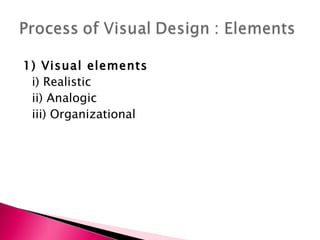
1) Visual elements i) Realistic ii) Analogic iii) Organizational
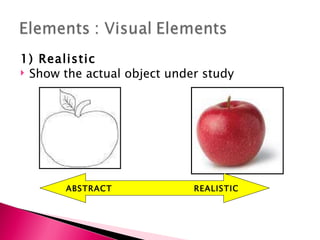
1) Realistic Show the actual object under study ABSTRACT REALISTIC
1) Realistic visuals The more realistic a visual is, the closer it is to the original Elements : Visual Elements 2) Analogic visuals Convey topic by showing something else and implying a similarity E.g. the function of human memory with the function of computer memory
Elements : Visual Elements 3)  Organizational visuals Such as flowcharts, graphs, maps, classification charts
Letter Style:  No. of Lettering Styles Capitals: only when normally required or short headings. Color of Lettering: contrast between lettering color and background color. Size of lettering:  1/2 inch high for 10 feet of viewer distance Spacing between characters: Optical spacing Spacing between Lines: slightly less than the average height of the lowercase letters
S urprise Think unusual metaphor, a dramatic change of size Texture Convey the idea of the subject to the viewer by involving the sense of touch. Interaction Ask learners to respond visual displays by manipulating materials on the display.
Alignment (positioning)  -shows visual relationship to each other. Shape -Elements arranged into a familiar shape easily linked. e.g. circle, Z. Rule of thirds Balance formal balance -- equilibrium informal (asymmetrical) balance: catch eyes imbalance: should be avoided.
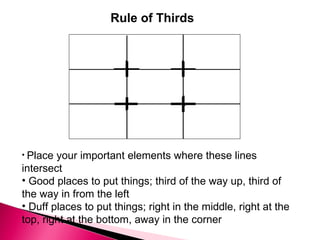
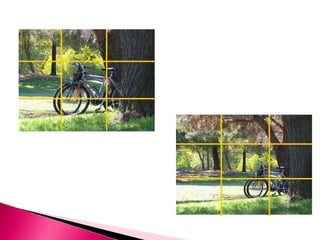
Rule of Thirds Place your important elements where these lines intersect  Good places to put things; third of the way up, third of the way in from the left  Duff places to put things; right in the middle, right at the top, right at the bottom, away in the corner
 
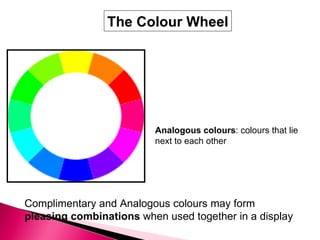
Style:  -choice of lettering and type of pictures -preferences of the audience Color Scheme: Acceptable Complementary colors -opposite on the color wheel. Analogous colors  - next to each other on the color wheel. Juxtapose two complement colors not recommended a background color, a color for the images or test, a color for the highlights.
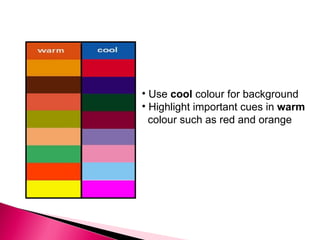
warm versus cool colors warm as highlights and cool as background in general, children prefer warm cool colors while maturity prefers cooler colors and subtler combinations. Cultural colors
Analogous colours : colours that lie  next to each other Complimentary and Analogous colours may form  pleasing combinations  when used together in a display   The Colour Wheel
Use  cool  colour for background Highlight important cues in  warm   colour such as red and orange
Red China: Good luck, celebration, summoning  Cherokees: Success, triumph  India: Purity  South Africa: Color of mourning  Russia: Bolsheviks and Communism  Eastern: Worn by brides  Western :  Excitement, danger, love, passion, stop, Christmas (with green) Orange Ireland: Religious (Protestants)  Western :  Halloween (with black), creativity, autumn  Yellow China: Nourishing  Egypt: Color of mourning  Japan: Courage  India: Merchants  Western: Hope, hazards, coward
Green China: Green hats indicate a man's wife is cheating on him, exorcism  India: Islam  Ireland: Symbol of the entire country  Western: Spring, new birth, go, Saint Patrick's Day, Christmas (with red) Blue Cherokees: Defeat, trouble  Iran: Color of heaven and spirituality  Western: Depression, sadness, conservative, corporate, "something blue" bridal tradition Purple Thailand: Color of mourning (widows)  Western: Royalty White Japan: White carnation symbolizes death  Eastern: Funerals  Western :  Brides, angels, good guys, hospitals, doctors, peace (white dove) Black China: Color for young boys  Western :  Funerals, death, Halloween (with orange), bad guys, rebellion
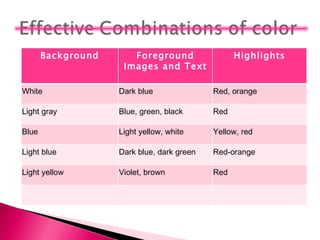
Background Foreground Images and Text Highlights White Dark blue Red, orange Light gray Blue, green, black Red Blue Light yellow, white Yellow, red Light blue Dark blue, dark green Red-orange Light yellow Violet, brown Red
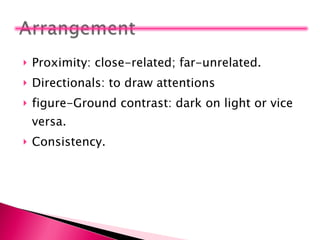
Proximity: close-related; far-unrelated. Directionals: to draw attentions figure-Ground contrast: dark on light or vice versa. Consistency.
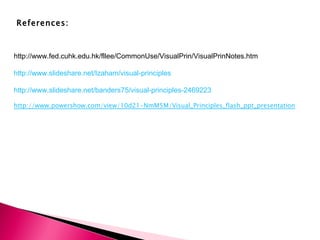
http://www.fed.cuhk.edu.hk/fllee/CommonUse/VisualPrin/VisualPrinNotes.htm http://www.slideshare.net/Izaham/visual-principles http://www.slideshare.net/banders75/visual-principles-2469223 http://www.powershow.com/view/10d21-NmM5M/Visual_Principles_flash_ppt_presentation References:

Visual Principles

  • 1.
    JEDALYN R. BRIONESMA in Education-Educational Management Dr. Christopher Chua Professor
  • 2.
    Roles of Visuals Visual Literacy Decoding: Interpret visuals Encoding: Creating Visuals (Basic Goals) Process of Visual Design Visual Design Elements Visual Design Pattern Visual Design Arrangement
  • 3.
    Slightly superior thantext display only depends on many factors provide concrete reference for ideas attract and hold attention, generate emotional responses simplify information that is difficult to understand redundant channel for information
  • 4.
    Input strategies todecode, or read visuals proficiently Output strategies to encode, or write, visuals to express themselves and communicate with others.
  • 5.
    Developmental Effects: before12 -- section; after 12 -- whole. Relationships should clearly spelt out. Avoid highly realistic visuals which may distract children. Cultural Effects Visual Preferences color preferred photographs preferred preferred versus effective
  • 6.
    Ensure legibility (givingexamples) Reduce the effort required to interpret the message (proximity, consistency,..) Increase the viewer’s active engagement with the message (motivation) Focus attention on the most important parts of the message
  • 7.
    Elements –selecting the verbal/visual elements to be incorporated into display Pattern – choosing an underlying pattern for the elements of the display Arrangement – arranging the individual element within the underlying pattern
  • 8.
    PROCESS OF VISUALDESIGN Visual Design Element Visual Design Pattern Visual Design Arrangement Visual Element Verbal Element Realistic Analogic Organization Letter style Colour Capitals Number of style Size Spacing Add Appeals Surprise Texture Interaction Alignment Style Balance Shape Colour scheme Colour appeal Proximity Directionals Figure-ground contrast Consistency
  • 9.
    1) Visual elementsi) Realistic ii) Analogic iii) Organizational
  • 10.
    1) Realistic Showthe actual object under study ABSTRACT REALISTIC
  • 11.
    1) Realistic visualsThe more realistic a visual is, the closer it is to the original Elements : Visual Elements 2) Analogic visuals Convey topic by showing something else and implying a similarity E.g. the function of human memory with the function of computer memory
  • 12.
    Elements : VisualElements 3) Organizational visuals Such as flowcharts, graphs, maps, classification charts
  • 13.
    Letter Style: No. of Lettering Styles Capitals: only when normally required or short headings. Color of Lettering: contrast between lettering color and background color. Size of lettering: 1/2 inch high for 10 feet of viewer distance Spacing between characters: Optical spacing Spacing between Lines: slightly less than the average height of the lowercase letters
  • 14.
    S urprise Thinkunusual metaphor, a dramatic change of size Texture Convey the idea of the subject to the viewer by involving the sense of touch. Interaction Ask learners to respond visual displays by manipulating materials on the display.
  • 15.
    Alignment (positioning) -shows visual relationship to each other. Shape -Elements arranged into a familiar shape easily linked. e.g. circle, Z. Rule of thirds Balance formal balance -- equilibrium informal (asymmetrical) balance: catch eyes imbalance: should be avoided.
  • 16.
    Rule of ThirdsPlace your important elements where these lines intersect Good places to put things; third of the way up, third of the way in from the left Duff places to put things; right in the middle, right at the top, right at the bottom, away in the corner
  • 17.
  • 18.
    Style: -choiceof lettering and type of pictures -preferences of the audience Color Scheme: Acceptable Complementary colors -opposite on the color wheel. Analogous colors - next to each other on the color wheel. Juxtapose two complement colors not recommended a background color, a color for the images or test, a color for the highlights.
  • 19.
    warm versus coolcolors warm as highlights and cool as background in general, children prefer warm cool colors while maturity prefers cooler colors and subtler combinations. Cultural colors
  • 20.
    Analogous colours :colours that lie next to each other Complimentary and Analogous colours may form pleasing combinations when used together in a display The Colour Wheel
  • 21.
    Use cool colour for background Highlight important cues in warm colour such as red and orange
  • 22.
    Red China: Goodluck, celebration, summoning Cherokees: Success, triumph India: Purity South Africa: Color of mourning Russia: Bolsheviks and Communism Eastern: Worn by brides Western : Excitement, danger, love, passion, stop, Christmas (with green) Orange Ireland: Religious (Protestants) Western : Halloween (with black), creativity, autumn Yellow China: Nourishing Egypt: Color of mourning Japan: Courage India: Merchants Western: Hope, hazards, coward
  • 23.
    Green China: Greenhats indicate a man's wife is cheating on him, exorcism India: Islam Ireland: Symbol of the entire country Western: Spring, new birth, go, Saint Patrick's Day, Christmas (with red) Blue Cherokees: Defeat, trouble Iran: Color of heaven and spirituality Western: Depression, sadness, conservative, corporate, "something blue" bridal tradition Purple Thailand: Color of mourning (widows) Western: Royalty White Japan: White carnation symbolizes death Eastern: Funerals Western : Brides, angels, good guys, hospitals, doctors, peace (white dove) Black China: Color for young boys Western : Funerals, death, Halloween (with orange), bad guys, rebellion
  • 24.
    Background Foreground Imagesand Text Highlights White Dark blue Red, orange Light gray Blue, green, black Red Blue Light yellow, white Yellow, red Light blue Dark blue, dark green Red-orange Light yellow Violet, brown Red
  • 25.
    Proximity: close-related; far-unrelated.Directionals: to draw attentions figure-Ground contrast: dark on light or vice versa. Consistency.
  • 26.